SANDUSKY, Ohio — There’s a certain serenity for Christine Parthemore when she watches the sunset along Lake Erie from near her home in Sandusky.
“People take vacations to get views like that,” she said. “It’s a huge quality of life benefit.”
Parthemore and her husband moved to the area from Washington, D.C., four years ago when they started focusing on the type of environment they wanted their daughter to grow up in.
“You think a lot about their future and whether they have clean air and clean water and those types of things,” she said. “Thinking the long term for us and our family, we wanted to calculate where we would have a sustainable place where we knew we could have a safe house and fewer natural disasters and clean water in abundance.”
Advertisement
News 5
Christine Parthemore reflects on growing up in the area, investing in property, and ultimately making the move back to Sandusky after spending years in Washington D.C.
The family is what many would refer to as “climate migrants:” those that made the move, at least in part, because of the world they saw changing around them.
“I’ve traveled all over the world and especially in certain regions of Asia and the Middle East,” she said. “It’s so apparent how the climate is changing and how it impacts people’s lives and you can’t forget that’s going to be hitting us here in the United States. Dealing with those more extreme temperatures swings that shape how you live your life, it’s not pleasant. I don’t have any of that here in Sandusky.”
As Cuyahoga County Executive Chris Ronayne points out, Northeast Ohio and the Great Lakes region could truly shine in the years ahead, given its natural resources, including 20% of the world’s freshwater supply.
A chance to draw in families seeking safety and stability from this county’s increasing collection of wildfires, storm surges and rising sea levels.
Advertisement
“It’s inevitable that people will find their way back to a place frankly that can absorb that migration because we were built for bigger populations way back when,” he explained. “Around these great five lakes will be the sustainable global future.”
News 5
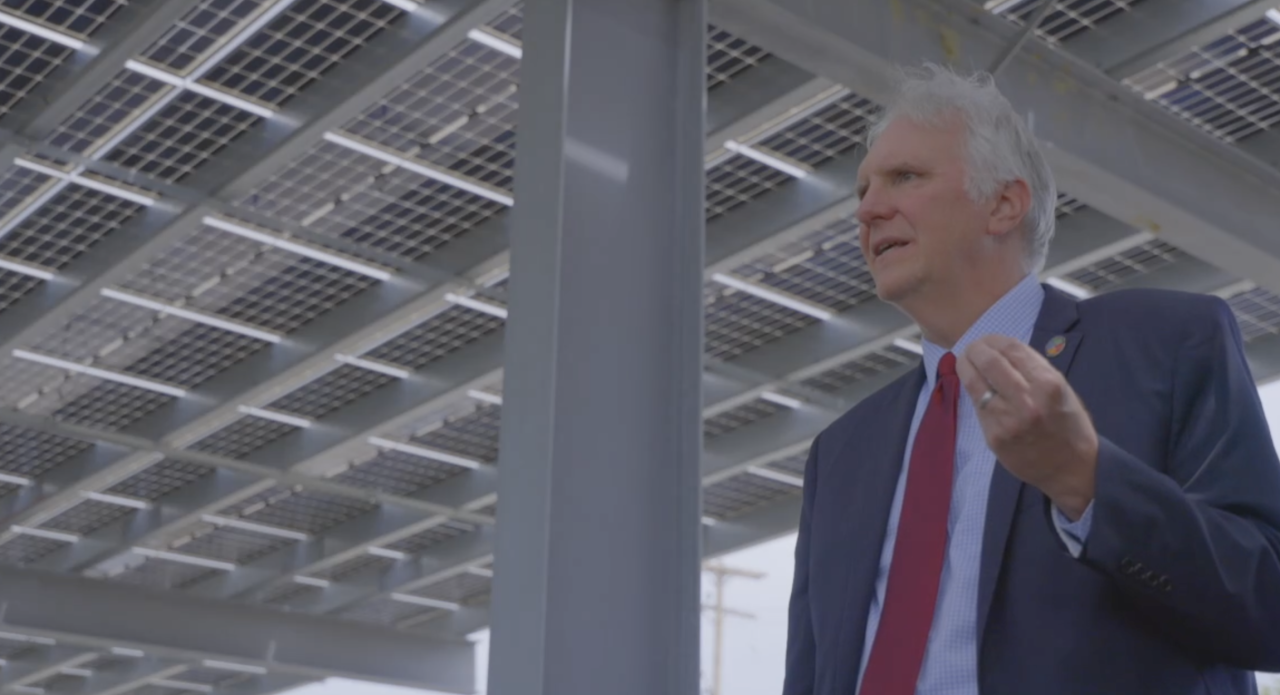
Cuyahoga County Executive Chris Ronayne talks with News 5 underneath a solar panel canopy at the Cleveland Foundation, just one of the area’s efforts underway to harness clean energy.
The 250-kilowatt solar canopy over the surface parking lot, which opened last year, is estimated to produce up to 30% of total annual electric demand for the foundation’s headquarters building.
But is Greater Cleveland destined to be a climate haven for others as our country sees more flooding, more fires, and more extreme temperatures?
Advertisement
While the premise makes sense, Terry Schwarz argues it’s not guaranteed.
“If we think people are going to pull up stakes and move because of climate issues, I think we need to look at that more closely,” she explained. “I just don’t think we know. Although there are challenges here, it’s not as extreme as in other parts of the country.”
Schwarz oversees the Kent State University Cleveland Urban Collaborative, which consults with communities on answering all sorts of urban issues, including climate migration.
“Is it crisis driven migration when lots of people be on the move all at once or is it happening gradually of people moving to the region to take advantage of opportunities and a place of relative safety,” she said.
While Cleveland’s population continues to fall, Schwarz points to Phoenix, one of the fastest-growing cities in the country, as proof that climate migration is not yet a reality in the country. Last year, residents in Phoenix experienced 54 days where the temperature crossed 110ºF.
Advertisement
News 5
For the past several years, Terry Schwarz has studied how cities should prepare for the potential of climate migration, and the many scenarios that could involve.
“When there’s a crisis, people don’t move from New Orleans to Cleveland, a lot of people moved from New Orleans to Texas and then experience Hurricane Hugo a few years later,” she said. “When there are heatwaves and droughts in California, they’re not necessarily moving to Wisconsin or Minnesota; they’re moving to Phoenix. People tend to stay in the areas where they are. I’m not saying the day won’t come, but I don’t think it’s on the horizon.”
Schwarz said to get a better idea of what could happen, we can look at certain indirect indicators, such as homeowners insurance rates or job opportunities, to better gauge climate migration in action.
“More likely, it would be something like companies moving to the great Lakes for water access, and then people moving not necessarily for climate but for job opportunities,” she said. “And if people can’t insure their homes, they might consider moving somewhere else.”
“We are seeing freshwater migrants,” EPA Regional Administrator Debra Shore told News 5. “I think industry will come before individuals but they are both coming.”
Advertisement
However, Schwarz added it doesn’t hurt for cities to be prepared.
“My colleagues refer to this as the ‘Get your house in order’ strategy,” she chuckled. “Simply, if you’re expecting guests, you get ready and clean up for them. If they don’t show up, at least the house is clean for the people who are already there.”
Schwarz’s study, which examines scenarios surrounding climate migrations, suggests that cities can regions can better prepare themselves for the future by focusing on affordable housing, restoring the urban tree canopy, reducing overall energy usage, better stormwater management and coordinating with other areas in the region.
Clay LePard is a special projects reporter at News 5 Cleveland. Follow him on Twitter @ClayLePard or on Facebook Clay LePard News 5.
Download the News 5 Cleveland appnow for more stories from us, plus alerts on major news, the latest weather forecast, traffic information and much more. Download now on your Apple device here, and your Android device here.
Advertisement
You can also catch News 5 Cleveland on Roku,Apple TV,Amazon Fire TV, YouTube TV, DIRECTV NOW, Hulu Live and more. We’re also on Amazon Alexa devices. Learn more about our streaming options here.
Ohio State University has reached a $100 million settlement with nearly 300 former students who had accused the school’s campus doctor of sexually assaulting them decades ago, the school and a lawyer for the victims said on Wednesday.
The settlement with 279 of the 280 former students was ratified by the university’s board on Wednesday. It followed years of litigation overaccusations of decades of abuse by Richard Strauss.
The abuse occurred from 1978 to 1998, the year he retired from the faculty.
“The mediation and its confidentiality are continuing as the parties work to finalize the details of the settlements, and additional information will be shared as appropriate,” the school and a lawyer for the victims said in a joint statement.
Advertisement
In February, the university reached eight additional settlements, bringing the total to 304 survivors and more than $60 million.
Strauss, who killed himself in 2005, was employed by Ohio State’s athletic department and medical staff for nearly two decades.
A 2019 report detailing the investigative findings said that Strauss had sexually abused at least 177 men, nearly all of whom were students, and that university staff who knew of the abuse failed to act. The abuse included groping and fondling of the students’ genitals and other acts under the guise of a medical examination.
News of the investigation and its findings prompted more than 500 plaintiffs to sue Ohio State, alleging they had been sexually abused by Strauss and that the school had shown deliberate indifference.
Another state is jumping into the fray to put the brakes on non-domiciled CDLs, with roughly 5,000 commercial drivers in Ohio facing the potential of having their licenses downgraded.
On Friday, May 29, the Ohio Bureau of Motor Vehicles announced it would be contacting approximately 5,000 non-domiciled CDL holders to verify the status of their credentials under updated rules from the Federal Motor Carrier Safety Administration.
According to the Bureau, non-domiciled license holders in the state will receive one of two notices, depending on the type of documentation they initially used to obtain their CDL.
For drivers whose documentation meets current FMCSA standards, their licenses will remain valid until their expiration date. For those who do not meet current standards, the process is a bit more complicated.
As for CDL holders whose original documents do not meet current FMCSA guidelines, they will receive a notice of downgrade, and their CDLs will be downgraded to a Class D license 30 days after receiving the notice.
Advertisement
Drivers who receive a downgrade notice can request a hearing with the BMV to dispute the downgrade, and can provide additional documentation to prove their eligibility. According to the Bureau, those documents include:
An unexpired Employment Authorization Document issued by USCIS, valid on the most recent CDL/CLP issuance date
An unexpired foreign passport with an unexpired USCIS I‑94 form, both of which must be valid on your most recent CDL/CLP issuance date
Officials said the Ohio BMV has not issued or renewed any non-domiciled CDLs since FMCSA put new standards in place in 2025, and that it does not intend to resume issuing non-domiciled CDLs in the future. Additionally, the BMV will not renew revalidated non-domiciled CDLs after they expire.
All notices will be sent by mail to the address listed on file with the Ohio BMV. The Bureau emphasized that the reverification process does not apply to full CDL holders or CDL holders with legally established permanent residence. LL