Iowa
Iowa’s book ban law reaches a federal appeals court

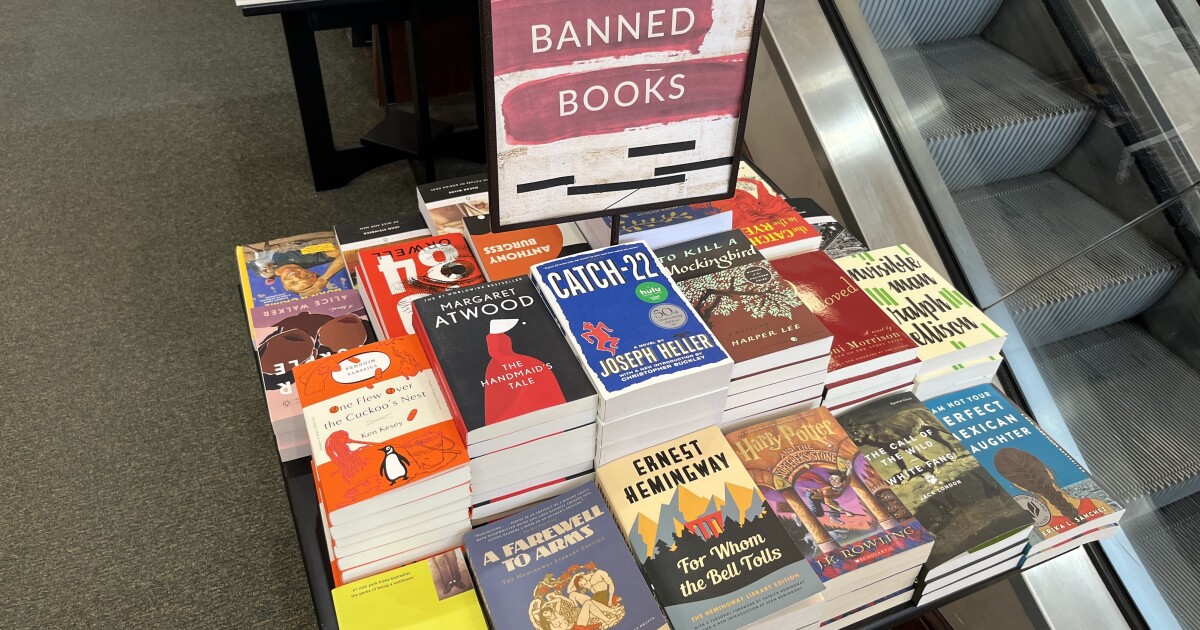
A panel of federal appeals court judges will choose what happens next for Iowa’s education law that bans books with sexual content in school libraries and prohibits instruction related to gender identity and sexual orientation for grades K-6.
In oral arguments held in a St. Paul, Minnesota, courtroom Thursday, an attorney for the State of Iowa asked the judges to lift a preliminary injunction that has blocked enforcement of SF 496 since late December.
That ruling was made in response to two separate legal challenges that argue the law silences LGBTQ students from expressing their identities and restricts students’ free access to information.
Iowa Solicitor General Eric Wessan told the three-judge panel with the Eighth Circuit Court of Appeals that the state has the ability to tell schools to remove books that show or describe sexual acts, as defined in criminal code, because “library curation is government speech.”
“The public schools are themselves representative of the state and the values that the state seeks to inculcate in children as part of its pedagogical goal of raising its future citizens,” Wessan said.
Matt Sieren
/
Iowa Public Radio
When District Court Judge Stephen Locher blocked enforcement of the law, he called it a “bulldozer” because so many books could be banned. The Des Moines Register has found nearly 1,000 different titles were removed from school libraries since the law first took effect. Those include titles by authors John Green and Jodi Picoult who are part of the lawsuit involving the publisher Penguin House, as well as well-known books like 1984, The Handmaid’s Tale and The Kite Runner.
Attorney Nathan Maxwell of Lambda Legal, which is part of a lawsuit with the ACLU of Iowa representing LGBTQ students, said the law’s definition of what is age appropriate is simply too broad.
“The problem with this law is it says if it’s not appropriate for a first grader it’s therefore not appropriate for a senior in high school. And so those seniors in high school are losing out on information,” Maxwell told reporters after the appeals court hearing. “There’s something special about a school library, which is where students go specifically to learn. Having access in school libraries is substantively different than being able to buy [a book] anywhere in the world.”
Judge questions scope of challenge
The lower court’s injunction also applies to a ban on instruction related to LGBTQ topics in kindergarten through sixth grade. The state argues both major pieces of the law should be enforced as the legal challenges proceed.
In questions he raised during oral arguments, Judge James Loken appeared to criticize the groups suing the state for bringing a facial challenge — that is, a claim that the law is entirely unconstitutional based on how it was written — instead of challenging how the law has been applied.
“This could easily have gone to a — probably a series, certainly more than one — as-applied challenge, from which, the judicial interpretation of this statute and how school boards should apply it, would become clear to educators in Iowa,” Loken said.
“I question how many it would take,” replied ACLU of Iowa attorney Thomas Story. “I can’t see any because I can’t see a way to read this law without it not making sense or not being constitutional.”
Speaking after the hearing, Story warned against guessing a judge’s position on the case based on the questioning in courtroom.
Christy Hickman, an attorney for the Iowa State Education Association, said the courts need to weigh in on the law because guidance from state education officials is limited and school districts don’t seem to agree on how it is supposed to work.
“If you look at the extreme differences across school districts and the number and types of books that have been removed, it shows you that there is a lot of confusion and ambiguity and interpretation,” Hickman said. “If we had to start all over, and start suing individual school districts, think about the court and school and public resources that go into that. I hope that is not where we end up.”
What happens if the book ban law is enforced
The law includes potential consequences for school districts or teachers who are found to have kept books on library shelves that contain sexual content.
One violation warrants a written warning from the Iowa Department of Education. But after two or more violations, the case would be referred to the Board of Educational Examiners, which certifies teachers and administrators to work in Iowa schools. The BOEE could bring up the case for disciplinary action.
The Eighth Circuit Court of Appeals must decide on the current preliminary injunction before the two cases against the education law continue.
Attorneys involved in the case would not comment on their strategy if the injunction is lifted, but Maxwell said they would continue to stand behind students and others impacted by the law.
“We will continue to fight for the students and families in Iowa to be able to access this information and to be able to speak freely about who they are in school and anywhere,” Maxwell said.


A train struck a semi-truck in eastern Iowa on Wednesday, killing one person and injuring another, authorities said.
The crash occurred at the crossing of a state highway and the Iowa Interstate Railroad in a rural area about 70 miles (113 kilometers) east of Des Moines, according to Poweshiek County Sheriff Matt Maschmann.
One person in the semi-truck died and another was transported with “serious injuries,” Maschmann said in a statement.
IN CASE YOU MISSED IT | Colorado railroad connects generations through a shared passion for trains
Seventeen train cars and two power engines derailed after the crash and caused “significant damage” to the railroad, he said. Images of the scene showed a massive heap of railcars with billowing smoke.
No hazardous material was spilled, according to Iowa State Patrol spokesman Sgt. Alex Dinkla.


Tate Schendel on Waukee Northwest boys soccer’s win over Urbandale
Hear from Waukee Northwest goalkeeper Tate Schendel after the Wolves beat Urbandale in the Class 4A boys soccer state semifinals.
It took two overtimes and six penalty kicks to decide a winner in Waukee Northwest’s Iowa high school boys soccer state quarterfinal matchup against Johnston on Monday.
And it looked like the semifinal would go the same way, that is, until Eman Alicic came up big on a penalty kick in the final minutes of the No. 2 Wolves’ state semifinal game against No. 3 Urbandale on Wednesday, June 3.
“It was too long of a game last time,” joked Northwest goaltender Tate Schendel postgame. “From now on, we’re just going to try to close things out, get it done and keep moving on.”
It took more than 10 minutes for either team to record a shot, and even longer for an attempt to go on goal.
The Wolves hammered a dozen shots in the direction of Urbandale’s goal in the opening 40 minutes, but only a couple came close to going in – including a shot from Alicic that bounced out after hitting the corner of the crossbar.
The J-Hawks had fewer chances at the net, but more attempts hit the target. Of Urbandale’s seven first-half chances, four were on goal – and Schendel stopped all of them.
With one defense keeping shots on goal away from their keeper and the other team’s goalie stepping up to make risky saves, Northwest and Urbandale headed to the locker room tied, 0-0, at halftime.
“He’s been with us now for three years as a starter, and each year he’s come up big and done great things,” Waukee Northwest head coach Carlos Acebey said about Schendel. “I don’t think he gets a lot of credit for how well he plays between the goalposts, and he’s a solid player for us.”
The Wolves took control in the second half, firing off 12 more shots – including seven on goal – to Urbandale’s three shots, only one of which made its way into Schendel’s hands. But despite Northwest’s ability to keep much of the pressure on the J-Hawks’ end of the field, the game remained scoreless deep into the second half.
With just under four minutes remaining in regulation, Eddie Mihura won the ball around midfield, and then Alicic sent a cross-field pass that was misplayed by one of Urbandale’s players and made its way to Sully Ervin.
He took the ball downfield on a breakaway, but didn’t get a chance at the net, as a J-Hawks player took him down in the box, resulting in a penalty kick.
“He’s just a little buzz saw,” Acebey said about Ervin. “He creates a lot of problems just because he’s annoying, but he’s a great annoying for us. I love it.”
Alicic – the sophomore star and leading goal scorer on Northwest’s roster – lined up for the penalty kick and nailed it, sending the ball left as Urbandale’s goalie dove to the right.
“He’s really wiser than people give him credit for,” Acebey said. “He’s a sophomore, but he’s very intelligent. His soccer IQ is off the charts. He’s a player that gives us a lot of confidence…and the last three teams that we played have tried to double team, triple team him, and he still is going to get the ball.”
The J-Hawks attempted to get another chance at a goal in the final minutes of the game, but Northwest had an answer for everything Urbandale tried. The final horn bellowed, and the Wolves celebrated their first trip to the championship game since the program’s inaugural season in 2022.
Northwest will face off against No. 1 Ankeny Centennial – still undefeated – at 2:30 p.m. on June 5 at Mediacom Stadium.
Alyssa Hertel is the college sports recruiting reporter for the Des Moines Register. Contact Alyssa at ahertel@dmreg.com or on Twitter @AlyssaHertel.

-

 Lifestyle3 minutes ago
OTB Takes Full Control of Viktor & Rolf
-
 Politics10 minutes ago
Senate rejects an initial attempt to ban Trump’s $1.8-billion ‘anti-weaponization’ fund
-
 Science13 minutes ago
Emergency room visits during heat waves available to the public in ‘near-real time’ in L.A. County
-
 Sports18 minutes ago
How Myles Garrett’s arrival has the Rams — and even Cooper Kupp — talking Aaron Donald return
-

 World28 minutes ago
Russia kills 12 in Ukraine as Kyiv mourns 707 children killed since 2022
-

 News55 minutes ago
Trump’s name must come off the Kennedy Center by June 12
-

 Los Angeles, Ca2 hours ago
Overnight military training brings loud flash bangs, simulated gunfire to quiet Pasadena neighborhood
-

 Detroit, MI3 hours ago
Detroit Lions add UDFA rookie WR during OTAs

