Lifestyle
Inside L.A.'s oldest letterpress printer beloved by celebs, from Oprah to Jon Hamm

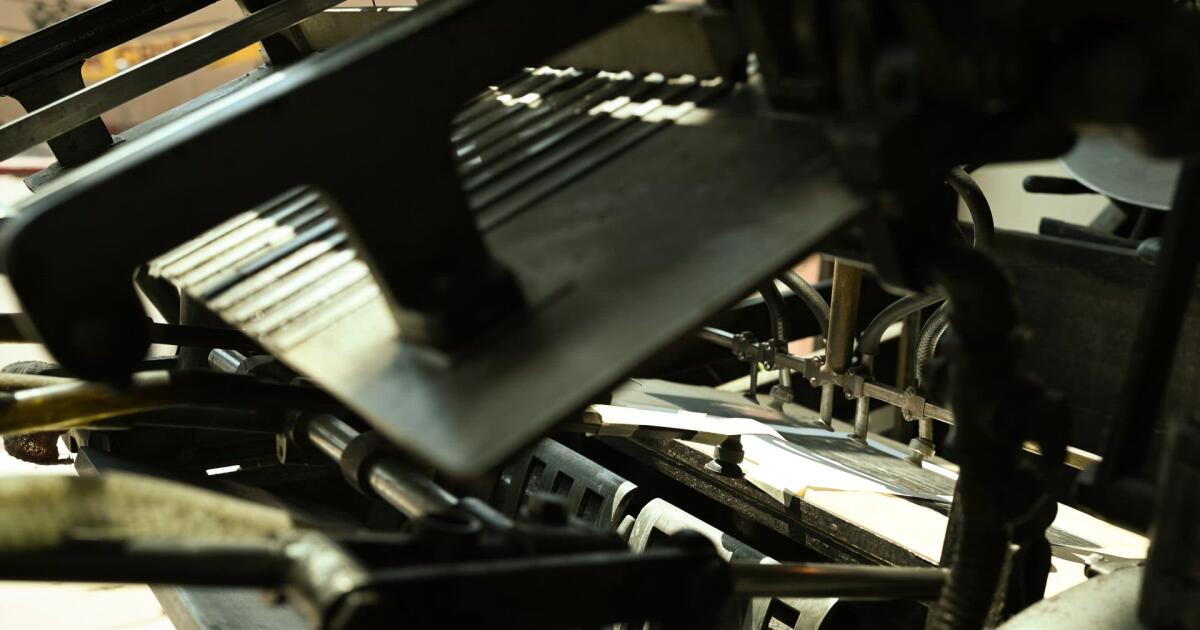
Surviving in an obsolete industry as long as Aardvark Letterpress has requires fundamental elements of entrepreneurship. Skill, dedication, creativity and professionalism are essential. General manager and co-owner Cary Ocon returns to another theme that’s kept what’s now the city’s oldest letterpress print shop running since 1968.
“Dumb luck,” he says.
Brothers Brooks and Cary Ocon on the floor of Aardvark Letterpress.
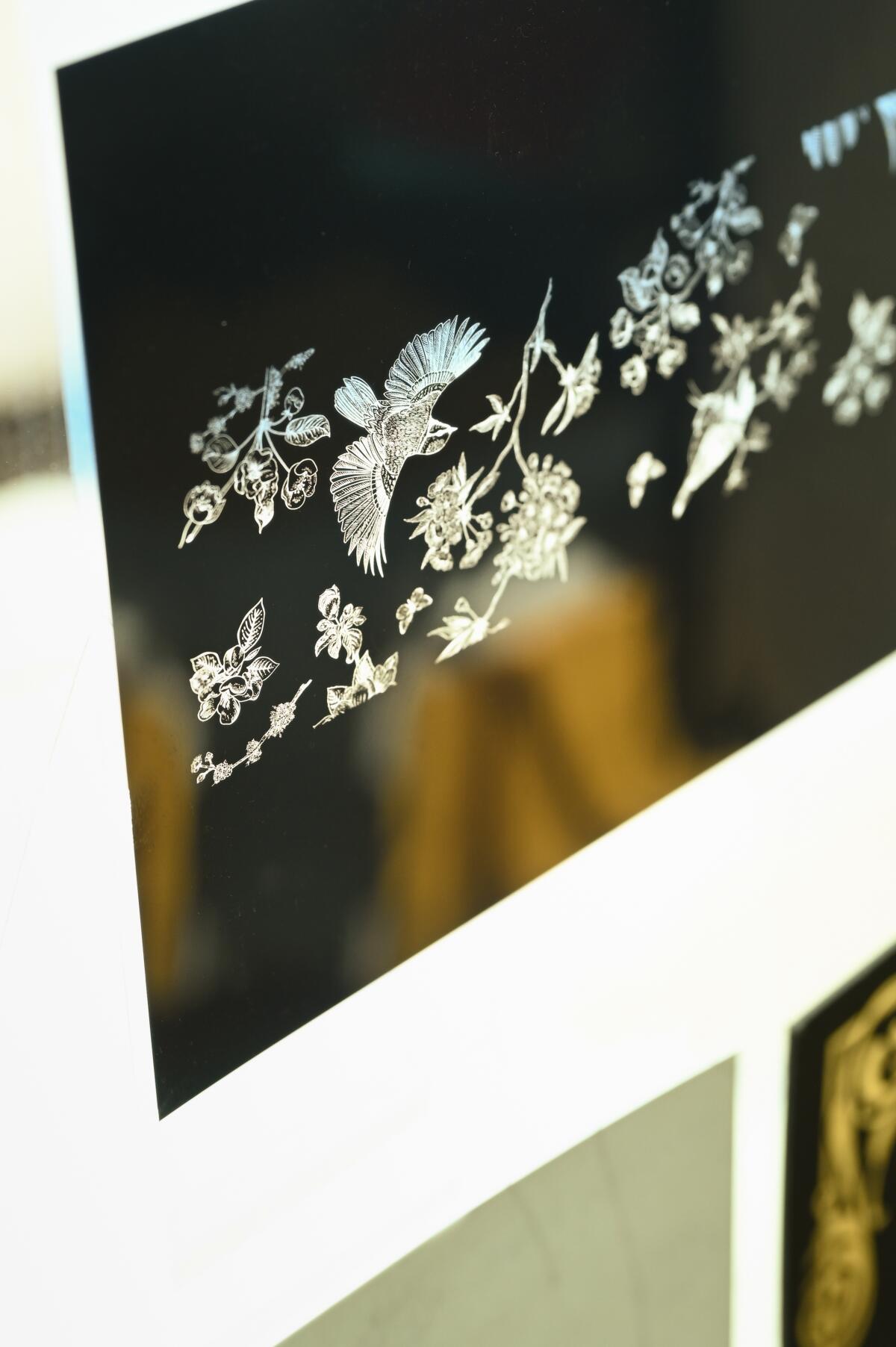
A test negative taped to the window of Aardvark’s office.
The lack of pretense and polish here belies the pedigree of much of Aardvark’s client base. Entertainment, fashion, art and other creative industries converge at the unlikely corner of 7th and Carondelet streets overlooking the southwest edge of MacArthur Park. Both basic and technically complex, making letterpress goods is a process that involves the physical act of pressing inked plates onto paper using mechanical presses in a manner that literally leaves a deeper impression.
A look through samples of artful work imprinted with boldfaced names and known entities from Apple to Rihanna’s Fenty Corp. to Valentino to Billie Eilish reveals the many layers of exceptionalism at work that inspire trusting partnerships. When actor and producer Jamie Lee Curtis established her production company Comet Pictures in 2019, “Aardvark Letterpress helped me start off with a strong logo and design,” she shares via text message. “I’m grateful for their expertise and guidance.”
In addition to relying on Aardvark to help shape their professional image and branding, people come here for a richly tactile experience. Personally printed matter made with this level of care has a way of inspiring connection and celebration.
“Cary and the team at Aardvark represent that sadly disappearing sector of tradecraft in the current culture,” actor Jon Hamm says via email. “Singularly, almost maniacally, devoted to one thing, they practice an attention to detail that is as precise and exacting as it is gorgeous in its finished quality.”
“We were typographers before we were printers,” Cary says, pointing to the hulking Intertype brand typography machine dating from the early 20th century that stands in one of the shop windows. With its complex movements that cast lead into a mold to form letters, leaving piles of shavings that get repurposed, it’s the original piece of equipment Cary’s father, Luis Ocon, obtained when he bought Aardvark Typographers 56 years ago in its previous location on Grand View Avenue.
The atmosphere is earnest and soulful, imbued with the makings of a one-act play setting and populated with a cast of characters. Gently sarcastic Cary handles overall management duties, while technically minded Brooks Ocon is the hands-on printing expert, alongside laser-focused master printer Bill Berkuta. Derek Pettet, a friend of Cary’s since the fourth grade, adds to the familiar dynamic.
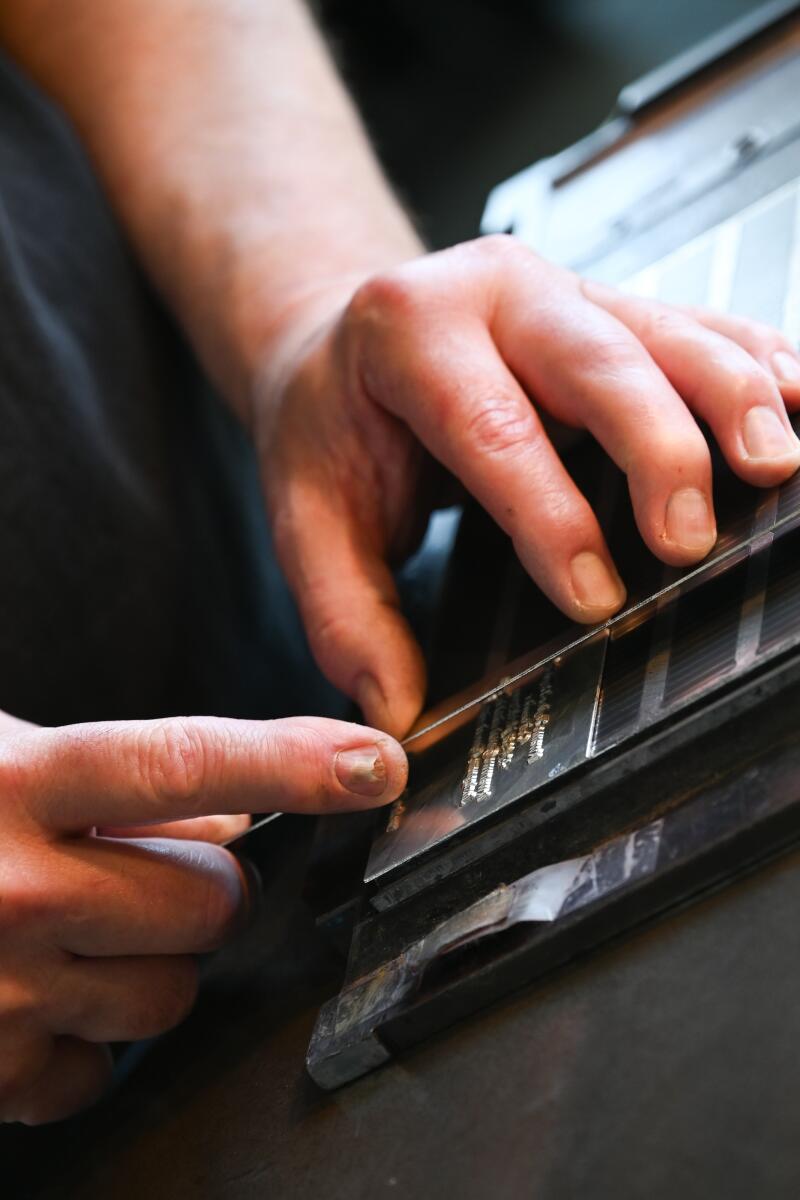
Brooks Ocon aligns a block for printing.
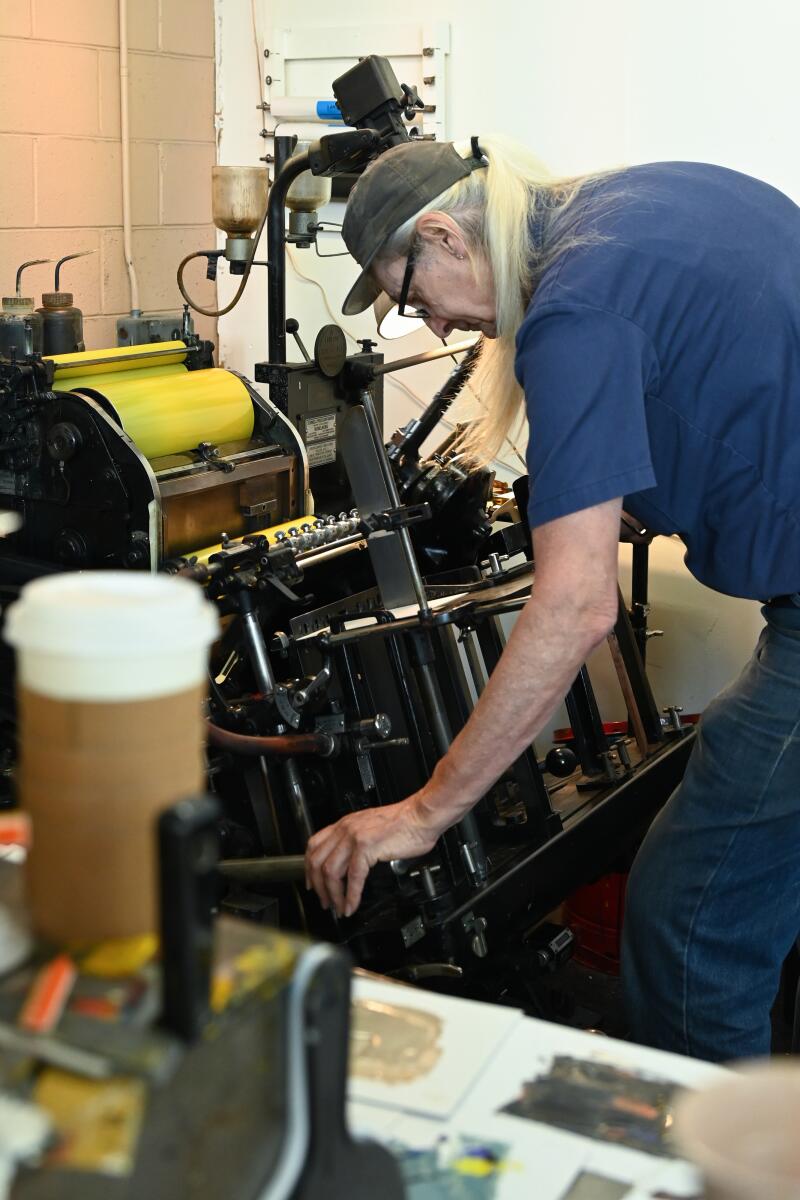
Master Printer Bill Berkuta prints an order for a customer.
Another moment of good timing came in 1988 when Brooks went to run an errand at H.G. Daniels art supply store on 6th Street. He couldn’t find what he was looking for, so he was directed to McManus & Morgan Fine Art Paper nearby. Brooks noticed a “for lease” sign in an adjacent storefront inside the detailed 1924 Spanish Colonial Revival-style Westlake Square Building designed by architect Everett H. Merrill. It struck him as an ideal place for Aardvark to put down new roots, and his father agreed.
“This was the original art district,” Cary notes, referencing the erstwhile concentration of art schools in the area. Otis Art Institute (later renamed Otis College of Art and Design), the ArtCenter School (ArtCenter College of Design) and Chouinard Art Institute, which was the predecessor of CalArts, were clustered within blocks of each other before relocating to their respective campuses. Multiple art supply stores catered to the student population.
The initial period of Aardvark Letterpress becoming a studio whose services are prized among glitterati clientele like Oprah Winfrey and art galleries and fashion houses, however, was not so smooth.
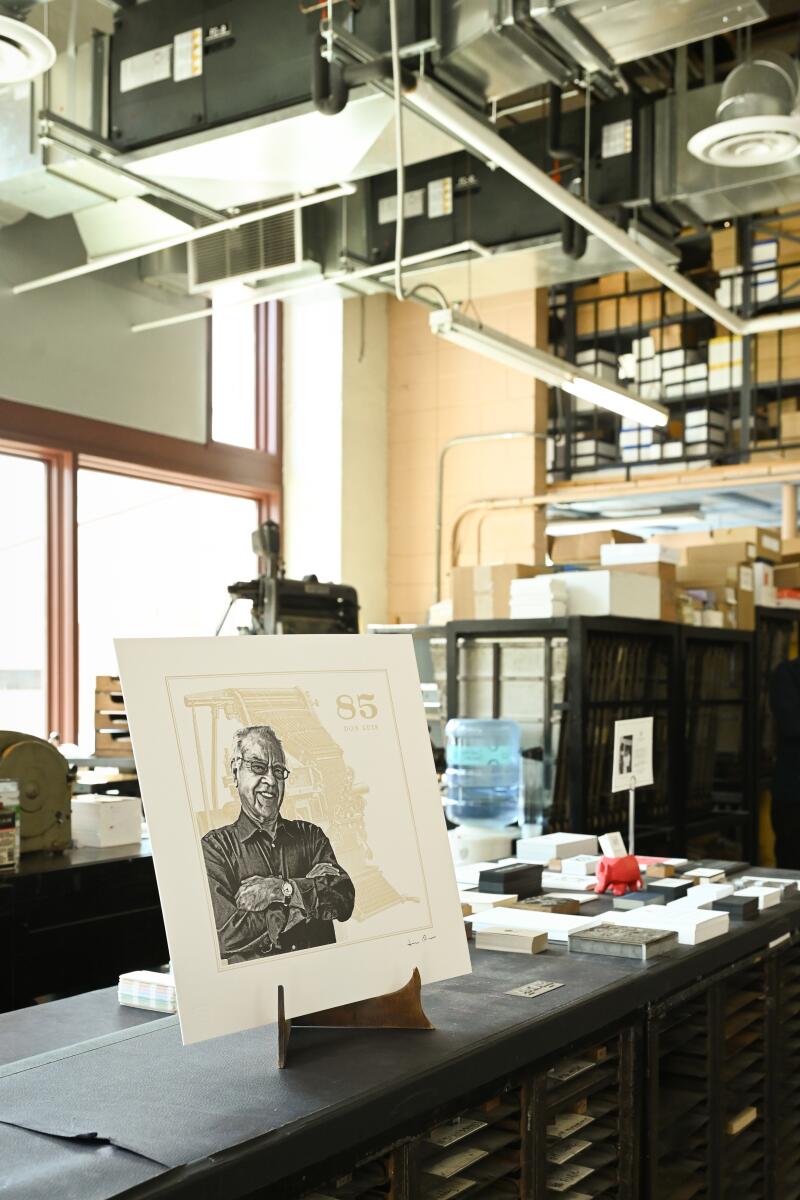
A print of founder Luis Ocon at Aardvark’s entrance.
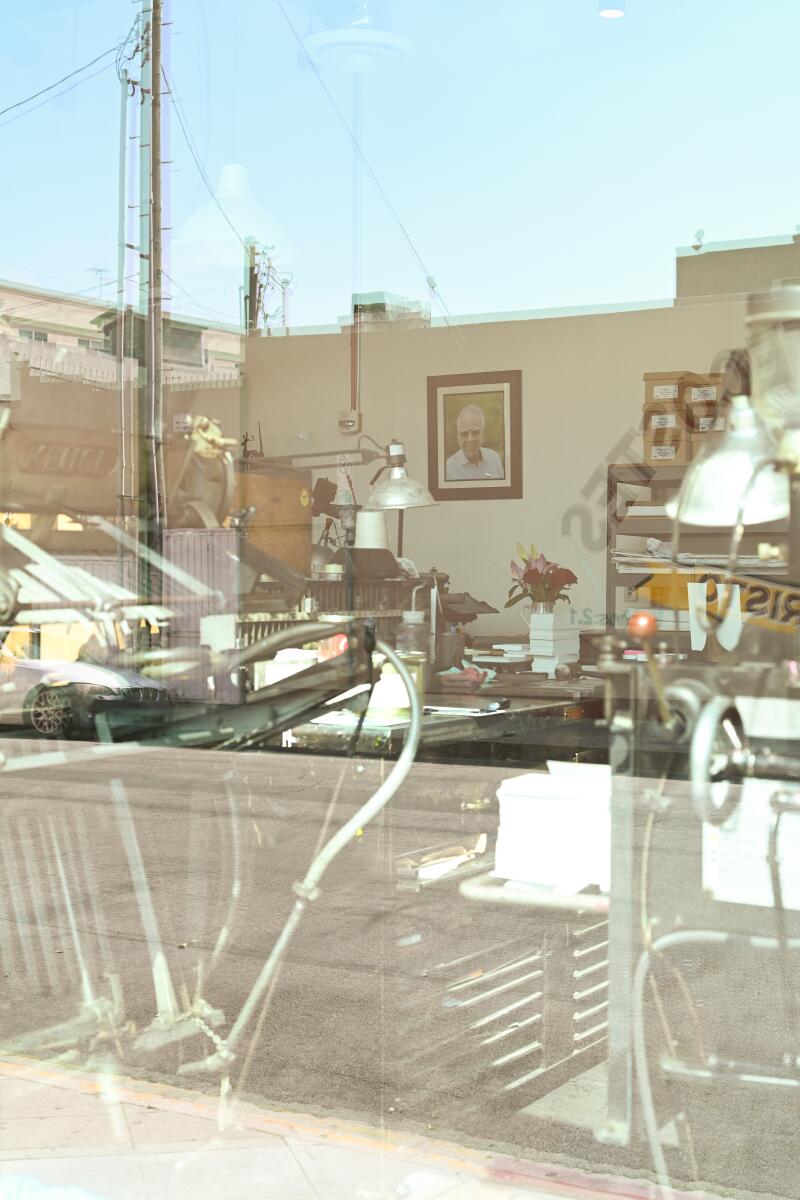
A view of Aardvark from South Carondelet Street.
A self-taught newspaper Linotype operator who immigrated to the U.S. from Mexico City, Luis Ocon’s purchase of Aardvark Typographers from his former boss Ken Matson coincided with the early adoption of computerized typesetting. “The business just started to nosedive because no one’s doing metal type anymore,” Cary explains. A customer suggested they learn to print in order to adapt to the changing times. “We got our first press and stumbled our way through letterpress printing,” Cary recalls.
While Cary was earning degrees at UC Berkeley and the University of Minnesota and then embarked on what would be an unsatisfying law career, Brooks and Luis were “struggling” to keep Aardvark afloat. Patriarch Luis, who passed away last year at the age of 86, was their stepfather who raised them as his own after meeting their mother, Helen, when Luis and Helen worked at the Holland House Cafeteria in what was Britts Department Store across the street from the Original Farmers Market. (The Ocon brothers also have two sisters and a half-sister.)
Decades before exclusive event planners trusted Aardvark Letterpress to create exquisite wedding invitations and noted artists such as Shepard Fairey partnered with the team on limited edition letterpress works, the business was hyper-local. Mariachi musicians would walk in on a Monday morning needing a fresh supply of business cards after a busy weekend promoting their talents.
Otis Art Institute in its original Westlake location accounted for the occasional job, and Gary Wolin, who still owns the century-old McManus & Morgan, referred customers who needed to print on the specialized papers he sold. The simpatico, closely connected businesses remain neighbors after Wolin downsized within the same building. (Newer tenants in the recently renovated property include taste-making firm Commune Design and Hannah Hoffman gallery.)
“We were a secret among graphic designers,” says Cary, who joined the business full time in 1998. Otis alumni would remember the old school print shop down the street, where the 1920s stencil-painted ceilings, multiple Heidelberg, Germany-made production presses, sturdy wooden drawers full of brass type in hundreds of fonts and other tools still serve as a portal to a pre-digital era.
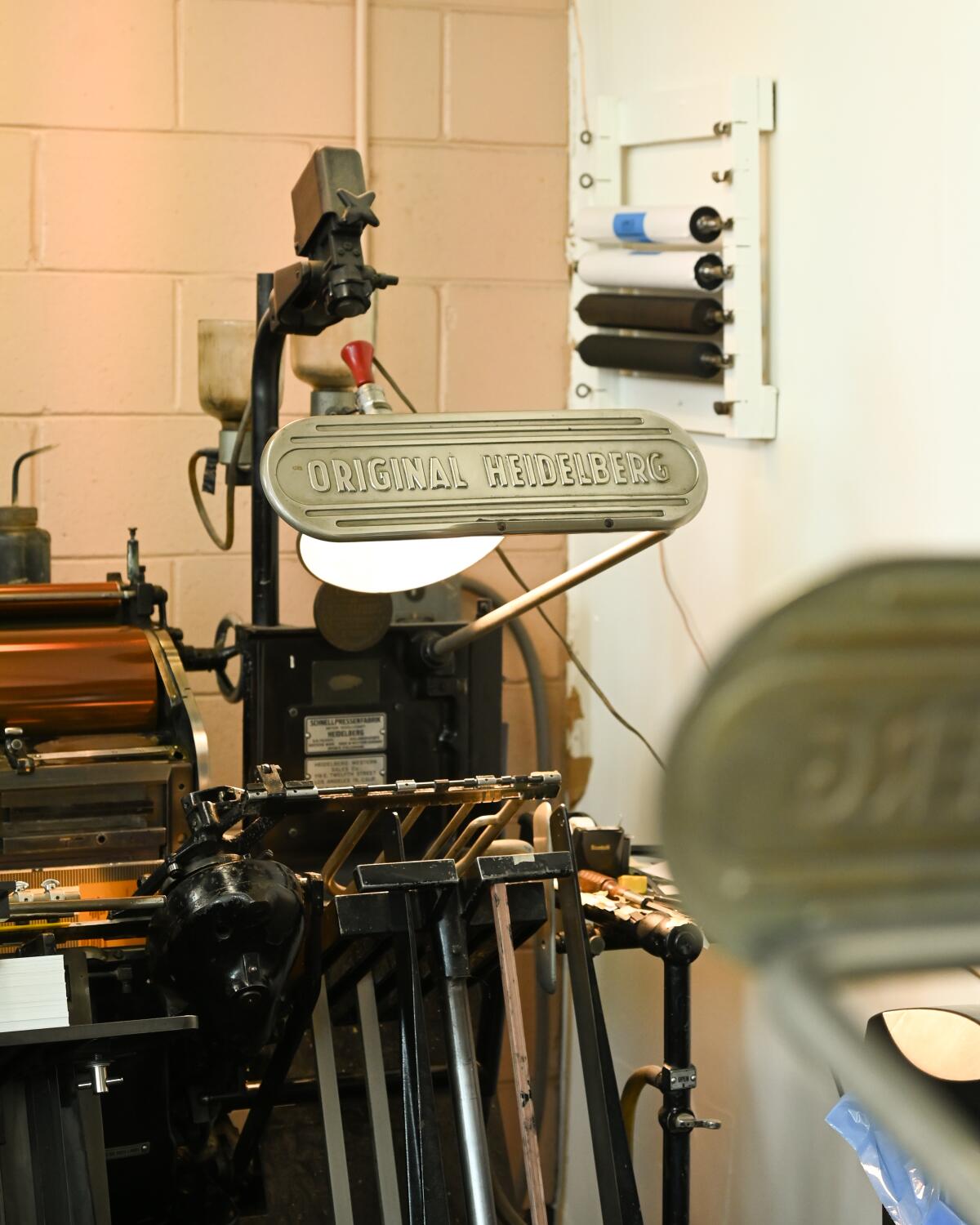
One of Aardvark’s six Heidelberg presses, vintage printing machines that apply designs directly to paper.
Because cultural tastes and trends have a way of being cyclical, toughing it out eventually paid off. Cary points to Martha Stewart’s championing of letterpress stationery as part of the reason why a revival came around in the early aughts. Aardvark was ready to meet new demand. “Again, it was dumb luck, because we had all the ability to set type.”
In this analog environment computers are used to manage workflow, and a processor upstairs transfers digital design files to make polymer plates used for most jobs. (Aardvark turns to A&G Engraving in Vernon to fabricate photoengraver metal plates for select projects and fine art prints.) This team’s expertise remains unrivaled in L.A. To mix inks, for instance, Berkuta refers to the color recipes on his well-worn Pantone fan deck and then relies on his eye and experience. “I’m weighing it in my head,” he says about getting the ratios right.
“I have collaborated with the team at the Aardvark studio adjusting plate pressure, ink colors and translucency to achieve sublime effects that no other medium can deliver,” artist Fairey states via email.
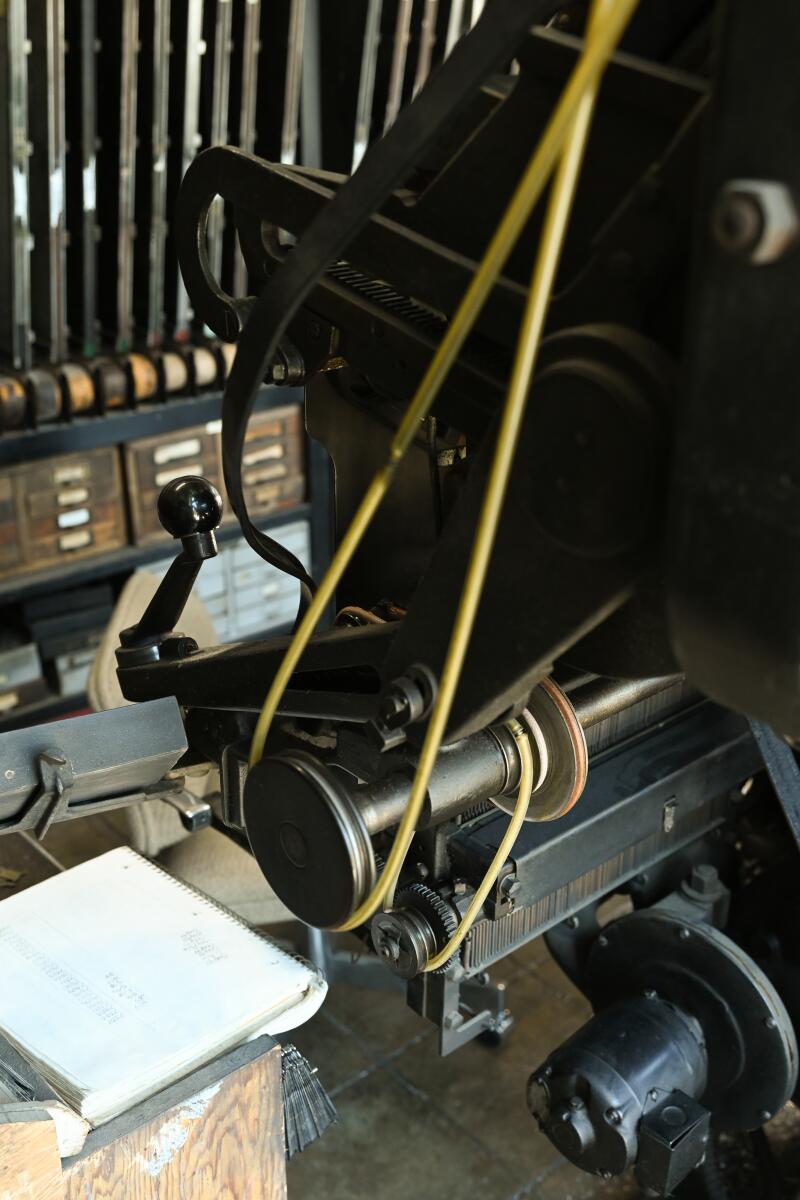
A linotype detail.
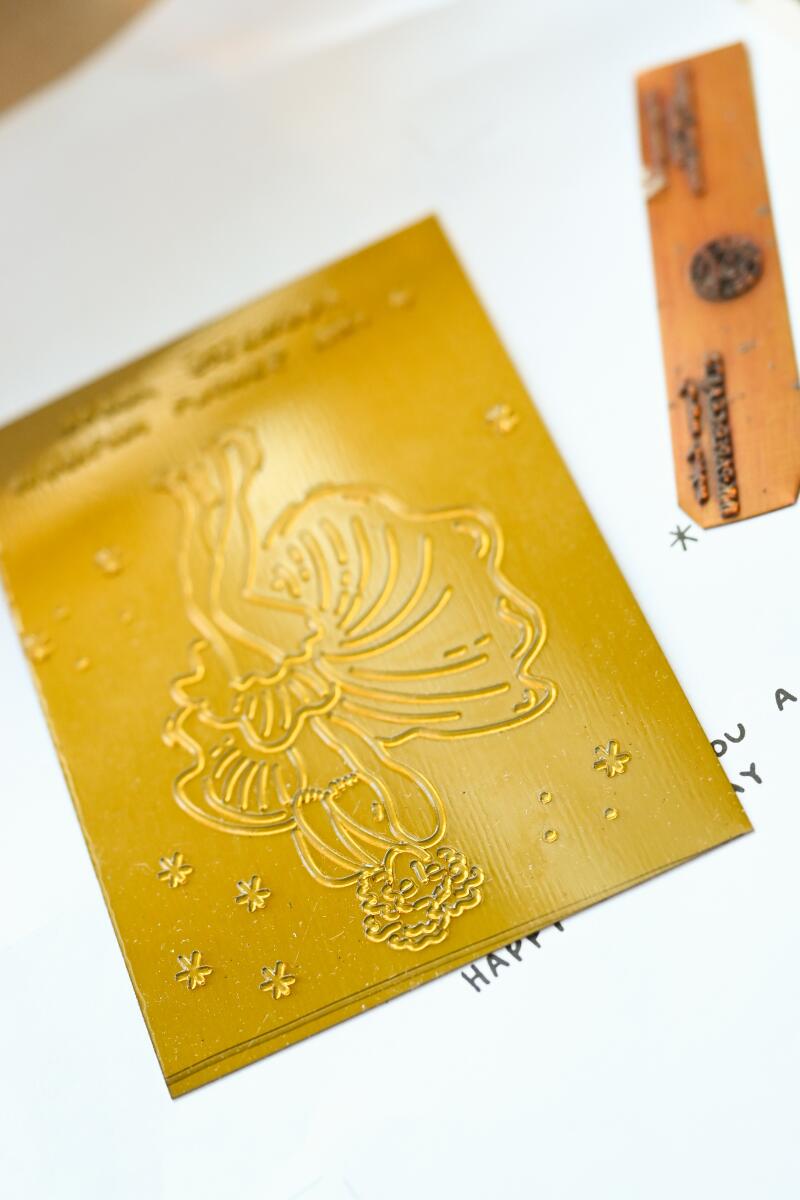
A Marilyn Monroe print on foil.
“I consider the invitations, menus and other objects they provided for our wedding to be works of art. Turns out 100 years of experience is worth something!” Hamm adds.
Despite the accolades, Cary is upfront about the challenges of sustaining this artisan enterprise. “To even print a simple business card, it’s much more labor intensive, so we can’t do it for 50 bucks,” he explains. To keep evolving, he’s preparing to launch Aardvark Printworks, a collection of letterpress art featuring imagery such as artists’ renderings of L.A. landmarks.
“I didn’t appreciate what we were doing,” Cary reflects about his earlier relationship to Aardvark Letterpress’ niche trade. “I see how it does move people.” Even if the family has yet to devise a clear succession plan for the future, the Ocons are proud of their legacy. “It’s something special. We’re thankful we can keep going,” Cary says.
Their impact reaches beyond Los Angeles. “I value a family business that keeps the craft of letterpress, an important printmaking tradition, alive and accessible to L.A. artists and businesses,” Fairey echoes.



Sydney (Ayo Edebiri) and Carmy (Jeremy Allen White).
FX
hide caption
toggle caption
FX
There has always been a metaphorical parallel between The Bear, the television show, and The Bear, the fictional restaurant on the television show. Even as Carmy (Jeremy Allen White) and Sydney (Ayo Edebiri) transformed the Italian beef joint into the fancy restaurant of their dreams and wished for a Michelin star, there were undoubtedly locals who thought, “This is great and all, and I’m sure the food is good, but … I liked the beef sandwiches.” There’s still a window at The Bear to get them, but the focus is certainly elsewhere.
When it started, The Bear was mostly about the work that took place in the kitchen. The stresses of too many orders, territoriality from Richie (Ebon Moss-Bachrach), the arrival of Sydney, and the tightly wound but undeniably talented Carmy, making everybody both extremely stressed and significantly better. Over time, it shifted and grew, putting together beloved departure episodes like “Fishes” in Season 2, which introduced a boatload of guest stars for a flashback story of a disastrous family dinner before Mikey (Jon Bernthal) died. It spent time with Sydney’s family, it explored the way Tina (Liza Colón-Zayas) and Mikey originally met, it followed Marcus (Lionel Boyce) to Copenhagen, and it went with Richie to work for Andrea (Olivia Colman). All these episodes were excellent. And there was still a kitchen. But the focus seemed to be elsewhere.

At times, the show seemed to have disappeared up its own nose, to the point where you weren’t watching the show The Bear as much as you were watching the phenomenon The Bear. There were too many real-life chef cameos, until it seemed like those chefs were checking a box on a list of “things all the cool kids do.” There were too many other cameos, culminating in a rare miss from the reliably charismatic John Cena. The show placed a lot of narrative weight on Carmy’s love interest, Claire (Molly Gordon) — weight that the underwritten character couldn’t support. But even if every experiment and every diversion had worked, viewers couldn’t be blamed for missing the close focus on the kitchen and the camaraderie — for thinking, “This is all really special, but I do miss the beef sandwiches.”
The fifth and final season dispenses with the departure episodes, and it mostly dispenses with cameos. It all takes place on one day, just after Carmy tells Richie and Sydney that he wants to step back from the restaurant and give it to them and Sugar (Abby Elliott) to run, and it mostly takes place right there at The Bear. Now that the clock set by Jimmy (Oliver Platt) has run out, his money has run out as well, and a series of cascading disasters puts Sydney, Carmy and Richie behind the 8-ball from very early in the day, not least because of the tension hanging over all three of them as they prepare to tell the staff about Carmy’s decision to leave.

Tina (Liza Colón-Zayas).
FX
hide caption
toggle caption
FX
We spend this day mostly with the people we know best: our three leads, along with Sugar, Tina, Marcus, and the rest of the staff — including Luca (Will Poulter), who has stayed around to keep working with Marcus. Jimmy is running around with Computer (Brian Koppelman) and a young apprentice of his named Cheese (Elsie Fisher of Eighth Grade), trying to figure out what to do about his finances since it is Jimmy, and not just the restaurant, who’s out of money.
This day takes a while to get cooking, so to speak. The first three episodes of the season are slow, the first two in particular. It’s pouring rain outside, the lighting is dim, and the score maintains the same contemplative melancholy for a long, long time. For about two and a half episodes, it feels like one extended, low-energy scene.
But after that, there’s a shift in tone as the staff looks to get through service, and through seven episodes (FX did not make the finale available in advance for critics), the rest of the season is terrific. What you see is the core story of The Bear, which is people trying to serve food and overcome problems, but through the lens of everything that has happened over the show’s run: Carmy’s retreat from his obsessiveness, Richie’s expansive (and inspiring) discovery of his gift for hospitality; Sydney’s stepping forward from second-in-command to leader; Tina’s complex relationship with the restaurant and her grief over Mikey; Sugar and Carmy’s relationship with Donna (Jamie Lee Curtis); the arrival of Marcus as a high-end pastry chef.
The question the show asks over the last four episodes is: Given all those digressions and flashbacks, given all those visits with families and others, given everything we know about where all these people have been and what they’ve experienced, how does a high-pressure service — of the same kind we used to see in that first season — look now? How do they behave differently, and how does their behavior read differently? How are they the same people we have always known, but at a different juncture, in a different context? How do their wins mean more to them, and to the audience?
On the one hand, making a season this way, there are fewer surprising grace notes, like “Napkins,” the Tina/Mikey flashback episode in Season 3, or “Worms,” the episode in Season 4 where Sydney hung out with her cousin (Danielle Deadwyler) and her cousin’s kid. The Bear feels less daring and more conventional.
But oh, when they have victories under pressure? Victories, large or small? It is immensely, richly satisfying. There’s also more comedy other than just the goofy Faks family than we’ve had in a few seasons; Richie is perhaps the MVP of the season, and that’s partly because of how often he gets to be really funny. Ayo Edebiri continues to be the show’s best reactor, showing Syd eternally a little bit surprised (dismayed?) that she’s chosen to throw in her lot with these people.
There are a couple of questions yet to answer in the finale, both little plot items and broader character resolutions. Over these seven episodes, though, there is much to cheer.


Lifestyle
John Cena wanted to step away from the WWE ring before he became ‘too slow for the show’ : Wild Card with Rachel Martin

A note from Wild Card host Rachel Martin: First a confession: I have never watched a WWE match in its entirety. Don’t get me wrong, I appreciate the athleticism and the performance, it’s just not my thing. But there is something about John Cena I’ve never been able to shake.
Yes, he is a wrestling legend, but he has built a career as an entertainer that transcends the ring. The first time I saw him lead a cast was the 2019 family movie “Playing with Fire” and his rapport with kids in that film didn’t seem like acting at all. The man contains multitudes!
He co-stars with Eric Andre in his newest film, “Little Brother.”

Xie Miao and Yang Enyou in The Furious.
Norachai Kajchapanont/Lionsgate
hide caption
toggle caption
Norachai Kajchapanont/Lionsgate
There have been some fantastic movies released this year, and we know you can’t see them all. So we’re recommending four recent movies we missed that you should add to your watchlist: The Furious, Tuner, She’s The He, and Heresy.
If you need a few more fun film recommendations, check out these episodes:
Fun movies you may have missed
Our favorite movies on Tubi
We debate the best movies to watch on an airplane
Connect with Pop Culture Happy Hour:
Letterboxd / Facebook
Our weekly newsletter
Support Pop Culture Happy Hour+
-
Tennessee2 minutes ago
TN Lottery Cash 3 Morning, Cash 3 Midday winning numbers for June 25, 2026
-
Texas9 minutes ago
Texas school board to vote on required Bible readings in public education
-

 Utah12 minutes ago
Lawsuit claims Utah prison wrongfully conducted mass strip search of more than 100 women
-
Vermont17 minutes ago
VT Lottery Gimme 5, Pick 3 results for June 25, 2026
-
 Virginia24 minutes ago
Virginia man uses art to heal after years in prison, mental health battle
-

 Washington27 minutes ago
AJ Dybantsa arrives in Washington, ready to work on turning Wizards around
-

 Wisconsin32 minutes ago
What’s the Wisconsin wolf population? DNR issues latest estimate.
-

 West Virginia39 minutes ago
Register now: West Virginia’s largest yard sale grows with more Webster County sellers for 2026

