Politics
Mexico elects leftist Claudia Sheinbaum as the first female president in its history

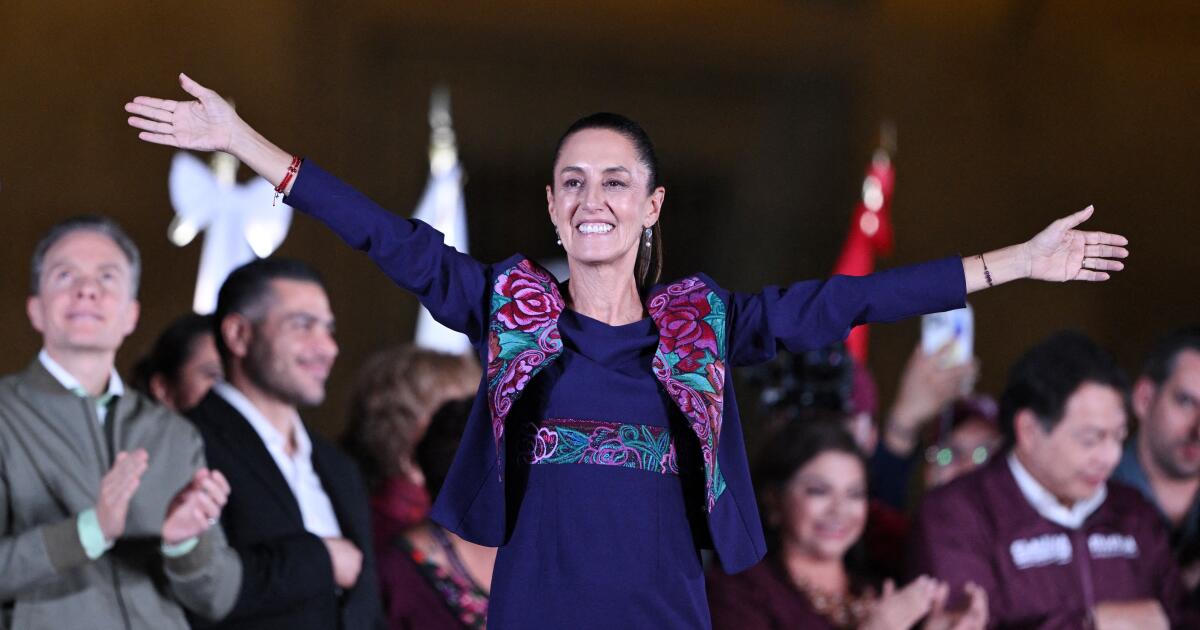
Claudia Sheinbaum, a U.S.-educated scientist-turned-politician, was elected Sunday as Mexico’s first female president, shattering gender barriers in a country known for a culture of machismo and high rates of violence against women.
“In 200 years of the Mexican republic, I have become the first woman president,” she told supporters in her acceptance speech, describing her victory as a win for all women. “I did not arrive alone,” she said. “We all arrived.”
The leftist former mayor of Mexico City, Sheinbaum, 62, will also become the first president of Jewish ancestry in the overwhelmingly Catholic country.
She will lead a prosperous but polarized nation that in recent years has been plagued by widespread gang violence. And she will be closely watched to see how she navigates the long shadow of her mentor, outgoing President Andrés Manuel López Obrador.
Sheinbaum was elected in landslide fashion, according to preliminary vote counts, which showed her winning with 58% of the vote compared with 30% for her closest rival, Xóchitl Gálvez Ruiz.
A successful businesswoman, Gálvez ran a spirited campaign representing an opposition coalition, but ultimately could not overcome the well-oiled machinery of Morena, Sheinbaum’s political party. Trailing in third behind the women was Jorge Álvarez Máynez, a member of Congress.
Sheinbaum is the protege and hand-picked successor of López Obrador, who founded Morena in 2011 and who has since transformed it into a political behemoth that has drawn comparisons to the Institutional Revolutionary Party, which ruled Mexico in autocratic fashion for most of the 20th century.
López Obrador, who under the constitution is limited to a single six-year term, is a deeply polarizing figure: Supporters laud him for helping lift millions out of poverty while critics assail him for disregarding democratic norms and failing to curb cartel violence.
Candidate Xóchitl Gálvez Ruiz waves after polls closed Sunday.
(Marco Ugarte / Associated Press)
Although López Obrador was not on the ballot, many viewed the election as a referendum on his term.
Many Sheinbaun supporters said they believed she would advance López Obrador’s trademark anti-poverty policies, particularly his government’s welfare payments to students and elderly people.
“She is going to continue with all the help that the president has given us,” said Rosa Maria Velazco, a 52-year-old teacher. “She will continue to support the poorest.”
Gálvez supporters, on the other hand, largely said they backed her because she promised to change the course set by López Obrador.
“I’m very angry at this government,” said Julieta Jujnovsky, 45, a professor of biology.
She said she didn’t oppose López Obrador’s ideology so much as his style of governing. “He doesn’t want any opposition,” said Jujnovsky, who described the president’s efforts to reform the Supreme Court, slash the number of seats in Mexico’s legislature and overhaul the country’s elections institute as part of a “deterioration” of Mexico’s democracy. “Democracy depends on counterweights and listening to the other side,” she said.
How Sheinbaum will mange to mend the divisions so evident during López Obrador’s term is one of the many questions hanging over her presidency. And, while López Obrador has vowed to retire from politics, many wonder whether he will indeed stay away from the political fray that has animated his entire adult life.
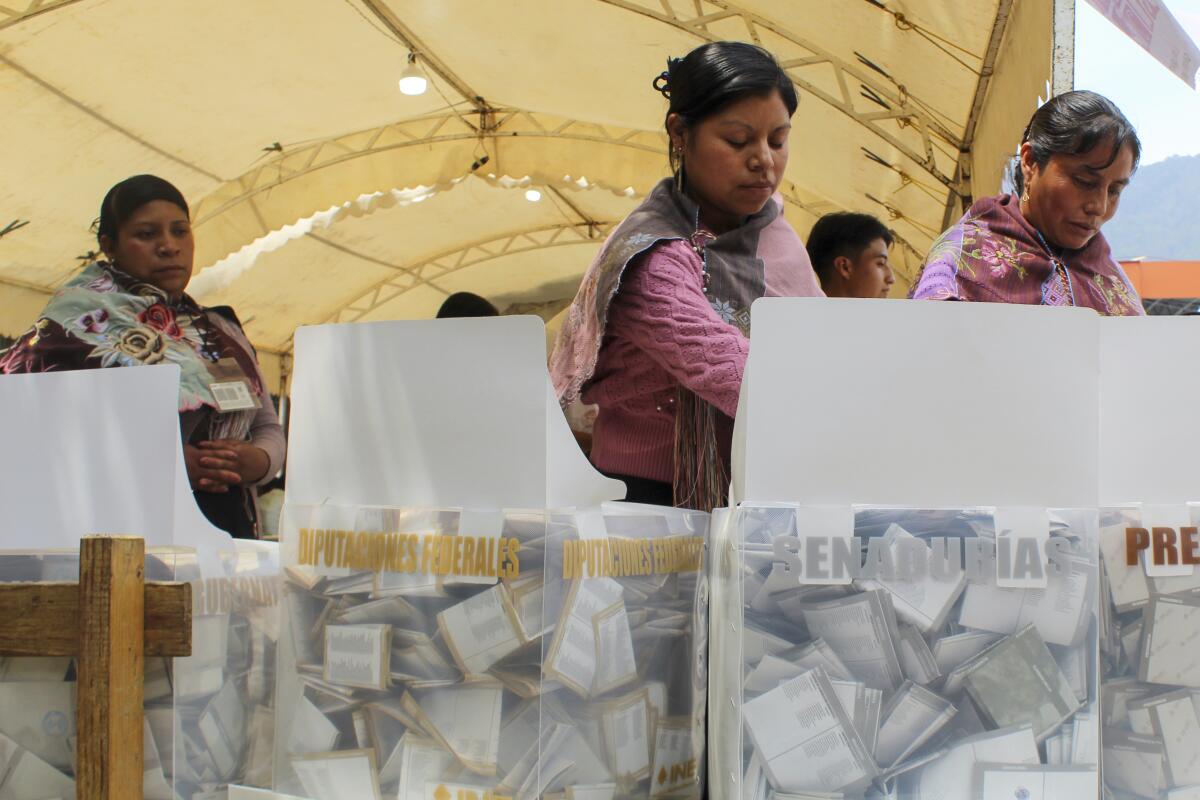
Indigenous women vote in Zinacantan, in southern Mexico, on Sunday.
(Luis Etzin / Associated Press)
Sheinbaum, for her part, has dismissed such questions as misogynist.
Her victory was a groundbreaking development in a country where women were barred from voting until 1954.
Her success is in some way a culmination of years of efforts by Mexican authorities to impose gender equality in a nation where politics was traditionally a male affair. A 2019 constitutional reform set quotas requiring gender parity in all elected posts at the federal, state and municipal levels.
Today, more than half of the members of Mexico’s congress are women, the fourth-highest rate in the world. Eight of the nation’s 31 governors are female and a woman heads the Supreme Court.
Some voters expressed wonderment that Mexico had elected a female leader before much of the rest of the world, including the United States.
“Never in my entire life did I imagine that a woman would be president of my country,” said Cristina Navarrete Santillán, 76, who voted for Sheinbaum in Mexico City alongside her two daughters and two granddaughters. “I am glad to be alive to see it.”
Sunday’s election was Mexico’s largest ever, with voters also choosing a new Congress, eight state governors, the Mexico City mayor and some 20,000 local officeholders nationwide.
Preliminary results showed that Morena performed well in the congressional elections, and would, as part of a coalition with two allied parties, likely have a supermajority that would allow it to easily pass legislation.
In the United States, which is home to nearly 11 million people born in Mexico, migrants who in the past were able only to vote in Mexican elections by mail could vote for the first time in person at consulates.
Long lines of voters stretched for blocks in cities that included Chicago and Orlando, Fla. In Los Angeles, the line at the Mexican Consulate in MacArthur Park wrapped around the block twice, with some people arriving as early as 4 a.m.
Voters draped in Mexican flags waited patiently as mariachi music blasted.
Laura Torres, who arrived with a group from Oxnard, said she had waited six hours to vote and would wait another six if necessary. The group planned to vote for Sheinbaum.
In some parts of Mexico, voters also lined up before dawn.
That was the case in the middle-class neighborhood of San Andres Totoltepec, where Sheinbaum, an environmental engineer by training, was reared and where she voted early Sunday.
As the candidate took her place in a line of about 100 people to cast her ballot, the crowd broke out in chants of “Presidenta!”
Sheinbaum spent much of her career as an academic, although she was raised in a highly political family.
Both her parents were active in the 1968 student movement, best known for the infamous Tlatelolco massacre in which Mexican security forces killed scores of protesters in the capital. Her first husband was a leftist politican.
When López Obrador was elected mayor of Mexico City in 2000, he launched Sheinbaum’s political career by making her secretary of environment for the capital.

Andrés Manuel López Obrador, Mexico’s president, kneels during an Indigenous ceremony during his inauguration six years ago.
( Bloomberg / Getty Images)
She later joined his breakaway political group, the National Regeneration Movement, known as Morena, and was elected in 2015 as borough president of Tlalpan, a district in southern Mexico City.
Three years later, she was elected mayor of Mexico City and he was elected president in a landslide victory for Morena.
López Obrador vowed to put the “poor first” in a country that he said had been hijacked by a corrupt and conservative elite. López Obrador’s approval rating still tops 60%, making him one of the most popular leaders in Latin America.
When he departs office in October, he will leave his successor with a strong economy that has been bolstered by the relocation of foreign firms from Asia and elsewhere to Mexico. The Mexican peso has been among the world’s strongest currencies.
But the next president will also inherit a number of crises, including dire water shortages, a struggling healthcare system, stubborn inequality and violence from criminal gangs and cartels so severe that the U.S. State Department warns its citizens not to travel to many Mexican states.
López Obrador’s controversial “hugs not bullets” strategy — which prioritizes social programs for the young over direct confrontations with cartels — has failed to stop the country’s violence, although homicides have fallen some during the last six years. Security is by far Mexicans’ main concern, polls show.
While voters were fiercely split on the issues at the heart of the race, many on both sides of the political divide were elated to have the chance to vote for a woman.
Fewer than a third of the countries in the United Nations have ever had a female leader, according to a Pew Research Center analysis from last year.
Rosa Maria Beltrán, a 39-year-old dentist who voted for Sheinbaum, said she was proud of her country.
“Tell the people in the United States that in Mexico we are going to have a female president before them,” she said.
Cecilia Sánchez Vidal in Mexico City and Anthony De Leon and Dania Maxwell in Los Angeles contributed to this report.


NEWYou can now listen to Fox News articles!
The House has officially shipped a colossal bipartisan housing package to President Donald Trump, and lawmakers are hoping that, at the very least, he doesn’t veto it.
Trump was supposed to sign the 21st Century ROAD to Housing Act last week, but his last-minute decision to ghost the signing ceremony with House Speaker Mike Johnson, R-La., and Senate Majority Leader John Thune, R-S.D., put into question whether the bill was dead.
His refusal to sign the bill, which passed with overwhelmingly bipartisan support in both chambers, was to leverage the Safeguarding American Voter Eligibility (SAVE) America Act, which doesn’t currently have the votes to succeed in the Senate.
WARREN TELLS TRUMP TO ‘SIGN THE DAMN BILL’ AS BIPARTISAN HOUSING PACKAGE REMAINS STALLED IN WASHINGTON
Trump has refused to sign the 21st Century ROAD to Housing Act. (Shawn Thew/EPA/Bloomberg via Getty Images)
Trump appears to be in no hurry to sign the bill, despite Republicans who are hungry for a win in the affordability fight ahead of the midterm elections.
“It’s so unimportant … compared to the SAVE America Act,” Trump told reporters in the Oval Office on Monday. “I think the SAVE America Act is exactly what it says. It’s saving America from crooked elections.”
“Here’s what I would like to sign, much more than a bill that — big deal, it’s a yawn,” he continued. “Some people say it’s wonderful. To me, compared to the SAVE America Act, just about everything is a big yawn.”
GOP INFIGHTING OVER TRUMP’S VOTER ID BILL ERUPTS AS TOP SENATOR CALLS STRATEGY ‘FANTASY’
It’s legislation that is loaded with nearly 60 provisions from both sides of the aisle in both chambers that’s designed to make it easier for homes to be built and for younger Americans to buy their first home. It also includes a ban on hedge funds buying up housing stock that Trump pushed Congress to include during the State of the Union earlier this year.
Sen. Elizabeth Warren, D-Mass., one of the architects behind the bill in the upper chamber alongside Sen. Tim Scott, R-S.C., charged that Congress handed the bill to Trump “on a silver platter.”
“When you ask me what happens next, if he cared about the American people, he’d have already signed the damned thing, and we’d be underway,” Warren said on WCVB’s “On the Record” on Sunday.
But Trump doesn’t have to put his signature on the bill for it to become law.
IRATE REPUBLICANS ACCUSE TRUMP OF HANDING DEMOCRATS A WIN AFTER BLOWING UP HOUSING PACKAGE
The Senate advanced a massive, Trump-backed housing package geared toward lowering the costs of homes and supercharging the housing supply. Sen. Elizabeth Warren, D-Mass., pitched it as legislation to prevent America from becoming a “nation of renters.” (Jemal Countess/Getty Images for Protect Borrowers; Anna Moneymaker/Getty Images)
The Constitution grants presidents the ability to veto a bill within 10 days of it being transferred over to the White House. In that scenario, Congress could override a veto of the housing package.
It’s happened before under the Trump administration. In early 2021, Congress overrode Trump’s veto of the annual National Defense Authorization Act — a massive Pentagon funding authorization package that some House Republicans are trying to use as a vehicle to pass the SAVE America Act.
But during that 10-day period, if Trump doesn’t sign the bill, it would automatically become law. That’s unless Congress completely adjourns, in which case a “pocket veto” could happen. The Senate is currently in recess and the House is scheduled to leave town by week’s end, but neither count as a full adjournment.
CLICK HERE TO DOWNLOAD THE FOX NEWS APP
Johnson, who spent the last few days meeting with Trump at the White House about the housing bill and the SAVE America Act, said: “I hope he does sign it.”
“If he doesn’t, it’s still law,” Johnson said. “We’ll still celebrate it, but he’s trying to make a point, and I think he’s making it very effectively. And the fact that you all ask me every three steps down the hallway illustrates that he has achieved the desired objective, and that is to make SAVE America the number one thing, because if we don’t get that right, everybody’s concerned about what happens next.”

Britain’s culture minister may challenge Paramount Skydance’s takeover of Warner Bros. Discovery — presenting a potential speed-bump to David Ellison’s plan to wrap up his $111-billion deal by September.
Earlier this month, Paramount secured the U.S. Justice Department’s blessing to buy the Warner assets, which include CNN, HBO, Cartoon Network, Animal Planet and the Warner Bros. film and TV studios in Burbank.
Paramount also must win the approval of British and European regulators, who are known for drilling deeply into media matters because of their influence on society.
Britain’s Competition and Markets Authority took a preliminary step this month by opening an investigation into Ellison’s proposed merger.
On Tuesday, Lisa Nandy, Britain’s Secretary of State for Culture, Media and Sport, notified Parliament that she was inclined to intervene in the blockbuster deal.
In a written statement, Nandy cited her ability to weigh in on “public interest grounds,” due to concerns about maintaining a competitive media market in Britain.
“The UK’s move to intervene in the Paramount–WBD deal confirms what we’ve been saying for months. The real regulatory risk was never in the US — it’s in Europe,” Forrester VP Research Director Mike Proulx said Tuesday in a statement.
While Nandy cautioned she has not made “a final decision on intervention at this stage,” she has invited Paramount and Warner Bros. to respond to her concerns by July 6.
June 2026 photo of Culture, Media and Sport Secretary Lisa Nandy arriving at Downing Street for the weekly Government cabinet meeting in London.
(Alishia Abodunde/Getty Images)
Paramount did not offer immediate comment.
The company owns CBS News, children’s channel Nickelodeon and Channel 5, one of the largest over-the-air television broadcasters in the United Kingdom.
Warner Bros. Discovery owns CNN, Cartoon Network and TNT Sports, which broadcasts the Olympics, Champions League and Premier League soccer matches.
“I am conscious that the proposed acquisition is global in nature,” Nandy wrote in her statement. “In reaching this decision, my focus has been, and will remain, on the UK public interest and the range of services available to UK audiences, including Channel 5, TNT Sports, Cartoon Network, Nickelodeon, and CNN International, as well as Paramount+ and HBO Max.”
If Nandy decides to intervene, the Office of Communications, known as Ofcom, would launch an assessment of the deal. Britain’s Competition and Markets Authority also would determine how the merger might reshape the competitive landscape.
Teams from the two companies have been huddling for months to plan for the melding of the two operations as soon as Paramount receives all of its regulatory approvals.
Australia, New Zealand, China, Saudi Arabia, Ukraine, Serbia, France and Italy have already given their approvals to the deal.
Saudi Arabia’s Public Investment Fund is planning to contribute $10 billion to help the billionaire Ellison family pull off the merger, which would make the Saudi royal family a significant, although passive, equity owner. In addition, the royal families of Qatar and Abu Dhabi have agreed to each contribute $7 billion in equity financing.
The Federal Communications Commission must evaluate the foreign ownership stakes due to Paramount’s holding of CBS broadcast licenses. U.S. antitrust regulators already have concluded the combination would not violate federal anticompetition laws.
Approval had been expected because President Trump — who has friendly ties with Ellison and his father, tech billionaire Larry Ellison — favors the deal.
Trump has been eager for changes at CNN.
The U.S. government stopped short of asking Paramount to make concessions or divestitures. Many expect that Paramount may have to reconfigure its children’s television holdings abroad due to the proposed combination of two large players — Nickelodeon and Cartoon Network.
Nandy suggested that Britain also should scrutinize the impact of combining two major streaming services HBO Max, a Warner property, with Paramount+.
HBO programming, including “Game of Thrones,” “Boardwalk Empire,” and “Succession,” has long been popular in Britain.
A coalition of state attorneys general, led by California Atty. Gen. Rob Bonta, also is expected to challenge the deal, in part, due to concerns about news media consolidation. Bonta’s office has said the matter remains under review.
Opposition to the deal has been building in the U.S. for months. A group of Hollywood activists — led by actors Jane Fonda and Mark Ruffalo — have spearheaded a “block the merger” campaign that now has support from more than 5,000 entertainment workers.
The group’s open letter calls on Bonta to take action to thwart the Ellison expansion effort. Paramount’s Chief Legal Officer Makan Delrahim has blasted the campaign, calling it “fear-mongering” and a partisan distortion of antitrust law.
Forrester’s Proulx noted differences in attitudes toward the deal among the various constituencies.
“For US consumers, this merger has become a proxy fight about political influence and control of media,” Proulx said. “In the UK, it’s being treated as a structural competition issue where regulators, not consumers, will decide how this deal plays out and how long it takes.”
Politics
Fetterman unleashes on ‘dirtbag’ wing of Dems after far-left victories: ‘Orgy of socialism’

NEWYou can now listen to Fox News articles!
Sen. John Fetterman, D-Pa., unloaded on his own party on Sunday evening, blasting a series of victories for progressives he called “anti-America.”
“Big night for the dirtbag left,” Fetterman said, referring to New York’s recent primaries, where two members of the Democratic Socialists of America (DSA) won primaries.
“I’ve said the party is becoming an orgy of socialism. Clearly anti-America, anti-Western Civilization,” Fetterman said.
Fetterman’s striking calls give a rare look at how some moderates may view the developments on their far-left flank that have dominated the party’s momentum in recent months, sparking concern that their high visibility is dragging the party further and further left.
FETTERMAN WARNS DEMOCRATS ‘DRIFTING FIRMLY INTO COMMUNISM’ AFTER SOCIALIST PRIMARY WINS
Sen. John Fetterman, D-Pa., speaks to reporters outside the Senate Chamber during votes on Nov. 10, 2025, on Capitol Hill in Washington, D.C. (Andrew Harnik/Getty Images)
His comments come on the heels of a handful of key progressive victories.
In Maine, Graham Platner, a controversial Democratic candidate for U.S. Senate, has attracted controversy for denying knowledge of the meaning behind a Nazi-linked tattoo, for off-color comments about race and calling himself a “communist” in a deleted Reddit post.
In New York, one DSA member, Claire Valdez, won a primary on a platform of abolishing ICE and a Green New Deal-style approach to climate change. Similarly, Darializa Avila-Chevalier, another DSA candidate, beat out incumbent Rep. Adriano Espillat, D-N.Y., a high-ranking Democrat and the chair of the Congressional Hispanic Caucus.
WINNERS AND LOSERS EMERGE AFTER SOCIALIST EARTHQUAKE ROCKS NYC PRIMARIES
Graham Platner, Democratic Senate candidate for Maine, speaks at a primary election night event at the Blue Hill YMCA in Blue Hill, Maine, on June 9, 2026. Platner won the party’s Senate primary after a campaign marked by accusations of past misbehavior and voter concerns. (Graeme Sloan/Bloomberg via Getty Images)
Both Chevalier and Valdez had the backing of New York Mayor Zohran Mamdani, himself a socialist.
The wins have captured national attention and drawn criticisms from Republicans who have pointed to their success as emblematic of the direction of the Democratic Party.
Fetterman, who has not shied away from confrontations, has been one of the few Democrats to express alarm about the kind of candidates carrying the party’s banner.
“I mean, you look at some of the things that people have said. Abolish prison, abolish the border, abolish ICE, I mean these crazy people — I have colleagues in my caucus that refuse to even call this out,” Fetterman said.
FETTERMAN REACTS TO MAMDANI’S REFUSAL TO ACCEPT SUPREME COURT’S IMMIGRATION RULING
U.S. Sen. John Fetterman, D-Pa., walks through the Senate Subway during the Senate War Powers vote on April 22, 2026, in Washington, D.C. (Heather Diehl/Getty Images)
CLICK HERE TO DOWNLOAD THE FOX NEWS APP
“Between P-hustle in Maine and some of the other winners in New York, they should form their own party and run on all the things that they’ve had to delete on social media,” Fetterman said, referring to Platner.
“That’s where our party has moved,” he added.
-

 Technology4 minutes ago
Google’s NotebookLM can sum up your research in a TikTok-style clip
-

 World11 minutes ago
Trump admin backs Bolivia state of emergency as leftist ex-leader’s loyalists fracture nation
-

 Politics14 minutes ago
Congress eyes rare bipartisan housing win with or without Trump’s help
-

 Health19 minutes ago
America’s national parks could add years to your life — here’s how they boost health
-

 Sports26 minutes ago
LeBron James Next Team Odds: Warriors, Cavaliers, Heat In Mix
-

 Technology29 minutes ago
The trick to smoother streaming at home and on the road
-
 Business34 minutes ago
Downtown L.A. World Trade Center to become affordable apartments
-
 Entertainment41 minutes ago
’47 Ronin’ director Carl Erik Rinsch sentenced to 30 months in prison for Netflix fraud case

