Politics
Mexico elects leftist Claudia Sheinbaum as the first female president in its history

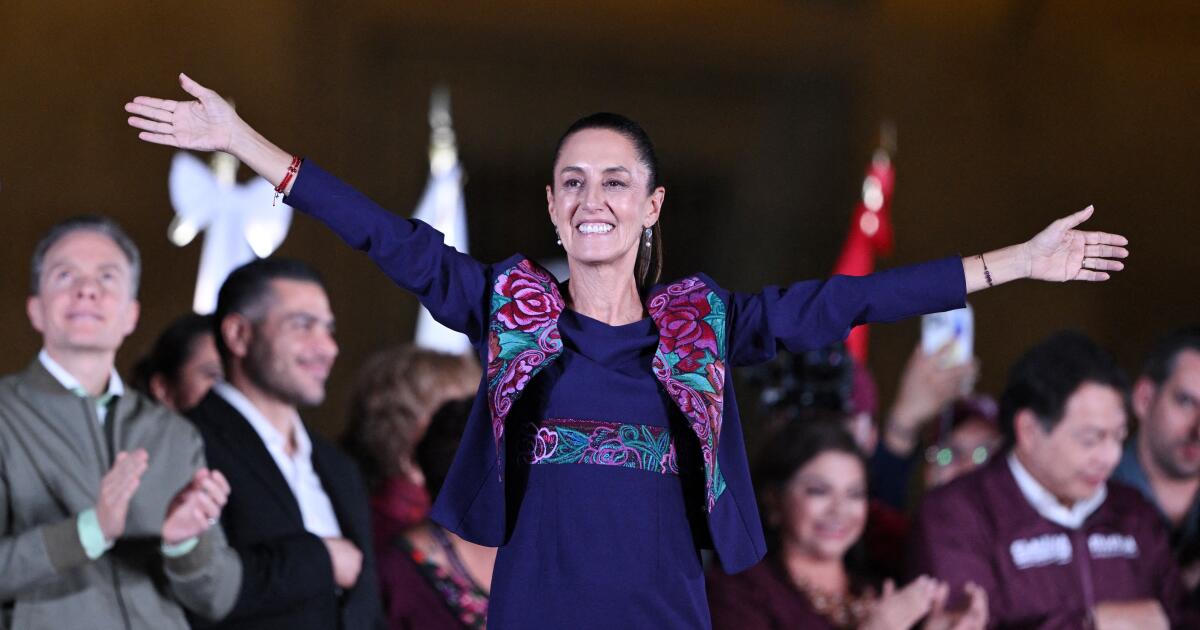
Claudia Sheinbaum, a U.S.-educated scientist-turned-politician, was elected Sunday as Mexico’s first female president, shattering gender barriers in a country known for a culture of machismo and high rates of violence against women.
“In 200 years of the Mexican republic, I have become the first woman president,” she told supporters in her acceptance speech, describing her victory as a win for all women. “I did not arrive alone,” she said. “We all arrived.”
The leftist former mayor of Mexico City, Sheinbaum, 62, will also become the first president of Jewish ancestry in the overwhelmingly Catholic country.
She will lead a prosperous but polarized nation that in recent years has been plagued by widespread gang violence. And she will be closely watched to see how she navigates the long shadow of her mentor, outgoing President Andrés Manuel López Obrador.
Sheinbaum was elected in landslide fashion, according to preliminary vote counts, which showed her winning with 58% of the vote compared with 30% for her closest rival, Xóchitl Gálvez Ruiz.
A successful businesswoman, Gálvez ran a spirited campaign representing an opposition coalition, but ultimately could not overcome the well-oiled machinery of Morena, Sheinbaum’s political party. Trailing in third behind the women was Jorge Álvarez Máynez, a member of Congress.
Sheinbaum is the protege and hand-picked successor of López Obrador, who founded Morena in 2011 and who has since transformed it into a political behemoth that has drawn comparisons to the Institutional Revolutionary Party, which ruled Mexico in autocratic fashion for most of the 20th century.
López Obrador, who under the constitution is limited to a single six-year term, is a deeply polarizing figure: Supporters laud him for helping lift millions out of poverty while critics assail him for disregarding democratic norms and failing to curb cartel violence.
Candidate Xóchitl Gálvez Ruiz waves after polls closed Sunday.
(Marco Ugarte / Associated Press)
Although López Obrador was not on the ballot, many viewed the election as a referendum on his term.
Many Sheinbaun supporters said they believed she would advance López Obrador’s trademark anti-poverty policies, particularly his government’s welfare payments to students and elderly people.
“She is going to continue with all the help that the president has given us,” said Rosa Maria Velazco, a 52-year-old teacher. “She will continue to support the poorest.”
Gálvez supporters, on the other hand, largely said they backed her because she promised to change the course set by López Obrador.
“I’m very angry at this government,” said Julieta Jujnovsky, 45, a professor of biology.
She said she didn’t oppose López Obrador’s ideology so much as his style of governing. “He doesn’t want any opposition,” said Jujnovsky, who described the president’s efforts to reform the Supreme Court, slash the number of seats in Mexico’s legislature and overhaul the country’s elections institute as part of a “deterioration” of Mexico’s democracy. “Democracy depends on counterweights and listening to the other side,” she said.
How Sheinbaum will mange to mend the divisions so evident during López Obrador’s term is one of the many questions hanging over her presidency. And, while López Obrador has vowed to retire from politics, many wonder whether he will indeed stay away from the political fray that has animated his entire adult life.
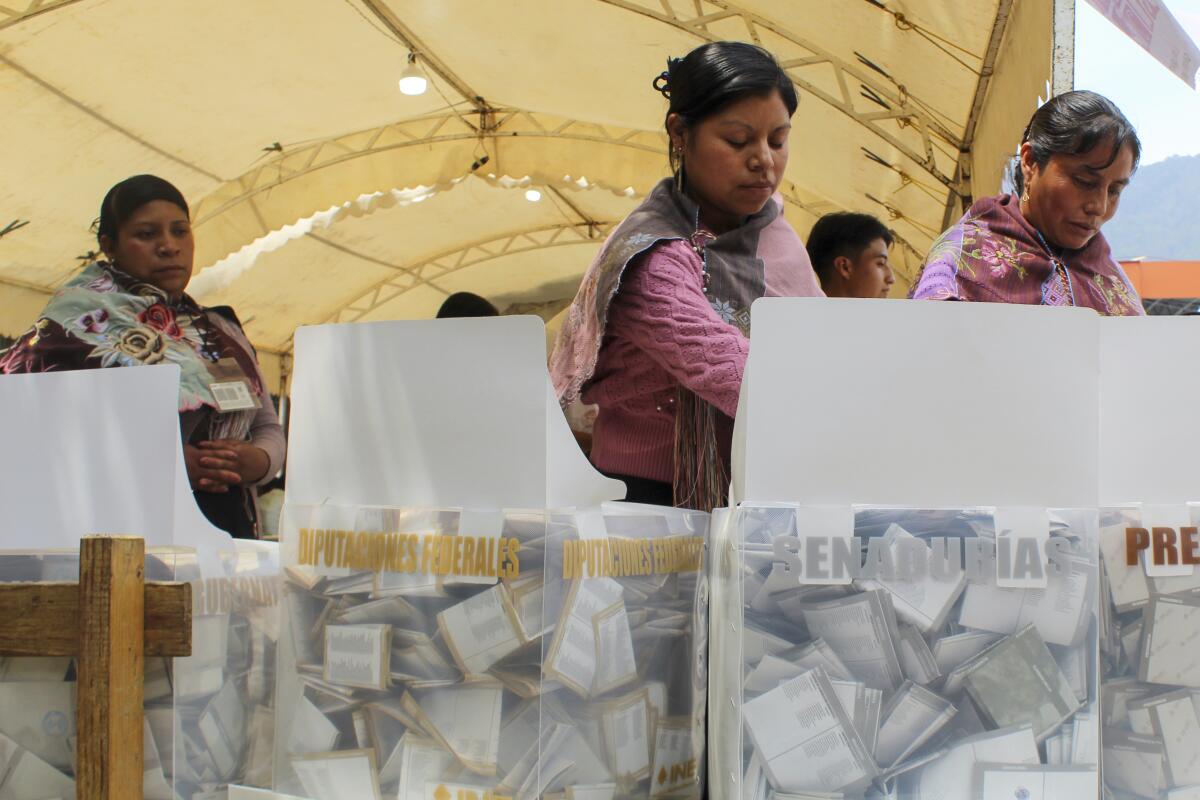
Indigenous women vote in Zinacantan, in southern Mexico, on Sunday.
(Luis Etzin / Associated Press)
Sheinbaum, for her part, has dismissed such questions as misogynist.
Her victory was a groundbreaking development in a country where women were barred from voting until 1954.
Her success is in some way a culmination of years of efforts by Mexican authorities to impose gender equality in a nation where politics was traditionally a male affair. A 2019 constitutional reform set quotas requiring gender parity in all elected posts at the federal, state and municipal levels.
Today, more than half of the members of Mexico’s congress are women, the fourth-highest rate in the world. Eight of the nation’s 31 governors are female and a woman heads the Supreme Court.
Some voters expressed wonderment that Mexico had elected a female leader before much of the rest of the world, including the United States.
“Never in my entire life did I imagine that a woman would be president of my country,” said Cristina Navarrete Santillán, 76, who voted for Sheinbaum in Mexico City alongside her two daughters and two granddaughters. “I am glad to be alive to see it.”
Sunday’s election was Mexico’s largest ever, with voters also choosing a new Congress, eight state governors, the Mexico City mayor and some 20,000 local officeholders nationwide.
Preliminary results showed that Morena performed well in the congressional elections, and would, as part of a coalition with two allied parties, likely have a supermajority that would allow it to easily pass legislation.
In the United States, which is home to nearly 11 million people born in Mexico, migrants who in the past were able only to vote in Mexican elections by mail could vote for the first time in person at consulates.
Long lines of voters stretched for blocks in cities that included Chicago and Orlando, Fla. In Los Angeles, the line at the Mexican Consulate in MacArthur Park wrapped around the block twice, with some people arriving as early as 4 a.m.
Voters draped in Mexican flags waited patiently as mariachi music blasted.
Laura Torres, who arrived with a group from Oxnard, said she had waited six hours to vote and would wait another six if necessary. The group planned to vote for Sheinbaum.
In some parts of Mexico, voters also lined up before dawn.
That was the case in the middle-class neighborhood of San Andres Totoltepec, where Sheinbaum, an environmental engineer by training, was reared and where she voted early Sunday.
As the candidate took her place in a line of about 100 people to cast her ballot, the crowd broke out in chants of “Presidenta!”
Sheinbaum spent much of her career as an academic, although she was raised in a highly political family.
Both her parents were active in the 1968 student movement, best known for the infamous Tlatelolco massacre in which Mexican security forces killed scores of protesters in the capital. Her first husband was a leftist politican.
When López Obrador was elected mayor of Mexico City in 2000, he launched Sheinbaum’s political career by making her secretary of environment for the capital.

Andrés Manuel López Obrador, Mexico’s president, kneels during an Indigenous ceremony during his inauguration six years ago.
( Bloomberg / Getty Images)
She later joined his breakaway political group, the National Regeneration Movement, known as Morena, and was elected in 2015 as borough president of Tlalpan, a district in southern Mexico City.
Three years later, she was elected mayor of Mexico City and he was elected president in a landslide victory for Morena.
López Obrador vowed to put the “poor first” in a country that he said had been hijacked by a corrupt and conservative elite. López Obrador’s approval rating still tops 60%, making him one of the most popular leaders in Latin America.
When he departs office in October, he will leave his successor with a strong economy that has been bolstered by the relocation of foreign firms from Asia and elsewhere to Mexico. The Mexican peso has been among the world’s strongest currencies.
But the next president will also inherit a number of crises, including dire water shortages, a struggling healthcare system, stubborn inequality and violence from criminal gangs and cartels so severe that the U.S. State Department warns its citizens not to travel to many Mexican states.
López Obrador’s controversial “hugs not bullets” strategy — which prioritizes social programs for the young over direct confrontations with cartels — has failed to stop the country’s violence, although homicides have fallen some during the last six years. Security is by far Mexicans’ main concern, polls show.
While voters were fiercely split on the issues at the heart of the race, many on both sides of the political divide were elated to have the chance to vote for a woman.
Fewer than a third of the countries in the United Nations have ever had a female leader, according to a Pew Research Center analysis from last year.
Rosa Maria Beltrán, a 39-year-old dentist who voted for Sheinbaum, said she was proud of her country.
“Tell the people in the United States that in Mexico we are going to have a female president before them,” she said.
Cecilia Sánchez Vidal in Mexico City and Anthony De Leon and Dania Maxwell in Los Angeles contributed to this report.

Politics
Fetterman unleashes on ‘dirtbag’ wing of Dems after far-left victories: ‘Orgy of socialism’

NEWYou can now listen to Fox News articles!
Sen. John Fetterman, D-Pa., unloaded on his own party on Sunday evening, blasting a series of victories for progressives he called “anti-America.”
“Big night for the dirtbag left,” Fetterman said, referring to New York’s recent primaries, where two members of the Democratic Socialists of America (DSA) won primaries.
“I’ve said the party is becoming an orgy of socialism. Clearly anti-America, anti-Western Civilization,” Fetterman said.
Fetterman’s striking calls give a rare look at how some moderates may view the developments on their far-left flank that have dominated the party’s momentum in recent months, sparking concern that their high visibility is dragging the party further and further left.
FETTERMAN WARNS DEMOCRATS ‘DRIFTING FIRMLY INTO COMMUNISM’ AFTER SOCIALIST PRIMARY WINS
Sen. John Fetterman, D-Pa., speaks to reporters outside the Senate Chamber during votes on Nov. 10, 2025, on Capitol Hill in Washington, D.C. (Andrew Harnik/Getty Images)
His comments come on the heels of a handful of key progressive victories.
In Maine, Graham Platner, a controversial Democratic candidate for U.S. Senate, has attracted controversy for denying knowledge of the meaning behind a Nazi-linked tattoo, for off-color comments about race and calling himself a “communist” in a deleted Reddit post.
In New York, one DSA member, Claire Valdez, won a primary on a platform of abolishing ICE and a Green New Deal-style approach to climate change. Similarly, Darializa Avila-Chevalier, another DSA candidate, beat out incumbent Rep. Adriano Espillat, D-N.Y., a high-ranking Democrat and the chair of the Congressional Hispanic Caucus.
WINNERS AND LOSERS EMERGE AFTER SOCIALIST EARTHQUAKE ROCKS NYC PRIMARIES
Graham Platner, Democratic Senate candidate for Maine, speaks at a primary election night event at the Blue Hill YMCA in Blue Hill, Maine, on June 9, 2026. Platner won the party’s Senate primary after a campaign marked by accusations of past misbehavior and voter concerns. (Graeme Sloan/Bloomberg via Getty Images)
Both Chevalier and Valdez had the backing of New York Mayor Zohran Mamdani, himself a socialist.
The wins have captured national attention and drawn criticisms from Republicans who have pointed to their success as emblematic of the direction of the Democratic Party.
Fetterman, who has not shied away from confrontations, has been one of the few Democrats to express alarm about the kind of candidates carrying the party’s banner.
“I mean, you look at some of the things that people have said. Abolish prison, abolish the border, abolish ICE, I mean these crazy people — I have colleagues in my caucus that refuse to even call this out,” Fetterman said.
FETTERMAN REACTS TO MAMDANI’S REFUSAL TO ACCEPT SUPREME COURT’S IMMIGRATION RULING
U.S. Sen. John Fetterman, D-Pa., walks through the Senate Subway during the Senate War Powers vote on April 22, 2026, in Washington, D.C. (Heather Diehl/Getty Images)
CLICK HERE TO DOWNLOAD THE FOX NEWS APP
“Between P-hustle in Maine and some of the other winners in New York, they should form their own party and run on all the things that they’ve had to delete on social media,” Fetterman said, referring to Platner.
“That’s where our party has moved,” he added.
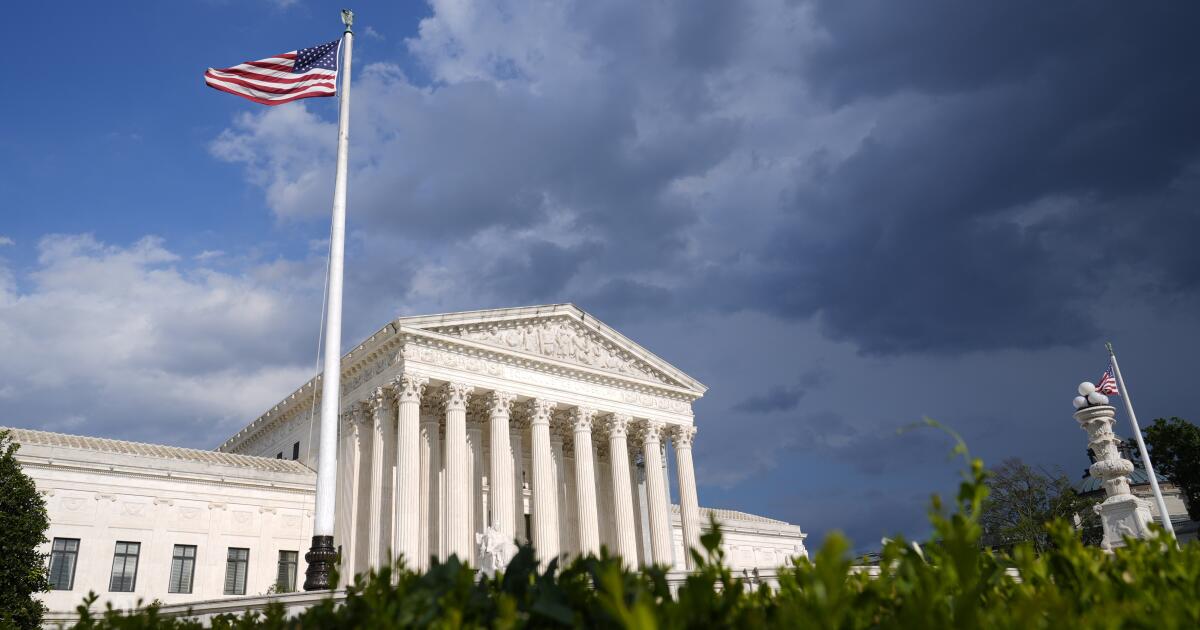
WASHINGTON — The Supreme Court cast doubt Monday on whether police may obtain cellphone data to find crime suspects.
In a 6-3 decision, the justices said this location information showing where a cellphone user has traveled is personal and private and subject to the protection of the 4th Amendment’s ban on unreasonable searches.
Justice Elena Kagan said these “records serve as a personal journal of a user’s movements.”
She said the information “resembles other private materials — think of emails, documents, photographs, or calendars—that even if stored on Google’s servers, a user reasonably views as his own…and reasonably expects to be shielded from the inquisitive eyes of the government.”
Because an “individual has a legitimate expectation of privacy in his cellphone location data,” she said police investigators need a valid search warrant from a magistrate.
The court stopped short of deciding the proper basis for a search warrant in such cases. Instead, the justices sent the case back to judges in Virginia.
But the outcome casts doubt on “geofence warrants.”
In recent years, police have gone to Google and cellphone companies seeking tracking data on cellphones that were at a crime scene. Sometimes, they have had a warrant from a magistrate.
Civil libertarians say the use of this tracking data raises the specter of mass surveillance on innocent people.
Police and government lawyers say no one has a reasonable right to privacy when they are walking on a sidewalk or driving down the street.
The case before the court arose from the armed robbery conviction of a Virginia man who stole $195,000 from a credit union in a small town near Richmond.
By the time police arrived, the robber had fled. But surveillance cameras showed he was carrying a gun and a cellphone.
Lacking other leads, detective Joshua Hilton asked a judge to issue a special type of warrant seeking information from Google.
Referred to as a “geofence warrant,” it seeks data from phones in a particular area at a particular time.
The detective sought data on phones that were within 150 yards of the credit union within one hour of the late afternoon robbery.
After examining and paring down the data, the detective asked for the phone records of Okello Chatrie. Then, with a search warrant of his home, investigators found two robbery-style demand notes, a semi-automatic pistol and about $100,000 in cash.
A judge refused to suppress the evidence from an allegedly unconstitutional search, and Chatrie entered a conditional guilty plea.
The full 4th Circuit Court of Appeals split evenly on the legality of the geofence warrant, and the Supreme Court agreed to decide the issue in Chatrie vs. U.S.
Usually investigators obtain warrants to search the home or vehicle of a known crime suspect.
The new and disputed geofence warrants seek to find a suspect by examining data on the cellphones that were at the scene of a crime.
The FBI used this cellphone data in 2021 to identify suspects who broke through police barricades on Jan. 6, 2021, and pushed their way into the Capitol to disrupt the official counting of electoral votes.
Chief Justice John G. Roberts Jr. and Justices Sonia Sotomayor, Neil M. Gorsuch, Brett M. Kavanaugh and Ketanji Brown Jackson agreed on the outcome in Chatrie vs. U.S.
In a 21-page dissent, Justice Samuel A. Alito Jr. said the court had “carefully set the stage for its planned performance: striking a pose as a great champion of privacy in the digital age. I cannot support this irresponsible escapade.”
Justice Clarence Thomas agreed.
Justice Amy Coney Barrett agreed in a one-paragraph dissent. “Chatrie had no reasonable expectation of privacy in data about his public movements that he voluntarily disclosed to Google,” she said.
The Supreme Court ruled 6-3 that President Trump could fire independent regulators for any reason. But the justices carved out an exception for the Federal Reserve, preventing the immediate removal of Lisa D. Cook, a Federal Reserve governor.
-
 News27 minutes ago
Rep. Tom Kean returns to Congress, says depression is why he went missing for months
-

 Los Angeles, Ca2 hours ago
LeBron James informs Lakers he will play elsewhere next year
-

 Detroit, MI2 hours ago
5 realistic cornerback trade targets for the Detroit Lions after Terrion Arnold’s release
-

 San Francisco, CA2 hours ago
Headlines, June 30 – Streetsblog San Francisco
-

 Dallas, TX2 hours ago
LIVE | Ivory Coast, Norway meet for World Cup knockout match at Dallas Stadium
-

 Miami, FL2 hours ago
Every Dolphins head coach’s start in Miami from worst to best
-

 Boston, MA2 hours ago
Historian clears up one of the biggest myths about the Boston Tea Party
-
Denver, CO3 hours ago
Nemanja Jokic, the older brother of\u00a0Denver …

