Lifestyle
Can you make music from Joshua trees — or is that wild science? Yes.


Artist Scott Kildall waves his microcontroller over a Joshua tree, recording wavelengths of light that are not perceptible by humans.
Carlos Jaramillo for NPR
hide caption
toggle caption
Carlos Jaramillo for NPR
The artist Scott Kildall is waving his hand over the contours of a Joshua tree, just inches from its spiky green, bayonet-like leaves.
“If I get too close to it, it will prick me and draw blood,” he says. “And it’s done that before.”
In his palm, he has a microcontroller — just about the size of a credit card. It’s got a few wires sticking out, and an infrared sensor, which picks up wavelengths of light just beyond what the human eye can perceive.
“It’s kind of like magic,” Kildall says. “And the magic is just revealing something that’s right beyond our levels of perception.”
The magic is part of Kildall’s latest sound installation — a work he calls Infrared Reflections. He developed the piece as an artist-in-residence at Joshua Tree National Park this spring, and it transforms near-infrared light bouncing off the iconic scraggly yuccas into a shimmering mosaic of otherworldly music — essentially turning the Joshua tree into an instrument.
Kildall is neither a computer scientist nor a musician, though he does play the ukulele. This artwork relies on both disciplines, as Kildall needs to build sensors, route their data to a computer, process and smooth that data, and convert it all into something beautiful for the ear.
“With art and technology, you have to constantly think about wearing multiple hats. Are you an IT person? Are you an artist? And you have to be able to troubleshoot on the fly,” he says.
The installation relies on a fundamental interplay between the sun and the Joshua tree. When sunlight hits the plant, cells in its healthy leaves soak up lots of red and blue light, and reflect back most of the green – which is why the clusters of piercing leaves at the end of the Joshua tree’s branches appear green to the human eye. (It’s also why most plants on Earth appear green to us.)

Spiky Joshua trees grow in Arthur B. Ripley Desert Woodland State Park, north of Los Angeles.
Carlos Jaramillo for NPR
hide caption
toggle caption
Carlos Jaramillo for NPR
But other types of light rain down on the Joshua tree too, including wavelengths we can’t see, like near-infrared light. The plant’s shaggy, grayish-brown bark doesn’t reflect much of that infrared light, but its healthy leaves — packed with compounds like water, carbohydrates and defense chemicals — reflect much more. And that’s exactly what Kildall sees as he passes his sensor from the yucca’s dead bark to its green, leafy buds.
“Beyond our perceptions lies a whole realm of invisible data,” he explains. “And so what I do is I find some sort of invisible phenomena such as water quality or air quality or infrared light reflection, and then map that data into sounds, so that we can hear that data.”
That technique is known as sonification, and Kildall has previously designed installations that sonify water flow in trees, or tap into the electrical signals of mushrooms. Infrared Reflections follows in that vein, but it’s much more site-specific — it’s meant to be played on the Joshua tree, which is endemic to the Mojave Desert.

Kildall needs a speaker and a bag of equipment on site to make his music.
Carlos Jaramillo for NPR
hide caption
toggle caption
Carlos Jaramillo for NPR
With that in mind, earlier today Kildall lugged his laptop, a box of electronics and a giant speaker into a field full of Joshua trees at the Arthur B. Ripley Desert Woodland State Park, north of Los Angeles.
Gusts of wind scream through the high desert here, and Kildall eyes individual Joshua trees with the eagerness of a kid at Guitar Center, ready to pick out an axe.
“I see one Joshua tree that’s about a hundred feet away that is moving a little bit in the wind and has multiple leafy sections and bark sections,” he says. “And that one really looks like it is asking to be sonified.”

Kildall’s speaker sits next to several Joshua trees.
Carlos Jaramillo for NPR
hide caption
toggle caption
Carlos Jaramillo for NPR
After a short walk, Kildall sets down the speaker and begins fiddling with his laptop. It’s perched on a camp chair, in direct sun, and refuses to boot up — a reminder, Kildall says, of how preparing for a field installation is like planning a NASA space mission (though with non-lethal stakes.)
“You want to reduce the number of points of failure. And so with the system I have, I have backup electronics, I only have one laptop. So that’s the only point of failure that I’m really worried about.”
But not to fear. The machine soon boots up, along with a local Wi-Fi network — which connects the small infrared sensor to the computer — and Kildall is ready to rock.

A view of Joshua trees at Arthur B. Ripley Desert Woodland State Park.
Carlos Jaramillo for NPR
hide caption
toggle caption
Carlos Jaramillo for NPR

Here’s the same landscape viewed through a thermal infrared camera. It captures a different part of the infrared spectrum from what Kildall is picking up with his sensor, but gives a sense of how these plants appear differently when viewed at different wavelengths of light.
Carlos Jaramillo for NPR
hide caption
toggle caption
Carlos Jaramillo for NPR
As he caresses the air just above the tree, the yowling of a theremin rises and falls from the speaker, lending an eerie soundtrack to the already alien-looking landscape. A few hikers walk by, but seem unphased by the guy performing reiki on a Joshua tree. The high desert is known for its eccentrics, after all.
Kildall has designed three more “instruments” to be played like this, along with the theremin sound.
His favorite combines the drone of a theremin with spiraling arpeggios.
Another sounds more like haunting electric guitars, reverberating in a cathedral.
The final sound is more pared-back and simple — resembling a kid plinking at the piano.
“In some ways, it feels a little bit more direct and accessible because we all kind of understand how to press notes randomly on the piano,” Kildall explains. “And as I move the sensor over these sort of leafy spots in the sun, those will produce a higher pitch on the piano.”
As he slides the sensor further down the branch, to the bark, the notes get lower and lower, moving deeper into the bass clef.
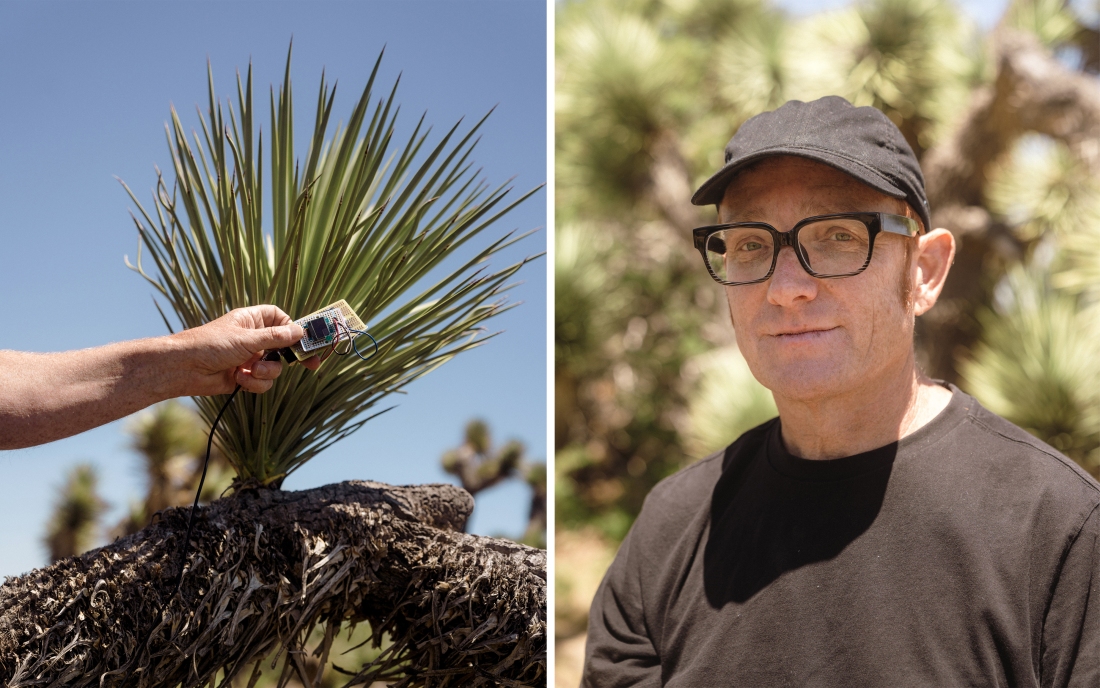
Kildall holds his device a few inches above a spiky Joshua tree to avoid getting pricked.
Carlos Jaramillo for NPR
hide caption
toggle caption
Carlos Jaramillo for NPR
It’s a fascinating way to make music. The infrared-sensing technology at the heart of the work also happens to be something scientists have employed for decades.
“From our aircraft or satellites, we use it to separate the living vegetation from the dead vegetation,” says Greg Asner of Arizona State University in Hawaii. “That’s very important in a grassland — is the grassland dry and ready to go up in smoke in a fire, or is it wet and green and living? And so we can translate that to fire fuel load for grasslands.”

Joshua trees viewed through a thermal infrared camera.
Carlos Jaramillo for NPR
hide caption
toggle caption
Carlos Jaramillo for NPR
Asner has also soared above the Amazon basin, measuring infrared signals from a plane — which allows him to tease out individual tree species, based on the fingerprints of infrared light that bounce off the trees.
“When I fly over a tropical rainforest with the infrared sensors, the maps literally are like Willy-Wonka-candy-store-style variation. They are amazing to look at,” he says.
“So there’s this enormous diversity of plants when you look at them in infrared light. And unfortunately, a lot of people just see them as green because that’s all we can see with our limited eyesight. There’s much more variety out there. And it’s a very beautiful world when you look at it in the infrared.”
Asner says he’s thrilled to see artists now experimenting with the same technology.

Left: A close up view of a Joshua tree. Right: A thermal infrared view of Kildall holding his device in front of a Joshua tree.
Carlos Jaramillo for NPR
hide caption
toggle caption
Carlos Jaramillo for NPR
“Our studies for decades now have been stuck in the halls of science. And this will help translate what we have come to understand, utilize, love as scientists — it’s going to translate it to a much wider audience.”
Kildall says, in some sense, that’s his goal.
“One of the things I like to do is to engage people with nature and issues of climate change and issues of ecology through means other than science articles,” he says. “Science articles are great. I read them all the time. However, they don’t engage people on a more visceral storytelling level, as artwork does.”
And though this installation was conceived and developed with the Joshua tree at its center, it could work with the infrared reflections of other plants, if Kildall calibrates his code — which is a good thing, since Kildall calls San Francisco home.
“There aren’t any Joshua trees in San Francisco, so I might have to go to Golden Gate Park and see what I come up with.”


Sunday Puzzle
NPR
hide caption
toggle caption
NPR

On-air challenge
The on-air challenge goes here.
Last week’s challenge
Last week’s challenge comes from Joshua Green, of Columbia, Md. Think of a popular film franchise with many sequels. Hidden in consecutive letters inside its name is a place mentioned multiple times in the Bible. Replace that place with a single letter and you’ll name a Major League Baseball team. What franchise and team are these?
Answer: “The Avengers” –> (Detroit) Tigers
Winner
Erin Kealiher of Silver Spring, Maryland.
This week’s challenge
This week’s challenge comes from Joseph Young, of St. Cloud, Minn. Name a famous actor of the past, seven letter first name and seven letter last name. Remove three consecutive letters from him last name and the remaining letters in order will be the well known lead character from a long running series of films. What actor and character are these?
If you know the answer to the challenge, submit it here by Thursday, May 21 at 3 p.m. ET. Listeners whose answers are selected win a chance to play the on-air puzzle. Important: include a phone number where we can reach you.
Lifestyle
For Tory Burch, a 20-year fashion career is a sport driven by endurance, discipline and grit

Clarke wears Tory Burch multi screw heeled sandals and Gemini Link pendant necklaces.
This story is part of Image’s May Momentum issue, which looks at art as a sport and sport as an art.

It’s 2 p.m. on a quintessentially balmy Los Angeles afternoon when I spot fashion designer Tory Burch in the lobby of the iconic Beverly Hills Hotel. She’s wearing oversize sunglasses, a crisp collared shirt, an even crisper pleated navy skirt and leopard-print pumps. I start walking over to introduce myself, but a fan gets there first. This would happen several times during our meeting at the hotel — wherever Burch goes, a small flock of admirers form.
Burch is in town for the Fashion Trust U.S. Awards, where she was recognized with the designer of the year award. Ever since she took back creative control of her brand about six years ago, Tory Burch is back at the center of the American fashion zeitgeist. Compared to the resort-ready tunics and preppy Reva flats that embodied Tory 1.0 in the 2000s, Tory 2.0 has evolved into a “weirder,” more innovative version of itself. Think: a jersey dress with knotted ruching in an unexpected shade of green, or leather mules with an inverted heel that makes you look twice. While the Tory customer of the past felt neatly aligned with the country club aesthetic, the Tory customer today embodies a modern sensibility of polish and dynamism. You could easily imagine these clothes on a marketing exec at the office, a buyer at fashion week or an author on book tour.
There’s no doubt the “Tory-ssance” is in full swing. During New York Fashion Week, my TikTok page was flooded with behind-the-scenes clips of model it-girl Alex Consani getting ready for Tory Burch’s runway show. On the nouveau fashion blogs of Substack, women exchange styling ideas for the brand’s signature pierced mules. And on the streets of L.A. — from Sunset and Rodeo to Melrose and Wilshire — colorful Tory Burch logo sandals abound.

Clarke wears Tory Burch Mellow Mary Jane jellies, Gemini Link pendant necklace, and printed asymmetric viscose dress.
We sat down for tea at the Polo Lounge and talked about her design instincts, what women actually want to wear, freaky footwear and how a long career in fashion is its own kind of sport.
Viv Chen: Hi, Tory, it’s a pleasure to meet. Congratulations on receiving the designer of the year award from Fashion Trust U.S. this week. What does that kind of recognition mean to you at this point in your career?
Tory Burch: It’s a huge honor, and to be recognized by your peers is even more special. Being in that room and meeting some of the up-and-coming new designers, the creative energy was just palpable and super exciting to take in. I love what Tania [Fares] has built to support emerging designers.
VC: I heard you got to dress Pamela Anderson.
TB: Yeah, she presented the award to me. Pamela and I met through our boys, so it was very special because we have a friendship and I admire her so much.
VC: This award feels like another marker of the “Tory-ssance.” There’s been such a compelling story over the last few years about how you’ve reinvented the brand to feel fresh and relevant again. How do you see that evolution?

Clarke wears Tory Burch beaded heel sandals and cotton jacquard shirtdress.
TB: We’re just starting in many ways. When I first started the company 20 years ago, it was very much a creative journey. As time went on, I was also running the company and became the CEO. After a certain point, managing both was not doable. About six years ago — it was probably the one silver lining out of COVID — I had the opportunity to reset and give up my role as CEO. Now, 100% of my time is dedicated to the creative process. It’s something we’re still very much in the process of — not at the peak. I still have a lot I want to do.
VC: You redesigned your Rodeo Drive store last year. What is it about the L.A. market that influenced the design decisions you made?
TB: First of all, it’s really funny because a lot of people think I’m from L.A. I love the casual elegance of L.A. I’m very outdoorsy, I’m very sporty, so there’s a lot of things that I relate to from a design standpoint. And I’ve always been obsessed with interior design. It wasn’t as much about L.A., but it was more about using the light here. We opened up the top of the store with skylights, so it had shapes that the front of the store brought in with the light.
VC: You seem to have unlocked what women actually want to wear. Tell me more about your design perspective.
TB: I like an ease and a realness to what we do, but balanced with creativity and innovation. So it’s taking things that are classic in spirit, but then giving a strangeness to it. Like something where you look closer and see an interesting fabric or different stitching. I like tension.

Melissa wears Tory Burch pierced strappy heel sandals and printed silk dress.

Clarke wears Tory Burch Hank ballet sneakers.
VC: I want to talk about footwear, because you’ve designed some major hits. The Reva flat was such an iconic shoe in the 2000s. And now, your pierced mules are fueling the contemporary rise in “freaky footwear.” What is it about footwear that is such a powerful category for you?
TB: I’ve always loved footwear. When I started with the pierced [mule], I was looking at toe rings. I thought, how do you incorporate the concept of that into a mule? It was like an exercise in architecture. Ever since I’ve taken back the reins of the creative process, I’ve focused on how footwear makes your leg look and how it feels. The Reva is interesting because it was meant to be a foldable shoe to throw in your bag, but also something you could walk in all day.
VC: What shoes are you wearing today?
TB: I’m wearing the pierced pump.
VC: How do movement and women in motion factor into how you design? I’m thinking about Tory Sport, which I think was ahead of the curve of the athleisure boom.
TB: We started in 2015. It was me and a very small team starting with what I felt like was missing in the market — which was great-looking clothing that was not restrictive, but also technical. Something you could move in from morning until evening. I also saw the prevalence of streetwear and the way women were dressing at the time.
VC: Culturally, when we talk about fashion designers, we focus on skills like creativity and artistry. Whereas in the language of sports, we talk about endurance, discipline and grit. Do you view your 20-plus year career in fashion as its own kind of sport?

Melissa wears Tory Burch jelly heel flip-flops.
TB: I do. It is a sport, and there’s a physicality to it as well. I think some people question whether I still go to the office. I don’t think I’ve had lunch in the last 21 years. I can be at the office for 10-hour days, which is like an athlete where it’s about discipline and grit and endurance.
VC: Athletes always get asked about the unglamorous work behind the wins. What’s your equivalent of daily reps?
TB: The mental capacity you need to have. Sometimes I make 4,000 decisions in a day. I touch every product. But I’m also lucky in that my days never really look the same either, because I do so many different parts of the business — whether it’s store design, marketing or the actual design of different categories.
VC: Beyond your brand, what is the impact you are trying to make with the Tory Burch Foundation?
TB: We launched it in 2009 to support women entrepreneurs through mentoring, capital and community. We’ve committed to adding a billion dollars to the economy by 2030 through our fellows and entrepreneurs. We’re having a breakfast in three weeks honoring Anna Wintour. It’s our second fundraiser — last year it was Martha Stewart.
VC: What is the long game for Tory Burch?
TB: I don’t know that I’d sit and think about the long game as much as I think about trying to be present. I’m always interested in the zeitgeist and how we fit into that, but not necessarily to be on trend. I just am someone that has that curiosity to push things forward.
Viv Chen is a Bay Area–based fashion writer, and founder of the Molehill newsletter.

Photography Jennelle Fong
Styling Bin X. Nguyen
Talent Melissa Baltierrez, Clarke Brown
Nails Lila Robles
Videography D.J. Theriot
Lighting Assistant Phillip Acevedo
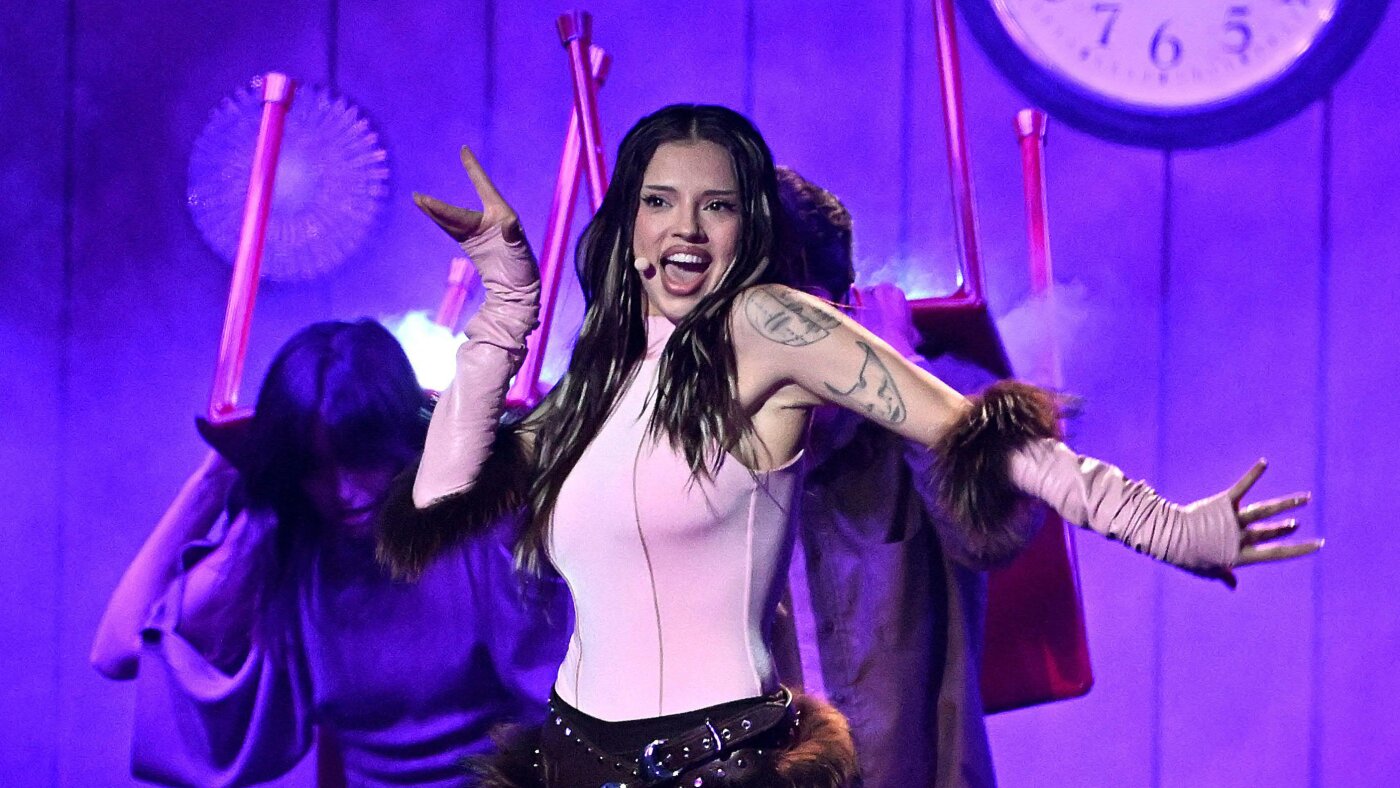
Dara and her song “Bangaranga” skyrocketed Bulgaria to first place at the 70th Eurovision Song Contest
Helmut Fohringer/APA/AFP via Getty Images
hide caption
toggle caption
Helmut Fohringer/APA/AFP via Getty Images
Bulgaria has won the 70th Eurovision Song Contest — the country’s first-ever win.
The achievement surprised many because Bulgaria wasn’t among the favorites to win in 2026. But with its catchy “Welcome to the riot!” refrain and bouncy vibe, performer Dara’s banging anthem “Bangaranga” bested 24 other nations for the glittery global musical crown at the finals on Saturday in Vienna, Austria.
Israel came in second, as it did last year. Ten competitors were eliminated from the original group of 35 in the semi-finals earlier this week.
In his appraisal of his 10 favorite Eurovision 2026 songs, NPR critic Glen Weldon called “Bangaranga” an “insanely catchy bop” and praised its “deep, profound, abiding grooviness.”
“Oh my god!” Dara yelled, as she accepted the Crystal Microphone, the event’s glass trophy, from last year’s winner, JJ of Austria.
As with other global cultural events, such as the Venice Biennale currently underway in Italy, the glittery annual songfest is intended as a display of goodwill and togetherness between nations. “In a world often divided, we stand united by music,” said host Michael Ostrowski at the conclusion of this year’s event.
Last year’s contest, held in Basel, Switzerland, saw record viewership, reaching 166 million viewers across 37 markets.
Israel prepared for ‘boos’
Eurovision has long strived to prioritize artistry over political antagonism. However, as with the Biennale, Eurovision 2026 found itself at the center of protests related to the war in Gaza.
Five countries — Iceland, Ireland, the Netherlands, Slovenia and Spain — pulled out between September and December 2025 in protest over event organizer European Broadcasting Union’s decision to allow Israel to participate amid the ongoing war in Gaza.
In this year’s finals, Israeli singer Noam Bettan performed the romantic breakup song “Michelle” in French, Hebrew and English. Unlike in the semifinal, when the artist sang over chants of “stop the genocide,” Bettan was not booed — at least audibly. The artist told The Times of Israel last month he had been practicing performing in front of hecklers.
There were both anti- and pro-Israel demonstrations in Vienna this week.
Pro-Palestinian protests at the last two contests called for Israel to be disbarred from Eurovision over its role in the conflict, as well as allegations it attempted to manipulate voting to favor its entries. The European Broadcasting Union changed its voting rules in response. Among other requirements, contestants and broadcasters are prohibited from taking part in promotional campaigns by third parties including governments. Countries outside of Europe, such as Israel, participate in Eurovision because eligibility is based on European Broadcasting Union membership, not necessarily geographics.
A double standard?
Although Israel’s participation is the biggest cause of dissent in 2026, the country avoided being banned from the event.
That was not the case with Russia, which was disbarred indefinitely from participating in the contest soon after launching its full-scale invasion of Ukraine in 2022.
European Broadcasting Union deputy director general Jean Philip De Tender defended his organization’s decision to allow Israel to perform, the European edition of Politico reported ahead of the contest’s final, because Israel’s public broadcaster KAN, the body behind its entry, is independent, whereas Russia’s state broadcaster, VGTRK, is run by the Russian government.
In a social media post on Friday, Spanish Prime Minister Pedro Sánchez decried the European Broadcasting Union for its “double standard.”
-

 New York1 hour ago
Read the complaint filed against a top militia commander linked to Iran.
-

 Los Angeles, Ca1 hour ago
Long Beach man arrested for murder in deadly hit-and-run crash
-

 Detroit, MI2 hours ago
Pistons’ playoff run ends in Game 7 blowout to Cavaliers
-

 San Francisco, CA2 hours ago
San Mateo supervisor urges CDC to step up protections amid hantavirus outbreak
-

 Dallas, TX2 hours ago
The art of showing up: how two Dallas women paint a new vision for relief
-

 Miami, FL2 hours ago
Messi’s goal, assist lead Inter Miami to 2-0 win over Portland and first at new stadium
-

 Boston, MA2 hours ago
Fire breaks out at East Boston home, spreads to neighboring buildings
-

 Denver, CO2 hours ago
Nuggets’ Nikola Jokic finishes 2nd in MVP voting; Shai Gilgeous-Alexander repeats

