Lifestyle
Can you make music from Joshua trees — or is that wild science? Yes.


Artist Scott Kildall waves his microcontroller over a Joshua tree, recording wavelengths of light that are not perceptible by humans.
Carlos Jaramillo for NPR
hide caption
toggle caption
Carlos Jaramillo for NPR
The artist Scott Kildall is waving his hand over the contours of a Joshua tree, just inches from its spiky green, bayonet-like leaves.
“If I get too close to it, it will prick me and draw blood,” he says. “And it’s done that before.”
In his palm, he has a microcontroller — just about the size of a credit card. It’s got a few wires sticking out, and an infrared sensor, which picks up wavelengths of light just beyond what the human eye can perceive.
“It’s kind of like magic,” Kildall says. “And the magic is just revealing something that’s right beyond our levels of perception.”
The magic is part of Kildall’s latest sound installation — a work he calls Infrared Reflections. He developed the piece as an artist-in-residence at Joshua Tree National Park this spring, and it transforms near-infrared light bouncing off the iconic scraggly yuccas into a shimmering mosaic of otherworldly music — essentially turning the Joshua tree into an instrument.
Kildall is neither a computer scientist nor a musician, though he does play the ukulele. This artwork relies on both disciplines, as Kildall needs to build sensors, route their data to a computer, process and smooth that data, and convert it all into something beautiful for the ear.
“With art and technology, you have to constantly think about wearing multiple hats. Are you an IT person? Are you an artist? And you have to be able to troubleshoot on the fly,” he says.
The installation relies on a fundamental interplay between the sun and the Joshua tree. When sunlight hits the plant, cells in its healthy leaves soak up lots of red and blue light, and reflect back most of the green – which is why the clusters of piercing leaves at the end of the Joshua tree’s branches appear green to the human eye. (It’s also why most plants on Earth appear green to us.)

Spiky Joshua trees grow in Arthur B. Ripley Desert Woodland State Park, north of Los Angeles.
Carlos Jaramillo for NPR
hide caption
toggle caption
Carlos Jaramillo for NPR
But other types of light rain down on the Joshua tree too, including wavelengths we can’t see, like near-infrared light. The plant’s shaggy, grayish-brown bark doesn’t reflect much of that infrared light, but its healthy leaves — packed with compounds like water, carbohydrates and defense chemicals — reflect much more. And that’s exactly what Kildall sees as he passes his sensor from the yucca’s dead bark to its green, leafy buds.
“Beyond our perceptions lies a whole realm of invisible data,” he explains. “And so what I do is I find some sort of invisible phenomena such as water quality or air quality or infrared light reflection, and then map that data into sounds, so that we can hear that data.”
That technique is known as sonification, and Kildall has previously designed installations that sonify water flow in trees, or tap into the electrical signals of mushrooms. Infrared Reflections follows in that vein, but it’s much more site-specific — it’s meant to be played on the Joshua tree, which is endemic to the Mojave Desert.

Kildall needs a speaker and a bag of equipment on site to make his music.
Carlos Jaramillo for NPR
hide caption
toggle caption
Carlos Jaramillo for NPR
With that in mind, earlier today Kildall lugged his laptop, a box of electronics and a giant speaker into a field full of Joshua trees at the Arthur B. Ripley Desert Woodland State Park, north of Los Angeles.
Gusts of wind scream through the high desert here, and Kildall eyes individual Joshua trees with the eagerness of a kid at Guitar Center, ready to pick out an axe.
“I see one Joshua tree that’s about a hundred feet away that is moving a little bit in the wind and has multiple leafy sections and bark sections,” he says. “And that one really looks like it is asking to be sonified.”

Kildall’s speaker sits next to several Joshua trees.
Carlos Jaramillo for NPR
hide caption
toggle caption
Carlos Jaramillo for NPR
After a short walk, Kildall sets down the speaker and begins fiddling with his laptop. It’s perched on a camp chair, in direct sun, and refuses to boot up — a reminder, Kildall says, of how preparing for a field installation is like planning a NASA space mission (though with non-lethal stakes.)
“You want to reduce the number of points of failure. And so with the system I have, I have backup electronics, I only have one laptop. So that’s the only point of failure that I’m really worried about.”
But not to fear. The machine soon boots up, along with a local Wi-Fi network — which connects the small infrared sensor to the computer — and Kildall is ready to rock.

A view of Joshua trees at Arthur B. Ripley Desert Woodland State Park.
Carlos Jaramillo for NPR
hide caption
toggle caption
Carlos Jaramillo for NPR

Here’s the same landscape viewed through a thermal infrared camera. It captures a different part of the infrared spectrum from what Kildall is picking up with his sensor, but gives a sense of how these plants appear differently when viewed at different wavelengths of light.
Carlos Jaramillo for NPR
hide caption
toggle caption
Carlos Jaramillo for NPR
As he caresses the air just above the tree, the yowling of a theremin rises and falls from the speaker, lending an eerie soundtrack to the already alien-looking landscape. A few hikers walk by, but seem unphased by the guy performing reiki on a Joshua tree. The high desert is known for its eccentrics, after all.
Kildall has designed three more “instruments” to be played like this, along with the theremin sound.
His favorite combines the drone of a theremin with spiraling arpeggios.
Another sounds more like haunting electric guitars, reverberating in a cathedral.
The final sound is more pared-back and simple — resembling a kid plinking at the piano.
“In some ways, it feels a little bit more direct and accessible because we all kind of understand how to press notes randomly on the piano,” Kildall explains. “And as I move the sensor over these sort of leafy spots in the sun, those will produce a higher pitch on the piano.”
As he slides the sensor further down the branch, to the bark, the notes get lower and lower, moving deeper into the bass clef.
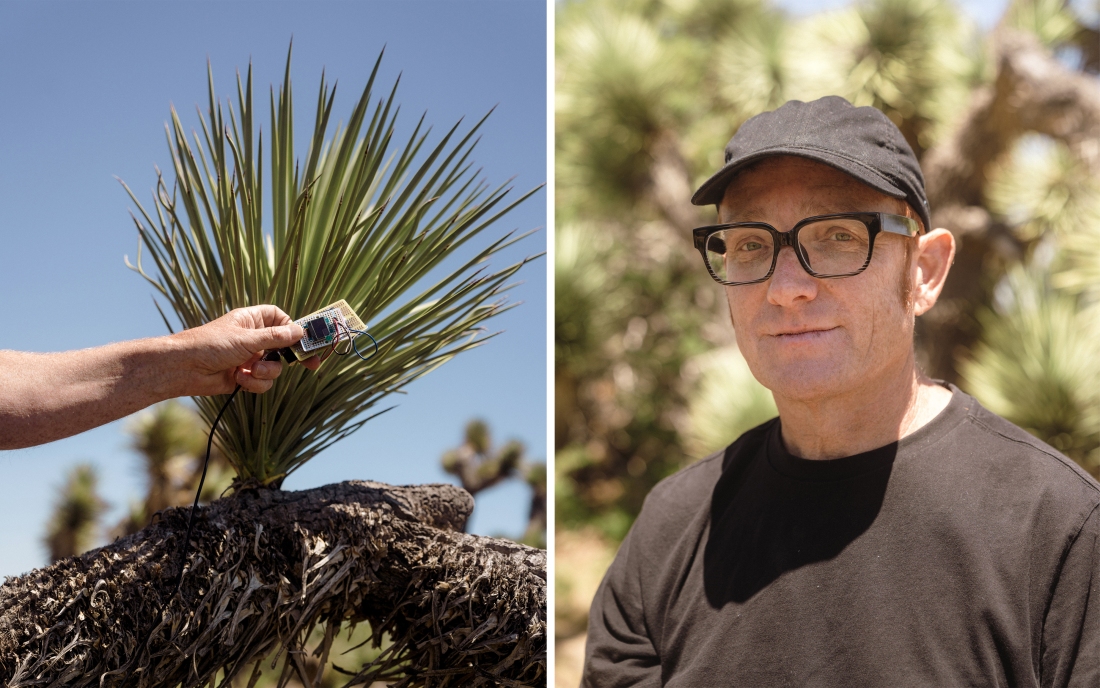
Kildall holds his device a few inches above a spiky Joshua tree to avoid getting pricked.
Carlos Jaramillo for NPR
hide caption
toggle caption
Carlos Jaramillo for NPR
It’s a fascinating way to make music. The infrared-sensing technology at the heart of the work also happens to be something scientists have employed for decades.
“From our aircraft or satellites, we use it to separate the living vegetation from the dead vegetation,” says Greg Asner of Arizona State University in Hawaii. “That’s very important in a grassland — is the grassland dry and ready to go up in smoke in a fire, or is it wet and green and living? And so we can translate that to fire fuel load for grasslands.”

Joshua trees viewed through a thermal infrared camera.
Carlos Jaramillo for NPR
hide caption
toggle caption
Carlos Jaramillo for NPR
Asner has also soared above the Amazon basin, measuring infrared signals from a plane — which allows him to tease out individual tree species, based on the fingerprints of infrared light that bounce off the trees.
“When I fly over a tropical rainforest with the infrared sensors, the maps literally are like Willy-Wonka-candy-store-style variation. They are amazing to look at,” he says.
“So there’s this enormous diversity of plants when you look at them in infrared light. And unfortunately, a lot of people just see them as green because that’s all we can see with our limited eyesight. There’s much more variety out there. And it’s a very beautiful world when you look at it in the infrared.”
Asner says he’s thrilled to see artists now experimenting with the same technology.

Left: A close up view of a Joshua tree. Right: A thermal infrared view of Kildall holding his device in front of a Joshua tree.
Carlos Jaramillo for NPR
hide caption
toggle caption
Carlos Jaramillo for NPR
“Our studies for decades now have been stuck in the halls of science. And this will help translate what we have come to understand, utilize, love as scientists — it’s going to translate it to a much wider audience.”
Kildall says, in some sense, that’s his goal.
“One of the things I like to do is to engage people with nature and issues of climate change and issues of ecology through means other than science articles,” he says. “Science articles are great. I read them all the time. However, they don’t engage people on a more visceral storytelling level, as artwork does.”
And though this installation was conceived and developed with the Joshua tree at its center, it could work with the infrared reflections of other plants, if Kildall calibrates his code — which is a good thing, since Kildall calls San Francisco home.
“There aren’t any Joshua trees in San Francisco, so I might have to go to Golden Gate Park and see what I come up with.”


Paul Tremblay has made a career of pushing the horror genre – and the novel format – in strange and exciting new directions.
In his latest, Dead but Dreaming of Electric Sheep, the author offers an amalgamation of genre elements that can be best described as psychological-dystopian-science-fiction horror. It’s a mouthful, but the narrative does all of that and more in a way that defies categorization.
Julia Flang is a former semiprofessional gamer working two mediocre jobs she dislikes and living in a modest ranch house in a San Fernando Valley suburb with her retired uncle, whom she calls Uncle Fun. Julia likes movies and gaming but there’s little else going on in her life, so when her estranged mother, the CFO of a large tech company, contacts her with a possible job offer – a “once-in-a-lifetime thing” that pays handsomely just for doing the interview – she hesitantly agrees.

The job is relatively simple and perfect for someone with gaming skills: using a controller built into a phone to get a man, who is stuck in a vegetative state, from California to the East Coast. It will require her to learn how to control his body – walking, moving, sitting, standing, using his arms – so she can maneuver him out of the facility where he is located and into cars and planes and through crowded airports. A fan of movies, Julia decides to call the man Bernie – after the movie Weekend at Bernie’s. When the ethics of the job start to bother her, Julia realizes it’s too late and she must go through with it. However, she’s soon contacted by people interested in sabotaging the whole thing, people who, like her, don’t align with the shady interests of conglomerates and those set to make “gobs of money” from this new, somewhat inhuman technology.

As with every Tremblay novel, any synopsis barely scratches the surface. The novel’s chapters alternate between Julia and you (yes, you). Julia’s chapters are “normal” in the sense that they obey a chronological order and have action, basic descriptions of movement and places, and dialogue. The chapters in second person are like fever dreams from a shadow world; the desperate experiences of a man trapped inside his own body with no control of it, no clue what’s happening to him, and only a few fragmented memories of his life. Also, Tremblay uses a similarly fragmented style of storytelling (including words and sentences trapped in boxes and/or “moving” on the page) to keep things interesting but also confusing and creepy.
This novel operates on several different levels and – planes of existence? Bernie has a head full of AI that controls his body, but his consciousness is still there and struggling to regain control, struggling to remember things. There are monsters, leeches, mysterious rabbits, and eerie shadows in his world, but the true horror comes from the lack of control, from being moved around against his will and having no clue what comes next. Bernie is the embodiment of losing control to AI, and when taken together with the commentary of creativity and AI and the meta interludes in which the author takes a wrecking ball to the fourth wall and addresses readers, this is the best anti-Generative AI story horror has produced so far.
Despite the horror of it, this is a very funny novel. Julia is sarcastic and struggles to keep her comebacks in line, but the conversations she has and messages she writes are always entertaining. However, the humor is far from the crown jewel here. That title belongs to a plethora of big ideas Tremblay juggles. The nature of life, death, and consciousness, the evils of conglomerates, inhuman practices in the name of capitalism, and AI, and even what it means to be human are all explored here: “Is Bernie alive? Is he feeling pain? Is he experiencing everything as a prisoner looking through the bars of his body? Has his consciousness been winnowed to a metaphysical keyhole? Where does consciousness begin or end?” There are no definite answers here, but the way Tremblay infuses humanity, love, the importance of relationships, and humor throughout the narrative provides the kind of answers that can’t and don’t need to be spelled out.
A genre-bender full of big ideas that constantly switches between a world full of real or uncomfortably plausible nightmares and a bizarre hellscape in which loss of self, memory, and autonomy are only the tip of the proverbial iceberg, Dead but Dreaming of Electric Sheep is a horrific and terrifyingly disorienting novel that invites readers to consider a future that already started. Tremblay has always been an innovator, but this beautifully written collection of real and imagined grotesqueries cements him not only as one of the most original and exciting voices in horror but also as one of the smartest, most engaging authors in contemporary fiction.
Gabino Iglesias is an author, book reviewer and professor living in Austin, Texas. Find him on X, formerly Twitter, at @Gabino_Iglesias.


Give a girl a bow and arrow, take her to the woods, and anything feels possible.
That’s what I was thinking as I positioned myself in front of bales of hay in an open field at the Woodley Park Archery Range in Van Nuys. Channeling my inner Katniss, I took a “power stance:” shoulders back, legs slightly bent, bow cradled in my upper body. I slid a small but fierce-looking arrow bearing orange feathers onto the bow “nock,” filled my lungs with air, then heaved the tense bowstrings back to my jaw, one eye closed and the other narrowed in concentration.
Then I did what often feels impossible for me: I let go.
-
Share via
The arrow hurdled forward, unleashing an audible woosh followed by a distant thwack. I missed my target entirely, stabbing the hunk of hay more than a foot away from the bull’s-eye. But the feeling of release as the bowstrings were left vibrating in my arms was palpable, intensely satisfying.
This was Mindful Archery.

Angie Fadel, founder of Soulcare, leads Mindful Archery.
(Eric Thayer / Los Angeles Times)
The seemingly militaristic act of archery and peaceful meditation may seem diametrically opposed. But at Angie Fadel Soulcare, they make perfect sense together. Fadel leads workshops in Mindful Archery that combine meditation, somatic practices such as breathwork, immersive nature therapy and archery instruction.
The idea, Fadel says, is for participants to gather in a healing nature setting while becoming mindful of something they want to either let go of (an unfulfilling job or toxic relationship, for example) or something they’re aiming for and want to bring into their lives. Fadel leads a short guided meditation at the start of the workshop for participants to relax and get grounded, followed by a nature walk so they can further sink into the moment and become clear on what, exactly, their targets will be for the day — what they’ll be shooting for, or at. Then participants draw their individual targets on paper with colored markers that Fadel provides.

Attendees hold up their targets during a Mindful Archery class.
(Eric Thayer / Los Angeles Times)
One target might look like an abstract drawing representing a feeling, another might be a jumble of words and symbols such as “Love,” “$” and “Health.” Or an illustration of Donald Trump, as one past archer aimed for.
“I’ve seen everything,” Fadel says. “People have put their parents, their exes, people have put rapists — the most damaging things that have happened to them — on a target because if you can hit that thing, it feels better in your body. The same thing happens when you hit something good, it’s a hopeful mechanism in the body.”
Fadel’s archery instruction is as much about how the sport feels in the body as it is about technical precision. The slow and steady, intentional steps of deep breathing, taking aim and shooting at a carefully considered target is a powerful act, she says.
“Even if the arrow doesn’t go where you want, there’s this immediate thing that happens in your body that feels good,” Fadel says. “When you let go of that string, there’s an energy, there’s a movement — actual, physical energy moves. Something magical happens. It helps the things that are stuck in the body get unstuck. It’s somatic. Then it’s an extra bonus if you do hit your target, because the slap of the paper feels even better.”

Angie Fadel readies bows.
(Eric Thayer / Los Angeles Times)
Fadel, who lives in Portland, Ore., and calls herself “a soul-collaborator,” has a masters in spiritual companionship and spent a decade working as a pastor in a Portland church helping members find untraditional spiritual paths. She’s also been an archer for more than 15 years. She came to both practices — spiritual companionship and archery — separately before they organically entwined. Midway through pursuing her master’s in 2011 she discovered a friend was a master archer. She’d always wanted to learn archery, since she was a kid growing up in rural Washington, and she persuaded him to give her a lesson.
“It was just one lesson, but it changed my life,” Fadel says. “I was doing something that I’d always dreamed of doing. It unlocked something I didn’t realize could be unlocked.”

Targets pinned to a hay bale allow participants to take aim at what they want to bring into their lives.
(Eric Thayer / Los Angeles Times)
Fadel found archery increasingly therapeutic. She was doing a lot of introspective Jungian journaling at the time. As life challenges came up in her journaling — the stress of school or a difficult roommate, “or just society as a whole,” she says — she’d put them on targets in the form of words. Shooting at them helped her process the conflict. She thought the beneficial side effects of archery were particular to her, however. Then she took a struggling friend out for her first archery lesson and the response was profound.
“I realized, you know what? This works. I can take you from never touching a bow to your leaving with your nervous system relaxed. I thought: I have to figure out how to give this to other people.”
Now with Soulcare, Fadel conducts multiple types of archery workshops in Portland and around the country, including in Colorado, Texas and throughout California. She comes to Los Angeles to lead workshops several times a year. One workshop is a Mindful Archery class, not to be confused with her other course Meditative Archery, which involves Jungian journaling; and there’s a one-on-one archery session with spiritual guidance.
Empowering women and minorities, Fadel says, is a key part of her archery workshops.
“An archery range can be a very white, male-dominated space,” she says. “And the stance, with a bow and arrow in your hand, shooting — it’s very male. And [men] don’t have any problem, most of the time, taking up space. So it is a practice to remind ourselves, as a queer woman, a trans person, nonbinary person, anybody that’s kind of othered in our society, to be able to take up space. To adopt a power stance and be, like, I’m allowed to be here.”
Inside the Mindful Archery workshop
Our workshop began with gentle stretching in an open field. It was a cool, overcast day and as the wind rustled the tree leaves, a baby coyote raced across the lawn in the distance. During introductions, attendees shared why they were here.

Archery is about “letting go” and here, a student lets her arrow fly.
(Eric Thayer / Los Angeles Times)
“I’m actually a very anxious person,” said Rachel Clipper, 26, “so I’m always looking for something to help me feel more grounded and promote mind-body connection.”
Kati Lee, 29, said that as a “‘Hunger Games’ girlie,” she’d always thought archery was cool. “But what drew me to keep coming back was the mindful part of it,” she said. “My favorite part is that we make our own targets.”
During the nature walk, we ambled down a tangle of dirt trails as Fadel pointed out wild rose bushes, Aspen trees and elderberry, giving a recipe for syrup. When we came to a body of water in a clearing — the Woodley Park Wetlands — we watched as a majestic-looking cormorant stretched its wings in the distance.
“Think about what would feel good to either annihilate,” Fadel said as we returned to the range. “Or bring in, or let go of, or make peace with. You can put all of it on your target.”
And so we did. We hunkered down at a picnic table by the archery range for crafting and snacks that Fadel provided, every one of us falling into silent sketching and scribbling as we munched on peanuts and granola bars. It felt like summer camp.
Lee set her markers down. “Done,” she said, contemplating her target. It was adorned with words such as “Health,” “Love,” “Family” and “Friends” inside concentric hearts.
Yvonne Golomb, 70, said she’d done archery as a high school student in gym class. She was shy back then, but archery had made her feel bold. Now that she’s retired, she’s craving that feeling again and is returning to the sport for sustenance.
“It’s this nice memory, it made me feel strong, it was freeing,” she said. “Now that I’m retired I’m exploring it. I wanted to bring back those memories.”
When it was time for our archery lesson, Fadel conducted one last somatic exercise to loosen us up. She had us tap up and down our body parts, from our feet to our ears, before shaking out any remaining stress.
Then she coached us, individually, as we took aim at our targets in sets of three.
“Breathe, zero in on your target, OK, now smooth …,” she said, hovering over one attendee.
May Claire La Plante, 31, said she was doing archery today, in an “adaptive stance” Fadel had taught her, to build up her arm strength after a surgery.

Kati Lee, right, and Tristan Gonzales affix their targets during a Mindful Archery class.
(Eric Thayer / Los Angeles Times)
“I was feeling very frustrated that I couldn’t get it at the beginning,” La Plante said. “I didn’t even finish my arrows. But getting back up and the act of trying again — despite the injury and all the baggage that comes with it — is really empowering.”
“Bull’s-eye!” Clipper cheered nearby, her anxiety seemingly dissipated. She’d hit her target, dead center. What was on it? A labyrinth-like spiral of words with “Peace,” “Love” and “Creative Control” at the epicenter.
I wasn’t having as much luck and was missing my target repeatedly.
“Try loosening your grip,” Fadel coached. She adjusted my stance. “Now breathe.”
It seemed counterintuitive to slacken my grip given such a precise goal — to land a slender arrow in the epicenter of a black dot. But I did, letting the edge of the bow sit loosely, even wobbly, between my fingers. I took aim and shot. This time the arrow flew strong and straight.

One participant hit the bull’s-eye, which calls for “peace” and “love,” dead center.
(Eric Thayer / Los Angeles Times)
Another round later and it landed smack on the paper target, just above my bull’s-eye.
“See?” Fadel said, elated. “Archery isn’t about doing it right, it’s about repetition. The more you can be in your body, and relaxed with the repetition, the better you are. Rarely do I have someone not hit their target at least one time.”
She squinted at my target, then turned to me.
“It’s because they’re relaxed and it’s because they trust me,” she added. “And they learn to trust themselves more.”

-

 Rhode Island1 minute ago
Foulkes still holds 20-point lead over McKee, but gap is narrowing
-

 South-Carolina6 minutes ago
Live nightly lottery drawings hit ABC15 as SC Education Lottery partner
-

 South Dakota13 minutes ago
130 mph straight line winds devastate South Dakota wind farm – Oklahoma Energy Today
-

 Tennessee16 minutes ago
Former Tennessee baseball pitcher Garrett Stallings called up by Milwaukee Brewers
-

 Texas22 minutes ago
Texas man admits embezzling $3.2 million to pay student loans, fuel online gambling, prosecutors say
-

 Utah28 minutes ago
‘I was duped’: Utah senator apologizes for sharing Kevin O’Leary’s ‘Chinese Communists’ claim
-

 Vermont31 minutes ago
Outright Vermont calls Supreme Court transgender athlete ruling ‘devastating’
-

 Virginia37 minutes ago
New Virginia laws starting July 1: Pay transparency, rent rules and more

