Movie Reviews
The Beast (2023) – Movie Review


The Beast, 2023.
Directed by Bertrand Bonello.
Starring Léa Seydoux, George MacKay, Kester Lovelace, Julia Faure, Guslagie Malanda, Dasha Nekrasova, Martin Scali, Elina Löwensohn, Marta Hoskins, Félicien Pinot, Laurent Lacotte, and Xavier Dolan.
SYNOPSIS:
The plot is set partly in a near future in which artificial intelligence is in control of everyone’s lives and human emotions are perceived as a threat.

An ambitious story of tragic and toxic love sprawled across the past, rearview window present, and near future, Bertrand Bonello’s The Beast wonders what it would be like if, in one of those three timelines, a well-intentioned man in one of them was also a raging misogynist making deeply disturbing YouTube videos promoting a violent cleansing coming by his hand as retaliation for women having always rejected his advances. This is a love story that is also anything but a love story, which is part of what makes it so compelling.
It certainly makes for a deeply uncomfortable moment when, roughly halfway into the film, present-day Gabrielle Monnier (Léa Seydoux impressively pulling off three variations of the same character, layering them all with a wide range of emotions and one haunting final shot that sticks in the mind sonically and visually) meets that man, Louis Lewanski (George MacKay, also terrific pulling off polar opposite depictions of this character and, at times, scarily finding a bit of humanity in the deranged variant), feeling that unexplainable gravitational connection, urging him to walk her home after a California earthquake. Louis repeatedly declines, insisting that something bad might happen, signifying that his hatred towards women comes less from the way they treat him and is more about his deep-sea-level fears and insecurities.

While that dynamic does make for some traditional thrills, perhaps the real horror comes from a psychological place that, for anyone fascinated by stories about reincarnation or love across different timelines, there could be an utterly psychotic version of all of us out there. Or that we could be longing for someone so unhinged without knowing it. However, the film is, and rightfully so, much more concerned with Gabrielle’s emotional and physical journey returning to those past timelines as part of an AI-mandated process in the future to eliminate feelings from humans to make them “less dangerous” and more fit for a barebones workforce.
This Eternal Sunshine of the Spotless Mind reminiscent procedure takes Gabrielle to early twentieth-century France, where she is in a loveless marriage to the wealthy Georges (Martin Scali), encountering Louis at a glamorous party who is taken aback by her, vowing to protect her after she speaks of this inexplicable connection and an intense feeling that something disastrous is eventually going to happen. They remain in contact, and he is interested in her and her fascination with crafting dolls (a recurring motif across the film.) It is also worth mentioning that, yes, George MacKay and Léa Seydoux speak English and French in the respective timelines, only adding to the commitment and depth of these tremendous performances. Essentially, he is her savior in one life and her worst nightmare in the next; it’s a loaded juxtaposition that the filmmakers don’t waste.

There is also an experimental visual style that plays with pixel distortion and the nature of filmmaking, chiming in on how green screen and AI remove realism. The script (written by Bertrand Bonello, Guillaume Bréaud, and Benjamin Charbit, loosely based on aspects of the Henry James novel The Beast in the Jungle) brilliantly brings some of these conversations back into a portion of the grand, mind-shattering finale, sharply making that point. Without giving away, the ending sequence is a variation of one earlier scene that brings forth immense dread not only because of what is happening but also on a metatextual level in the filmmaking process.
The Beast is primarily split into two halves, with each containing stops in the future world, which is also fleshed out as a numbing existence overrun by technology and aesthetically detailed nostalgia nightclubs, which does work, especially if one has no idea about the second half-wild direction for George MacKay’s character. However, most viewers might already know about that going in (it’s not worth writing around in a review to be vague about what gives the film such unnerving depth) and become somewhat restless during the slower first half.
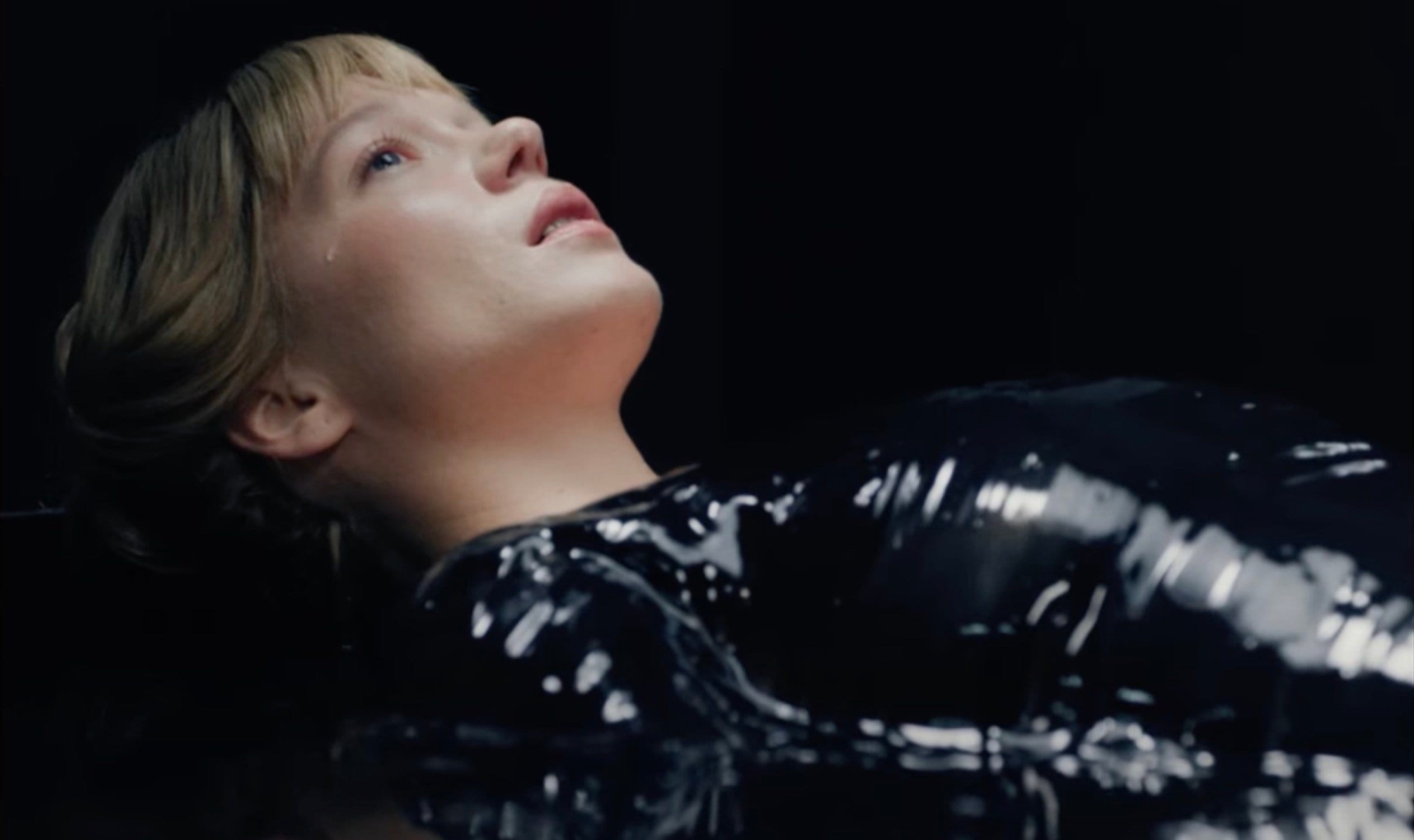
The Beast grows on the viewer as it gradually reveals more information and ideas, which is a lot considering the 146-minute running time. Nevertheless, there is love and danger here, packaged together in one cruel, psychologically torturous package. It is sweet and hellish, yet also clued into a depressing future informing its characters and ideas.
Flickering Myth Rating – Film: ★ ★ ★ ★ / Movie: ★ ★ ★ ★
Robert Kojder is a member of the Chicago Film Critics Association and the Critics Choice Association. He is also the Flickering Myth Reviews Editor. Check here for new reviews, follow my Twitter or Letterboxd, or email me at MetalGearSolid719@gmail.com
https://www.youtube.com/watch?v=embed/playlist



Movie Reviews
‘Finnegan’s Foursome’ Review: Edward Burns’ Spiky-Quaint Sports Dramedy Is a Tale of Family Therapy Through Golf

Thirty years after “The Brothers McMullen,” the writer, director, and actor Edward Burns looks preserved in amber — his hair and beard have some silver, but at 58 he’s still lean and handsome in that prince-of-the-working-class Irish-American way. And it’s not just Burns who’s more or less unchanged; so is his filmmaking style. “Finnegan’s Foursome” is his 16th feature, and he’s still doing that shaggy-likable, spiky-quaint, semi-low-budget Edward Burns dramedy thing — the script that’s talky and kind of funny, though in a way that often sounds like a script; the camerawork that never strays too far from the functional; the acting that hovers between lively and broad. The style Burns works in is now closer to television than movies, and given that “Finnegan’s Foursome” is getting a streaming release (starting today), you could say it’s a minor indie movie that has found its rightful home.
It’s a sports comedy, about golf and Ireland and family conundrums (it would be overstating it to call them demons), and a key thing that might put you in the audience demo for it is if you happen to be a serious golfer. It’s a movie spun out of the love of the game. Burns, who first shows up in a samurai man-bun, plays Freddy Finnegan, a wealthy clothing entrepreneur who seems to have a happy and settled life, except that he’s got anger-management issues, all stemming from his rivalrous relationship with his irascible Irish father, Jack (Ian McElhinney).
At first, we think the movie is going to be about these two facing off. Jack, at his home in South Carolina (he came over from the old country in 1959), is hosting the latest edition of the Finnegan’s Cup — an annual golfing competition in which four members of the family face off against one another, mostly as an excuse for Jack, a retired golf instructor, to tell his old jokes and stories and reminisce about the days when he was good enough to rub shoulders with the Big 3 (Arnold Palmer, Jack Nicklaus, and Gary Player).
He’s a blustery egomaniac, though he strikes us as a warm-hearted one. And Freddy, of course, resents the hell out of him. But what we think are going to be the fireworks between these two come to a halt when one of the players hits a hole in one and Jack keels over in shock, dead of a heart attack.
The family now has to scatter Jack’s ashes in the four locations he has chosen in Ireland (two of them are golf courses). And that’s an excuse for Freddy, who resents his da even in death; his more benign older brother, Teddy (Brian d’Arcy James), a novelist who has been suffering from writer’s block; Freddy’s musician son, Frankie (Brian Muller), whom he treats nearly as cavalierly as his father treated him; and Teddy’s adult daughter, Marie (Erica Hernandez), to take a week’s vacation in Ireland, where they’ll play out the Finnegan’s Cup at a handful of fabled golf courses, smacking around some home truths along with the ball.
There’s plenty of on-the-nose dialogue (“His dying wish was to get us all back here to Ireland”), as well as cornball boasting (“It’s not about the clubs, little brother, it’s about the man who’s swingin’ ’em”) and generic braggadocio (“I believe that is what you call an eagle!”). Freddy and Teddy never stop making side bets and busting each other’s chops, mostly about who has the better golf game, this being the locker-room form of brotherly love. If the family tension simmers, it’s mostly because Freddy and Teddy have opposite feelings about their father. Listening to their back-and-forth taunts, Marie says, “I’m sorry, so this entire trip is nothing but constant ball-busting?” Swap in “movie” for “trip,” and you’ve got an idea of “Finnegan’s Foursome,” though you should also toss in Frankie doing his cringe mock-sports-announcer banter.
“Finnegan’s Foursome” is structured as a sports movie, and Burns, working with the cinematographer Jeff Muhlstock, connects you to the geometric majesty of the links. But when you watch a film like “Tin Cup,” part of the thrill is that you want to see the Kevin Costner hero win; that’s the dramatic Zen of a sports film. Watching “Finnegan’s Foursome,” we’re not overly invested in whether Edward Burns’ entitled a-hole gets a winning golf score over his novelist brother.
There’s a touching scene where three of the characters sing “The Parting Glass” at a pub. But here’s how “Finnegan’s Foursome” is a bit soft. The movie is about Freddy coming around to see that his da really did love him, and that he wasn’t such a bad guy (he gave him the love of golf, after all). But the reason we readily buy this is that it’s so apparent from the outset. Jack’s big crime? Being away “at the office” (i.e., the golf course) too much. As ultimate sins of parents go, it’s kind of a dated sin. You want to say to Freddy, “Stop whining.” Especially because the Jack we see, in his competitive Irish way, had a lot of spirit; he was no ogre. Of course, he also tried to “get into Freddy’s head” on the golf course, but that’s kind of a privileged problem. It’s Freddy who needs to dismantle the ogre of resentment in himself, and that’s not quite a movie — that’s therapy.
The blithe and likable “The Brothers McMullen” won the Grand Jury Prize at the 1995 Sundance Film Festival and went on to have a healthy theatrical life, launching Burns’ career as a homespun auteur — at the time, he almost seemed like the shoestring Irish-American answer to Woody Allen. I was a fan of the early Burns films (especially “She’s the One,” his 1996 crossover movie, costarring Jennifer Aniston and Cameron Diaz), but his moment in the spotlight didn’t last long. After crossing over, he kind of crossed back, retreating into the not-fully-on-the-radar indie wilderness. That’s where he has remained, and watching “Finnegan’s Foursome” you see why: He’s trying to stay true to his world (all the Irish chop-busting and piss-taking), but he hasn’t grown as a filmmaker. Then again, maybe that’s not so important. He doesn’t hit long drives, but by the end of “Finnegan’s Foursome” the ball is in the cup.

Photo: 1-2 Special/Everett Collection
The English director Mark Jenkin works a bit like a local artisan from another era. Filming in and around his native Cornwall, he shoots his pictures himself on a 16mm Bolex, the kind of camera that might have been used by film students decades ago and that produces tactile, slightly grainy images. He also edits the movies himself, and records his sound later, layering in dialogue and effects and music (sometimes composed by himself) with an austere, handcrafted precision. This gives Jenkin’s work a certain timelessness, as if it belongs to the past but not to any specific period of the past. True, such an old-fashioned approach could feel performative, like an unusually well executed Instagram filter. But Jenkin’s style ties directly to his subjects and his expressive philosophy. His latest, Rose of Nevada — which stars two name actors, Callum Turner and George MacKay, and opens in New York today after doing the festival rounds — has the beguiling simplicity of a fable and the captivating textures of a dream. It stays with you like an unexpected and unanswerable question.
Jenkin privileges atmosphere through the collection of minute, sometimes abstract details. Set in a sparsely populated and depressed fishing village, Rose of Nevada opens with the unexpected return of the empty boat of the title, thought lost decades ago. Its arrival is announced by close-ups of barnacles, of rusty edges on ancient metal, of curious plant growth and moldy, tangled coils of black rope, as if its return was just part of a broader natural order. The Rose of Nevada clearly has a tragic history, which perhaps explains the psychological paralysis of the few remaining townsfolk. But it’s here, and so it must set off on a new fishing voyage.
Joining the journey, almost as if they were pulled towards it, are Nick (MacKay), a downcast man who needs money and seems incapable of meeting his young family’s most basic needs, and a drifter, Liam (Turner), whom we first see running down a road as if he were fleeing something. Both men are alienated from their environs, though for different reasons: MacKay conveys Nick’s quiet awkwardness well, and Turner has a charming, freewheeling energy that suggests he’s up for anything. When they return from the fishing expedition, however, the two men find that they’ve transported back several decades in time, and they’re mistaken for — or rather, they appear to be inhabiting the bodies of — two young deckhands who died long ago. Now that it’s the 1990s again, the fishing village is thriving, its local pub crowded with people and blaring pop. Nick and Liam see the younger, happy versions of the broken townspeople they’d left behind. Liam (now known as Alan) suddenly has a family, and Nick (now known as Luke) suddenly has parents. It’s almost as if the young men have been offered to the harvest gods as a sacrifice. And it’s worked.
So, it’s a ghost story, and a time travel story, and a folk tale, and something of a kitchen sink drama, but it’s also none of these things, really, and that’s where Jenkin’s formal gambits come in. His filmmaking has a lovely, homespun directness. We can feel scenes and moments being constructed, which fixes our attention on seemingly simple exchanges. An example: Early on, we see Nick hand his daughter a candy. Other filmmakers might shoot such a scene in a quick, offhand manner to mask its emotional weight, but Jenkin goes in the opposite direction, shooting everything in relative close-up and cutting the action to both extend and clarify it: We see Nick pull the candy out of its box, we cut to the girl receiving the candy, we see his wife see the girl, we cut to the wife taking the candy, we cut to a close-up of her unwrapping it, we cut to the girl getting the candy back, and we see Nick’s response. On some level, this could be an introductory filmmaking exercise: a whole series of extremely deliberate shots and edits designed to show this man’s feeling of inadequacy. But within the general precision of Jenkin’s style, the moment doesn’t stand out. Instead, it’s one in a long line of specific, human moments through which he builds his narrative and conjures a mood.
Such straightforwardness give Rose of Nevada a fable-like quality: There’s no narration, but we feel the deliberate rhythms of the storytelling, the telling emphasis on certain details over others. But weirdly, it also has something of the opposite effect: The film’s intimacy and Jenkin’s attention to the elements (along with his fondness for elliptical, well-timed flash frames) lends everything an otherworldly aura. Despite the time travel premise, nobody’s running around looking for a time machine to take them back, nor are they wasting much time trying to figure out how the dynamics of time travel work. The writer-director lets the unexplainable remain unexplained, because he’s interested more in our emotional response to it. We watch how people interact with these transformed versions of Nick and Liam, and we watch Nick and Liam’s own disparate responses to this new world, to the competing philosophies of life that emerge from this bewitching film. Rose of Nevada’s power lies in its peculiarities.
See All

Movie: Maa Inti Bangaaram
Rating: 2.5/5
Banner: Tralala Moving Pictures
Cast: Samantha, Gulshan Devaiah, Srinivas Gavireddy, Manjusha Mukkavilli, Diganth, Sreemukhi, Gautami, Anand, Lakshmi, Rachana, and others
Music Director: Santhosh Narayanan
DOP: Om Prakash
Editor: Dharmendra Kakarala
Producers: Raj Nidimoru, Samantha, Himank Reddy Duvvuru
Written by: Raj Nidimoru, Vasanth Maringanti
Directed by: BV Nandini Reddy
Release Date: June 19, 2026
Nearly three years after her last lead-role outing, Samantha returns to the big screen with “Maa Inti Bangaaram.” The film marks an important milestone in her career, serving as a comeback vehicle and also her first collaboration with husband Raj Nidimoru, who has co-produced the film and penned the story for this family action drama.
The big question is: has Samantha delivered a strong comeback with “Maa Inti Bangaaram”? Let’s find out.
Story
Swarna (Samantha) arrives with her husband at her in-laws’ village home to attend a family wedding. It is their first visit after marriage, as her husband had married her against his parents’ wishes.
Hoping to win over the family, Swarna settles into the household and tries to impress everyone, even seeking help from a friend for her cooking.
Just when she begins to feel accepted, trouble arrives. A group of men starts searching for her, determined to find out whether she is really Swarna or someone named Jhansi.
As the story unfolds, her hidden past comes to light. Years ago, she escaped from her mentor Karuna (Gulshan Devaiah) after discovering his true intentions. Since then, she has been living under different identities before eventually finding love and marrying her husband. Now, Karuna, who has completed a prison sentence, is back and determined to reclaim her at any cost.
Can Swarna protect herself and her newfound family from Karuna?
Performances
Samantha slips comfortably into the role. Despite returning to a lead role after nearly three years and overcoming health challenges, she retains her star presence and carries much of the film on her shoulders. While this may not rank among her best, she convincingly handles both the emotional and action-heavy portions, particularly in the second half.
Diganth plays her husband and delivers a decent performance, though the role offers him little scope. Gulshan Devaiah initially makes an impact as the antagonist, but the character gradually becomes routine, limiting his effectiveness.
Manjusha Mukkavilli gets a well-written supporting role and leaves a positive impression. Sreemukhi is adequate in her brief part.
Vennela Kishore appears in a cameo, while the rest of the cast performs within the requirements of their conventional roles.
Technical Aspects
Santosh Narayanan’s background score works reasonably well and elevates several scenes, especially in the latter half.
Cinematography is functional without offering any standout visuals. Production design serves the narrative adequately.
The film’s biggest technical shortcomings lie in its writing and editing. The dialogues rarely stand out, and the screenplay unfolds without enough surprises or dramatic highs.
A tighter edit and shorter runtime could have significantly improved the film’s overall impact.
Highlights
Samantha’s screen presence and performance
A few engaging moments in both halves
Some clever references
Drawbacks
Predictable screenplay
Unconvincing backstory
Lack of strong dramatic moments
Analysis
“Maa Inti Bangaram” is neither the emotional family drama audiences typically associate with Nandini Reddy nor the stylish action-driven narrative one expects from Raj Nidimoru’s storytelling sensibilities. Instead, it attempts to blend family drama with action, placing Samantha in a role usually reserved for a male commercial hero.
The basic premise feels familiar. Like many mainstream action films, it revolves around a protagonist whose troubled past threatens the peaceful life they have built. The difference here is that Samantha occupies the center of that narrative, taking on responsibilities and action beats traditionally assigned to male stars.
The first half unfolds largely as a family drama. Nandini Reddy focuses on the dynamics between the new daughter-in-law and her in-laws, presenting a series of domestic situations and emotional tests. The portions involving Samantha seeking help from her friend to impress the family with her cooking generate some humor and provide the film with a few enjoyable moments. Apart from these stretches, however, the narrative progresses at a measured pace.
The film gradually reveals why Jhansi became Swarna and why Karuna remains obsessed with finding her. While the backstory involving Naxalism provides the necessary motivation for the conflict, it never feels entirely convincing or emotionally compelling.
Once the central conflict is fully revealed by the interval, the film shifts gears. The second half becomes a straightforward battle between Swarna and the force threatening her family. While this creates a clear objective, it also reduces the scope for surprises.
A couple of scenes work reasonably well, and the climax action sequence inside the house provides some excitement, but the overall narrative goes on expected manner.
The film deserves credit for attempting something different within the commercial framework. Giving a female protagonist the kind of role usually written for male stars is a refreshing idea. Unfortunately, the execution lacks the emotional depth and dramatic strength needed to make the concept truly resonate.
Even the husband’s character feels somewhat artificial, functioning largely as a gender-reversed version of the supportive spouse often seen in hero-centric films.
Interestingly, some of the film’s most enjoyable moments come not from the action but from its lighter touches. References to older films, the creative use of the song “Mutyamantha Muddu,” and Samantha’s largely saree-clad appearance throughout the film, including during action sequences, add a distinctive flavor.
Ultimately, “Maa Inti Bangaram” attempts to merge family drama with female-led action. However, predictable storytelling and underdeveloped drama prevent it from reaching its full potential. The film remains watchable largely because of Samantha’s star appeal, but it never evolves into the engaging and emotionally satisfying experience it aspires to be. It makes an okay watch.
Bottomline: Not Pure Gold
-

 Finance5 minutes ago
Financial adviser warns, ‘stay away from the hype’ of an IPO
-

 Fitness12 minutes ago
The Best Fitness Trackers for Your Lifestyle, Workouts, and Goals
-

 Movie Reviews20 minutes ago
‘Finnegan’s Foursome’ Review: Edward Burns’ Spiky-Quaint Sports Dramedy Is a Tale of Family Therapy Through Golf
-

 World30 minutes ago
‘X-Men’ Star Famke Janssen Says Marvel ‘Made a Mistake’ By Not Asking Her to Return as Jean Grey in ‘Avengers: Doomsday’
-
 Lifestyle1 hour ago
James Burrows, director of classic shows ‘Cheers’ and ‘Friends,’ dies at 85
-

 Technology1 hour ago
Nothing cancels this year’s CMF phone due to RAM prices
-

 World1 hour ago
Two-train crash leaves at least 1 dead, 89 injured as emergency crews rush to chaotic scene
-

 Politics1 hour ago
Double endorsement drama: Trump backs second candidate in red state’s GOP gubernatorial runoff

