Lifestyle
The other Angelenos: What a naturalist's survey of Los Angeles wildlife reveals

Book Review
Unnatural Habitat: The Native and Exotic Wildlife of Los Angeles
By Craig Stanford
Heyday: 264 pages, $24
If you buy books linked on our site, The Times may earn a commission from Bookshop.org, whose fees support independent bookstores.
Los Angeles tends to strike outsiders as a borderless mishmash of suburbs spread over an unfriendly landscape with no significant natural source of water. When it’s not on fire, it seems to be sliding into the ocean or collapsing under the weight of its own untamable development.
And yet Los Angeles transplants will still brag to their loved ones across the country that they could go skiing and surfing in the same day (if for some reason they felt so inclined). As the conservationist Craig Stanford reminds us, however, you don’t have to drive to Big Bear or the beach to feel the pulse of nature in L.A.
In “Unnatural Habitat: The Native and Exotic Wildlife of Los Angeles,” Stanford offers Angelenos — and anyone interested in the function and dysfunction of (sub)urban ecosystems — a guide to the natural life that teems beneath our freeways, wanders into our backyards and fights for survival in the deserts and mountains that surround our city.
Stanford, who has conducted field research around the world, lives in Pasadena, in the foothills of the San Gabriel Mountains. As he details more than 150 species of L.A. flora and fauna — from native mountain lions to exotic earthworms, weeds that occur naturally and palm trees that, surprisingly, don’t — he evokes a portrait of an unusual city’s special, bizarre and unexpectedly fragile wildlife. He conjures up evolutionary histories, stories of foreign species’ arrival and their effects on an ecosystem that is massively and continuously altered by human influence.
But Stanford’s mission here isn’t simply to describe the creatures at hand — though he does do plenty of that, never hesitating to anthropomorphize even the most inhuman of them; to him, snakes are “secretive,” tarantulas “ominously deliberate.” The book excels — feels necessary, even — when it unravels the intricate interplay between human and animal habits; societal institutions and nature; common sense and our desire to decorate and navigate Los Angeles however we please.
He also offers prescriptions, micro and macro, private and public, for better stewardship of our environs. We can decide what we plant in our own gardens, for example, so Stanford advises readers to fill their yards with something native and drought-tolerant that can contribute to a more robust, stable and diverse ecosystem. (Of course, most of our city’s residents probably won’t get the memo.)
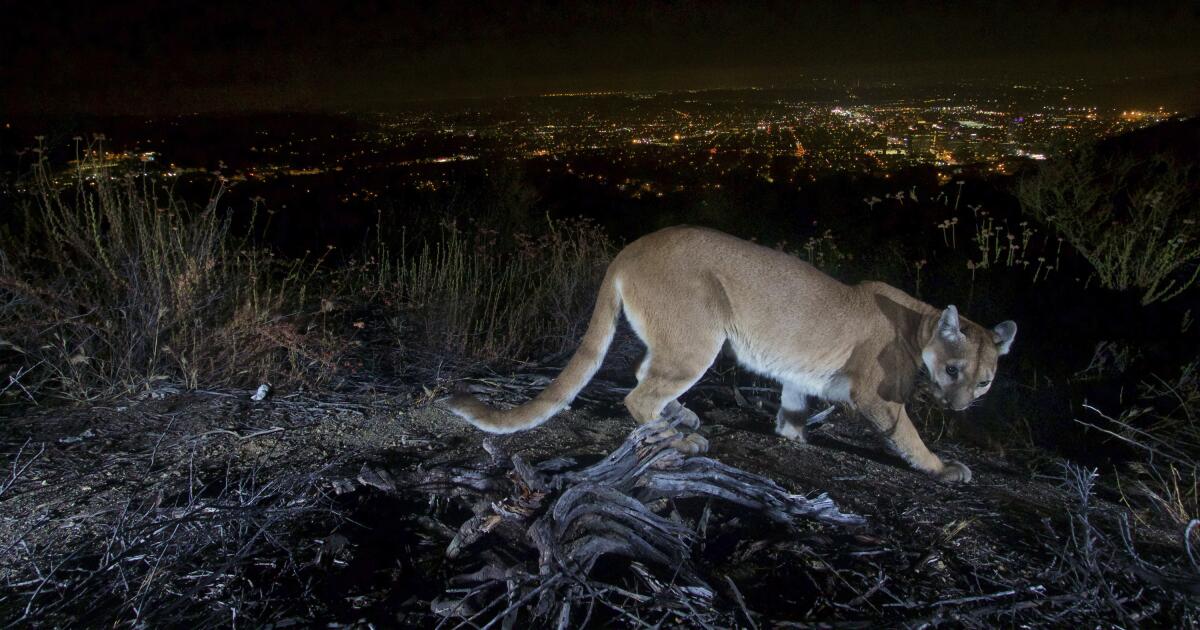
On the public front, Stanford highlights potential institutional improvements as well as bureaucratic roadblocks. In what is perhaps the book’s most compelling chapter, he writes about the man-made challenges to L.A.’s mountain lions. The gravest threat to these magnificent animals is our ubiquitous freeway system: Since 2015, more than 500 California cougars have become roadkill. Perhaps anyone could guess as much, but what a layman might never know without Stanford’s book is that our busy roads severely circumscribe the territory cougars can roam, leading to isolation and inbreeding.
A wildlife crossing is under construction over the 101 to allow cougars to traverse the freeway safely, expanding the territory they can access. But the cost of the project is high (about $90 million), as is competition for land that might otherwise serve as sanctuary for wildlife. Stanford, who usually comes across as optimistic, can wax cynical in the face of such frustrations.
His unexpected insights range from comical to shocking. He offers a snapshot of his cat having a field day with the finches in his backyard birdbath — and then explains the vicious cycle that creates invasive populations of feral cats that kill literally billions of birds across North America every year.
Stanford’s self-proclaimed ecological purism doesn’t mean he believes we should do away with nonnative species altogether, though. In fact, human interference has helped many species worth keeping around. Hummingbirds, for example, stay in L.A. year-round because our backyard feeders preclude any need for them to migrate in search of sugary plants. With that comes the responsibility to care for the wildlife we cultivate in this landscape that he acknowledges is “beautiful but largely nonfunctional.” It’s not clear whether he thinks we’re up to the task.
At his best, Stanford interweaves vivid prose, a reverence for nature and a seasoned Angeleno’s eye for what makes this city unique. At times, however, he fails to draw a connection between a species and the city, punctuating the book with vignettes laden with contextless taxonomy.
Regardless, the overall effect is a worthy and illuminating entry in the tradition of works exploring urbanization’s effect on the environment. (Stanford references Rachel Carson’s “Silent Spring,” and that author’s influence is felt throughout his book.) Moral questions abound, ranging from animal rights to humanity’s role in nature. Stanford’s fundamental message is clear and simple (and oft-repeated): To preserve a Los Angeles in which humans and nature benefit from one another, we must increase our understanding of our city’s fragile wildlife mosaic.
Stanford is heavy-handed only when he has to be, and his subtlety often hits harder. One chapter concerns a succulent so common in Los Angeles that I never knew its name: It’s called the live-forever (genus Dudleya), and, ironically, it’s at risk of extinction due to poaching. You can buy the plants at Home Depot, and yet they’re disappearing from our cliff faces and hiking paths. At the chapter’s close, Stanford articulates a profoundly upsetting truth: “Each generation grows up accustomed to the scope of Nature that surrounds it.”
Despite all he has to say about it, L.A.’s biodiversity is waning before our eyes. Fortunately, with Stanford’s help, we can acquire some of his vision for preserving our native species while effectively introducing exotic ones. Los Angeles is, after all, a city of transplants.
Daniel Vitale is a writer in Los Angeles and the author of the novel “Orphans of Canland.”



Once rivals on the tennis court, Martina Navratilova, left, and Chris Evert have become close friends in retirement. They are pictured above at the French Open in 1986.
Trevor Jones/Getty Images Europe
hide caption
toggle caption
Trevor Jones/Getty Images Europe
Chris Evert and Martina Navratilova were the most successful women’s tennis champions of their generation. Both were 18-time Grand Slam tournament winners — and each other’s greatest rivals.
Evert, a Florida native, became a tennis star in her teens. Navratilova was born in communist Czechoslovakia, and emerged as a player after Evert was established. They first faced off during a match in Akron, Ohio, in 1973, when Evert was 18, and Navratilova was 16. Evert won, but Navratilova left an impression.
“I remember thinking to myself, holy cow, when this young girl gets into better shape, she is going to be a force to be reckoned with,” Evert says. “She had so much talent. Her hands were quick, she had a big first serve, she had a big forehand, and she just was so powerful.”

Two years later, on the day she lost a semifinals match to Evert at the U.S. Open, Navratilova defected to the U.S. In the years that followed, her tennis game improved. Though she and Evert had initially been friendly, the friendship cooled as their rivalry heated up.
“Playing Chris was difficult because how can you not like Chris? What’s not to admire?” Navratilova says. “She was like the epitome of cool.”
The new Netflix documentary Chris & Martina: The Final Set tells the story of how Evert and Navratilova re-established their friendship and how they both faced cancer in retirement. Evert was diagnosed with ovarian cancer in 2021; Navratilova was diagnosed with throat and breast cancer in 2022.
“I can’t get away from her,” Evert jokes. “We had a 15-year career, and then we got cancer at the same time. It really is freaky, but I always say: If I want someone to be in the trenches with me, it’s Martina because she has been so supportive and so understanding.”

Navratilova agrees: “We have such a level of trust that we know whatever we say to each other, it stays there. We give each other the best advice we know how to. And there is no ulterior motive, no playing games.”
At the time that this interview was taped, Evert and Navratilova were both in remission from cancer. But late last week, Evert disclosed she’d recently been diagnosed with a recurrence of ovarian cancer.

“We know whatever we say to each other, it stays there,” Martina Navratilova says of her friendship with Chris Evert.
Netflix
hide caption
toggle caption
Netflix
Interview highlights
On supporting each other through cancer
Evert: There are a lot of phone calls between us. … I don’t cook, but Martina would bake bread for me, and her wife Julia would cook, make some chicken soup. … I got a lot of food from Martina. She got a necklace from me.
Navratilova: I get jewelry from Chris, she gets food from me.
Evert: Martina’s and my relationship — because we’ve had one for 50 years — is not the type where we have to talk to each other every day to maintain the closeness. I always knew she was there. She always knew I was there if we needed to talk, and that was that.
On the weakness they experienced with cancer
Navratilova: Chris’ diagnosis and treatment was much more life-threatening than mine, percentage wise, but my treatment was more difficult physically. … I was in New York for seven weeks and I literally sat on a yoga mat, maybe half an hour of the seven weeks, and did some stretching. I couldn’t even do the down dog pose because I would have fallen down. I had absolutely zero strength left.
Evert: The chemo kicked my butt, let’s put it that way. … It left me very weak, very, very weak. After chemo I would have three or four days of intense nausea and I just would feel tingling in my body and it just wasn’t nice. I didn’t have the energy. To walk six blocks was a big deal for me. And it was foreign. You know, it felt like it wasn’t my body, for sure.
On watching the old footage of their matches together for the documentary
Navratilova: For me, it was fun watching with Chris, because we had different reactions to what happened on the court. But what impressed me is how well we played with those wooden rackets. Because you know what? Those rackets are not easy to play with. But you try to put yourself in there physically, what it was like, mentally, what it is like. And it’s like, “Oh, I should have gone down the line,” or, “I can’t believe I missed that shot.” Or “Chris, you had such a great pass.” It was amazing. So it was impressive. … I wish I could still have that six-pack, but anyhow.

Evert: I remember feeling genuinely happy for her. I remember it was her first Wimbledon. That’s always been her dream since she defected. Her family couldn’t be there to watch her. She was all alone. And I just was happy for it. And I knew that this was gonna be one of many for her to win.
On defecting to the U.S. in 1975 when she was 18 years old
Navratilova: I was thrilled to be in the States. I always loved American cars. And when you ordered a ham sandwich, you got, like, two inches of ham and two slices of bread. Whereas growing up, you had thick bread and one slice of ham. So I thought I was in heaven. And it was $2.30 for that sandwich. I still remember it. I couldn’t believe how much ham I was getting.
Lauren Krenzel and Nico Gonzalez Wisler produced and edited this interview for broadcast. Bridget Bentz, Molly Seavy-Nesper and Beth Novey adapted it for the web.

-
Lifestyle36 minutes ago
How should we behave online? : It’s Been a Minute
-

 Technology47 minutes ago
After a great start, DC’s new cinematic universe is already slowing down
-

 World52 minutes ago
UK asylum seekers could have to pay government $13K before applying for settlement
-

 Politics59 minutes ago
Fetterman unleashes on ‘dirtbag’ wing of Dems after far-left victories: ‘Orgy of socialism’
-

 Health1 hour ago
Doctors thought man had brain cancer — they found live tapeworms instead
-

 Sports1 hour ago
Paraguay stuns four-time World Cup champions Germany in penalty shootout after controversial call
-
 Business1 hour ago
Comcast is spinning off NBCUniversal media and entertainment assets
-
 Entertainment1 hour ago
Alannah Keyser is latest fired ‘Love Island USA’ contestant to apologize for using a racist slur

