World
Sanchez: “I will recognise the Palestinian state next Wednesday”.


Spain’s prime minister said during a rally in Catalonia that he is going to propose the parliament’s official recognition of Palestine as a state on Wednesday, 22 May.
Sanchez defended the decision “out of moral conviction”, considering it “a just cause” and the “only way” to achieve peace and security in the Israeli-Palestinian conflict.
Ireland, Malta and Slovenia are expected to follow suit, and have already agreed to take the first steps in that direction.
In a phone call on Saturday, Taoiseach Simon Harris and Norwegian Prime Minister, Jonas Gahr Store agreed to remain in close consultation in the days ahead. Norway’s parliament adopted a government proposal in November for the country to be prepared to recognise an independent Palestinian state.
Harris and Store said that the deteriorating humanitarian conditions in Gaza underscored the need for an immediate ceasefire and for unhindered access for aid.
Earlier this week, Slovenian Prime Minister Robert Golob said his country would recognise Palestine’s statehood by mid-June.
Sanchez meanwhile criticised the Popular Party for refusing to recognise the Palestinian state and responded to former President Jose Maria Aznar by stating that “Spain will recognise it”.
The prime minister also acknowledged his party’s positive result in the Catalan elections of 12 May and said that Salvador Illa would make a good President of the Generalitat.
Spain would be the 10th European country to recognise the Palestinian State
There are already nine countries in the EU that have recognised Palestine as a state and Spain would be the tenth. On the list are: Bulgaria, Cyprus, Czech Republic, Hungary, Malta, Poland, Romania, Slovakia, Sweden and Slovakia.
Sanchez confirmed on Friday that Spain’s recognition will not be made at Tuesday’s Council of Ministers, as had been suggested.
The prime minister said that his position on the Israel-Hamas conflict is much like his country’s support for Ukraine following Russia’s invasion more than two years ago.
He stressed that Spain demanded ”respect for international law from Russia, and from Israel, for the violence to end, the recognition of two states, and for humanitarian aid to reach Gaza”.
Sanchez added his voice to a chorus of other European leaders and government officials who have said that they could support a two-state solution in the Middle East, as international frustration grows with Israel’s military actions in the Palestinian territories.
French President Emmanuel Macron said last month that it’s not ”taboo” for France to recognise a Palestinian state. British Foreign Minister David Cameron said that the United Kingdom could officially recognise a Palestinian state after a cease-fire in the Israel-Hamas war.
Five months after Hamas militants attacked Israel on 7 October, killing about 1,200 people and taking 250 others hostage, the Israeli military has responded with air and ground assaults that have killed more than 35,386 Palestinians, according to the Gaza Health Ministry.
Why does Spain support recognition of Palestine as a sovereign state?
Spain has been historically close to the Arab world and, as such, the nation is actively trying to push a line more favourable to Palestinian aspirations within the European Union.
In a speech made shortly after his re-election last year, Sanchez promised that his new government’s “first commitment” on foreign policy would be to “work in Europe and Spain to recognise the Palestinian state”.
At the same time, he said he was “on the side of Israel” in the face of “the terrorist attack” of 7 October, but also called on the Jewish state to put an end to the “indiscriminate killing of Palestinians”.
The stance comes at a time when many Western countries are facing criticism in the Arab world for being seemingly too favourable towards Israel.
 ADVERTISEMENT
In 2014, under a conservative government, the Spanish Parliament adopted a resolution calling for the recognition of the Palestinian state, supported by all political parties.
The vote, though, was non-binding and not followed by any action.
In Europe, several countries have taken this step in a more effective way.
They include Sweden, Hungary, Malta and Romania – but none of the main EU member states have done so, meaning that Spain could become a pioneer.
A brief history of Spanish-Arab relations
Geographically close to the Maghreb region of North Africa, Spain turned to Arab countries during the Franco dictatorship which ran from 1939 to 1975 in order to circumvent its isolation in the West.
ADVERTISEMENTIt was not until 1986, however, that the nation established official relations with Israel.
The relatively late date was a consequence of tensions born from Israel’s opposition to Spain’s entry into the UN at the end of the Second World War, due to its proximity to Nazi Germany.
In 1993, they played a role in the Oslo Accords, through which Israel and the Palestine Liberation Organization mutually recognised each other as part of the peace process.
Overall, though, Spain remains perceived by many as a pro-Arab country.
At the end of October, a mini-diplomatic crisis even broke out with the Israeli embassy after controversial statements by a far-left Spanish minister who spoke of a “planned genocide” in Gaza.
ADVERTISEMENTWith much of Europe firmly pro-Israel, Isaias Barrenada, a professor at the Complutense University of Madrid, said it will be an uphill battle for Sanchez.
”It is difficult to imagine that Spain has the capacity to reorient the European position,” Barrenada told AFP, but “it can contribute to showing that there are sensitivities within the EU.”



As Israel’s war on Lebanon rages, hundreds gather in Rmeileh by Sidon Gate to watch the 2026 World Cup. Organised by influencer Bilal Haddad, the fan zone offers food trucks, shisha and family activities, giving people a rare chance to relax. Al Jazeera’s Justin Salhani went to check it out.
Published On 20 Jun 2026

WASHINGTON (AP) — Mark Schiefelbein has been based in Washington, D.C., with AP for about three years, and before that spent a decade in Beijing at AP’s China bureau.
Here’s what he had to say about this extraordinary photo.
Why this photo?
This was an event that had never happened before in the 250-year history of the United States and may never happen again: a night of mixed martial-arts cage match brawls on the South Lawn of the White House, with bloodied competitors battling it out in front of the president, vice president, and other leaders of the country. AP had other photographers ringside at the event focusing more on the fights themselves. So I felt my role was to capture the context of the evening — the location, the people in attendance, the environment.
How I made this photo
A small group of other photographers and I, the White House press pool, had been allowed to photograph part of the evening from a position in the stands directly opposite the White House. I was carrying four cameras with a variety of lenses from 12 mm to 300 mm. This let me capture everything from ultra-wide views of the “claw” structure built for the fights, to close-ups of leaders and celebrities in attendance. I had been following Diego Lopes with my longest lens as he moved around the ring celebrating his win over Steve Garcia. When I saw him start to climb onto the cage, I immediately realized there might be a possibility of a picture like this and zoomed out to capture more of the scene.
An octagon on the White House lawn for Trump’s 80th birthday and the nation’s 250th, in photos
Why this photo works
The White House is surely one of the most recognizable buildings in the world. The columns of the South Portico, the fighter standing with arms and legs spread wide in celebration, and the octagon padding of the UFC ring tell an entire story as your eyes move from top to bottom of the frame. With Lopes standing with his back to the camera, facing the White House, it becomes less a photo of him and more about the evening, the event, and the spectacle. It was fortunate that it was after nightfall, so things that might have been distracting, like the Marine Band and spectators seated behind the ring, are mostly in the dark. Only the key elements – the White House, Lopes, and the ring are lit up.
—
For more extraordinary AP photography, click here.
World
British Prime Minister Keir Starmer faces potential leadership challenge from newly-elected Andy Burnham

NEWYou can now listen to Fox News articles!
Andy Burnham has officially won his special election and regained a seat in Parliament, setting him up to challenge the deeply unpopular Keir Starmer as the leader of the Labour party and as prime minister.
Burnham, currently the mayor of Greater Manchester in northwest England, won a seat in Makerfield and came away with 55% of the vote in a field of more than a dozen candidates, according to The Associated Press. The runner-up was Rob Kenyon of Reform UK, a right-wing populist party, who received more than 9,000 fewer votes than Burnham.
Burnham last served as a member of Parliament in 2017 but strongly implied in his victory speech that he is returning with the intention to lead the United Kingdom.
“Everyone knows that politics isn’t working. Everyone can feel that the country isn’t where it should be. Tonight could, just could, be the turning point,” he said, according to the AP. “This result will bring about a country that works fairly for everywhere and for everybody.”
TRUMP ALLY NIGEL FARAGE DEALS MAJOR BLOW TO STARMER IN LOCAL UK ELECTIONS AS RESIGNATION CALLS MOUNT
Britain’s Labour party candidate Andy Burnham speaks to supporters after the Makerfield by-election in Ashton in Makerfield, England, on Friday, June 19, 2026. (Jon Super/AP)
This special election, called by-elections in Britain, was unusually significant because the area’s Labour MP, Josh Simons, intentionally resigned to allow Burnham to win the seat and pursue leadership.
The potentially outsized impact of this election was juxtaposed with the strange scene that unfolded when all the candidates gathered on Friday morning to hear the results. Burnham stood in between an independent candidate dressed in a fox costume and another candidate known as “Count Binface”.
As his name suggests, “Count Binface,” whose real name is Jonathan David Harvey, was wearing a trash can on his head and regularly runs in U.K. elections to advocate for increased voter turnout.
Starmer congratulated Burnham in a social media post on X, saying voters “chose Labour’s campaign of hope and optimism over division and hate.”
When asked about Burnham’s intentions to oust him as leader, Starmer said he will fight to remain prime minister, a position he has held for nearly two years.
“I’ve said repeatedly I’m not going to walk away from that,” Starmer told reporters.
Labour party candidate Andy Burnham, center, stands with other candidates on the podium at the Edge Wigan, awaiting the Makerfield by-election result announcement in Wigan, England, on Friday, June 19, 2026. (Jon Super/AP)
AS EPSTEIN-LINKED APPOINTMENT SPARKS BACKLASH, UK PM STARMER FACES PARTY REVOLT AMID RESIGNATION CALLS
Starmer led the Labour party to a landslide victory in July 2024 and ever since, his popularity has been eroding thanks to a persistently high cost of living, an anemic economy and a scandal over his willingness to accept gifts from wealthy donors.
Last September, Starmer was slammed for appointing Peter Mandelson as the British ambassador to the United States, when it was known as early as 2019 that Mandelson had a friendship with convicted child sex offender Jeffrey Epstein. Following an enormous public backlash, Mandelson was quickly dismissed from his post.
With Starmer as leader, Labour is increasingly losing liberal-minded voters to the Green Party, while also facing stronger challenges by Reform UK, a Nigel Farage-led party that advocates against mass migration and in favor of tighter border controls. Farage, an ally of U.S. President Donald Trump, said he was disappointed by Burnham’s victory.
Burnham is expected to head to London to be sworn in as soon as Monday. Under the British parliamentary system, the governing party can hold leadership elections in the middle of the term. The winner of such a contest can become prime minister without there having to be a national election.
British Prime Minister Keir Starmer awaits Switzerland’s Federal President Guy Parmelin on the sidelines of the G7 summit, in Evian-les-Bains, France, on Tuesday, June 16, 2026 (Isabel Infantes/Pool Reuters via AP)
CLICK HERE TO DOWNLOAD THE FOX NEWS APP
Under Labour rules, a lawmaker can challenge the leader if they win the backing of a fifth of their party’s members in the House of Commons. Burnham has enough lawmakers on board to trigger a leadership contest, according to a report from The New Statesman.
According to the AP, Culture Secretary Lisa Nandy said Burnham and Starmer will “have a conversation about what comes next” in the next few days.
The Associated Press contributed to this report.
-

 Politics17 seconds ago
Double endorsement drama: Trump backs second candidate in red state’s GOP gubernatorial runoff
-

 Health5 minutes ago
Measles-infected traveler may have exposed passengers at LAX and nearby hotel, health officials warn
-

 Sports12 minutes ago
World Cup Red Cards: 2026 Has More Red Cards Than Each Of Last 2 World Cups
-

 Technology15 minutes ago
China’s brain chip breakthrough raises big questions
-
 Business20 minutes ago
Ranch lovers can soon travel with a TSA-friendly kit of the popular American dressing
-
 Entertainment27 minutes ago
At the Fonda, Jane Remover’s violent yearning heralds a new kind of stardom
-
 Lifestyle30 minutes ago
Beer, with a twist? SoCal dads find solidarity through an unexpected activity
-
 Politics35 minutes ago
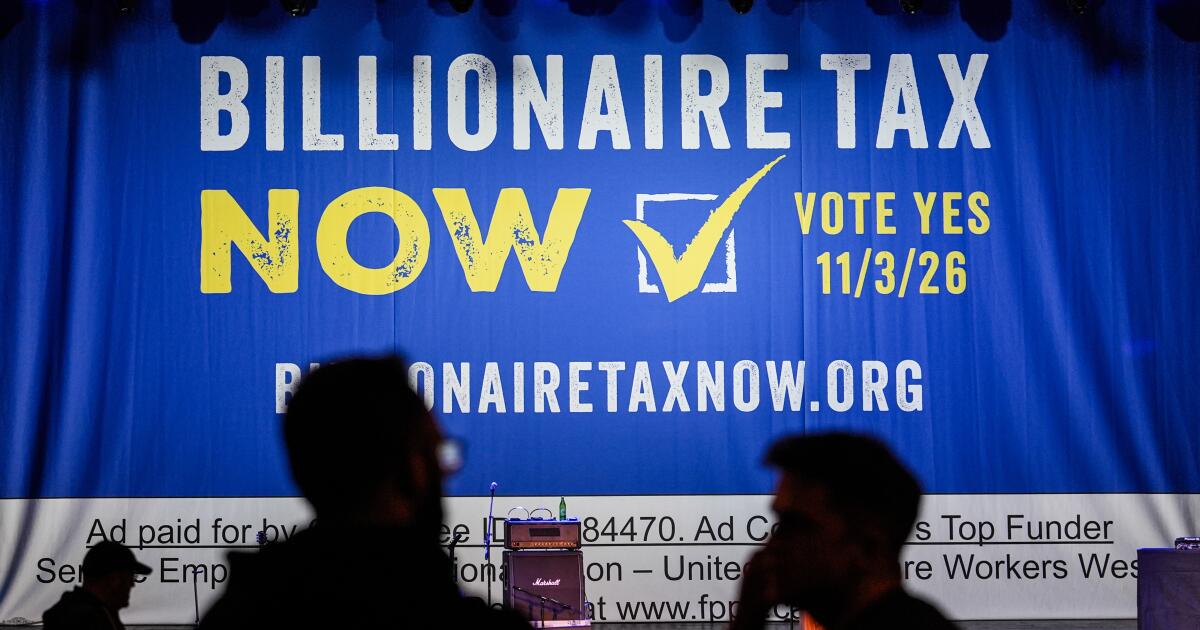
Billionaire tax proposal faces hurdles as it moves closer to November ballot

