Politics
In Ukraine, relief and rejoicing over U.S. aid vote


Ukrainians heaved a collective sigh of relief Sunday after the U.S. House of Representatives approved a long-sought $61 billion in aid, breaking a legislative logjam that had deepened hardships on the war’s front lines, and made it difficult for Ukrainian forces to fend off Russian attacks on civilian neighborhoods and critical infrastructure.
However, with a fresh infusion of aid ready to be rushed in as soon as the Senate approves the measure and President Biden signs the measure into law — both expected to happen by midweek — it may now take some time to determine whether Russian forces’ battlefield momentum of recent months can be reversed, analysts said.
And Ukrainians were braced for at least a short-term redoubling of the near-nightly pummeling of cities and towns across the country with missiles and drones — which in recent weeks was exacerbated by an alarming depletion of Ukrainian air defenses. An angry Russia could try to get in more punishing attacks before more air-defense help arrives, some feared.
“First of all — thank you, thank you,” said Anastasia Chuchin, 36, who was hurrying to catch a train on a rain-soaked morning in the capital, Kyiv. “We’re very grateful for this assistance. But we may still have some really hard days ahead of us.”
President Volodymyr Zelensky issued a statement of appreciation moments after the vote, which occurred late Saturday evening Ukraine time. He thanked by name House Speaker Mike Johnson, the Louisiana Republican who had been heavily lobbied by Ukraine’s supporters to bring the measure to a vote despite bitter opposition from his party’s far-right flank.
“This is a life-saving decision,” Zelensky said in a Saturday night address to the country in which he expressed gratitude to all those in the United States who, “like us in Ukraine, feel that Russian evil definitely should not prevail.”
Just as important in that initial reaction was what Zelensky did not say. The Ukrainian leader carefully refrained from alluding to Ukrainians’ frustrations over how long it had taken to move the aid measure forward — or to widespread fears here that American assistance might be on the verge of drying up altogether, particularly if former President Trump, the Republican nominee, wins back the White House in November.
In an interview aired Sunday, though, the Ukrainian leader took a starker tone about setbacks directly tied to the fact that “the process stalled for half a year.”
“We had losses …. in men, in equipment,” he said on NBC’s “Meet the Press,” particularly citing the deteriorating situation in Ukraine’s Donbas region, its industrial heartland.
“The east was very difficult, and we did lose the initiative,” he acknowledged. “Now we have the chance to stabilize this situation.”
As the political infighting dragged on in Washington, Ukrainian officials expressed particular alarm over the systematic destruction of crucial energy infrastructure, such as a power plant wrecked by missiles outside Kyiv this month. In some parts of the country, the targeting of electricity-generating plants has caused power cuts of a scope and duration comparable to those seen much earlier in the war.
U.S. defense officials have not provided a detailed breakdown of what will be in the first tranche of assistance, but the first order of business will likely be to replenish stores of munitions used by Ukrainian forces along a front line that stretches for hundreds of miles, arcing through the country’s south and east. Field units have reported rationing artillery shells and precision rockets even as Russian troops mount an aggressive push in places like the key eastern town of Chasiv Yar.
Speaking on CBS’ “Face the Nation” on Sunday, Sen. Mark R. Warner (D-Va.), head of the Senate Intelligence Committee, said he was confident the U.S. would be able to resume shipments of equipment by the end of the week.
“This should have happened six months ago,” Warner said of the House vote to approve the aid. “The next best time is now, this week. … If [Ukrainians] don’t have the materiels, they can’t carry this fight to the Russians.”
U.S. and Ukrainian officials said resupply efforts could take place relatively quickly, because of supply chains and logistical networks established early in the more than two-year-old conflict. Some of those could be reactivated within days.
Even so, the Institute for the Study of War, a Washington-based think tank, noted that “Ukrainian forces may suffer additional setbacks in the coming weeks” while waiting for the arrival of weaponry that will allow them to stabilize the front lines.
While Russia has not managed any major battlefield breakthroughs since capturing the eastern town of Avdiivka in February, independent military analysts had reported steady incremental advances, amounting to hundreds of square miles of territory, that could have left Ukrainians hard-pressed to contain a concerted Russian push.
With the imminent arrival of aid, though, Ukrainian forces “will likely be able to blunt the current Russian offensive assuming the resumed U.S. assistance arrives promptly,” the institute said.
Russia, predictably, hammered on what has become a key talking point — that U.S. assistance would do little more than prolong a bloody confrontation. Kremlin spokesman Dmitry Peskov also suggested that the main idea behind the package was to funnel money to U.S. weapons manufacturers.
The House vote “will make the United States of America richer, further ruin Ukraine and result in the deaths of even more Ukrainians, the fault of the Kyiv regime,” Peskov said, according to official Russian media.
Some U.S. lawmakers said coming to Ukraine’s aid now had helped avert sending a dangerous signal of U.S. weakness to Moscow.
“If we surrender Ukraine like we did Afghanistan, which was a debacle, will the United States be weaker or stronger?” Rep. Michael McCaul (R-Texas), chair of the House Foreign Affairs Committee, said on ABC’s “This Week with George Stephanopoulos.”
“We were running out of time,” McCaul said. “Ukraine was about to fall.”
In the NBC interview, Zelensky said the passage of the bill would send a powerful message to Russia that Washington stands by Kyiv, and that the war would not devolve into “a second Afghanistan.”
“I think this support will really strengthen the armed forces of Ukraine, and we will have a chance for victory,” Zelensky said through an interpreter.
European allies, for their part, had watched the drawn-out aid drama with mounting anxiety and exasperation. But most quickly pivoted to public expressions of optimism and unity.
“Ukraine is using the weapons provided by NATO Allies to destroy Russian combat capabilities. This makes us all safer, in Europe & North America,” NATO Secretary-General Jens Stoltenberg posted on the platform X.
A few, including Polish Prime Minister Donald Tusk, could not suppress a slightly sardonic tone even in expressing relief. NATO allies that feel more directly threatened by Russia, including the Baltic states and Poland, have long viewed the conflict with a sense of crisis and urgency, and were at times incredulous as U.S. support appeared to flag.
“Better late than too late,” Tusk wrote crisply on X, referring to the long-delayed House vote. “And I hope it is not too late for Ukraine.”
Many Ukrainians, whose days and nights are punctuated by air alerts that send people scurrying into basement bunkers or taking makeshift shelter behind a “second wall” at home, were eager to make the point that not only their own safety was at stake.
“This is a recognition that helping us in our fight against Russia and [Russian President Vladimir] Putin helps Europe, helps democracy, helps the entire whole world,” Dmytro Laba, a 36-year-old IT specialist in Kyiv, said of the House vote. “Even the United States of America.”
King reported from Kyiv and Wilkinson from Washington.

Politics
Fetterman unleashes on ‘dirtbag’ wing of Dems after far-left victories: ‘Orgy of socialism’

NEWYou can now listen to Fox News articles!
Sen. John Fetterman, D-Pa., unloaded on his own party on Sunday evening, blasting a series of victories for progressives he called “anti-America.”
“Big night for the dirtbag left,” Fetterman said, referring to New York’s recent primaries, where two members of the Democratic Socialists of America (DSA) won primaries.
“I’ve said the party is becoming an orgy of socialism. Clearly anti-America, anti-Western Civilization,” Fetterman said.
Fetterman’s striking calls give a rare look at how some moderates may view the developments on their far-left flank that have dominated the party’s momentum in recent months, sparking concern that their high visibility is dragging the party further and further left.
FETTERMAN WARNS DEMOCRATS ‘DRIFTING FIRMLY INTO COMMUNISM’ AFTER SOCIALIST PRIMARY WINS
Sen. John Fetterman, D-Pa., speaks to reporters outside the Senate Chamber during votes on Nov. 10, 2025, on Capitol Hill in Washington, D.C. (Andrew Harnik/Getty Images)
His comments come on the heels of a handful of key progressive victories.
In Maine, Graham Platner, a controversial Democratic candidate for U.S. Senate, has attracted controversy for denying knowledge of the meaning behind a Nazi-linked tattoo, for off-color comments about race and calling himself a “communist” in a deleted Reddit post.
In New York, one DSA member, Claire Valdez, won a primary on a platform of abolishing ICE and a Green New Deal-style approach to climate change. Similarly, Darializa Avila-Chevalier, another DSA candidate, beat out incumbent Rep. Adriano Espillat, D-N.Y., a high-ranking Democrat and the chair of the Congressional Hispanic Caucus.
WINNERS AND LOSERS EMERGE AFTER SOCIALIST EARTHQUAKE ROCKS NYC PRIMARIES
Graham Platner, Democratic Senate candidate for Maine, speaks at a primary election night event at the Blue Hill YMCA in Blue Hill, Maine, on June 9, 2026. Platner won the party’s Senate primary after a campaign marked by accusations of past misbehavior and voter concerns. (Graeme Sloan/Bloomberg via Getty Images)
Both Chevalier and Valdez had the backing of New York Mayor Zohran Mamdani, himself a socialist.
The wins have captured national attention and drawn criticisms from Republicans who have pointed to their success as emblematic of the direction of the Democratic Party.
Fetterman, who has not shied away from confrontations, has been one of the few Democrats to express alarm about the kind of candidates carrying the party’s banner.
“I mean, you look at some of the things that people have said. Abolish prison, abolish the border, abolish ICE, I mean these crazy people — I have colleagues in my caucus that refuse to even call this out,” Fetterman said.
FETTERMAN REACTS TO MAMDANI’S REFUSAL TO ACCEPT SUPREME COURT’S IMMIGRATION RULING
U.S. Sen. John Fetterman, D-Pa., walks through the Senate Subway during the Senate War Powers vote on April 22, 2026, in Washington, D.C. (Heather Diehl/Getty Images)
CLICK HERE TO DOWNLOAD THE FOX NEWS APP
“Between P-hustle in Maine and some of the other winners in New York, they should form their own party and run on all the things that they’ve had to delete on social media,” Fetterman said, referring to Platner.
“That’s where our party has moved,” he added.
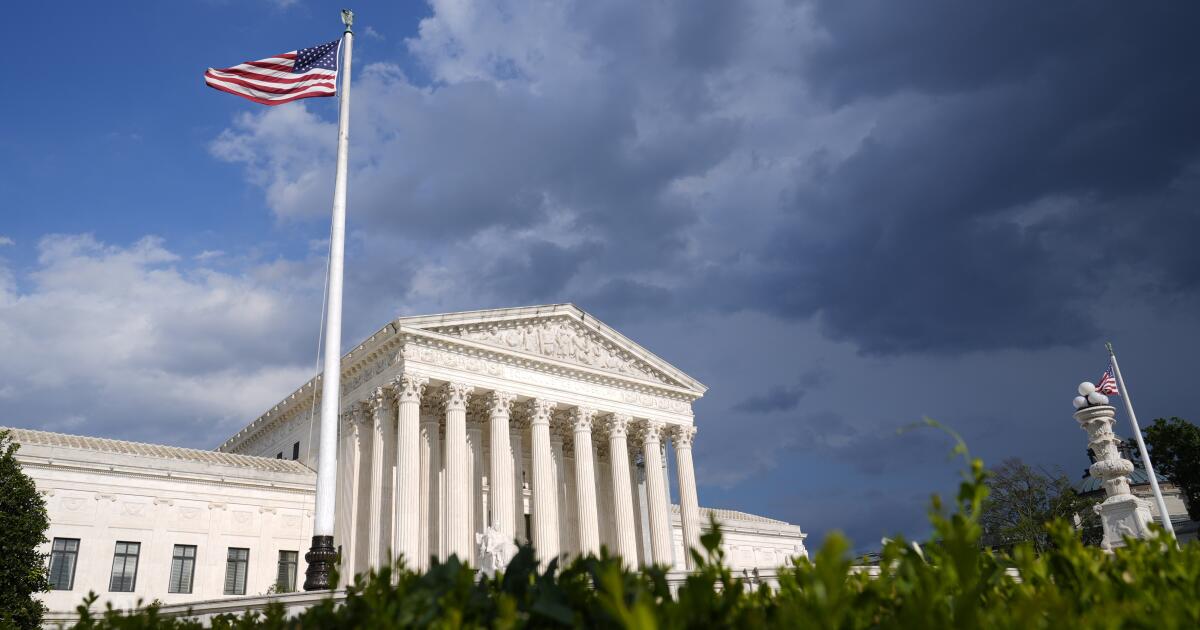
WASHINGTON — The Supreme Court cast doubt Monday on whether police may obtain cellphone data to find crime suspects.
In a 6-3 decision, the justices said this location information showing where a cellphone user has traveled is personal and private and subject to the protection of the 4th Amendment’s ban on unreasonable searches.
Justice Elena Kagan said these “records serve as a personal journal of a user’s movements.”
She said the information “resembles other private materials — think of emails, documents, photographs, or calendars—that even if stored on Google’s servers, a user reasonably views as his own…and reasonably expects to be shielded from the inquisitive eyes of the government.”
Because an “individual has a legitimate expectation of privacy in his cellphone location data,” she said police investigators need a valid search warrant from a magistrate.
The court stopped short of deciding the proper basis for a search warrant in such cases. Instead, the justices sent the case back to judges in Virginia.
But the outcome casts doubt on “geofence warrants.”
In recent years, police have gone to Google and cellphone companies seeking tracking data on cellphones that were at a crime scene. Sometimes, they have had a warrant from a magistrate.
Civil libertarians say the use of this tracking data raises the specter of mass surveillance on innocent people.
Police and government lawyers say no one has a reasonable right to privacy when they are walking on a sidewalk or driving down the street.
The case before the court arose from the armed robbery conviction of a Virginia man who stole $195,000 from a credit union in a small town near Richmond.
By the time police arrived, the robber had fled. But surveillance cameras showed he was carrying a gun and a cellphone.
Lacking other leads, detective Joshua Hilton asked a judge to issue a special type of warrant seeking information from Google.
Referred to as a “geofence warrant,” it seeks data from phones in a particular area at a particular time.
The detective sought data on phones that were within 150 yards of the credit union within one hour of the late afternoon robbery.
After examining and paring down the data, the detective asked for the phone records of Okello Chatrie. Then, with a search warrant of his home, investigators found two robbery-style demand notes, a semi-automatic pistol and about $100,000 in cash.
A judge refused to suppress the evidence from an allegedly unconstitutional search, and Chatrie entered a conditional guilty plea.
The full 4th Circuit Court of Appeals split evenly on the legality of the geofence warrant, and the Supreme Court agreed to decide the issue in Chatrie vs. U.S.
Usually investigators obtain warrants to search the home or vehicle of a known crime suspect.
The new and disputed geofence warrants seek to find a suspect by examining data on the cellphones that were at the scene of a crime.
The FBI used this cellphone data in 2021 to identify suspects who broke through police barricades on Jan. 6, 2021, and pushed their way into the Capitol to disrupt the official counting of electoral votes.
Chief Justice John G. Roberts Jr. and Justices Sonia Sotomayor, Neil M. Gorsuch, Brett M. Kavanaugh and Ketanji Brown Jackson agreed on the outcome in Chatrie vs. U.S.
In a 21-page dissent, Justice Samuel A. Alito Jr. said the court had “carefully set the stage for its planned performance: striking a pose as a great champion of privacy in the digital age. I cannot support this irresponsible escapade.”
Justice Clarence Thomas agreed.
Justice Amy Coney Barrett agreed in a one-paragraph dissent. “Chatrie had no reasonable expectation of privacy in data about his public movements that he voluntarily disclosed to Google,” she said.
The Supreme Court ruled 6-3 that President Trump could fire independent regulators for any reason. But the justices carved out an exception for the Federal Reserve, preventing the immediate removal of Lisa D. Cook, a Federal Reserve governor.
-

 Austin, TX7 minutes ago
Home Automation Austin Brings Personalized, Full-Service Home Automation to Homeowners in Austin
-

 Alabama10 minutes ago
Former Alabama Inmate Arrested After Allegedly Flying Drone with Contraband Toward Prison
-

 Alaska15 minutes ago
As war stalls, Putin concedes he never cut a deal with Trump in Alaska
-

 Arizona21 minutes ago
Flags are at half-staff today in Arizona. Here’s who is being honored
-

 Arkansas25 minutes ago
What Is The Arkansas Razorbacks Toughest Stretch of the 2026 Season?
-

 California30 minutes ago
Southern California residents say HOA made them take down American flags
-

 Colorado37 minutes ago
Colorado’s Most Beautiful State Parks, Ranked By A Colorado Local
-

 Connecticut40 minutes ago
CT poised to invest again in childcare, pay down pension debt

