Midwest
Nebraska lawmakers propose tax-funded school choice bill

Nebraska lawmakers are on track to pass a bill that would circumvent an upcoming ballot initiative in which voters could repeal a new state law that funds private school tuition with taxpayer money.
The bill from Omaha Sen. Lou Ann Linehan, the author of last year’s Opportunity Scholarships Act, advanced late Wednesday to a final round of debate, just a day after advancing from the first round of debate. It would change the way the private school scholarships, enacted last year, are funded.
The law passed last year by Nebraska’s officially nonpartisan Legislature did not appropriate taxpayer dollars directly to private school tuition. Instead, it allowed businesses and individuals to donate as much as $100,000 per year of their owed state income tax to nonprofit organizations that award private school tuition scholarships. Estates and trusts could donate as much as $1 million a year. That dollar-for-dollar tax credit is money that would otherwise go into the state’s general revenue fund.
NEBRASKA LEGISLATURE REJECTS TRUMP-APPROVED ‘WINNER-TAKE-ALL’ ELECTORAL SYSTEM BILL
The law triggered an immediate pushback from public school advocates who blasted the measure as a “school voucher scheme” that would hurt enrollment, and therefore funding, for public schools and would allow taxpayer dollars to go to private schools that are allowed under religious tenets to discriminate against LGBTQ+ students.
Those critics organized a petition drive to ask voters to repeal the law, and the drive collected far more signatures than needed to get the question on the November ballot.
Acknowledging that voters might reject the new law, Linehan, a Republican, is now pushing a bill that would directly fund the private school scholarships from state coffers, thereby rendering moot any vote on a repeal of last year’s law. The move drew renewed protests from opponents.
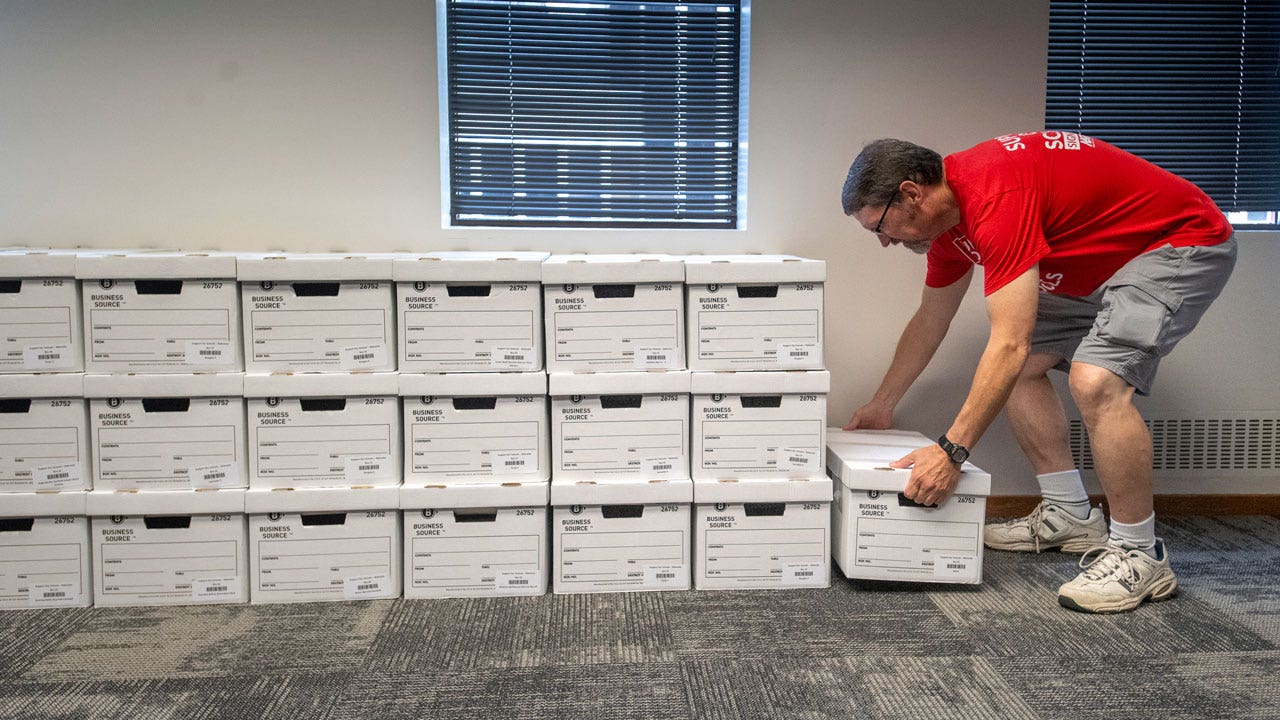
John Heineman delivers a box of petition signatures from Support Our Schools Nebraska to the Nebraska Secretary of State, Aug. 30, 2023, in Lincoln, Nebraska. Nebraska lawmakers are on track to pass a bill that would circumvent Nebraska voters who could repeal a new law that funds private school tuition with taxpayer money. (Justin Wan/Lincoln Journal Star via AP, File)
Jenni Benson, president of the state’s largest teachers union and a leader of the petition initiative, called Linehan’s new bill “a slap in the face to the 117,415 Nebraskans who signed the successful referendum petition to have voters decide the issue on the November ballot.”
Some lawmakers said Linehan’s new bill violates the Nebraska Constitution, which explicitly forbids the appropriation of public funds to nonpublic schools. Linehan countered that direct funding is allowed under a 1984 Nebraska Supreme Court ruling that allowed state funds to be used for scholarships at either public or private colleges.
“The voters deserve an opportunity to be heard on this,” Omaha Sen. John Cavanaugh, a Democrat, said Tuesday during debate. “I disagree with the idea that we’re going to interject ourselves between the petition process and the voters before they have their opportunity to be heard.”
Wednesday night’s debate went much the way Tuesday’s had, with proponents of the bill saying their intent was to give students whose parents might not otherwise be able to afford it a choice to go to a private school if their public school is failing them. Opponents maintained that voters should get the right to decide if they want public dollars to be reserved for public schools.
“Let’s not do tricks to try to repeal bills once a referendum comes through,” said Sen. Wendy DeBoer, a Democrat, said Wednesday night. “Let’s let the people of Nebraska decide.”
Linehan’s effort to rejigger the bill has not been without struggle. She drastically lowered the amount allocated in last year’s measure using tax credits, which had allotted $25 million this year and in 2025, and up to $100 million annually thereafter to cover such donations. She dropped that amount to $10 million a year, with no escalation in the future, in an effort to secure more votes.
She got just enough votes to end a filibuster and advance the bill both Tuesday and Wednesday. It is likely to get enough votes to get through a final round of debate and pass before the end of the session’s last day on April 18.
Read the full article from Here



Rick Mahorn talks about why he settled in Detroit
Rick Mahorn talks about the appeal of Detroit as a place to live and raise a family.
Hartford, Connecticut may be Rick Mahorn’s hometown, but Detroit has his heart.
The original Pistons’ “Bad Boy” has worn many hats in basketball, from player to coach to broadcaster, but now he is back in the coaching realm leading Detroit’s BIG3 team, the Detroit Amps.
“The city has always been good to me, I figured I have to give something back,” Mahorn said about coming back and representing Detroit. “The fact is that I made Detroit home and one thing about Detroit, it’s always going to love me and Imma love Detroit.”
Mahorn spent 18 seasons in the NBA and won the 1989 championship with the Pistons. After retirement in 1999 as a Philadelphia 76er, he started his coaching career with the Atlanta Hawks, and the “coaching phase” never faded.
Serving as the assistant coach for the Detroit Shock for four years, he helped lead them to two championships and moved up to the head coach position before the franchise was relocated.
Years later he joined the BIG3 when it launched in 2017 as the head coach for the Trilogy and won the league’s first ever championship, along with its first ever Coach of the Year Award. He recently stepped back into coaching for the BIG3 as the Amps coach.
Along with his love for coaching, his love for the Pistons was at the heart of it. In between each coaching position, he took a break to focus on being a color analyst for the Pistons radio network and recently completed his 20th season in that role.
“It keeps calling me back, but the thing I love about coaching is that you have to ‘each one, teach one,’” Mahorn said. “Someone taught me as a coach, that kept me on the straight and narrow, making sure I was always positive about what I do for a living, but basketball opens up so many avenues.”
Founded by Ice Cube and Jeff Kwatinetz, the BIG3 played its inaugural season in January 2017 with eight teams. It expanded to 12 teams in 2019 but dropped back to eight with new cities and logos.
Detroit was a part of the rebrand with the Detroit Amps, also known as the Detroit Amplifiers, and they joined the league last season.
Although this isn’t Mahorn’s first rodeo coaching in the BIG3, or coaching Detroit basketball, it is his first season coaching the Amps after taking over the role following the former coach, hall of famer George Gervin.
Mahorn technically never left the Detroit fan base, and has continuously been connected with the Pistons, but it is still a great feeling for him to be back coaching on Detroit’s side for the Amps.
“What they do to me is keep me young. You think you getting old and the next thing you know you’re coaching some young guys,” Mahorn said. “I want them to have the respect of being a professional. The fact is they’re the ones carrying the torch later.”
Ice Cube or Kwatinetz weren’t in attendance Saturday, but Ice Cube’s son, Oshea Jackson Jr., was present and working with CBS Sports on interviews.
Other celebrities came out to support, like Pistons forward Ronald Holland, former Detroit Amps head coach and hall of famer George Gervin, and local artist Payroll Giovanni, who performed at halftime of the Amps game.
Week two of season nine kicked off Saturday, and the Amps continued their losing streak, falling to 0-2 after a 51- 44 loss to Miami 305.
This isn’t the only time Michiganders will see the league this season at Little Caesars Arena. It will be back for week six on July 23.
“Detroit is a beautiful city — it’s a hardworking city,” Mahorn said. “One thing about Detroit: they embrace everybody that comes back, that’s done some things — the championships I have in my repertoire, but it’s just the fact that I just love Detroit.”
BIG3 WEEK TWO RESULTS
Game 1: Dallas Power 50, LA Riot 33
Game 2: Chicago Triplets 51, DMV Trilogy 49
Game 3: Miami 305 51, Detroit Amps 44
Game 4: Boston Ball Hogs 51, Houston Rig Hands 36

MILWAUKEE – The death toll from two earthquakes in Venezuela has topped 1,400 with an estimated 69,000 people still missing.
Earthquakes in Venezuela
The backstory:
The initial earthquakes registered at 7.2 and 7.5 on the Richter scale, and there have been more than 400 aftershocks since then. Meanwhile, neighbors in Milwaukee are doing their part to provide relief for families affected.
FREE DOWNLOAD: Get breaking news alerts in the FOX LOCAL Mobile app for iOS or Android
Milwaukee relief effort
Local perspective:
Organizers told FOX6 News the generosity was nonstop since doors opened Saturday morning, all to collect basic needs for those impacted by the tragedy in Venezuela.
On Historic Mitchell Street, all hands were on deck as neighbors dropped bags filled with clothes, emergency care items and toiletries. People boxed up the items to send off to families in Venezuela.
“Wipes, Pampers that we have, so many things that we have collected,” said organizer Ana Gilmond. “There is no infrastructure there, so people are struggling.”
Gilmond helped organize the disaster relief collection site at Voces de la Frontera’s headquarters Saturday.
SIGN UP TODAY: Get daily headlines, breaking news emails from FOX6 News
“We all feel devastated, and we thought, ‘We have to get together in order to to help,’” she said. “We might be far, but our heart is there right now.”
Gilmond said she is thinking of families and her friend who died after her building collapsed during the back-to-back earthquakes. It’s a labor of love that has brought dozens of donations to the site from folks like Alex Wenzel and her mother, Deb Smith.
“Just saw images of people being pulled out of the rubble and leaving little dogs,” said Wenzel. “If there’s something you can do, why not do it?”
Group collects donations for Venezuela earthquake relief at Voces de la Frontera headquarters in Milwaukee
“Out of the hopelessness, I know that when we take action in this collective way, we’re all helping each other,” Smith said.
It’s a simple gesture they hope will make a difference. As organizers work to pack up and load donations overseas, Gilmond has a message:
“Fuerza, be strong – we’re here for you,” she said.
Upcoming relief drive
What you can do:
This earthquake relief drive will continue at Blessed Sacrament Catholic Church at 41st and Oklahoma. It takes place from 9 a.m. to 3 p.m. starting Monday and continuing through Friday, July 3.
Desired items include non-perishable foods and cases of water, temporary household needs like new batteries and blankets, and hygiene products like toilet paper and toothpaste.
The Source: Information in this story is from FOX6 News interviews and FOX Television Stations coverage of the earthquakes.

“Like so many good queer stories, ours starts in the closet,” said Iggy Gehlen, board vice president of the Quatrefoil Library in Minneapolis — one of the country’s oldest and largest collections of LGBTQ+ literature.
The closet is in this case both physical and metaphorical: before being publicly out in the 1980s, avid reader Dick Hewetson stored his ever-growing queer pulp collection in his partner David Irwin’s linen closet. Until then, he had resorted to reading these books with haste at the local bookseller. Possessing them, he worried, would out him by proxy.
While Hewetson’s personal collection expanded, general access to queer stories didn’t. The AIDS crisis, which resulted in the deaths of 125 Minnesotans by 1987, only reinforced the stigmatization. Irwin and Hewetson were soon running a quasi-library out of their home. Friends and their friends lent texts at such a high frequency and with such apparent thirst that when the opportunity presented itself for the pair to establish a publicly accessible library at the Minnesota Civil Liberties Union (now the ACLU of Minnesota) building in 1986, they took it. Christened the Quatrefoil Library, the collection made it out of the closet along with its founders.
In the 40 years since, Quatrefoil’s materials, most of which are donated, have outgrown various locations. In 2011, the library found its current home: a comfortable brick-and-mortar building on East Lake Street. More than 27,000 materials (including films and magazines) are accessible seven days a week due to the efforts of dedicated volunteers who staff the library. In 2025 alone, about 150 people participated in some volunteer capacity.
In that number lie countless stories of chosen family, social groups and even romantic partnerships.
The stacks host no shortage of thoughtfully curated books that fit tight, but right. There are several displays (including a current one that exhibits books published around 1986, the year of the library’s founding) and gathering areas that seem to beckon you to stay a while. The front desk is covered in rainbow flags with a coffee station manned by volunteers who are happy to gently guide first-time visitors or chat with the regulars.

Community forming space
In the past few years, Quatrefoil has reinvigorated its purpose: memberships have “basically doubled,” Gehlen said, a symptom to him of increased legislative uncertainty for queer folks around the nation. Quatrefoil provides a space for community forming, which manifests in craft circles, recovery and support groups, tarot readings and many different book clubs.
“We’re finding that people are needing that space more (today),” said Ollin Montes, board president of the library. “Since 2023, when there was this wave of criminalization of gender-affirming care, and widespread targeting of queer folks, we’ve had folks migrating to Minnesota and coming to the library.”
New groups form and congregate in the library often. Recently, migrant volunteers from the southern United States created a group that welcomes transplants from all parts of the country. Those who come to the library hoping it will bridge them to queer community find that it offers just that.
“It’s really important that people have safe spaces, where they feel affirmed, and where they can just let their hair down,” Montes said. “I feel grateful that we’re able to provide that space for folks who are needing it.”
He first connected with Quatrefoil as an escape from feelings of burnout from his day job as an immigration organizer in 2019.
“I came in and I just fell in love,” Montes said. “It was surreal to be in a space where all of the content was focused on queer issues and topics.”
Shared identities
What touched him most upon his arrival were the two older front-desk volunteers willing to plunge into deep conversation with him immediately — a moment he soon realized was one of his first experiences of conversation with queer elders.
Intergenerational connection is especially challenging in queer communities because unlike other minority groups, LGBTQ+ people don’t traditionally congregate in a central hub. Youth are less likely to grow up around people with shared identities after which they can model, or at least visualize their future. This makes positive representation in physical media all the more important.
But at Quatrefoil, patrons have the chance to hear stories of survival straight from the source. Current head librarian Karen Hogan, for example, became a visiting patron of the library in 1987 and has volunteered since the ’90s. She’s a resource beyond her role, a walking archive of sorts, and has been especially helpful in planning the 40th anniversary celebration that the library will host in October.
This intergenerational aspect is something Montes says keeps him in the space. Talking to queer elders about their personal experiences has helped him through several milestones in his life, like presenting his boyfriend to his parents for the first time.
“Hearing those stories gives you a sense of power,” Montes said. “Our history is passed down both through what we write and the stories we’re told. Some of those stories are told by virtue of having the opportunity to have a conversation with somebody who was alive during that time.”
Queer people have long relied on pioneers within the community to recognize, safeguard and circulate materials relevant to their lives. Thanks to the efforts of Jean-Nickolaus Tretter, for example, who donated his large lifelong collection of LGBTQ+ related materials, the University of Minnesota now has one of the largest LGBTQ-specific archival repositories in the country.
Digitizing the collection
Clubs and bars are nice places to find community, Montes says, but spaces to “nerd out” are just as important.
Volunteers have started to digitize the collection as well. As some Pride events are tabled in rural areas this month, library volunteers will be able to point curious minds to the virtual site.
For closeted kids in rural Minnesota, virtual access could help prevent the same issue founder Dick Hewetson faced.
“It gives you a kind of plausible deniability,” Gehlen said. “You don’t have to hide the book in your backpack. You can just close out of the app if you don’t want somebody to see what it is that you’re reading.”
Montes says that having access to queer history as a young person gave him strength.
“Learning about all the things that queer people did to protect ourselves, to care for each other, to support one another … made me understand that (we) are so resilient,” Montes said. “We have the capacity to meet these moments of crisis and uncertainty.”
He points to a quote by writer James Baldwin, who said: “You think your pain and your heartbreak are unprecedented in the history of the world, but then you read.”
A bittersweet anniversary
The name of the library pays homage to the seminal 1950 queer novel “Quatrefoil” by James Fugaté (pen name James Barr), one of the first texts to depict gay characters in a positive romantic light. The lessons taken from history and fiction is what continues to guide the space into the future.

“There’s a lot of scariness outside in the rest of the world, and we don’t want to downplay that,” Gehlen said. “But within this space, we have a lot of people who care a lot about protecting great stories, and share their time and expertise to continue to create something that is even bigger, beautiful and accessible, while really staying true to that original mission that was created by Dick and David.”
The anniversary will be bittersweet because both founders have passed — Hewetson just last July through medically-assisted death in California. In his self-written obituary, he wrote how he “had a wonderful life but was discouraged with the state of the world and the U.S.A.,” and encouraged continued activism.
Ten years ago, Hewetson stood in front of a crowd as he was honored at Quatrefoil’s 30th anniversary party. He described witnessing the growth from his hidden linen closet stash as “amazing.”
“Other cities brag about their gay resources, but we have a lot to be proud of,” Hewetson said. “What may have seemed a crazy idea has become a primary resource for the Twin Cities community.”
-
 Sports6 minutes ago
Kyle Tucker and Dalton Rushing rebound with consecutive homers, Dodgers rout Padres
-

 World18 minutes ago
Serbian Vučić says he will resign in weeks and calls early elections
-

 News41 minutes ago
Trump-backed Rep. Julia Letlow wins Louisiana Senate primary runoff
-

 New York2 hours ago
Metropolitan Diary Challenge Day 1: What Is Your N.Y. Story?
-

 Los Angeles, Ca2 hours ago
LASD releases video of man shot by deputy after allegedly charging them with knife
-

 Detroit, MI2 hours ago
Rick Mahorn returns to coaching Detroit basketball with BIG3 Amps
-

 San Francisco, CA3 hours ago
Suspect arrested after shooting near San Francisco Pride events, police say
-

 Dallas, TX3 hours ago
Dallas shooting injures 2 as police search for suspect

