Science
Surrogate otter mom at Long Beach aquarium is rehabilitating pup 'better than any human ever can'

Millie, a fatigued mother of an infant, was ready for a nap.
So she grabbed her baby, flipped it around, threw it on her belly and started grooming its tail — a soothing behavior.
Aggressive and impactful reporting on climate change, the environment, health and science.
Millie, a sea otter, is rearing what could be the Aquarium of the Pacific’s first orphaned pup to return to the wild. As a surrogate mom, she’s teaching her adopted baby everything she needs to know to fend for herself — in the hopes she can hack it in the ocean in a few months.
“It’s all instinctual, and she’s doing it way better than any human ever can,” said Megan Smylie, sea otter program manager at the Long Beach aquarium.
Their pairing isn’t all about cuddles and relaxation. Just before Millie decided it was nap time, the pup known as 968 was practicing manipulating a crab shell, one of the skills she’d need to survive in the ocean. She’d also need to master foraging for food and grooming her thick, insulating coat.
Megan Smylie, sea otter program manager at the Aquarium of the Pacific, watches Millie and pup 968 on a screen. The aquarium is limiting the young otter’s exposure to humans to improve her chances of survival if released into the wild.
(Allen J. Schaben / Los Angeles Times)
Climate warriors in limbo
Unlike seals and sea lions, otters need to be taught basic survival skills. And, conservationists say, their survival is a high priority.
They’re so important to maintaining a healthy coastal ecosystem that they’re often called “climate warriors.” Otters chow down on urchins, which voraciously devour kelp. When urchins are kept in check, kelp forests flourish — sequestering carbon and providing food and shelter for fish, shellfish and other life.
Once thought to be extinct, southern sea otters’ rebounding population has stalled, stymied by shark bites and parasites. They dive, hunt and float from south of San Francisco to just north of Santa Barbara, a fraction of their historical range, making them vulnerable to localized catastrophes such as oil spills.
There are now about 3,000 southern sea otters. That’s heartening relative to the total in the late 1930s — about 50 — but a far cry from their 150,000-300,000 peak in the early 18th century. Hunting nearly eradicated them, while protections helped them claw back. The population has stabilized over the last five years.
Sometimes baby sea otters get separated from their mothers, who might fall victim to a predator or get swept away during a storm. If they aren’t reunited or rescued by people, the outlook isn’t good; most baby otters can’t survive long alone.
With the recent rollout of its otter surrogacy program, the Aquarium of the Pacific joined the Monterey Bay Aquarium’s efforts and has roughly doubled the capacity in California to rehabilitate orphan otters using adoptive moms — a method research has shown gives the otters the best chance (about 75%) of being wild again.
It’s a promising expansion, but still falls short of the need. Most years, more otters strand than the Long Beach and Monterey facilities can accommodate, according to staffers.
“So growing this program is going to be a pretty high priority for people that are invested in otter conservation,” Smylie said.
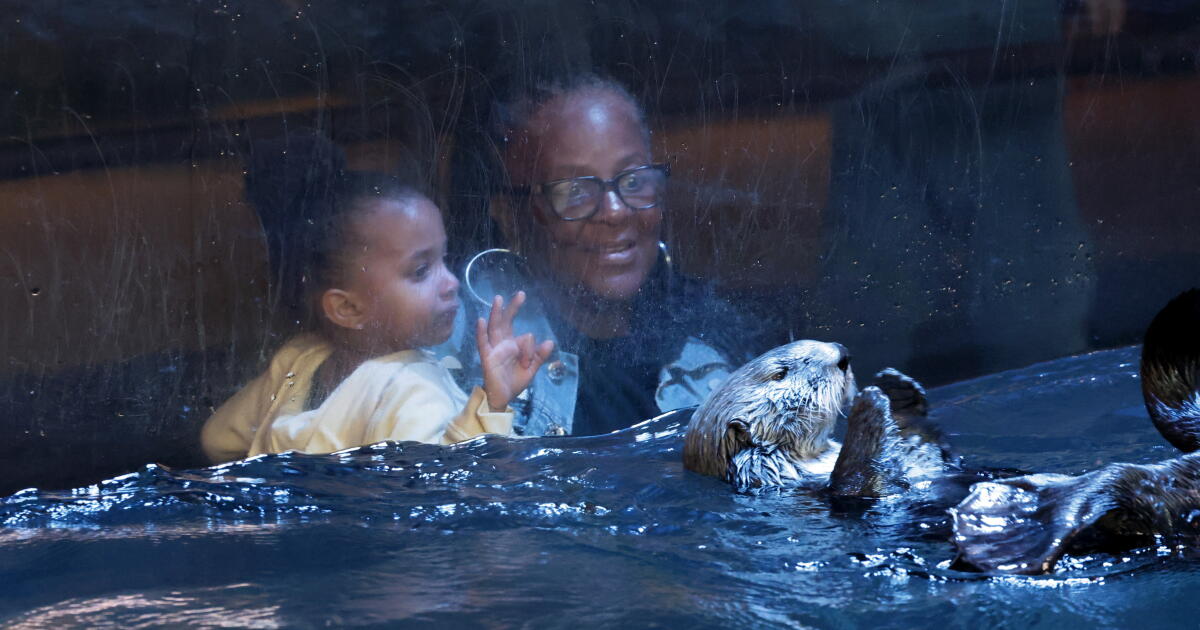
The otters the public can see at the Aquarium of the Pacific provide plenty of cuteness. (Allen J. Schaben / Los Angeles Times)
Hello 968
Toward the end of January, a passerby found 968 stranded north of Santa Cruz. Sometimes an otter mom can be heard calling out for her baby somewhere nearby. But the pup was all alone.
She was about 8 weeks old, and still dependent on her mother for survival. (Otter dads are not in the picture.)
So she was taken to the Monterey Bay Aquarium, where all sea otter pups stranded in California pass through. Her number denotes that she’s the 968th otter to enter the aquarium’s rehabilitation program.
Pups aren’t just tossed back into the surf; they must go through rehabilitation to learn how to be an otter.
So began her long, and still uncertain, path back to the chilly coastal waters of Central California.
Teaching an otter how to be an otter
The Aquarium of the Pacific’s foray into otter surrogacy is an outgrowth of the pioneering efforts of the Monterey Bay Aquarium, which started rescuing otter pups in the mid-1980s, even before it officially opened its doors.
The surrogacy concept emerged early on, said Jessica Fujii, manager of the Monterey Bay Aquarium’s sea otter program. In the wild, through their research program, staff “saw adoptions occurring naturally; it wasn’t common, but it had been seen,” she said. “So there was this thought that the strong maternal instincts that sea otters have could translate to the surrogacy in care.”
But an early attempt, in 1987, wasn’t successful. So for a time staffers tried to act as the pup’s mom, even swimming and diving alongside it in a big tidepool near the aquarium to teach it to forage.
To keep rehabilitating otters from becoming too comfortable with humans, aquarium staff members such as Brett Long watch them remotely.
(Allen J. Schaben / Los Angeles Times)
While otters raised this way were able to hunt, they didn’t always socialize properly, said Brett Long, senior director of birds and mammals at Aquarium of the Pacific. Many were too comfortable with people.
“We are very good at keeping them alive and very good at keeping them healthy,” Long said. “What we’re not very good at is teaching them how to be an otter back out there.”
Then, in 2001, the Monterey Bay Aquarium paired an orphaned pup with Toola, a stranded female otter who’d had a stillborn. The pair bonded.
From there, the aquarium tried pairing orphans with otters that hadn’t been “primed” by a recent birth. More success.
They continued refining the methods, distancing humans from the caretaking process as much as possible. Caretakers wear disguises reminiscent of Darth Vader’s getup during feedings — so they’re not recognized as people. Panels are put around their pools to block the sight of humans, and the otters are monitored remotely. Releasable otters are also never placed in aquarium displays where throngs of visitors can “ooh” and “ahh” at them.
Researchers previously thought “experience and knowledge of the ocean was the most important part” of the rearing process, Fujii explained. “And what we since learned is that really that social aspect and that kind of identification as, ‘You’re an otter,’ was really key.”
Over two decades, 70 pups have passed through the Monterey aquarium’s surrogacy program. Ten mature female otters did their part as adoptive moms. A study found the rewilded otters contributed to population growth in an estuary called Elkhorn Slough. In 2002, when the aquarium began its releases, there were only about 20 otters in the estuary. By 2016, there were more than 100.
In late February 2020, the Long Beach aquarium announced it was joining the surrogacy program as a partner and welcoming Millie, who is now 7. The pandemic around the corner delayed the program’s rollout, and it wasn’t until September 2023 that the permit was approved. But they still had to wait for a stranded otter to put Millie’s surrogacy skills to the test.
A long road home
After a three-week stabilization period, 968 was driven from Monterey to Long Beach. During the roughly six-hour drive, she had ice to munch on and cool air piped in.
When 968 met Millie in February, it wasn’t familial love at first sight — at least on the pup’s end.
She stranded later than most pups, meaning she may have had some memory of her biological mom, experts said.
“And so the first time it met Millie, it was like, ‘You’re not my mom.’ And Millie, fortunately, was just patient and was, like, ‘Hey, I’m in the pool. I’m hanging out,’” Long said.
A very chill stepmom tactic.
But by the sixth day, things were less chill. If a bond doesn’t form in seven days, then it likely never will, Long said.
Aquarium personnel would get excited every time the pup swam closer to Millie. When the two otters finally united, after nearly seven days, cheers erupted from the office where they watched the events unfold on a livestream.
Millie and 968, seen on a TV screen at the Long Beach aquarium, are now inseparable.
(Allen J. Schaben / Los Angeles Times)
“I don’t know that that’s going to fade,” Long said of the collective enthusiasm. “There’s some invested people on this project, [and] this has become a very popular corner of our administration.”
Now Millie and the pup are inseparable. In late March, 968 rested on Millie’s belly the best she could — the pup had grown to around 18 pounds, from about 11 when she arrived in Long Beach.
After a relaxing nap in the sun, they made their way to the other side of the pool. The pup, now about 4½ months old, played with a piece of a crab shell as Millie relaxed on a platform. Soon the hyper baby scampered up next to mom in what appeared to be the otter version of “Ma, look at me!” According to Long, the pup was in a stage akin to the terrible twos.
Millie, in a sense, is giving back to the program. She was raised through surrogacy herself and for a while did just fine in the wild — until people started feeding her, which is illegal, experts said.
When she was about 2½ years old, she started jumping on kayaks, and federal wildlife officials ordered her out of the water. When Millie was fished out, it turned out she was pregnant. (Millie’s story is reminiscent of the surfboard-stealing otter that became a national sensation over the summer. That otter, dubbed 841, gave birth in the wild shortly after her antics grabbed headlines.)
Millie raised her pup using the surrogacy program protocols, and it was eventually released. It appears her maternal instinct hasn’t faded.
The sea otter surrogacy program exhibit at the Aquarium of the Pacific in Long Beach doesn’t have a live video feed of Millie and 968, but it does have cute baby otter footage.
(Allen J. Schaben / Los Angeles Times)
The test
The release of 968 will depend on whether she can reach certain developmental milestones. She has to show she can care for her luxurious fur; crack open clams, mussels and other food; socialize reasonably well with other otters and avoid humans.
She’ll separate from Millie when she’s about 6 months old — the age pups typically leave “home” — and head back to the Monterey aquarium where she’ll hang out with otters closer to her own age. There, she’ll also get the opportunity to hunt live prey.
If all goes well and she passes a final health exam, she’ll return to her native waters. She’ll be implanted with a tracker and rigorously monitored for two weeks. After that period, her survival chances are as good as any otter.
Unfortunately, you can’t wave to 968.
Because the surrogacy program hinges on keeping humans away, visitors at the Long Beach and Monterey aquariums won’t be able to see the otters. The rearing pools at the Aquarium of the Pacific are tucked behind a medical center and a marine mammal protection law prohibits livestreaming their activities to the public.
However, the Long Beach aquarium has launched an exhibit explaining the program. And, yes, it does include adorable video of baby otters.
(Allen J. Schaben / Los Angeles Times)


new video loaded: NASA Announces Artemis III Crew
transcript
transcript
NASA Announces Artemis III Crew
NASA announced the crew of Artemis III mission, which will fly to low-Earth orbit to test rendezvous and docking maneuvers with one or two lunar landers.
-
“I am excited to welcome you as the next crew in the Artemis journey to successfully return to the moon — this time to stay.” “I’m honored by the role that I’ve been given. I’m also very humbled by the task in front of us. But first and foremost, I’m grateful.” “So with that, the Artemis II crew, comrade, hands you the baton. You got the controls.” “As you know, we had a significant anomaly at our Launch Complex 36A on May 28. We’ve redoubled our efforts and are moving forward.”
By Alisa Shodiyev Kaff
June 9, 2026
Science
Santa Monica Mountains’ last steelhead trout survived the Palisades fire — and even had babies

Scientists feared the Santa Monica Mountains’ last remaining steelhead trout were dead, smothered by debris flows unleashed by the Palisades fire.
But the endangered fish surprised them: A team of biologists recently spotted 30 of the rare trout — and 21 babies — in Topanga Creek.
“There was a lot of happy dancing in the creek,” said Rosi Dagit, principal conservation biologist for the Resource Conservation District of the Santa Monica Mountains, which works with public and private landowners to conserve natural resources.
That’s because the steelhead here are endangered, at both the state and federal levels. Once, they swam in most streams of the Santa Monicas, but their numbers plummeted amid overfishing and coastal development. Increasingly frequent wildfire has further stressed their habitat. Topanga Creek, a biodiversity hot spot, is home to their last known population in the mountains that stretch from the Hollywood Hills to Point Mugu in Ventura County.
The trout that were spotted, including this one, are part of a distinct Southern California population that’s listed as endangered at the state and federal levels.
(RCDSMM Stream Team)
The California Department of Fish and Wildlife spearheaded a complex mission to rescue trout threatened by the Palisades fire that sparked in January 2025.
Time was of the essence. The fire hadn’t yet been fully contained. But rain was on the way, which would sweep massive amounts of sediment from the denuded hillsides into the water. Fish are often killed this way.
Crews stunned the fish with electricity, scooped them up in buckets, trucked them to a hatchery and ultimately moved them to Arroyo Hondo Creek in Santa Barbara County.
Within days, Topanga Creek was choked with mud. Some assumed the fish left behind were goners.
But in March, the conservation district’s team found four. The following month, when water conditions were clearer, they saw more.
“These fish continue to amaze me,” said Kyle Evans, environmental program manager for the state Department of Fish and Wildlife, who had seen the damage to the creek. “I had seen populations get wiped out in similar situations. So when I heard, I was thrilled.”
Evans surmises the fish that survived were in an area of the creek where less charred material and sediment were swept in.
“These fish likely hunkered down, were hiding under some rocks or places to try to get away from the main concentration of flow,” he said. “And luckily they weren’t buried.”
The ones that were spotted were fairly small, around 6 to 14 inches. Rainbow trout and steelhead trout are the same species, but with different lifestyles. If the fish remain in freshwater, they’ll be considered rainbows. However, they can migrate to the ocean and become steelhead, where they typically grow larger before returning to their natal waters to spawn.
Topanga Creek hasn’t fully recovered from the damage it sustained, but scientists say it’s looking better. Surveys last year were “so depressing,” Dagit said, with very few animals, and stretches that were essentially transformed into flat roads from all the sediment buildup. Some of the riparian canopy burned right down to the creek.
Then came 32 inches of rain over the last nine months, scouring out and moving sediment, creating deeper pools. Dagit said they recently found newt egg masses for the first time in years, as well as a few adult newts and many frogs. Plants that provide cover are starting to recover.
She provided photos comparing certain pools last year and this year, some dramatically transformed. In September 2025, the Shrine Pool could have been an overgrown hiking trail. This April, it was filled with shallow water.

The Shrine Pool in September 2025, left, and the same location in April 2026, right, with RCDSMM’s Isaac Yelchin donning a wetsuit.
(RCDSMM Stream Team)
Topanga Creek is home to another endangered fish, the small but hardy northern tidewater goby, often described as cute. Not long before the trout operation, Dagit led a rescue of hundreds of these fish too. Many were repatriated to the lagoon at the mouth of the creek in a moving ceremony last June.
There’s still the matter of what to do with the trout that were moved to Santa Barbara County last year. Evans would like to bring them home to the Santa Monicas at some point, but isn’t sure if it will happen. On one hand, they could bolster the small, genetically isolated surviving population. On the other, they might inadvertently bring in a disease or bacteria. There is some time to decide. Evans estimates the creek still needs to recover for two to three more years.
For now, the fish are functioning fine in their adopted creek. Experts worried the trauma wrought by the move would disrupt their spawning process, but they had babies that spring. This year, they spawned again.

The Pacifica Municipal Pier was shut down and taped off Thursday after city workers noticed cracks running through the landmark structure and concrete chunks falling into the ocean.
It’s just one of many coastal California structures that have recently crumbled under pressure from a rising and relentless ocean.
Officials from the small, beach city south of San Francisco said the pier was closed due to “cracking, separation, and displacement of the concrete walkway and structural elements.”
It will stay closed while structural engineers asses its safety.
Photos taken by city employees show a wide crack that runs from top to bottom and across the structure as well. Other photos show a large horizontal crack under the foundation of a small restaurant on the pier, the Chit Chat Cafe.
The cafe was also shut down.
This is not the first time the 53-year-old pier has shown signs of stress. In 2021, part of it was shut down after handrails along the edge collapsed. And in 2023, after a series of storms pummeled the Central California coast, damaging parts of the pier, the structure was partially closed for more than year.
Those same storms caused extensive damage in Aptos and Capitola, 70 miles south, where piers and waterfront infrastructure were swept away or damaged.
In 2024, a 150- to 180- foot section of the Santa Cruz wharf was ripped off by powerful waves.
At least 10 of the state’s dozens of coastal public piers were closed for part or all of 2024 due to structural damage sustained in winter storms since 2022. At least five others have longer-term upgrades planned to address structural issues.
“These things are costly to maintain,” said Zach Plopper, senior environmental director at Surfrider. “They are a part of our California coastal culture in many ways, but we’re going to need to reckon with, one, the state that they’re in, and two, the continuous and worsening threats they’re going to experience,”
He said most of the piers were constructed in the early 1900s, and they weren’t built to withstand decades of rough seas, storms and rising sea level.
“With this incoming El Niño, which is forecasted to be significant, and this marine heat wave we’re in the midst of, we’re kind of in uncharted waters as far as what this winter could bring in terms of storms and swells to the California coast, and we’re likely going to see a lot more damage,” he said. “Not just piers, but roads and other coastal infrastructure up and down the state.”
There was no storm in Pacifica earlier this week, so no single event could be blamed for the destruction.
However, a 2025 report from an outside engineering firm, GHD, found that several sections of the pier were in “poor” or “serious” condition, and they recommended closure before anticipated storms or events that could “subject the piles to high winds, swells and large waves.”
The firm found several areas of the pier where concrete was missing and rebar was exposed and corroding.
“The pier has continued to experience high winds and large waves in a harsh marine environment,” the engineers wrote in the report, noting that continuous exposure to seawater or marine spray was “detrimental” to the structure.
A 2023 city report estimated it would cost $19 million to repair.
That same year, a state law was enacted to require local governments along the California coast to plan for sea level rise in the coming decades.
Sea level has risen some 8 inches, on average, along the coast in the past 150 years, Plopper said, and researchers anticipate another foot in the next 25 years.
“We’re going to see profound shifts on our coastline, none that we have ever experienced before, and building static structures on the coast just doesn’t work all that well,” he said. “We’re going to have to make some really hard decisions.”
-

 New York54 minutes ago
This Parking Spot Is Free. Should It Be?
-

 Los Angeles, Ca59 minutes ago
O.C. Uber customer says driver asleep in Tesla on 405 Freeway
-

 Detroit, MI1 hour ago
One person dead, another in custody following shooting in Detroit, police say
-

 San Francisco, CA2 hours ago
Bay Area artists celebrate Wong Kim Ark’s legacy in San Francisco’s Chinatown
-

 Dallas, TX2 hours ago
Plano’s new tax increment reinvestment zone could allocate $700M for Dallas Stars arena
-

 Miami, FL2 hours ago
Home intruder shot and killed in Miami Gardens
-

 Boston, MA2 hours ago
Rays hold on to beat Tolle, Red Sox 4-3
-

 Denver, CO2 hours ago
The steep price the Denver Nuggets must pay to get off Zeke Nnaji’s contract

