Washington, D.C
The best things in Washington, DC with kids


America’s capital city is a fantastic destination to visit with children in tow. It’s filled with kid-friendly museums, has an abundance of parks in which younger visitors can burn off excess energy, and a logical, pedestrian-friendly layout (let’s not forget that DC was designed to showcase urban planning at its very best).
Here are our top tips for exploring the city with children.
Is Washington, DC, good for kids?
As America’s first purpose-built city, Washington, DC, is, in many ways, a dream to explore with younger visitors. It’s flat with very few hills, and roads and sidewalks are wide, smooth and well-maintained, perfect for parents pushing strollers.
Almost all of DC’s top attractions are refreshingly accessible – every Smithsonian Museum has ramps, for example, and most museums and major landmarks will have family-friendly restrooms. Generally, you’ll almost always be able to enter with strollers, although the White House, which has some of the tightest restrictions, is one of the few places where strollers are on the banned list.
The large number of gardens and parks means there are endless places for kids to burn off excess energy – the National Mall, for example, has over 20,000 trees and numerous dedicated picnic areas with benches and tables. Thirsty kids (and their parents) are also in luck – most businesses, including restaurants, museums and galleries, will happily top up water bottles, and you’ll find public water fountains throughout the city, including 47 on the National Mall alone.
A tactical approach to timing can transform your holiday. If you’re visiting during August and September (the hottest months of the year), you’ll want to avoid spending too much time outside in the late morning and early afternoon. Take advantage of the extended opening times offered by many museums – crowds tend to thin out after 5pm, and the Library of Congress, the Smithsonian Museum of Natural History and the National Gallery of Art are just a few of the institutions that run so-called “late nights.”
Catching public transport
Public transport in Washington, DC, is also incredibly accessible, and all train stations have ramps, elevators and extra-wide ticket gates designed with strollers and wheelchairs in mind. All Metro trains have priority seating, usually next to the train’s doors. Almost all public buses have ramps, although if you’re traveling with a stroller, check the size – most buses, including the DC Circulator buses, won’t allow strollers more than 48″ long and 24″ wide.
Getting around DC is easier than you think – here’s how

Best things to do in Washington, DC, with babies and toddlers
National Museum of American History
At the National Museum of American History, parents can take some time out at the Wegmans Wonderplace in the museum’s west wing. This baby and toddler-friendly hangout has a playroom, family restroom and nursing area (complete with nursing pillows).
Rock Creek Park
The beautiful Rock Creek Park north of the city center has 1754 acres to explore and plenty of fantastic picnic spots (including several next to waterfalls). Toddlers will love the park’s Discovery Room, filled with hands-on exhibits and children’s books about wildlife, and many of the trails – including the Edge of the Woods Trail – have been designed with strollers and wheelchairs in mind.
Best things to do in Washington, DC with children
US Botanic Garden
The US Botanic Garden, which is free to visit, has a dedicated Children’s Garden where younger visitors can help staff care for the various plants, along with a scavenger trail lined with rare plants – kids who spot certain species can get a passport book stamped.
A boat tour along the Potomac
A riverboat tour is a great activity for kids, who can tick off the city’s famous landmarks as they float along the Potomac. Capitol River Cruises offers a range of sailings, although their 45-minute scenic sightseeing cruise hits all the highlights. Tickets are priced around $25 for adults and $15 for children between three and 12. Kids under three are free.

Best things to do in Washington, DC with teenagers and tweenagers
Mount Vernon
Let’s face it: teenagers and tweenagers are prone to occasional protestations of boredom, but we’ve got the perfect solution for anyone who starts to moan about being “museumed out.”
For a change of scenery, head across the water to the Mount Vernon estate, the former home of George and Martha Washington. You can explore the main house on guided tours, watch sparks fly in the blacksmith’s shop and stop by the estate’s working farm (activities here include sheep-shearing lessons and the chance to pet the ridiculously cute Hog Island Sheep). Not only will you learn about the Washington family – you’ll also gain insights into the lives of people enslaved on the estate. The estate is 15 miles south of Washington, DC. To get there, take the metro’s Yellow Line to Huntington Station before hopping on the Fairfax Connector bus to Mount Vernon.
The International Spy Museum
Wannabe James Bonds will love L’Enfant Plaza’s International Spy Museum, which is filled with interactive exhibits, including ones that encourage them to take part in their very own undercover mission. Our only gripe is that this is one of the few museums that isn’t admission-free. Entry fees vary according to the time of year, but children’s tickets start at around $19, while adults’ tickets start at around $29. Children aged under six visit for free.
Paddle across the Tidal Basin
This is a two-mile-long reservoir wedged between the Potomac River and the Washington Channel. Teens and tweens can hire a paddle boat (from $38 per hour) and admire landmarks such as the Jefferson Memorial and Martin Luther King Jr. Memorial from the water.
Planning tips
- Don’t underestimate how accessible DC’s transport network is – the city’s bus and metro system is refreshingly easy to navigate.
- If you’re visiting a museum or gallery, always ask what kid-friendly programs and events are taking place.
- DC has plenty of places to cool off, including lots of splash parks, such as The Yards Park in the Capitol Riverfront area. There’s a large splash pool and brightly lit dancing fountains after dark. Another notable destination is Canal Park Fountains (also in the Capitol Riverfront area), which has numerous fountains and splash pools with stepping-stone crossings.
- Always ask what kid-friendly freebies are available. For example, staff at the US Capitol’s visitor center have stashes of police badges to hand out to children.
- Whether it’s a museum, gallery or landmark, always book in advance if tickets are required, even if tickets are free – you won’t just get guaranteed entry but will also cut queuing times.
Keep planning your trip to Washington, DC:
These experiences should be on your DC itinerary
And these incredible experiences won’t cost you a thing
Get up close with nature and more history on these day trips
Get to know DC like a local in these top neighborhoods


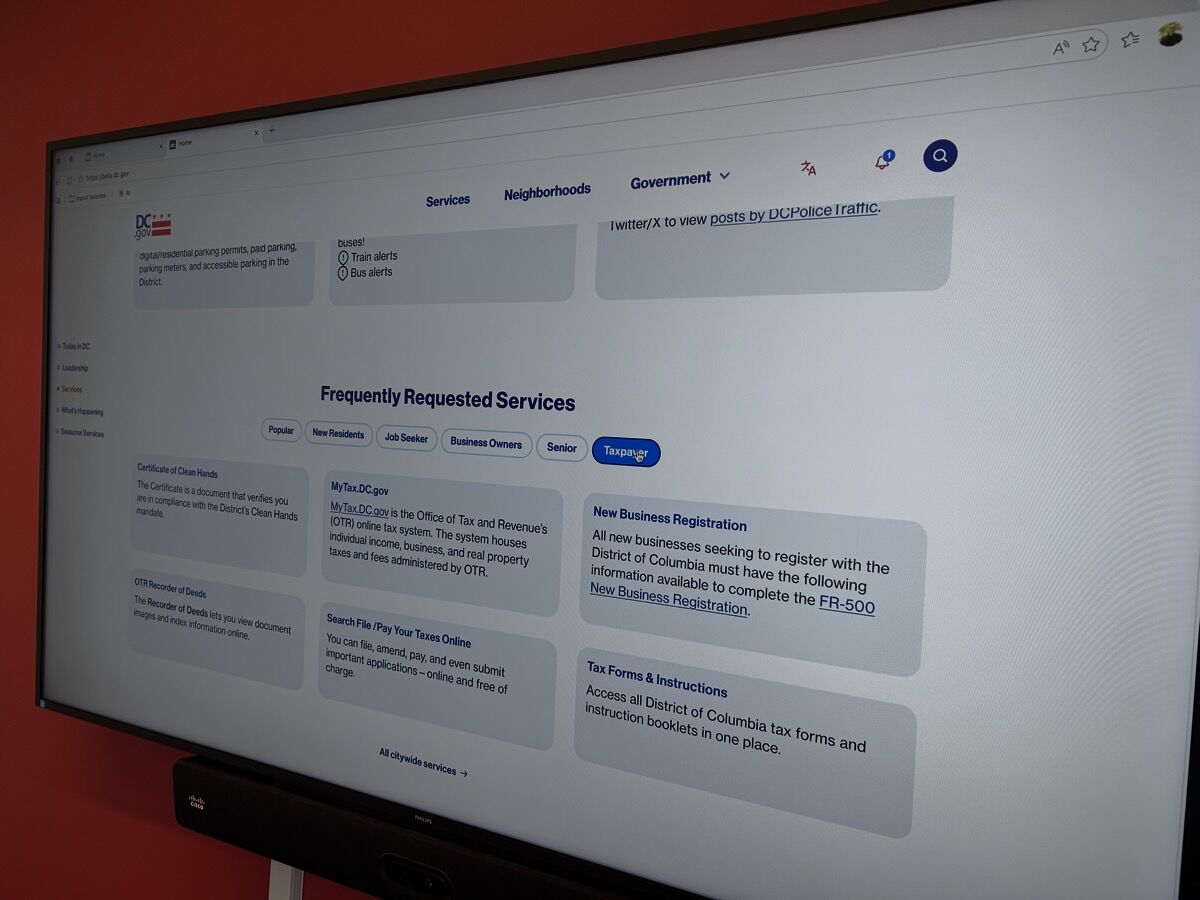
The overhaul is the first in more than a decade and comes in response to feedback that it’s hard to find information on the current site without being efficient at using Google or other search tools.

The D.C. government’s website is getting a complete revamp, a step city leaders hope will make it easier for residents, visitors and business owners to access the help they need.
The District unveiled a beta version of the new DC.gov — beta.dc.gov — and plans to have the redesigned site ready to launch before the end of the year.
The website’s overhaul is the first in more than a decade. It comes in response to feedback that it’s hard to find information on the current site without being efficient at using Google or other search tools.
“This website, it’s really going to eliminate the alphabet soup that you have to remember every day,” said Stephen Miller, the District’s chief technology officer. “So, do you need to know that it’s DPW that’s picking up your trash, or you just need to know that it’s dc.gov?”
The site is built on Drupal 11, which the city said has stronger built-in security features. It includes an integrated calendar and sections for seasonal government services.
Popular searches, based on site traffic data, will also be featured prominently on the main page.
“It’s going to show you, here’s popular services today, based on being a resident, based on being a new resident, based on being a job seeker, based on being a business owner, or based on just being a general resident of the city,” Miller said.
The project cost about $500,000 in dedicated funds.
“We’re setting this up so that you can just go in, say, ‘My trash was missed,’ and it’s going to tell you exactly how to fix that problem,” Miller said.
D.C.’s Office of the Chief Technology Officer is collecting feedback. Residents can leave comments on the beta site and at events at Haynes Senior Wellness Center and Eastern Market, among others, in the coming weeks.
An artificial intelligence-powered search tool, built using Google’s AI technology, will be included on the new DC.gov site after its official launch.
The District, Miller said, is “trying to clean up our content, because what we want to make sure is when we put AI into this site, it’s giving you the right information.”
“We see a lot of future use with AI,” Miller said. “I’d love to get to a point where it’s, ‘Hey Siri, renew my driver’s license,’ and we’ve laid out the foundation for something like that to happen in the future.”
Get breaking news and daily headlines delivered to your email inbox by signing up here.
© 2026 WTOP. All Rights Reserved. This website is not intended for users located within the European Economic Area.

A 16-day state fair is among the biggest attractions of the country’s 250th celebration in Washington DC. The Great American State Fair, which features attractions from each of the 50 states, runs from 25 June to 10 July across the National Mall from the US Capitol to the Washington Monument.
The BBC asked visitors why it was important for them to attend the fair.
Video by Meiying Wu
Produced by Madeline Gerber
Washington, D.C
Great American State Fair opens Thursday on National Mall. See hours and security info

The Great American State Fair, celebrating the United States’ 250th birthday, opens Thursday, bringing a Ferris wheel, special exhibits and road closures to the National Mall.
D.C. residents and visitors may have seen a Ferris wheel towering 110 feet over the fairgrounds. It’s free to ride, and it’s the first-ever Ferris wheel to be on the National Mall, a Talley Amusements spokesperson said on social media.
Visitors will also find exhibits representing all 56 states and territories, fair organizers Freedom 250 said, although some states decided not to sponsor programming, several media outlets reported. Metro will showcase its newest and oldest railcars at the fair.
Expect road closures and Metrobus detours into July.
Great American State Fair hours
The Great American State Fair is free and opens to the public at 10 a.m. Thursday. It runs daily through July 10. Each day has a theme, including Make America Health Again (MAHA) Mondays and Military & Veterans Appreciation Day on Sunday, June 28.
Fair hours will be 10 a.m. to 9 p.m. Sunday to Wednesday, 10 a.m. to 11 p.m. Thursday to Saturday.
Fairgrounds will be open 10 a.m. to midnight on July 4, when President Donald Trump promised “the largest pyrotechnics display in the history of the world.”
Great American State Fair security: bag policy and prohibited items
Visitors must go through security at the gates on either 12th or 7th street.
“To enhance security screening and expedite entry into the event venue, all attendees will be required to follow the Clear Bag Policy,” the event’s website says. Bags are subject to inspection.
Bag policy: Each guest may bring one clear, see-through bag that does not exceed 12″ x 6″ x 12″. A small clutch purse not exceeding 10″ x 6″ x 2″ is also permitted. Anyone accompanying a child 6 or under can bring one diaper bag.
Prohibited items: Aerosols (including bug spray and sunscreen), animals, backpacks, food, water bottles, umbrellas, balls, drink tumblers, drones, glass and metal containers, packages, selfie sticks, sign supports, toy guns and weapons of any kind, including firearms, are among prohibited items. See a full list on the event’s website.
Driving and walking anywhere near the National Mall is drastically different as it’s being transformed for the state fair. News4’s Mauricio Casillas reports.
How to get to the Great American State Fair
Organizers recommend you take public transit or ride share. Nearby Metro stations include Federal Triangle and Smithsonian on the Blue, Orange and Silver lines; Archives on the Green and Yellow Lines; and Gallery Places on the Green, Yellow and Red lines.
You can use Metro’s Trip Planner tool or apps like Google Maps to get directions.
“All ride-share services (Uber, Lyft, taxi, etc.) must use the designated Ride-Share Pick-Up & Drop-Off areas. Locations will be updated and communicated at a later time,” the event’s website said on Thursday morning.
President Trump kicked off fair after artists dropped out
Trump formally kicked off the celebrations on Wednesday night with a rally that included a series of flyovers by stealth bombers, military bands and Lee Greenwood singing “God Bless the USA.”
“There has never been anything like the United States of America, and together we are making it bigger and better and stronger and far more exceptional than ever before,” Trump said.
Trump announced he would headline the event after several musicians pulled out of the event’s concert series. Some artists have said they were misled about the event’s theme and want to avoid political controversy.
The event is organized by Freedom 250, a public-private partnership created by Trump that labels itself as a nonpartisan nonprofit organization, NBC News reported.
The fair is just the latest event drawing crowds downtown, prompting extra security and road closures. It follows the UFC fight, problems with the Reflecting Pool and the debut of a FIFA World Cup fan zone.
In August, the Freedom 250 Grand Prix will send cars speeding at 190 mph through D.C.
Subscribe to The Weekend Scene, our free newsletter about events, experiences and adventures for you and for your family around the DMV.
-

 Technology6 minutes ago
World Cup ticket scams target desperate fans
-
Business8 minutes ago
Snap sued by parents of girl who was raped by man she met on Snapchat
-
 Entertainment14 minutes ago
‘The Bear’ at closing time: Ayo Edebiri and Jeremy Allen White reflect on five seasons
-
 Lifestyle21 minutes ago
L.A. Affairs: After decades of near-misses, I finally told him: ‘I’m not leaving here without you’
-
 Politics24 minutes ago
Trump budget request omits funds for L.A. fire relief, prompting criticism from senators
-
 Science29 minutes ago
EPA touts crackdown on smuggled pesticides in L.A. visit
-
 Sports36 minutes ago
Commentary: Did Padres curse themselves by messing with that anti-Dodgers FTD burger?
-

 World44 minutes ago
Copernicus lead warns extreme heat measures needed or deaths to ensue

