Business
Column: Republican states would rather keep poisoning children with lead than pay for a fix

Here are a few things we know about lead in drinking water:
◆ There is no known safe level. More than a decade ago, the Centers for Disease Control and Prevention ceased setting minimum acceptable standards for children’s blood lead levels.
That was because scientific studies couldn’t identify any concentration that didn’t have “deleterious effects” on children’s health. The only proper approach, the CDC said, is prevention “to ensure that no children in the U.S.” face any exposure to lead.
Lead exposure causes damage to the brain and kidneys and may interfere with the production of red blood cells that carry oxygen to all parts of the body.
— Environmental Protection Agency
◆ Removing all the sources of lead exposure is expensive, but over the long term a sound investment, for it eliminates long-term effects that lead to massive healthcare costs, cognitive deficits and higher crime rates.
◆ Children in low-income and minority neighborhoods are the most seriously affected, because their families have few options to avoid exposure. The lead crisis in Flint, Mich., erupted as a national scandal in 2011, but it was the tip of the iceberg.
◆ Industry has been opposing abatement programs for decades — in California, for instance, three companies that produced and promoted lead paint for homes fought a 19-year legal battle to evade the costs of residential abatement. They finally reached a $305-million settlement with several counties and cities in 2019.
That brings us to the latest initiative by the Republican attorneys general of 15 red states, aimed at stifling a lead abatement initiative of the Biden administration.
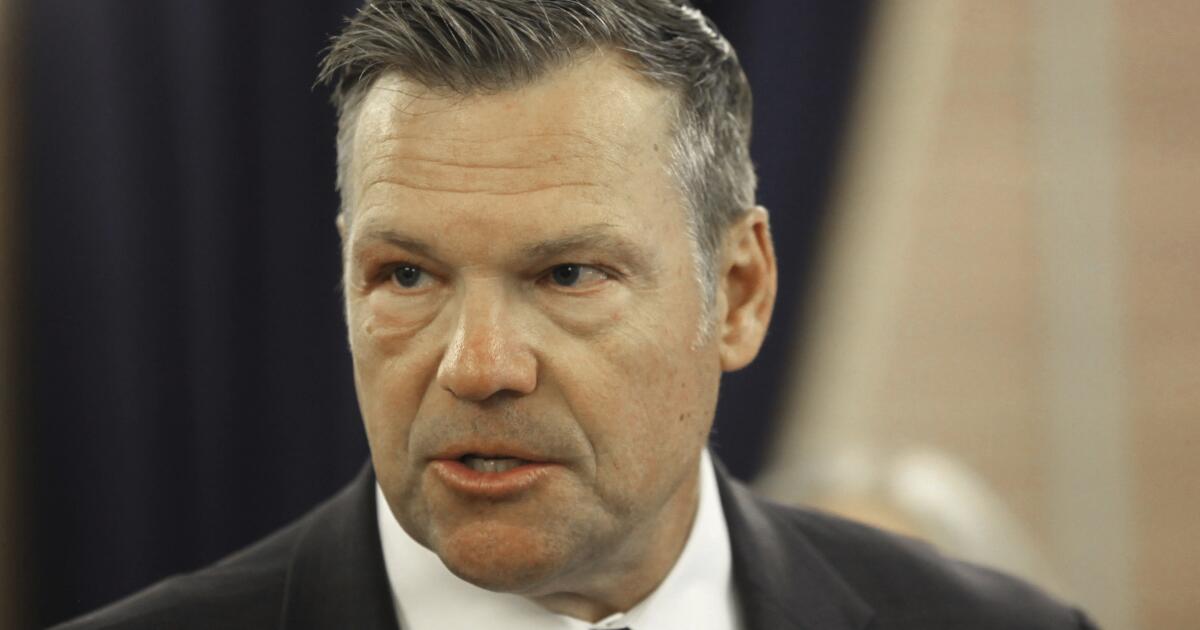
Led by Kansas Atty. Gen. Kris W. Kobach, they’ve taken aim at a proposal by the Environmental Protection Agency to order the removal of some 9 million lead water lines across the country. The rule conforms with an action plan Biden issued in 2021 aimed at replacing 100% of the lead water lines serving homes in the U.S.
You may remember Kobach’s name from his adventures waging various right-wing culture battles, all of which he lost — often at the expense of the localities that followed his lead as Kansas secretary of state. These included failed efforts to enact draconian anti-immigration ordinances.
In 2018, Kobach suffered a mortifying defeat at the hands of a federal judge who overturned a Kansas law he championed that required proof of citizenship to vote. The judge further held him in contempt for repeatedly flouting courtroom procedure.
Kobach lost races for governor in 2018 and the U.S. Senate in 2020, but managed to win a race for attorney general in 2022. From that perch he has been pressing his new cause — exposing Kansans to lead in their drinking water.
In a comment letter to the EPA, Kobach and his colleagues call the proposed rule “unworkable, underfunded, and unnecessary.” They also say the benefits “may be … entirely speculative.”
They suggest it’s an infringement of states’ rights, which is an argument that has seldom been heard since the Civil War.
The Kobach cabal, which encompasses the attorneys general of Arkansas, Florida, Georgia, Idaho, Louisiana, Iowa, Mississippi, Montana, Nebraska, South Carolina, South Dakota, Texas, Utah and Wyoming, further asserted that private homeowners would “bear the brunt of the costs.”
With one exception, all these claims are false. The one true assertion is that the mandate is underfunded. Estimates of the cost of meeting the EPA’s proposal run from about $45 billion to $60 billion.
Biden’s 2021 infrastructure bill allocated $15 billion for the purpose — but he originally proposed $45 billion, which was pared down in congressional negotiations.
As for the rest, obviously the rule isn’t “unworkable.” The EPA proposes to give localities and utilities 10 years to complete the mandated replacements, averaging 10% of the work per year. The red states say that’s an unreasonably “tight timeline.” But the rule makes municipalities with especially numerous lead pipes, such as Chicago, Cleveland, New York and Detroit, eligible for extensions.
The technology and engineering necessary for the job are well understood. Newark, N.J., replaced its more than 23,000 lead water lines via a three-year, $170-million program that commenced in 2019, all at no direct cost to homeowners — despite what Kobach et al. claimed. Green Bay, Wis., completed the replacement of its 2,000 lead lines in 2020, after a five-year effort that also required no out-of-pocket spending by homeowners.
Is it “unnecessary”? Are the benefits “speculative”? Surely not.
The adverse health impacts of lead in drinking water are absolutely indisputable. The EPA’s proposed rule spelled them out, with citations to the relevant scientific data.
“Lead exposure causes damage to the brain and kidneys and may interfere with the production of red blood cells that carry oxygen to all parts of the body,” the proposal stated. “The most susceptible life-stages are the developing fetus, infants, and young children…. Because they are growing, children’s bodies absorb more lead than adults do, and their brains and nervous systems are more sensitive to its damaging effects. As a result, even low-level lead exposure is of particular concern to children.”
As for the special vulnerability of children in low-income communities to these conditions, a 2021 study in JAMA Pediatrics found that children in those communities are nearly 2.5 times as likely to have elevated blood lead levels compared with those in low-poverty areas.
Another 2021 study found that Black infants suffered a 50% higher average loss of IQ points attributable to blood lead than white or Hispanic infants, costing them an estimated loss in lifetime earnings of more than $47,000.
These considerations should make the eradication of lead from drinking water a major goal for a party that claims to be devoted to the health and welfare of children, even before infancy. But actions speak louder than words, and the actions of Republicans tell us that they care a lot more about money than about children.
Let’s start with the lead water pipe rule that the new EPA proposal aims to replace. The old rule was promulgated by the EPA under Trump. It was issued on Jan. 15, 2021, five days before Trump left office.
The Trump rule left in place a preexisting standard of 15 parts per billion of lead in water that had been the trigger for lead pipe removal. That was three times the level deemed the maximum allowable in Canada and the European Union, the Natural Resources Defense Council reported.
The Trump rule also extended the deadline for pulling out lines in the most heavily contaminated systems to 33 years, from 14. The NRDC estimated that the weakened standards would leave more than 5.5 million people exposed to heavily contaminated drinking water for decades to come.
The Biden administration suspended the Trump proposal upon taking office. That won support from the attorneys general of eight states, including California and the District of Columbia, who rightly labeled exposure to lead “a public health issue of paramount importance.”
The proposal being challenged by the Republican attorneys general is its replacement. It accepts no compromise in pulling the most dangerous sources of lead poisoning out of the ground.
No one disputes that eliminating lead from drinking water is an expensive undertaking. But if Kobach and his colleagues are really concerned that the EPA rule is an “unfunded mandate,” as they label it in their comment letter, there’s an obvious solution: They should turn their political influence to persuading their congressional delegations to funding it.
Those 15 states have 30 senators among them (all but three Republicans) and 118 House members (83 of whom are Republicans). That would be a good start at getting billions more appropriated to cover removal of every lead pipe in the country. If they truly care about the children, what are they waiting for?


An Orange County real estate investor accused of criminally defrauding an Arizona bank of nearly $100 million pleaded not guilty Monday and remains in custody.
Mahender Makhijani, 44, of Corona del Mar — who also was ordered by an arbitrator to pay $1.34 billion in a separate civil fraud case — was arraigned in Santa Ana federal court on two charges.
He is accused of bank fraud and making a false statement to a bank in a June 8 case involving a $100 million real estate loan made by Phoenix-based Western Alliance Bank. He was taken into custody on June 10.
Makhijani is accused of providing bogus collateral for the October 2024 loan now in default. In a civil lawsuit, Western Alliance said the outstanding balance as nearly $99 million.
Prosecutors say he falsified title insurance policies that showed the bank would have a first lien on the underlying collateral if the loan went bad, when in fact it did not.
A trial was set for August 11 before U.S. District Judge David O. Carter in Santa Ana.
Michael Schachter, his criminal defense attorney, did not respond to messages seeking comment.
In the civil case, an arbitrator in May ordered Makhijani to pay Laguna Beach real estate mogul Mohammad Honarkar $1.34 billion after ruling he had fraudulently induced him into a 2021 joint venture — and then wrested control and lost to creditors more than two dozen properties Honarkar had owned.
Makhijani has not been criminally charged in that case, but prosecutors alleged in an affidavit in support of the bank fraud charges that he used “force and threats” in his dealings with Honarkar and others — including taking over the landmark Hotel Laguna in 2023 that Honarkar was renovating.
Prosecutors sought to hold Makhijani without bail after his arrest.
The affidavit noted he is a legal Indian immigrant with a home and bank accounts in that country, has access to private jets and threatened to “run away” if caught in a difficult situation.
The request was denied and he was granted $500,000 bail.
However, Makhijani remains in custody after a hearing sought by prosecutors last month before Magistrate Judge Autumn Spaeth.
The judge declined to accept a $450,000 cashier’s check submitted by a Makhijani associate for the bail, finding insufficient proof the source of the funds was legitimate, according to court records.
Makhijani is not prominent outside Orange County real estate circles, but he established a thriving distressed-assets business over the last decade that attracted prominent Southern California real estate investors.
Prosecutors said it paid for a lifestyle that included two multimillion-dollar homes in Corona del Mar, a luxury apartment in Newport Beach and various luxury vehicles.
As of last month, prosecutors had not fully traced his assets, which they believe are not held in his name and some of which may be in India.
The businessman employed an array of shell companies and strawmen to sign documents on his behalf, and to stand in for him as operators of his companies, according to the affidavit.
Makhijani told an associate he took extra precautions because wanted to insulate himself from litigation and that “they were sharks in the distressed world who took advantage of people,” the affidavit stated.
Business
Many indie festival films struggle to get distribution. Alamo Drafthouse is trying to change that

Dine-in movie theater chain Alamo Drafthouse Cinema is launching a new initiative to show unreleased independent films that had successful festival runs, a move that comes as specialty films have struggled to gain distribution.
The Alamo Exclusives program, announced Wednesday, will give limited theatrical runs to films that showed at festivals including Sundance, the Toronto International Film Festival, Tribeca Festival and South by Southwest festival, as well as Alamo’s own Fantastic Fest.
The idea is to help showcase films that received critical acclaim, but did not secure distribution or acquisition deals. The chain will not acquire these films, but instead will enter into agreements with filmmakers to exhibit their films on Alamo Drafthouse screens. By showing these films to audiences on the big screen, these films could get the momentum they need for further opportunities.
The program’s first film will be the documentary “Butthole Surfers: The Hole Truth and Nothing Butt,” which debuted last year at South by Southwest and chronicles the history of the punk rock band.
The film will be shown in Alamo Drafthouse theaters for a limited time later this summer.
The Austin-based chain, which is owned by Sony Pictures, has a long history of curating indie films for its audiences, giving Alamo Drafthouse confidence that its viewers want to see these kinds of movies, company chief executive Michael Kustermann said in a statement.
“Time and again, they’ve shown they’ll come out to support bold, original films when given the opportunity,” he said. The new Alamo Exclusives “gives us another way to champion filmmaker-driven films that deserve to be discovered and connect them with the wider Alamo Drafthouse audience.”
The initiative comes at a difficult time for indie films. Since the pandemic upended the movie business, traditional studios and distributors have had less appetite for risk, including betting on smaller indie films out of festivals.
And as the 2023 dual writers’ and actors’ strikes thinned out theatrical lineups, that aversion to uncertainty became a push for reliable and profitable hits.
“Too many incredible films premiere at festivals and then never receive the theatrical life they deserve,” Lisa Dreyer, director of Fantastic Fest and film innovation at Alamo, said in a statement. “We are actively searching for films across all genres, from horror to comedy, to everything in-between, to champion in this new, exciting way.”

The recall of a popular chip brand over salmonella concerns was recently upgraded to the U.S. Food and Drug Administration’s highest level, just ahead of the Fourth of July holiday and countless backyard barbecues.
On June 24, the FDA designated the recall of several varieties of Zapp’s and Dirty brand potato chips as Class I, meaning it’s “a situation in which there is a reasonable probability that the use of or exposure to a violative product will cause serious adverse health consequences or death.”
FDA has classified the following items as Class I:
Zapp’s
- 1.5-ounce Zapp’s Bayou Blackened Ranch Kettle Chips
- 2.5- and 8-ounce Zapp’s Bayou Blackened Ranch Potato Chips
- 1.5- and 8-ounce Zapp’s Big Cheezy Potato Chips
Dirty
- 1.5- and 2-ounce Dirty Brand Salt and Vinegar Potato Chips
- 2-ounce Dirty Maui Onion Chips
- 2-ounce Dirty Sour Cream and Onion Potato Chips
The chips are produced by Utz Quality Foods, LLC, which on April 28 issued a recall after learning “that a seasoning containing dry milk powder, sourced from California Dairies, Inc. and supplied by a third-party supplier, may contain the presence of Salmonella.”
Salmonella can lead to sometimes deadly infections in elderly people, young children and those with weakened immune systems, according to the FDA.
More than 680,000 bags are included in the recall.
Anyone who has these products should not eat them and should discard them immediately.
What to look for
Salmonella is a foodborne illness that can be fatal to young children, pregnant women, older adults and people with weakened immune systems, according to the National Institutes of Health.
Symptoms may develop 12 to 72 hours after infection, according to the FDA.
The FDA said that people with strong immune systems infected with salmonella may experience fever, diarrhea (which may be bloody), nausea, vomiting and abdominal pain. The illness can last four to seven days.
In rare cases, the infection may produce more severe illnesses such as arterial infections, endocarditis and arthritis, the agency added.
What to do if infected
If you contract salmonella, the Centers for Disease Control and Prevention recommends drinking plenty of fluids to prevent dehydration.
The CDC advises consulting a doctor before taking antidiarrheal medicine or antibiotics. If severe symptoms continue after two days, seek medical help, the agency says.
Because those with diarrhea can spread salmonella to others, it’s also recommended to avoid sharing food or preparing meals for others, sexual contact and swimming in public pools, and to stay home while sick.
Times staff writer Jasmine Mendez contributed to this report.
-

 Minneapolis, MN1 minute ago
MPD allegations under spotlight
-

 Indianapolis, IN4 minutes ago
Council Approves Increase in Indy Vehicle Tax
-

 Pittsburg, PA9 minutes ago
Overturned truck spills hazardous materials on the 62nd Street Bridge
-

 Augusta, GA16 minutes ago
Augusta Volleyball Announces 2026 Schedule, Promotional Calendar – Augusta University
-

 Washington, D.C19 minutes ago
Storm Team4 Forecast: Foggy morning before chances of scattered showers, storms
-

 Cleveland, OH24 minutes ago
1 dead, 3 injured in early morning shooting on Cleveland’s East Side
-

 Austin, TX31 minutes ago
POLL: Should Texas pass stricter or looser laws on THC products?
-

 Alabama34 minutes ago
How the 2026 Rose Bowl made Alabama football quarterback Austin Mack

