Plus special access to select articles and other premium content with your account – free of charge.
Please enter a valid email address.
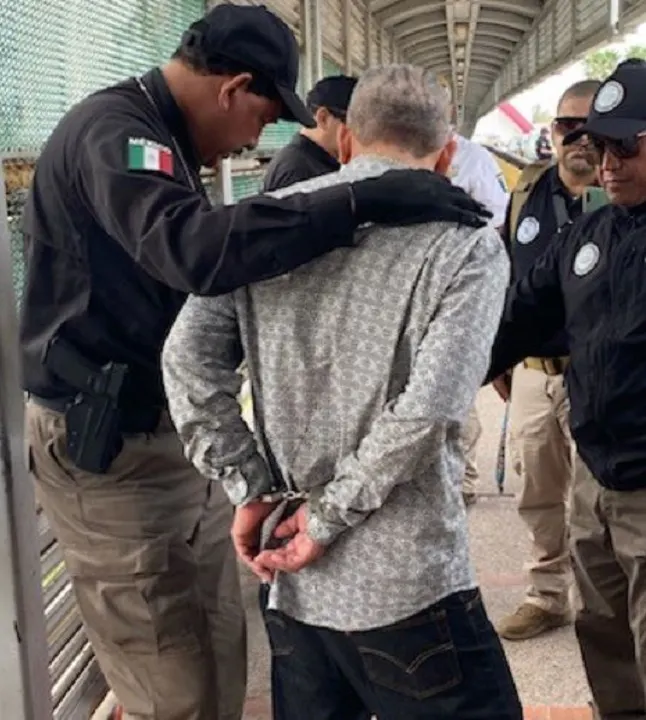
Immigration authorities deported a Mexican citizen to his home country last month to face charges for murder and other crimes dating back decades.
Joaquin Villalobos Navarro, 54, was turned over to Mexican authorities at the southern border in Brownsville, Texas, on Feb. 28, U.S. Immigration and Customs Enforcement said Friday.
Advertisement
DEMOCRATS ANGERED AT BIDEN AFTER HE CALLS LAKEN RILEY’S ALLEGED KILLER AN ‘ILLEGAL’: ‘EXTREMELY DISAPPOINTED’
He was wanted in Mexico for murder, robbery, criminal association and crimes against public officials, ICE said.
Joaquin Villalobos Navarro, 54, is seen on Feb. 28 being turned over to Mexican authorities at the southern border in Brownsville, Texas.(U.S. Immigration and Customs Enforcement)
“Needless to say, this is not someone coming to the United States for a better life; they are coming here to evade justice,” said Robert Lynch, the Detroit field office director for ICE’s Enforcement Removal Operations.
An arrest warrant was issued for Navarro on Feb. 18, 1994, by a judge in Coahuila, Mexico. Authorities did not know when he illegally entered the United States.
Advertisement
However, ICE was made aware of his fugitive status on April 1, 2022.
Navarro was arrested by immigration authorities on Oct. 17, 2023 in Bangor, Michigan.
On Dec. 14, 2023, a judge ordered that he be deported.
MINNEAPOLIS (FOX 9) – Minneapolis Mayor Jacob Frey has released his timeline for selecting the city’s next police chief following the sudden resignation of former chief Brian O’Hara last month.
Timeline announced
What we know:
Advertisement
Mayor Frey announced a 16-week timeline on Tuesday for a national search for the next chief that will take place in six phases.
The mayor says the search will begin immediately and will start by gathering feedback from community stakeholders.
Advertisement
Phase 1
Gather feedback from police department employees and hold council focus group.
Develop police chief position profile and recruit materials.
Community engagement
Finalize recruitment strategy
Phase 2
Launch recruitment campaign
Post listings
Accept and review applications
Phase 3: Screening interviews
Conduct candidate evaluations
Complete initial screening interviews
Prepare search report and presentation of candidates
Phase 4: First-round interviews
First-round interviews held
The interview panel may include: Officer of Community Safety leaders, Minneapolis Police Department leadership, and police labor leadership.
Phase 5: Second-round interviews
Advertisement
Second-round interviews held
The interview panel may include: Officer of Community Safety leadership and city council members.
Phase 6: Final interviews and selection
Final interviews with Mayor Frey, Office of Community Safety Commissioner Todd Barnette, and other city leaders held.
Finalist selected
Nomination process
What’s next:
The mayor anticipates submitting his nominee to the council sometime in October or November. From there, the council will review the nominee and vote on the selection.
Advertisement
What they’re saying:
“Selecting a police chief is one of the most important decisions a mayor can make,” said Frey. “We’ve made significant progress to make Minneapolis safer over the last several years, but we still have work to do. This position demands someone who can lead a complex department, support officers, build trust with residents, and continue delivering results – both fighting crime and making reforms. Filling this role is a priority, so we’re going to conduct a thorough search and get this right.”
Advertisement
The backstory:
Former Chief O’Hara resigned last month after an investigation into allegations of him carrying on relationships with department employees. While the investigation never substantiated any of the allegations against O’Hara, investigations found O’Hara deleted a contact of one of the employees from his work phone. Investigators also say O’Hara violated requested confidentiality during the investigation process.
Bill Peterson was named interim police chief earlier this month. Peterson told media members that he isn’t interested in seeking the full-time gig.
INDIANAPOLIS (WISH) — Rain & storm chances are returning later in the week and it’ll really heat up next week.
TUESDAY EVENING/NIGHT:
Mostly sunny during the evening with fair skies and comfortable conditions overnight. Lows will be in the 50s for the 2nd night in a row.
WEDNESDAY:
Partly cloudy skies overall with highs in the upper 70s to lower 80s for most of Central Indiana. While most of the day should remain dry, there is a chance of a few showers & storms during the evening.
Advertisement
WEDNESDAY NIGHT:
Partly to mostly cloudy. Chance of a few showers & storms. Lows in the low to mid 60s.
THURSDAY:
Variably cloudy. Chance of a few showers & storms. Highs in the lower 80s.
THURSDAY NIGHT – FRIDAY:
Scattered rain & storms are looking more likely. Some heavy rain is possible and early projections suggest another 1-3” could fall across parts of Central and Southern Indiana. We’ll continue to monitor for some severe weather potential, but as of Tuesday afternoon no part of Indiana is in an official outlook from the Storm Prediction Center. Temperatures may only be in the upper 70s on Friday if we end up with more clouds and rain/storms.
WEEKEND:
Warm temperatures in the 80s are on track along with a chance for a few showers & storms both days. Humidity levels will be rising and the heat index by Sunday afternoon could be well into the 90s.
NEXT WEEK:
Advertisement
A hot and humid weather pattern is likely going to establish itself again over the Great Lakes region. While there could be a few stray storms from time to time and perhaps even a storm complex or two rolling in from the west, the main storyline will involve hot & muggy air. Highs are expected to push into the lower 90s with heat indices in the 100 to 105 range.
University of Minnesota star wrestler Max McEnelly won the 2026 NCAA national championship at 184 pounds, and he’s now set to face superstar Bo Nickal at Real American Freestyle (RAF) 12 on August 22nd in Cleveland, Ohio.
Advertisement
THIS MATCH UP🔥
Bo Nickal takes on Max McEnelly August 22 in Cleveland at RAF12.
— Real American Freestyle (@RAFWrestlingUSA) June 22, 2026
Advertisement
McEnelly is preparing for his redshirt junior season with the Gophers, and Nickal is 9-1 as a professional mixed martial arts (MMA) fighter, following a storied collegiate wrestling career at Penn State. Their freestyle wrestling match will be contested at 215 pounds.
RAF is an American freestyle wrestling promotion that was founded by Chad Bronstein, Terri Francis, and Hulk Hogan in 2025. The August 22nd show at Rocket Arena will be the one-year anniversary of the promotion. The fights will be broadcast on FOX Nation.
Nickal most recently competed at UFC Freedom 250 at the White House, where he defeated Kyle Daukas via first-round finish. He’s now 6-1 in his UFC career. His match against McEnelly will be his second under RAF. He defeated Jacob Cardenas via decision at the promotion’s first show last summer.
Nickal is 6-foot-1, and he wrestled at 197 pounds at Penn State. He competes at the 185-pound middweight division in the UFC, so he might have a slight size advantage over McEnelly, who’s 5-foot-10. The event will be a high-profile opportunity, as McEnelly continues to establish himself as one of the best pound-for-pound wrestlers in the country.




 Minneapolis, MN8 minutes ago
 Indianapolis, IN11 minutes ago
 Pittsburg, PA16 minutes ago
 Augusta, GA23 minutes ago
 Washington, D.C26 minutes ago
 Cleveland, OH31 minutes ago
 Austin, TX38 minutes ago


