Indiana
Students, faculty feel 'walled off' from Indiana University climate plan, sustainability projects

Indiana University said it’s reorganizing its sustainability offices to better implement the university’s climate action plan. But some students and faculty at IU Bloomington said they’ve been cut out of the process to make the university a cleaner, greener place.
How IU chooses to move forward could determine whether students, faculty and staff have a role in helping the university reach its climate goals.
Hands-on learning opportunities on campus take a hit
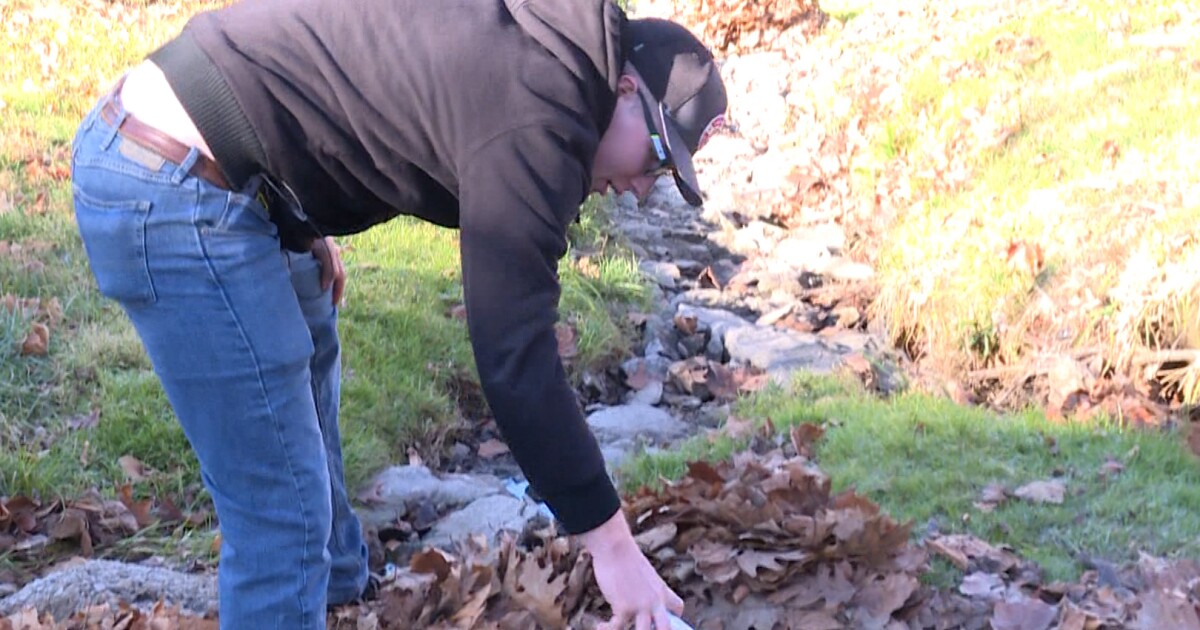
Sophomore Will Gardiner grew up playing in a nearby creek in Fort Wayne. Now he’s studying environmental science at IU Bloomington. He points out a sinking stream in Dunn Meadow on campus.
“It’s almost as if all the water goes right underneath and then right where that bridge is where the other side of the stream is. A little bit further up it shows right back up, it comes right out,” Gardiner said.
Gardiner said getting more hands-on experience would help him find a job and narrow down what he wants to do. But there aren’t enough good internships to go around for the more than 2,000 students in the IU Bloomington O’Neill School of Public and Environmental Affairs.
Since Gardiner is spending at least two summers working or taking classes — the pressure is on for the summer before his senior year.
“I pretty much have one real opportunity to get a good, solid internship in before I’m out of school. So you want to make it count,” he said.
Students used to get more of that hands-on experience right on campus. Professor Kelly Eskew is the director of education for the Kelley Institute for Environmental and Social Sustainability in IU’s business school.
She was also president of a now defunct advisory board which used to tackle sustainability projects on campus through seven working groups — only two of which are now active. Eskew herself chaired one where a company trained students to do waste audits.
“The goal was that we would repeat that work year over year, using students to take a look at what our trash looks like here at Indiana University. And that has completely fallen away. It’s really a terrible waste of a wonderful — no pun intended — but it’s a missed opportunity,” she said.
Students and faculty ‘walled off from the process’
Losing the board means faculty also lost a way to share their expertise as IU tackles possibly the most ambitious sustainability project ever — its climate action plan. Though the university held at least one public forum at each campus, the planning committee meetings weren’t open to the public. And at least for now, implementation committee meetings aren’t either.
“I think it’s kind of a tragic loss,” said Michael Hamburger, professor of earth and atmospheric sciences at IU.
“There is so much expertise and so much energy and enthusiasm about engaging with these issues. And more and more of many faculty and students feel walled off from this process, with many of the operations being handled in in secrecy and kind of behind closed doors,” he said.
That includes the new chief sustainability officer position — which oversees the climate plan for all of IU’s campuses.
Hamburger said faculty wanted an independent role hired through a national search — able to hold the campus accountable to its climate commitments and maybe more ambitious ones. Instead it reports to Capital Planning and Facilities and was posted internally. IU refused to explain why.
Reorganization makes the future of IU’s sustainability offices uncertain
While some faculty worry about all of these changes, Jessica Davis, the new chief sustainability officer, said she’s excited to get to work.
“We got a lot to do but it’s all very good, very exciting and really personally rewarding to be able to work on and serve the institution this way,” Davis said.
The climate plan implementation committee on IU Bloomington’s campus held its first meeting in January.
Davis admits her team has been more insular lately — that’s because the university was busy reorganizing all of its sustainability offices under the climate action plan.
“And ultimately it’s our job to implement and manage the climate action plan, as well as try to standardize the sustainability experience across IU to the best of our ability. So because that triggered a significant reorganization for us, now the provost’s office is working on what a new model might look like,” she said.
While things may be in flux right now, Davis said the implementation committee is working on a list of projects that students and faculty can get involved with. She said anyone on campus can always talk to their representative on the committee or request an audience with the committee.
Expert: IU isn’t an anomaly, but shouldn’t ignore opportunities for students
Like it or not — the way IU has organized its sustainability initiatives is not unusual, said Bridget Flynn. She works for Second Nature, a company that helps universities track their greenhouse gas emissions and find climate solutions.
They said having the chief sustainability officer position tied to facilities is very common — though today more of those roles are getting pushed up the hierarchy.
“More of those positions are reporting directly to the president or to a VP or like a CFO. Or a creation of a cabinet level position,” Flynn said.
Join the conversation and sign up for the Indiana Two-Way. Text “Indiana” to 765-275-1120. Your comments and questions in response to our weekly text help us find the answers you need on climate solutions and climate change at ipbs.org/climatequestions.
Flynn said no matter how they choose to reach their climate goals, universities should try to involve students as much as possible. Even if IU decides to, say, hire a contractor to make their buildings more energy efficient, students could write requests for proposals or evaluate bids.
Flynn said change will take time — there are a lot of stakeholders involved and that involvement is important.
“In order to have people feel like they were really part of the process and see themselves in the plan and implementation. And that it really represents the desires of the campus,” she said.
Rebecca is our energy and environment reporter. Contact her at rthiele@iu.edu or follow her on Twitter at @beckythiele.

Indiana
‘Foul play’ suspected in death investigation on Indiana-Ohio state line, Wayne County officials say

WAYNE COUNTY, Ind. (WISH) — Police are investigating the death of a person who died in the emergency department of Reid Health in Richmond.
Wayne County Coroner Brent Meadows was notified of the death Wednesday evening, according to a media release. Evidence has reportedly indicated that foul play is involved.
Officials believe the incident may have occurred in the area of the Petro Travel Center in New Paris, Ohio, just across the Indiana-Ohio state line.
The coroner’s office said the deceased person has been transported to the Miami Valley Regional Crime Laboratory in Dayton, Ohio, for a forensic autopsy and identification.
The office is still working the locate and identify the victim’s family.
This remains an active investigation.
News 8’s Michaela Springer contributed to this report.

Braden Smith spent four seasons with Purdue basketball proving all the power conference programs who overlooked him missed out.
Now the former Boilermaker point guard has a chance to do the same in the NBA.
Smith, a Westfield native, is headed to the Pacers after Indiana traded for him when the Chicago Bulls selected him with the 38th pick in the 2026 NBA Draft, a source confirmed to IndyStar.
Smith is Purdue’s third draft pick in five years, joining lottery picks Jaden Ivey and Zach Edey among a group of now 11 NBA draft selections to play at Purdue under Matt Painter.
Here’s a look at Smith’s Purdue career and what he brings to the Pacers.
Before capping a career that includes two Big Ten regular season and two Big Ten Tournament championships, along with helping Purdue end a 44-year Final Four drought, Smith broke former Duke guard Bobby Hurley’s all-time NCAA assists record.
Along the way, Smith took home the 2025 Bob Cousy Award as the nation’s top point guard in a season where he also was the Big Ten Player of the Year. A two-time consensus first-team All-American, Smith finished his Purdue career eighth in career points (1,932), third in steals (249) and has the top three assist seasons in school history that helped add to his NCAA record total of 1,103.
Smith’s knock is his 5-foot-10 1/2 height measurement, but that didn’t deter him from being one of college basketball’s top players.
What Smith lacked in height, he made up for in basketball IQ. He’s lethal with a midrange jump shot and showcased an unblockable fadeaway that allowed him to shoot over lengthier defenders. He mastered manipulating defenses while playing with marquee big men the last four seasons.
His role in the NBA likely will be not require him to be the team’s primary playmaker immediately. Smith’s awareness of that fact pushed a more defensive-minded approach in preparation for the next level. At the NBA Draft Combine in May, Smith showed he’s capable of defending elite guards.
Smith is an elite competitor who never showed to shy away from the dirty work, which is something that can help him earn NBA minutes as a rookie while trying to find his footing in an unfamiliar backup role.
Nathan Baird and Sam King have the best Purdue sports coverage, and sign up for IndyStar’s Boilermakers newsletter.

The body of a 13-year-old boy was recovered from Lake Michigan during a multiple-day search near a beach in Michigan City, Indiana.
Officials did not provide further details.
A search has been underway since Monday night after witnesses reported seeing a child wearing red shorts enter the water.
Michigan City police said officers responded to a possible drowning just before 5:40 p.m. on Monday near Washington Park Beach.
Police said the child disappeared underwater just south of the lighthouse and did not resurface.
A search was initiated with dive efforts, a fishing boat, drone technology, and a medical helicopter deployed.
The Michigan City Fire Department said three divers suffered minor injuries during the search and are being treated at Franciscan Health. Fire officials said divers encountered “challenging water conditions” before the search was suspended.
Officials have not identified the body recovered.
-

 Kentucky1 minute ago
Takeaways from Kentucky’s home and away SEC schedule for next season
-

 Louisiana6 minutes ago
Jeff Landry signs executive order on protecting ratepayers, but defends Louisiana data centers
-

 Maine13 minutes ago
Person hospitalized after shed fire in Harpswell
-

 Maryland16 minutes ago
Navy ship USS Marinette arrives in Maryland for Sail250:
-

 Michigan21 minutes ago
Michigan president has strong words for college sports after Dusty May exit
-

 Massachusetts28 minutes ago
Mass. lawmakers prioritizing 100 high-risk locations to implement wrong-way driving prevention measures – Boston News, Weather, Sports | WHDH 7News
-

 Minnesota31 minutes ago
Rationalizing Charlotte’s Shocking Decision to Trade LaMelo Ball to Minnesota
-

 Mississippi36 minutes ago
Mississippi Legislature will talk school choice, redistricting in 2027

