Entertainment
'Hannah Gadsby's Gender Agenda' pushes progress through punchlines at Netflix

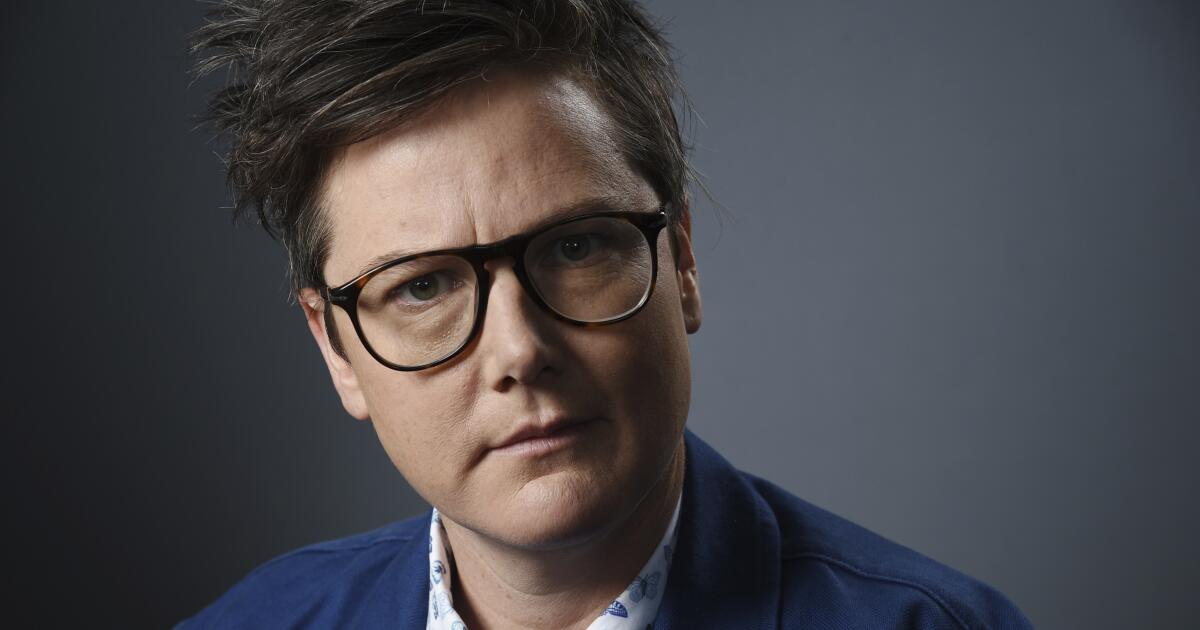
With the arrival of “Hannah Gadsby’s Gender Agenda,” the battle of Gadsby versus Netflix is officially on pause. “The last time Netflix brought this many trans people together, it was for a protest. So, progress!” the comedian jokes in the trailer for the new special, premiering Tuesday.
Now three specials deep — “Nanette,” “Douglas” and “Something Special” — Gadsby knows that in order to change the tone of a conversation, you first have to be willing to participate. So with this latest offering, Gadsby plays ringleader while showcasing incredible genderqueer comedic talent from all over the globe. Curated by Gadsby and taking place at the iconic Alexandra Palace Theatre in London, “Gender Agenda” features sets by Jes Tom, Asha Ward, Chloe Petts, Alok, Mx. Dahlia Belle, Krishna Istha, as well as a weird little guy, DeAnne Smith. (Calm down, it’s cool.)
The performers in this thoughtfully crafted group are all pros, so they’re right at home telling stories through jokes about topics like slurs, failing, being hot and gay, being a masculine lesbian, having fun with gender, rebranding anxiety, testosterone side effects, and there’s even a discussion on a baggage movement that we fully stand behind. Teaching, learning, laughing — they all identify as funny on that stage. Of the very variety.
“Gender Agenda” isn’t a lecture either. It’s simply comedic voices with a mix of humor, from dark to light. It has something for everyone, by design. “I put a lot of thought into the curating process. I wanted to create a show and not just, ‘here’s one comic, here’s another, here’s another’ … I took a lot of joy in creating a lineup that complemented each other and kept surprising. I think everyone will like someone,” Gadsby says.
In “Nannette,” you discussed self-deprecating humor and how you’ve used it in your act for years until you began playing with the honesty of storytelling. For “Gender Agenda,” did you encourage the comedians on the lineup to embrace their truths beyond just getting a laugh from the audience?
I still do self-deprecating, as it’s a really tough habit to break, but also, I think everyone should be capable of a little self-deprecation. I think it’s a really important texture, but for the individuals on the lineup, I didn’t interfere with tone or content or anything. People really have to feel comfortable with their own voices, but we did work at it. We also provided a space to work out material and facilitated the process of developing camaraderie, so everyone felt at ease.
Did you get to pick the venue that “Gender Agenda” was filmed in? Because great call on Alexandra Palace Theatre. It’s really beautiful.
We put a lot of thought into where in the world that we wanted to do this because we wanted to give the sense of it being a global community as opposed to U.S.-centric, which you know, can often happen. The “Ally Pally” is wonderful, and the word palace elevates it. It’s been restored beautifully, but there’s a bit of grunge to it, so I feel like it complements the queer community in that sense. It just sort of gave the event the feeling of some sort of elevated grandeur. It is a beautiful room.
Does paving ways like this while in beautiful rooms make you feel extra grateful that you didn’t quit the industry like you once wanted to?
Yeah, and it’s a little heavy and that’s why I hibernate and live outside of the showbiz world as much as I possibly can. You know, that was a very unique moment. I was just a hard-working artist who produced work that hit at a specific moment of extreme virility. For me personally, it was important to regain my equilibrium after that, but the upside of all of it meant that I could continue doing the comedy that I wanted to, to a certain extent. I have kept my focus on live comedy and performing, but now I have this fanbase that trusts when I’m trying to move in different directions, so I don’t have to take it personally.
Curated by Gadsby and taking place at the iconic Alexandra Palace Theatre in London, “Gender Agenda” features sets by Jes Tom, Asha Ward, Chloe Petts, Alok, Mx. Dahlia Belle, Krishna Istha, as well as a weird little guy, DeAnne Smith.
(Jess Gleeson / Netflix)
That’s great because the comment world versus real world is a really difficult balance for a lot of people.
I have this fairly unique position where I am able to insulate myself to a certain extent from that. But with that, I feel a personal responsibility to keep pushing those hot buttons. The thing I’ve discovered between positive and negative commentary on my work is, the negative is often one note, but it can also be overbearing. Then there’s also an individual tenor, which is the praise, and it’s just richer. It feels like I have a connection to a more human interface as opposed to the backlash.
I’ve read some really great comments that use the word “historic.” Do you feel like this special will shake up the landscape?
I haven’t read this feedback, I actually try not to. I take a very long time to process things, so I’ll probably take some time to process this whole thing after it’s relevant. I think my position is that I’m someone who starts a conversation, but I don’t feel the need to control the conversation or win the conversation. I feel like I have a talent to stir pots that need to be stirred.
I think you’re very humble. Admittedly, I learned about a handful of new comics because of this special and was happy to hear a lot of irreverent dark comedy. It’s almost like I didn’t expect it.
It’s a secret because of lack of representation. We all know that representation of one is not gonna do anything. But when you get a group of us together, the diversity is just apparent, and it’s not forced. It’s just a bunch of individuals with such distinct individual lives. And that’s the thing about being genderqueer in this moment particularly.
There really is a nice rhythm to the special, and it’s partially because everyone has their own specific point of view and style. They complement one another, but also stand out.
There’s a very different experience across generations so I tried to represent a little diversity within this lineup. Everyone is really great in their own right. If you take the heat out of it, the negative backlash, it picked up as a wedge issue, and the culture wars— gender is still a fascinating subject. It’s not dull and I think it would be great if we could have a broader conversation about gender without, you know, just the ridiculousness of the fear it’s all wrapped up in now. So, I wanted to have that moment. I wanted to create a little bit of breath where it’s like, let’s just have a space where we’re not trying to defend ourselves. I didn’t want to make this special as an opposition to the output of content on the platform, I just wanted to create another space.
Any chance Netflix will help facilitate that space by turning this into a series?
Personally, I would love that. There’s a depth of talent out there and stand-up is an accessible art form to be able to do. There are queer comedy scenes all over in the U.K. and New York — this is happening. I’m not inventing this talent. It’s there in the grassroots. I’d just love to create a more accessible upwards trajectory for this community. But that will rely on disrupting the algorithms to get them trending this way. I think it’s fairly safe to say that we need people to watch. That’s the only thing that’s gonna really shift it and sadly, that probably means that I’ll need to say something controversial. Kidding, but we’ll wait and see.


It’s a good year when we get movies like Remarkably Bright Creatures and The Sheep Detectives at the same time. If there’s one type of emotional draw we’ll never say no to when it comes to the fiction we consume, it’s wholesome. The kind of movies and TV shows that leave you with a bit more hope than you expected. The kind of stories that make you believe that humanity isn’t as broken as it really is.
The Sheep Detectives is essentially tailor-made for anyone who loves a good whodunnit that’s rich with nuance and humor. The clever decision to shift the genre into something both kids and adults could appreciate together is no small feat, and that’s largely where its mass appeal lies. Murder is a heavy subject to deal with—as is grief—yet this story makes sitting with the weight of both a little easier. It could kickstart a number of thoughtful conversations while it simultaneously delivers plenty of laughs along the way.
For adults, there’s also a huge appeal in the casting—the voice actors especially. Anyone who knows me knows that Ted Lasso is the kind of show I’ll always put first, so hearing Brett Goldstein voice a sheep is the kind of A+ decision that’s effortless to appreciate. Hugh Jackman, Nicholas Galitzine, Molly Gordon, Nicholas Braun, Emma Thompson, Julia Louis-Dreyfus, Bryan Cranston, Bella Ramsey, Regina Hall, Rhys Darby, Patrick Stewart, Hong Chau, and the whole cast do an exceptional job as well, making every moment of The Sheep Detectives thoroughly entertaining.

It’s hard to imagine anyone coming out of the movie not thinking it’s one of the best things we’ll watch all year, and that’s a high compliment considering 2026 is full of gems like Project Hail Mary and the upcoming The Odyssey. It’s the exact kind of movie we could all use, but more than anything, the kind of story we could use more of. If there’s any sort of sequel, sign me up. Let’s make it a trilogy. Give us more of the sheep.
The cinematography is gorgeous, the writing is sharp, the performances are thrilling, and the message is a gem worth holding onto. The Sheep Detectives is the kind of feel-good treasure that does an excellent job of reminding us why movies like this will always matter. There’s a thoughtful message about how grief is meant to be shared and why it’s so important to carry those who’ve passed with us. Yes, it’d be convenient to forget our pain by sheer mental willpower, but we aren’t meant to do that. As humans and as animals, I imagine that the good, bad, and ugly are all part of what makes life beautiful, and that’s a comforting message to sit with.
The concept of a whodunnit featuring sheep solving a murder sounds so wild on paper, yet everything about it results in the kind of movie that should signal to Hollywood we want more creative approaches to what’s familiar. There’s a reason The Muppets are so popular, and we shouldn’t be afraid of making things that sound a bit too whimsical on paper. In other words, The Sheep Detectives embraces the whimsy, and it’s exactly what makes it so delightful.
The Sheep Detectives is now streaming on Prime Video.
First Featured Image Credit: ©Amazon MGM Studios
Related
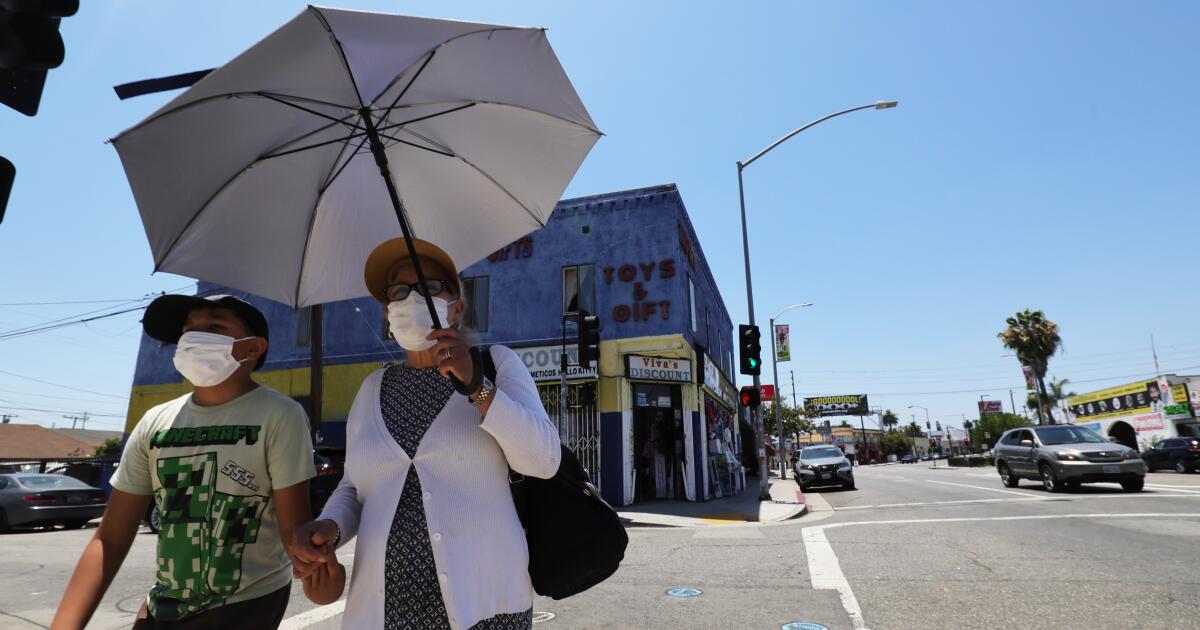
The National Weather Service has issued a heat advisory for this week that includes Los Angeles County and other parts of the Southland, especially in valleys and away from the coast.
Temperatures are expected to rise in the Santa Clarita Valley, the east and west San Fernando Valley, as well as parts of the San Gabriel Valley and northwest L.A. County mountains beginning Tuesday and lasting through Thursday, with warm, seasonably elevated fire weather conditions, according to the National Weather Service.
Forecasts indicate the mercury will reach 90 to 105 degrees in the interior, 80 to 90 degrees in the inland coastal plain — including downtown L.A. — with highs in the 80s and lower 90s in the foothills and canyons of southwest Santa Barbara County.
Rose Schoenfeld, meteorologist with the National Weather Service in Oxnard, said temperatures should be five to 10 degrees above normal for this time of year thanks to a high-pressure system building up over the region.
Though temperatures are expected to drop after Thursday, don’t expect that cooling to last.
“Looking ahead, you might be seeing some outlooks that look pretty favorable, but that heat will linger and redevelop with a pretty impressive heat wave for much of the west, that would be starting next weekend or so,” Schoenfeld said. “It doesn’t seem like we’re out of the woods, even if temperatures start to drop after Thursday.”
The rising mercury coincides a with major marine heat wave across the Pacific Ocean that has the potential to affect weather events around the world, bringing months of warmer oceans, which trigger thunderstorms and extreme heat thousands of miles away.
In recent weeks, record heat waves have baked parts of Europe, with temperatures hitting 104 degrees in some countries. France has reported more than 1,000 heat-related deaths.
In the U.S., record heat has gripped much of the Midwest and East Coast, with temperatures between 110 and 115 degrees in major metropolitan areas, with the National Weather Service issuing an extreme heat warning for much of the Midwest, Mid-Atlantic and Northeast.
The sweltering temperatures have disrupted travel and led to a number of cancellations planned for celebrations over the Fourth of July weekend, including Philadelphia’s Salute to Independence parade. The Great American State Fair, on the National Mall in Washington, was forced to shut down for a few hours.
Amtrak canceled some trains in the Northeast because of excessive heat that could affect the tracks.

The Isolate Thief, 2026.
Directed by John Suits.
Starring Mackenzie Foy, Odeya Rush, Joe Pantoliano, Sean Bean, Jack Kesy, Ty Simpkins, Bryan Martin, and Martin Sensmeier.
SYNOPSIS:
A young woman struggles to conceal the gold she stole from violent outlaws who have seized control of her remote outpost, outwitting them amid a deadly winter where survival becomes a game of cunning and betrayal.

Set at a Union outpost in frigid temperatures, John Suits’ The Isolate Thief transcends what was likely a small budget with a fittingly chilly, oppressive look, and an ensemble that sneaks up on you as not only packed but smartly cast. Front and center is Mackenzie Foy shedding her Twilight and Disney-oriented roots for gritty period-piece work that she handles capably and convincingly, whether it be fending off wolves at the outpost, bandaging a wound, playing a deceitful game for survival, or wielding a firearm.
That’s only the start, though, as Joe Pantoliano shows up as a harmless graverobber only to re-enter the picture as the hostage of a group of Union soldiers led by Sean Bean on a search for gold thought to be discovered by him, which in reality has been hidden away by Mackenzie Foy’s parentless (her father recently died in the war, meaning she is all alone at the outpost), grieving, underestimated caretaker waiting for the right moment to make a break with the gold for San Francisco. The merciless candor with which the Union soldiers are comfortable torturing the drifting graverobber should also be enough to signal that something is off about the group and that our hero probably shouldn’t trust them.

Without giving too much away, Ada (Mackenzie Foy) is up against a violent group of outlaws posing as Union soldiers under orders from Sean Bean’s Fiddler, who will stop at nothing for this gold (accompanied by fellow evildoers played by a range of underappreciated names such as Ty Simpkins and Jack Kesy). In the forest, she also stumbles across a badly injured Emily (Odeya Rush), who has a connection to these outlaws, reduced to being treated as a sex object (they refer to her as an unflattering term for a prostitute, which feels inaccurate given that such a term would imply she has a choice rather than having her agency regularly taken as it is here), so broken by her experiences with them that she advises Ada to give in to their demands as defying them typically results more horrifying outcomes.
Even if the screenplay from Kevin Lefler doesn’t necessarily crackle the way a pressure-cooker story like this should (there’s a lot of The Hateful Eight in the film’s DNA, but without anywhere near that level of character and thematic complexity), the cast elevates the material and provides a quiet intensity simmering underneath the casual conversations and deceptions that we know will eventually blow up in Ada’s face. It’s also a story that isn’t afraid to go to some fairly bleak places and put these women through the wringer as they fight back and try to make it out alive.

What it boils down to is a simplistic cautionary tale of ruthless, misogynistic outlaws underestimating the women they are up against. That is also desperately felt when the women turn the tables in the third act. Effectively accomplishing what it sets out to do. A freezing locale is used for atmospheric advantage (the ground is frozen solid, meaning graves can’t be dug, to give an idea of just how cold it is) while allowing Mackenzie Foy to tap into some new acting tools demonstrating resourcefulness, alongside Sean Bean believably going from calm to terrifying on a dime. The Isolate Thief is a feminist period-piece Western that organically empowers through familiar, albeit competent and engaging, storytelling, culminating in some tense battle-of-the-sexes action.
Flickering Myth Rating – Film: ★ ★ ★ / Movie: ★ ★ ★
Robert Kojder
https://www.youtube.com/watch?v=embed/playlist
-

 South Dakota30 seconds ago
One child dead following Hughes County fatal crash
-

 Tennessee13 minutes ago
Wild ride for temperatures: A look at Middle Tennessee’s first major heat wave of 2026
-

 Texas15 minutes ago
Riley Greene homers and triples for 4 RBIs as Tigers top Texas Rangers 6-3
-
 Utah20 minutes ago
Utah’s Venezuelan community gathers to honor victims, aid survivors after deadly earthquakes
-

 Vermont28 minutes ago
Vermont State Police seek missing Rutland man
-

 Virginia30 minutes ago
Way-Too-Early 2026 Virginia Tech Football Preview and Prediction: Week 12, @ Miami
-

 Washington36 minutes ago
Weather Alert: Storms move into DMV area
-

 Wisconsin43 minutes ago
3 fires in southeastern Wisconsin tied to improper fireworks disposal

