Virginia
Virginia surrogacy bill doesn't go far enough


Virginia is on the verge of legalizing surrogacy brokers. A bill sent to Gov. Glenn Youngkin last week would repeal the state’s ban on accepting compensation for facilitating surrogacy arrangements. The Republican governor has through March 8 to sign the bill into law.
Getting rid of the ban on brokering surrogacy is a good idea. But Virginia should go further and ditch its ban on commercial surrogacy, too.
Want more on sex, technology, bodily autonomy, law, and online culture? Subscribe to Sex & Tech from Reason and Elizabeth Nolan Brown.
Obsolete and Paternalistic
Under current law, it’s a Class 1 misdemeanor for any person or business “to accept compensation for recruiting or procuring surrogates or…otherwise arranging or inducing an intended parent and surrogates to enter into surrogacy contracts.” Doing so is punishable by up to a year in jail or a fine of up to $2,500. Someone in violation of this law could also be sued by parties to the brokered surrogacy contract.
“This 30-year-old statute is just absolutely obsolete, and it’s not enforced,” family law attorney Colleen Maria Quinn told a House subcommittee in January.
Yet House Bill 110, the measure repealing this provision, has been controversial—perhaps surprisingly so, considering that the old law is not being used and that actual surrogacy for pay would still be banned. In the Virginia House, votes on the measure were nearly evenly split (50–48).
The surrogacy brokerage ban was passed with an eye toward preventing people from being coerced into surrogacy, notes the Virginia Mercury. Some lawmakers have suggested that ending the brokerage ban would mean more coercion. But there are less extreme mechanisms that can ensure everything is on the up and up. As a surrogate, “you’ve got to have your own lawyer, for goodness’ sake,” Del. Rip Sullivan (D-Fairfax) said at the January subcommittee hearing. And this attorney is “obligated to make sure [a surrogate is] acting of [her] own free will.”
To recap: A woman can say she consents to be a surrogate, show through her actions that she consents to be a surrogate, have a lawyer attest to her consent to be a surrogate…and some people will still worry that she didn’t really consent to be a surrogate.
This is, alas, par for the paternalistic course when it comes to women’s decisions involving their bodies.
A certain sort of person will never be convinced that a woman would willingly become a surrogate, or get an abortion, or engage in sex for pay, and so on. So they deny the agency of women who do, in fact, willingly do these things. And they use this alleged lack of agency to justify roadblocks for women’s “protection.”
In this case, a woman who wants to be a surrogate is not only barred from being paid for her services, she also needs a court-appointed lawyer to speak for her so the state will see her as apable of speaking for herself.
Now Let People Pay Surrogates
There should be no ban on commercial surrogacy. Surrogacy is good for women and good for families (something I elaborated on in a recent op-ed for The Dispatch). It helps families have biological children they may not otherwise be able to have, and it can provide income and purpose to those serving as surrogates.
There’s been a good deal of research on surrogate mothers that counters conservative and radical feminist fears about the process. Far from being a last resort that only women with no other financial prospects do, surrogacy is often undertaken by women with altruistic as well as financial motives. Surrogates often report that their experiences are positive, harmonious, and meaningful. Decades of research on surrogate experiences has found that many are emotionally and psychologically well-adjusted. Studies also suggest that surrogates seldom regret the experience years later.
Of course, such positive experiences aren’t going to be universal. But we don’t generally ban things just because some fraction of people have negative experiences. In fact, it’s a bad idea to ban things based on the prevalence of positive or negative feelings about them at all. Is isn’t the government’s job to protect adults’ emotional well-being.
In this and so many other matters, the government should get out of the way and let consenting adults contract as they see fit.
Virginia lawmakers are right to repeal the state’s ban on surrogacy brokers. Next they should repeal the laws that forbid direct payment for the service of surrogacy and that allow surrogate compensation only for costs associated with the pregnancy.
They should also do away with laws making the whole process more burdensome for all parties and giving the government final say over whether surrogacy arrangements are OK. Under current Virginia law, a court must approve all surrogacy contracts and the approval is only good for 12 months. To get approval, intended parents and surrogates must pass a home fitness and parental fitness investigation undertaken by a social service worker or child welfare agent. They also have to undergo “counseling concerning the effects of the surrogacy.” In addition, the surrogate must prove that she has given birth at least once before and the intended parents must prove that they are infertile or unable to bear a child “without unreasonable risk.” And all parties must undergo “physical examinations and psychological evaluation” and turn records of such over to the court. Only if all of these conditions are acceptably met will the state give people permission to go forward with a surrogacy contract.
Underlying all of this is the idea that women are too dumb or fragile to make decisions about their own bodies and that the state should get to say who’s allowed to form families and under what circumstances. These ideas need to go, as does the idea that economic concerns can render consent invalid.
As Virginia Del. Candi Mundon King (D–Prince William) told her colleagues during the legislative debate, “being economically disadvantaged does not make you any less intelligent. It does not make you any less able to make your own decisions, whether they be financial, health or otherwise. We should be careful not to stigmatize those who are economically disadvantaged or put them into a category that they cannot understand how complicated and deeply personal surrogacy is.”
Today’s Image




We now know how much it cost Virginia to hold an election that didn’t count: $11.6 million.
Of that, the state will pick up $4.99 million, leaving localities to pay the balance of $6.6 million for the April 21 special election on redistricting that the Virginia Supreme Court later ruled was placed on the ballot unconstitutionally.
The numbers come from the Department of Elections, after Cardinal News filed a Virginia Freedom of Information Act request to find out the cost of the election.
I contacted localities small, medium and large and none said they’d have a particular problem paying their share. All said they’d already budgeted for primary elections that they expected in June. With the push to redraw Virginia’s congressional lines, those June primaries were bumped to August, putting them in a new fiscal year, so the money set aside for the June primaries was used to cover the special election on a proposed constitutional amendment to allow redistricting.
Election costs
Total cost of April 21 special election: $11,636,147
What state will pay for: $4,999,738
What localities must cover: $6,636,147
Source: Virginia Department of Elections
The issue some localities face now is that the Aug. 4 primary becomes an unexpected expense, although all said they’d figure out a way to pay for it. “We always budget for extra elections, so I think we will have money to cover this,” said Buckingham County administrator Karl Carter by email. It cost $44,373 to run the special election in his county. Of that, the state will pay $9,019, leaving the county to cover $35,353. (Each locality submits its expenses and the state calculates a reimbursement rate based on that.)
Other local government officials had similar things to say. The cost of running elections — paying for poll workers is one of the main expenses — depends largely on how big a locality is. Elections cost more in bigger localities, but they also have bigger budgets.
In Virginia Beach, the election cost $750,533. The state will pay $265,509, leaving the city to cover $465,023. City spokesperson Ali Weatherton-Shook said the city would save enough money through unfilled vacancies to cover unexpected election expenses.
In Chesterfield County, the election cost $619,970. The state will pay $223,356, leaving the county to cover $396,613. “Chesterfield tries to plan ahead for these growing demands,” said county spokesperson Stephen Bays. “In the county’s FY2027 budget, we added $630,000 to the Registrar’s budget to help fill the gap to cover the increasing costs of elections.”
The most expensive locality was, not surprisingly, the state’s biggest: Fairfax County. It cost $1,545,781 to hold the election there. The state will pay $655,424, leaving the county to cover $910,356. “We allocated additional funds out of carryover to address not only the special election on the amendment but a number of special elections due to both elected officials winning other seats and elected officials that went into the administration,” said county supervisor Pat Herrity, a Republican.
The closest I came to finding a locality that felt pinched by the election cost was Dickenson County. “Unfortunately, moving the primary to August added a third election to our FY-27 budget, which was already very tight,” said Dickenson County administrator Larry Barton by email. (The other two are the fall general election and presumed primaries next June for the 2027 local and legislative elections.) It cost $39,748 to run the special election in Dickenson. Of that, the state will cover $7,802, leaving Dickenson to pay $31,946.
While officials in other localities, though, said they’d have no problem paying the expense, they also pointed out the obvious: Money is finite. “Any time you spend money it competes with critical services and/or increases the tax burden on our residents,” said Herrity, the Fairfax County supervisor.
And some said they’d welcome additional state funding. “Like many localities, Chesterfield would welcome additional state funding for special elections,” said Bays, the county spokesperson. “When state funding falls short, local dollars must fill the gap, leaving fewer resources for other priorities.”
The new state budget that the General Assembly just approved does include an additional $680,000 to help with the cost of three proposed constitutional amendments that will be on the November ballot, in addition to congressional elections and, in some places, local elections.
Since I’m writing this as an opinion column, I will go ahead and inject my opinion here: The Virginia Supreme Court could have avoided this. The court declined to rule on legal challenges to the special election before the vote, citing a 1912 court ruling involving a similar challenge to an upcoming constitutional amendment. In that case, the court held that it should only rule after the vote, on the grounds that passing a constitutional amendment is akin to passing a law — and just as a court won’t intervene until after the governor signs a bill, it shouldn’t intervene until after voters approve a constitutional amendment.
I’m not a legal scholar, but that seems sound reasoning except for one thing: When the Supreme Court let the disputed 1912 amendment vote go forward, it was part of an election that was going to happen anyway, the 1912 presidential election — so there was no additional expense incurred. In this case, the only reason the special election was happening — and so there was expense involved. The court’s adherence to that 1912 precedent cost Virginia $11,636,147.
Of course, some might also say that Virginia Democrats cost the taxpayers that amount by skirting the rules involved in placing an amendment on the ballot, although there was legal dispute over those rules. You’ll recall that the constitutional question turned on when an election legally begins. The constitution says that the legislature must pass an amendment twice, with an election in between. Democrats contended that passing the amendment the first time in a special session in late October satisfied that requirement, because it was ahead of the November general election. The court later ruled that, legally speaking, the election really began when early voting started in September, so Democrats had misread the legal calendar. Democrats could say that Republicans are ultimately to blame, because it was President Donald Trump and Texas Republicans who started the push to redraw congressional lines to “find” more Republican districts so Democratic-controlled states such as Virginia had no choice but to respond in kind to balance things out.
Whoever you choose to blame, we can now put a dollar figure to that attempt — 11.6 million of them.
For more on those upcoming Aug. 4 primaries (for which early voting is already underway), see our Voter Guide. For more political news and analysis, sign up for West of the Capital, our weekly political newsletter that comes out on Friday afternoons.
Related stories

BIG STONE GAP, Va. (WCYB) — About 100 seniors from across Southwest Virginia spent the day enjoying food, games and fellowship at the Mountain Empire Older Citizens Organization’s annual summer picnic.
The event was held at Bullitt Park in Big Stone Gap and brought together seniors from seven congregate senior sites across several Southwest Virginia counties.
Attendees enjoyed a cookout, played yard games, tried their luck at bingo and caught up with friends.
Organizers said events like the annual picnic give seniors a chance to enjoy activities they may not otherwise have the opportunity to experience.
“It’s exactly what the program is designed for,” MEOC Nutrition Director Kristen Rutherford said. “To add nutrition and education but also promote socialization and prevent loneliness for seniors. A big part of seniors’ lives is that they’re isolated a lot of times. I love it, especially the games that they’re playing. I love that because they’re getting exercise.”
BE THE FIRST TO COMMENT
Organizers said the summer picnic is one of two major events they host each year, along with a Christmas celebration.


Cyclosporiasis public health update from Virginia Department of Health
Virginia reported 10 cases of Cyclosporiasis as of July 7. Learn the symptoms, travel risks, and infection prevention.
Cyclosporiasis has been causing illness throughout the United States. As of July 7, the Virginia Department of Health is reporting 10 cases of Cyclosporiasis but is not currently investigating any local outbreaks, according to a press release from state health officials.
Cyclosporiasis is an infection of the intestine caused by a parasite called Cyclospora.
Anyone can get cyclosporiasis. It is more common in people who travel to tropical areas, but the infection can occur in many different countries. The U.S. Centers for Disease Control has received reports of 145 cases of cyclosporiasis acquired in the United States of people who became sick from May 1 through June 16.
The majority of cases and outbreaks are reported during the spring and summer months, although infections can occur year-round. Most outbreaks of cyclosporiasis have been linked to imported fresh produce.
Cyclosporiasis is not spread directly from person-to-person. Infected people pass Cyclospora in their feces, but this form of the parasite cannot make people sick. The parasite needs time in the environment to change into a form that can make people ill. This form of the parasite then can infect someone by entering the body through the mouth, typically by eating or drinking something that is contaminated with Cyclospora.
Cyclospora infects the intestines and usually causes watery diarrhea. Other symptoms can include loss of appetite, weight loss, bloating, increased gas, stomach cramps, nausea, vomiting, muscle aches, low-grade fever, and fatigue. Symptoms usually appear within one week after exposure and if not treated, the illness can last from a few days to a month, or longer.
How to prevent cyclosporiasis
- Wash all fruits and vegetables thoroughly under running water before eating, cutting, or cooking.
- Wash hands carefully with soap and water before and after food preparation and after using the bathroom or changing diapers.
- Travelers, especially to tropical areas, should avoid eating raw or undercooked foods or drinking untreated water.
If you have symptoms of cyclosporiasis, contact your healthcare provider.
People who have diarrhea should rest and drink plenty of fluids. Specific antibiotics are sometimes prescribed.
Staunton News Leader reporter Monique Calello covers healthcare in the Shenandoah Valley and in Virginia. Connect with her at mcalello@newsleader.com.
-
 Entertainment2 minutes ago
Lucas Museum to give free annual passes to South L.A. neighbors, host community preview day
-
 Lifestyle7 minutes ago
Meow Wolf taps famed L.A. animation house for its new Los Angeles venue
-
Politics14 minutes ago
Column: Trump decries ‘communism’ while his government takes ownership of companies
-
 Science17 minutes ago
‘I’d rather my house burn down than get cancer’: Herbicide use upends California’s fight to save forests
-
 Sports22 minutes ago
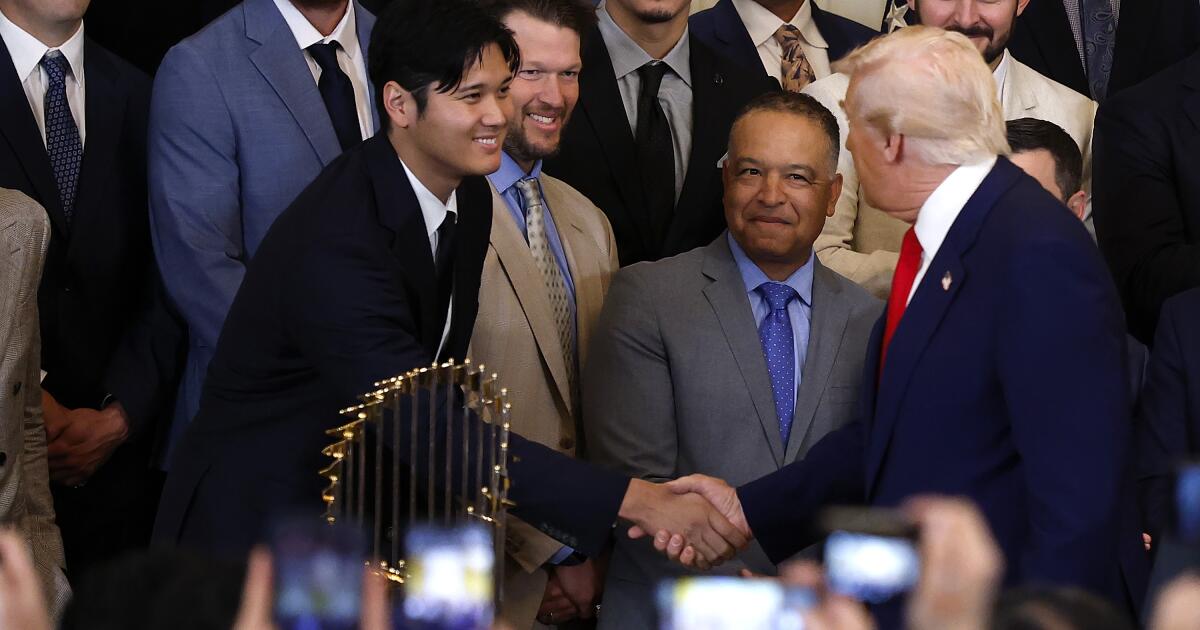
Dodgers scheduled to visit White House in late July to celebrate 2025 World Series win
-

 World32 minutes ago
Former US Olympian pleads not guilty in DC reflecting pool vandalism case
-
 News59 minutes ago
Former Olympian pleads not guilty in reflecting pool vandalism charges
-

 Los Angeles, Ca2 hours ago
Heat advisory, beach hazards in effect as Southern California sizzles


