Lifestyle
Looking for L.A.'s art cool kids? They're hosting exhibits in laundry rooms and garages

For some Los Angeles galleries, home is where the art is — or it’s in the laundry room, also known as Quarters Gallery, inside Nina Muccia’s two-bedroom Los Feliz duplex. The 32-square-foot space marked its first anniversary in March with a group show, “Hoarders,” of 50-plus works on clothespins, the breaker box and shelves usually reserved for dryer sheets and Tide Pods. At the next exhibit in June, artist Sam Dybeck diffused Fabuloso from a vintage fabric steamer and installed work inside the stacked washer and dryer.
“There are obvious built-in themes and parameters for artists to respond to,” Muccia said of Quarters, its name a sly nod to both coin-operated laundry and the gallery’s quarterly schedule. Exhibits, usually advertised on Instagram, typically last one weekend since she shares the unit with a roommate who, at one opening, was visibly annoyed while wearing a robe and stomping through the party in a huff with her hamper. “A performance piece, of course,” Muccia said of her actor roomie.
Quarters, an unassuming hidden art gallery housed within a laundry room in Nina Muccia’s home in Los Feliz.
(Wally Skalij / Los Angeles Times)
Quarters belongs to a new guard experimenting in the L.A. art scene by bringing exhibits in-house. Residences range from a Tudor mansion and a chateau-esque apartment to a five-car garage and a backyard cabin modeled after the Unabomber’s hideout. They’re a new spin on a nearly century-long L.A. tradition of domestic galleries that rely on word-of-mouth, neighborly trust and consummate hosts.
“When you have these residential spaces, a lot of times it’s because you want to keep the concept high and rents low,” said Danny Bowman, who started his gallery, Bozo Mag, in the revamped garage behind his rented Highland Park house. Openings tend to spill out into the patio or the emptied pool. “Instead of coming for 20 minutes, they stay for three hours,” he said.
“The Weight, the Wait,” an oil on canvas by artist Molly Bounds, is part of the “Nouveau Bozeaux” exhibit at Bozo Mag.
(Mel Melcon / Los Angeles Times)
The emptied pool outside of Danny Bowman’s garage-turned-art gallery at his Highland home.
(Mel Melcon / Los Angeles Times)
High rents and the pandemic were an unexpected boon to the city’s DIY art and literary scene — from roguish takeovers at IKEA to guerrilla readings in parking lots — meshing cultural events that fall somewhere between a kegger and a 21st century salon. Angelenos in the art industry have been a sort of anchor to it all, with a new school intersecting the Venn diagram of curators and patrons, artist-run commercial spaces and art-fair cool kids. Residential galleries also are defined by what they’re not: design showrooms, permanent exhibits, private collections or endowed artist shrines. Still, they’re hard to track — either because they pop up like Whac-a-Mole or remain underground for practical reasons.
Like most residential projects today, Sea View Gallery “takes its appointment system pretty seriously,” said founder Sara Lee Hantman, treating its corner of the Mt. Washington hilltop “as something sacred.” Luckily the street is an artists’ enclave, with some opening their homes for Hantman’s dinner receptions — one in January served gumbo family-style two doors down at a local artist’s Midcentury Modern house. “So much business can be done in these types of spaces without the feeling of business being done,” she said.
It also helps that the house structure itself is a talking point. In the late ’90s, L.A. artist Jorge Pardo got MOCA to help fund his “social sculpture” on Sea View Avenue as an off-site exhibition that became the artist’s home studio. Spatial restrictions notwithstanding, “Pardo designed the space to not have any 90-degree angles,” said Hantman, who leases from the artist’s family month-to-month.
In L.A., where most residences are zoned “single family,” home-based businesses like these technically have a limit on visitors (one per hour) and operating hours (8 a.m. to 8 p.m.). “It’s a decidedly gray area in terms of zoning,” said Sam Parker on his namesake gallery in a rented five-bedroom Storybook home in Los Feliz. Since 2017, Parker’s openings have posed a parking dilemma for his neighbors on the winding hillside. “There comes a very real anxiety with how long we can we keep this up and get away with this until it’s a larger problem,” Parker said.
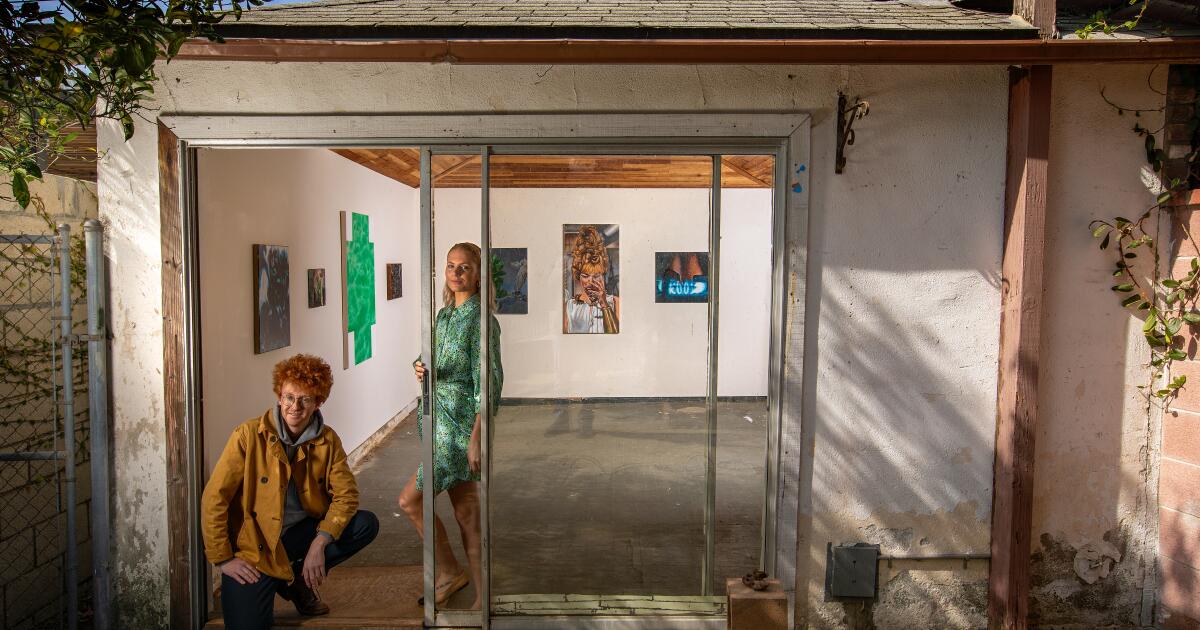
A fig vine grows around a side entrance to Bozo Mag. (Mel Melcon / Los Angeles Times)
The entrance to art gallery the Bunker, located on the grounds of Danny First’s home in Los Angeles. (Mel Melcon / Los Angeles Times)
Danny First, with his dog Diego, a 3-year-old Mexican hairless, stands next to his other art gallery, the Cabin L.A., on the grounds of his home in Los Angeles. In the background is a painting titled “Dressage,” an acrylic on canvas by artist Nick Modrzewski that is part of the current exhibition, “Modern Handshake,” running through March 31.
(Mel Melcon / Los Angeles Times)
His house’s domestic routine has changed too, to include his wife and 2-year-old son. (“He knows what not to touch,” Parker said.) In a bid for more legitimacy in the art world, Parker is trading the next-door model for foot traffic and will move the gallery to a storefront at 6700 Melrose Ave. in Hancock Park later this year. “First and foremost, we’re in service to our artists who are ready to have a more public-facing gallery,” he said.
The concept of the domestic museum in L.A. began at the 1920s home of voracious art collectors Louise and Walter Arensberg, according to Mark Nelson, who co-authored “Hollywood Arensberg: Avant-Garde Collecting in Midcentury L.A.” The Arensbergs kept an open-door policy for artists and art lovers to bask in nearly 1,000 works from pre-Columbian objects and Modern artists like Henri Matisse, Pablo Picasso, Salvador Dalí and their favorite, Marcel Duchamp. “Even the bathroom had several Paul Klees hanging from the towel rack,” Nelson said.
Their jam-packed Hollywood home at 7065 Hillside Ave. influenced artist-dealer William Copley and his short-lived but seminal Copley Galleries. For the last four years, Nelson has been rebuilding in his Beverly Hills bungalow Copley’s Surrealist gallery, which ran from 1948 to 1949. “There were probably as many or more Max Ernst paintings shoved into this domestic bungalow than there were in his entire Metropolitan Museum of Art retrospective,” Nelson estimated.
After the Arensbergs died in the 1950s, their art dealer who lived next door, Earl Stendahl, bought the property and opened the third iteration of his gallery that started inside the Ambassador Hotel. Ron Dammann, Stendahl’s grandson, and his wife, April, moved in around 1970 to help continue the business and raise their two kids.
“There were toddler birthday parties downstairs with all the breakable pre-Colombian art,” April Dammann remembered. “They played pin the tail on the donkey, and one missed dart could cost us $10,000.” In 2017, the Dammanns closed the gallery that had been operating in some capacity since 1921 and moved out of the historic Arensberg-Stendahl Home — complete with a sunroom by Richard Neutra and a carport by John Lautner.
Be it sprawl or architecture, light or climate, L.A. plays a lead role in hosting experimental spaces beyond the white-cube model. These DIY concepts, from pools to the L.A. River, are “crucial to the art scene in Los Angeles” that began in the 1970s, said Christine Messineo, director of Frieze L.A. and Frieze New York. The influx of moneyed and blue-chip galleries over the last decade has the city competing with top art hubs like New York, Berlin and London.
Art on display at Jay Ezra Nayssan’s home in Santa Monica, where an exhibition preview party/dinner for Frieze L.A. was held in 2022. (Jason Armond / Los Angeles Times)
Art lovers view select art pieces at an exhibition preview party/dinner for Frieze L.A. held in Jay Ezra Nayssan’s Santa Monica home in 2022.
(Jason Armond / Los Angeles Times)
In response, or perhaps opposition, to the gallery boom, curator Jay Ezra Nayssan started Del Vaz Projects out of his West L.A. apartment in 2014. “Everybody eats, everybody drinks, everybody’s invited,” said Nayssan, who now runs Del Vaz as a nonprofit in his Santa Monica home with his partner, Max Goldstein. “We don’t operate in this realm of exclusivity and scarcity, which is inherent in the commercial art world today.”
Joseph Geagan, a painter from the New York and Berlin art worlds, doesn’t think his buzzy penthouse gallery in Koreatown’s landmark Gaylord Apartments would have worked elsewhere. “There’s still a Wild West element for experimentation here,” he said of his “spooky, ‘Shining’-esque” building, which turns 100 this year. It’s a mythos that Geagan didn’t bother competing with; the apartment building and gallery share the same name. (Exhibit spectators usually end up at the HMS Bounty dive bar downstairs after a show.) He’s run Gaylord Apartments since 2021 with his boyfriend, John Tuite, in their living room with glittering views of Koreatown — windows framing the Hollywood sign and Griffith Observatory are in the next room. It’s more a social spot than a moneymaker, and Geagan makes a habit of showing early or midcareer artist friends from outside of L.A., making shipments and travel the bulk of the expenses. “And rent, of course,” he said.
The lower barrier for entry inspired Harley Wertheimer to open Castle Gallery in his dining room two years ago. He’s since quit his gig as vice president of A&R at Columbia Records and expanded the showroom into an empty unit downstairs, where weekend morning receptions come with a latte cart and bagels in the courtyard. Named for its historic 1920s chateau-esque building, Castle is a treasure box of prewar charm: lattice windows, crown molding, wainscoting, Art Deco tile.
Wertheimer views residential and commercial galleries like the so-called California double — surfing in the ocean and snowboarding in the mountains on the same day — one just as fun (and valid) as the other. Democratizing the business doesn’t have to mean watering it down, and art sold in a home isn’t mere decoration. “There’s definitely a desire from me and my peers to be treated as any other gallery,” he said.


Lifestyle
Vintage-obsessed millennial parents are driving L.A.’s booming kids’ clothing resale market

Kids’ vintage clothing sales are experiencing a remarkable boom at in-person markets and online, where prices for clothes for little ones have shot up on websites including Depop and Poshmark. Millennial parents are looking to outfit their kids in the clothes and TV and film characters they loved (or coveted) when they were kids.
The result? There’s a new generation of kiddos hitting the playground looking incredibly cool. Take Amari Case, a SoCal toddler who spent a Sunday afternoon this spring ambling around a vintage market in a West Hollywood warehouse clad in baggy jeans and a ’90s-era tee emblazoned with the “Dragon Ball Z” character Son Goku.
When she wasn’t scribbling on a Lorax coloring sheet, she’d been cruising around the market with her dad, Aaron Munoz Case, snapping up new pieces destined to make her the flyest kid at the preschool playground.
Neil Wright, from left, Kristine Nite Scalzo and Brandon Rosenblatt, co-founders of Elemeno Kids Vintage Market.
Showing off Amari’s new vintage satin L.A. Raiders jacket and tiny teal Grant Hill Detroit Pistons jersey, Munoz Case, who was also impeccably dressed, noted that while Amari went through a phase at about 18 months where she wanted to dress herself, eventually she gave up and went back to letting her dripped-out dad dictate her wardrobe.
Munoz Case found Amari’s first vintage piece at the Rose Bowl Flea Market and got the bug, going back every month to pick up something to add to his little’s wardrobe.
Trendspotters and researchers say Munoz Case isn’t alone in his quest. The market for kids’ vintage clothing has heated up precipitously over the last few years, perhaps hitting a boiling point in January when an Eeyore romper from the ’90s sold for over $3,000 on EBay. (It was new with tags, but one without tags still went for almost a grand about a month later.)
The thirst for tiny throwbacks is so popular that first-ever, all-kids market Elemeno — named after the “L-M-N-O” bit of “The Alphabet Song” and where Amari was toddling and shopping — drew 17 vendors and over 2,000 attendees over a single weekend in March. (There are plans for another Elemeno Kids Vintage Market pop-up later this year in New York, as well as plans to bring the event back to L.A. sometime next year.)

2

1. Cameron Scalzo, wearing a vintage McDonald’s T-shirt from the ‘90s, and mom Kristine Nite Scalzo. 2. Cameron Scalzo rocks an Avirex jacket from the ‘90s.
Eye Speak Vintage’s Kristine Nite Scalzo, who co-organized the event and is opening an all-kids vintage store in Pasadena this month, says she fell under the kids vintage spell in 2020 when she was pregnant with her son. She’d always been a vintage shopper for herself, so she knew she wanted to pass the passion down to the next generation. She started filling up her son’s closet, and soon enough, she found herself selling her other finds out of a bodega in her garage.
She has a by-appointment space in Pasadena now, where she draws everyone from Rihanna’s stylist to out-of-town moms who make a point to stop by on their way to Disneyland. “The community around kids vintage has really skyrocketed on Instagram over the past six years,” Scalzo says. “We want to know who we’re buying from. We want to know that we’re doing good with buying secondhand. And it’s a hobby for people that can turn into a possible business on the side. Because knowing there’s a big group that’s interested in vintage kids clothes, you can always pass an item [your kid outgrows] to someone else or resell it.”
Scalzo says some parents are out digging through bins at the Goodwill Outlet looking for the perfect piece, while others are content to pay up for, say, a ’90s Simpsons T-shirt or a mini-size Harley-Davidson jacket. Scouring the racks at the Elemeno market, most pieces cost $15 to $40, though there were special pieces pulled to the side in some booths with price tags that could make a parent’s eyes pop. (Think $275 for a set of well-worn Spider-Man overalls from the ’00s or $150 for a pair of Cross Colours denim shorts from the ’90s.)
In kids and adult vintage alike, mint condition is highly valued. No matter the era in which they were raised, kids tend to be messy. They get strawberry juice on their shirts or scuff up the knees on their Bugle Boy jeans. Vintage kids clothes that look pristine are more expensive, and while plain kids clothes do sell, items with characters on them or cool prints tend to draw more attention and dollars.
Brandon Rosenblatt, another of the Elemeno organizers, says he’s had his eye on a specific kids “Back to the Future” shirt for some time, but notes that it typically sells for about $1,000. He’s partial to McKids clothes for his daughter, from McDonald’s short-lived kids clothing brand, noting that he’s even snagged her a vintage official McDonald’s-themed aloha shirt from Hawaii, something he says he’s never seen anywhere else.
1

2

1. Siblings Amora and Milo Castilo wear vintage cowboy hats, jackets and chaps. 2. Thalia Castilo and her kids Amora and Milo.
Other collectors, he says, might be a little less obscure, leaning into mainstream characters such as Strawberry Shortcake or from ’80s and ’90s properties including “The Land Before Time” and “Rugrats.”
“A lot of millennials are having kids — like everyone who’s in their 30s and 40s — and they all want to put their kids in the same IP they grew up in,” Rosenblatt says.
“It’s the thrill of the hunt that gets everyone so excited,” Scalzo says. “Once you find that perfect nostalgic piece, you’re like ‘Holy s—,’ and you just want to chase that feeling again and again.”
Mia De La Rosa, a reseller who was at the Elemeno market, says that like Scalzo, she started buying kids vintage clothes when she was pregnant with her daughter, Liv, who’s 6 now, very into everything on PBS Kids and has a closet full of thrifted vintage garb covered in characters such as D.W., the annoying little sister from the ’90s show “Arthur.”
Everything Liv wears is “completely her style,” De La Rosa says. “She dresses herself every day and she gets compliments on what she’s wearing at school all the time.”
Other vintage-wearing kids — and in particular younger ones — might simply be sporting what their parents like or might just like the look of the shirt even if they don’t know what it’s advertising. (An 8-year-old boy at the Elemeno market, for instance, chose to wear a pristine T-shirt highlighting the ’90s Jim Carrey movie “The Mask” because it featured his favorite color: green.)
Derrick Broaster, a vintage enthusiast turned full-time reseller, says that while he chooses to put himself in clothes from the ’60s and ’70s, he outfits his two sons in clothes from the 2000s. (“How Bow Wow used to dress when he was a kid,” he says.)
Although his younger son tends to rebel against Broaster’s vintage picks, opting for whatever Spider-Man shoes happen to be in his eyeline, his older son has leaned in, letting his dad advise him on what vintage pieces could work and what would be the most stylish.
1

2

1. Julian, left, and Javier Gutierrez show off their vintage clothing. Javier says his mom always tells him to keep his vintage outfits clean. 2. Mom Priscilla Guzman, clockwise, Dad Javier Gutierrez and sons Julian and Javier Gutierrez enjoy the vibe of vintage clothing. Guzman says she’s been buying and selling kids’ vintage since her oldest son was born eight years ago.
Rosenblatt says a good portion of what vintage finds he sees in the market now has returned to the U.S. from places in Central America and South America or Asia where those pieces were likely sent decades ago after they were donated or given away.
“There’s a real underbelly of this vintage game with rag houses getting access to bulk product overseas and letting people sort through it,” he says. “There are companies now that rip through 20, 30 or 40,000 pieces of vintage clothing a week. It’s a really interesting ecosystem.”
For many kids vintage sellers, finding their stock is just as fun and interesting as getting it back into consumers’ hands. “Anywhere we can find clothes, we’re there,” says Matthew Carlos, owner of Long Gone Youth. He started selling vintage clothes 11 years ago, when he was 15, switched to kids vintage at 20 and has spent the last six years scouring flea markets, websites and swap meets.
“The kids market is definitely growing,” he says, “but I still feel like we haven’t even gotten close to where we can go. It’s just getting popular now, but the more events [like Elemeno] we can do, the more it’ll go mainstream.” Even now, some major brands like Gap and OshKosh B’gosh have recognized the interest in some of their styles from the ’80s and ’90s, moving to re-release the looks in limited runs.

Jackie and Frank Oropeza with daughter Rumi Mae shop at Elemeno Kids Vintage Market.
Kids resale is also leaning into streetwear culture. Rosenblatt, who worked in the streetwear industry, says that he’s noticed that a good portion of those interested in kids vintage — particularly, male shoppers — tend to be fans of streetwear brands like Supreme, Fear of God Essentials and Bape. At Elemeno, for instance, a good portion of the parents we saw pushing strollers were well-dressed dads seemingly on solo missions, something you don’t always see at kid-centric events.
“I just want my son to feel like I did as a kid,” said Justin Nguyen, while watching his toddler, Jayden, play with bubbles. “I want him to be happy, carefree and joyful, and I want to be able to spend time with him. My mom and dad were always working, even on the weekends. Now that I’m a dad, taking my son out on weekends to do stuff like this just seems like a blessing.”

Author Julia Elliott won for her short story collection Hellions.
Forrest Clonts/Tin House
hide caption
toggle caption
Forrest Clonts/Tin House
Writer Julia Elliott has won this year’s Carol Shields Prize for Fiction for her short story collection Hellions. The award honors work by women and nonbinary authors in the U.S. and Canada.
Elliott, who also authored the novel The New and Improved Romie Futch and the short story collection The Wilds, is known for blending elements of Southern gothic horror, surrealism and fairy tale. Hellions, published in 2025, includes stories set against backdrops like a plague-stricken medieval convent, a feminist art colony, and small Southern towns.
“This eerie, eclectic, genre-leaping collection takes no half-measures; every sentence of Hellions crackles or crawls,” wrote the prize jury in a statement. “Here, human folly moves against a backdrop of horror and magic … But for all its wildness, there is tremendous control.”
The prize, named after a Pulitzer Prize-winning novelist, awards $150,000 to one winner each year. Novels, short story collections, and graphic novels by women and nonbinary authors are eligible.
This year’s finalists included Quiara Alegría Hudes (The White Hot), Lee Lai (Cannon), Megha Majumdar (A Guardian and a Thief), and Sonya Walger (Lion). They will each receive $12,500.
The Carol Shields Prize went to writer Canisia Lubrin in 2025.
You can listen to actor Donna Lynne Champlin read Elliott’s story “Hellion” on the Death, Sex & Money podcast here.
-

 Detroit, MI5 minutes ago
Detroit Tigers sweep Tampa Bay Rays in win as Dillon Dingler stays hot
-

 San Francisco, CA15 minutes ago
Retired San Francisco firefighter dies from lung cancer after Blue Shield denies treatment claims
-

 Dallas, TX20 minutes ago
Trackdown: Dallas 7-Eleven robbery suspect wanted
-

 Miami, FL27 minutes ago
This new Italian restaurant in Brickell only has 10 items on the menu
-

 Boston, MA30 minutes ago
Visiting Boston this summer? Here are 8 navigation tips you need to know.
-

 Denver, CO35 minutes ago
Denver-ish Central Market? RiNo food hall vendors claim they’ve been pushed out
-

 Seattle, WA42 minutes ago
New Ben & Jerry’s location opening at Seattle waterfront’s Pier 54
-

 San Diego, CA45 minutes ago
Padres designate Nick Castellanos for assignment

