Minnesota
Helium confirmed at Northeast Minnesota drill site


BABBITT — A company looking for helium beneath Northeastern Minnesota’s forest floor said it found the lightweight gas this week, confirming an earlier 2011 finding.
In a news release Thursday, Feb. 29, British Columbia-based Pulsar Helium said its drilling rig encountered gases with a 12.4% helium concentration at depths of 1,750 and 2,200 feet. The concentration was measured with an on-site mass spectrometer. The collected gas samples will be sent to a laboratory for “full molecular composition, removal of atmospheric (air) contamination, and isotopic characterization,” the company said.
Gary Meader / Duluth Media Group
Pulsar Helium President and CEO Thomas Abraham-James called the initial findings “an outstanding result.”
“It is a big day for helium exploration, confirming the original discovery in the new jurisdiction of Minnesota. I look forward to keeping the market updated with further results as they are received,” Abraham-James said in the release.
The drill site, called the Topez Project, is located 9 miles down the graveled Dunka River Road — riddled with potholes and tire ruts amid an unusually warm winter — as well as Cleveland-Cliffs’ Peter Mitchell Mine and the unincorporated community of Isabella.
The
company began drilling earlier this month
and had planned to drill another 50 feet down to a depth of 2,250 feet, but abnormally warm temperatures and looming road weight restrictions have forced the company to stop early and dismantle the Wyoming drilling rig, which is usually used for oil and gas drilling.
Crews plan to install a well-testing device on the borehole to take additional samples and conduct more tests when road conditions allow.

Wyatt Buckner / 2024 file / Duluth Media Group
Helium was first found at the site in 2011
when a drill crew from Duluth Metals, a precursor to copper-nickel mining company Twin Metals, was searching for platinum-palladium minerals in the Bald Eagle Intrusion. A borehole instead hit a pocket of gas that tests showed contained 10.5% helium — the second-highest concentration found in North America — with the remainder carbon dioxide and nitrogen.
Anything above 0.3% is considered of economic interest.
Helium is often a byproduct of the oil and natural gas industry, but the Minnesota find could provide a hydrocarbon-free source of the element when there is otherwise a shortage of the gas. Pulsar has said it wants to install a production well on-site if conditions are right, but Minnesota would likely need new regulations overseeing it.
Helium is highly sought after for being very nonreactive and can be a lightweight gas or take a liquid form near absolute zero to cool equipment. It’s used in everything from magnetic resonance imaging (MRI) machines, semiconductor manufacturing and leak testing, to air tanks for medical patients and deep-sea divers, to the aerospace and defense industries.
Helium forms as radioactive elements uranium and thorium decay deep in the earth. It then moves up through fissures and gets trapped in pockets closer to the surface.
And thanks to the Midcontinent Rift, which formed 1.1 billion years ago as North America tried to pull itself apart, sending magma up and leaving behind deposits of copper, nickel and other metals in areas like Minnesota’s Duluth Complex and Tamarack Intrusion, there are plenty of fissures for that helium to take.
While this is the first helium discovery in Minnesota and the Duluth Complex, Pulsar officials believe the geology of the Bald Eagle Intrusion could contain more helium pockets.

Jimmy Lovrien covers mining, energy, climate, social issues and higher education for the Duluth News Tribune. He can be reached at jlovrien@duluthnews.com or 218-723-5332.



Timeline of severe storms on Wednesday
Strong winds, rain and lightning knocked down trees and power lines across the metro, leaving about 50,000 people without power in Minnesota.
Our 5 EYEWITNESS NEWS team captured trees down in multiple places across the Twin Cities including on West James Avenue and Wheeler Street in St. Paul’s Mac-Groveland neighborhood.
Forecast First Alert: Timing out rounds of severe storms
The tree was blocking the road after breaking off at the base and just missed hitting a red pickup truck when it fell.
In the Como neighborhood in Minneapolis, a tree fell on top of a house near Talmage and 22nd Avenues. It also fell on some power lines but did not start a fire.

Fire crews responded to secure the power lines and get the homeowner out of her house, since the tree fell on her bedroom and the front door, she told 5 EYEWITNESS NEWS.
The woman went on to say that she was shutting the windows and making sure the doors were shut when it happened.
Trees and branches also knocked down power lines across the metro. Most of the outages were in the eastern Twin Cities, according to Xcel Energy.
Xcel Energy said it had crews in place before the storms because it expected damaging winds. A spokesperson also said that about 275 crews are in the field now to safely restore power as quickly as possible, with additional teams slated to join later.
As of Wednesday at 7:45 a.m., over 50,000 people are without power in Minnesota and 25,000 of those are in Ramsey County.


(FOX 9) – Families and service providers across Minnesota are facing uncertainty after the state’s Medicaid revalidation process left thousands without funding.
Longtime provider cut off after decades of service
What we know:
Options Inc. in Sherburne County supports nearly 200 people with developmental disabilities, helping some find work and others live more independently.
The organization has existed since 1979, and relies heavily on Medicaid funding, which was recently cut off due to the state’s effort to revalidate providers and prevent fraud.
Colene and Dan Verdick, whose 29-year-old daughter Hannah attends Options, said the loss of services is taking a toll.
“It’s very stressful,” said Colene Verdick, a parent of an Options Inc. participant.
“We don’t know what life without it would be like. I mean, we had a small taste of it during COVID, and it was not good,” said Colene Verdick.
“Nope, she was miserable,” said Dan Verdick.
Options Inc. is one of about 3,400 providers statewide that lost Medicaid funding in the process.
Rep. Natalie Zeleznikar said, “to just shut off the spigot and terminate everybody, that means you put all the good providers in the bad apple bag, and that’s wrong.”
Medicaid service providers looking for answers
Throughout Minnesota roughly 3,400 Medicaid service providers are trying to prove the legitimacy of their services after the state disenrolled roughly 60% of its providers. FOX 9’s Corin Hoggard has the details.
The revalidation process and provider appeals
Timeline:
Options Inc. began the revalidation process in May 2025, received a response in April 2026, and submitted all required documents by May 20.
The Department of Human Services (DHS) said this did not give them enough time to finish the revalidation review, including a site visit.
“We should have had this revalidation done in June of 2025. I hate to have to put families and providers through all of this stress and heartache,” said Brenda Geldert, executive director of Options Inc
The state revalidated about 37% of providers, referred 1% for inspector general’s investigations, and allowed most others to appeal their disenrollment.
Rep. Zeleznikar is urging Gov. Walz to treat the situation as an emergency and create an incident command center.
DHS response and ongoing issues
The other side:
DHS has responded to FOX 9 about other providers profiled recently, saying most have minor paperwork issues to resolve.
One provider in Rep. Zeleznikar’s district has been revalidated. However, Bella Mente says the state’s system still won’t allow them to submit bills for their services.
Options Inc. and other organizations are waiting for answers, while families like the Verdicks worry about the impact on their loved ones’ daily lives.

(KNSI) — Minnesota has a mix of good news and concerning metrics in the latest Kids Count Data Book from the Annie E. Casey Foundation. Economic wellbeing shows strength, but like many other states, fourth grade reading proficiency is down.
The report shows Minnesota ranks fifth nationally in overall child wellbeing, placing it in the top tier of states and making it the highest-ranking state in the Midwest. Despite this high standing, Minnesota is identified as one of the states where children’s overall wellbeing worsened between 2019 and 2024, experiencing the fifth-steepest decline in the country during that period.
Minnesota’s performance is exceptional for economic wellbeing, ranking second nationally, up two spots from 2025.
Children in poverty: 10% (121,000 children)
Parents lacking secure employment: 20% (251,000 children)
High housing cost burden: 20% (257,000 children)
Teens not in school and not working: 4% (14,000 teens)
The state ranks fifth for health, down one spot from last year.
Low birth-weight babies: 7.5%
Children without health insurance: 4%
Child and teen death rate: 24 per 100,000
Overweight or obese children and teens: 25%
Child and teen deaths rose 8% between 2019 and 2024. Low birth-weight babies ticked up slightly. Youth obesity improved slightly after spiking during the pandemic. Health insurance coverage held steady at 94%. On the mental health front, nearly one in five high schoolers experienced major depression in 2023.
The state ranks fourth in family and community, with kids growing up in strong, supportive environments, up from seventh last year.
Children in single-parent families: 28%
Household heads lacking a high school diploma: 6%
Children living in high-poverty areas: 3%
Teen birth rate: 7 per 1,000
The state falters in education, ranking 21st, down from 17th last year.
Young children (ages 3 and 4) not in school: 55%
Fourth graders not proficient in reading: 69%
Eighth graders not proficient in math: 66%
High school students not graduating on time: 16%
Overall, proficiency levels declined dramatically, essentially undoing a decade of progress. Nationally, fourth graders not proficient in reading rose from 66% to 70%, while eighth graders not proficient in math jumped from 67% to 73%. These indicators are closely tied to future workforce readiness and economic success.
Despite significant pandemic disruptions, the national rate of high school students graduating on time was the only education measure that did not lose ground, improving slightly from 86% to 87%.
The Kids Count Data Book ranks Minnesota among the top states for child wellbeing, but education remains an area where the state continues to lose ground.
The full report is available here.
___
Copyright © 2026 Leighton Media. All rights reserved. This material may not be broadcast, published, redistributed, or rewritten, in any way without consent.
-

 Politics2 minutes ago
Republicans fear of ‘fatal mistake’ in must-win Platner race
-

 Health5 minutes ago
Americans born after 1970 face higher death rates from several major causes in middle age
-

 Sports10 minutes ago
Tracking America’s World Cup journey: How and when to watch the US Men’s National Team
-

 Technology17 minutes ago
Texas mom jailed over dirty water Facebook post
-
 Business20 minutes ago
Rivian begins deliveries of cheaper electric vehicles
-
 Entertainment25 minutes ago
Glen Walker is returning to broadcast news, months after being cut from KTLA
-
 Lifestyle32 minutes ago
A new L.A. Times feature: Now you can save our expert recs for your next adventure
-
 Politics35 minutes ago
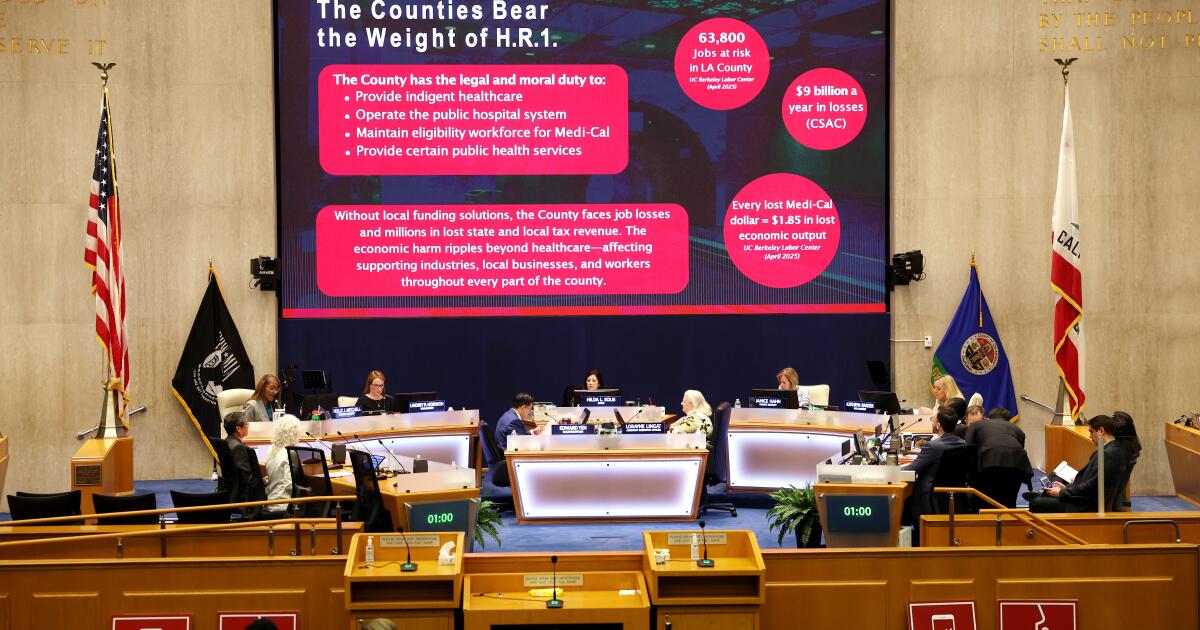
Supporters cheer new L.A. County healthcare sales tax: ‘It’s a lifesaver’

