Science
The countdown to NASA's Jupiter mission is on. This JPL engineer is helping it happen

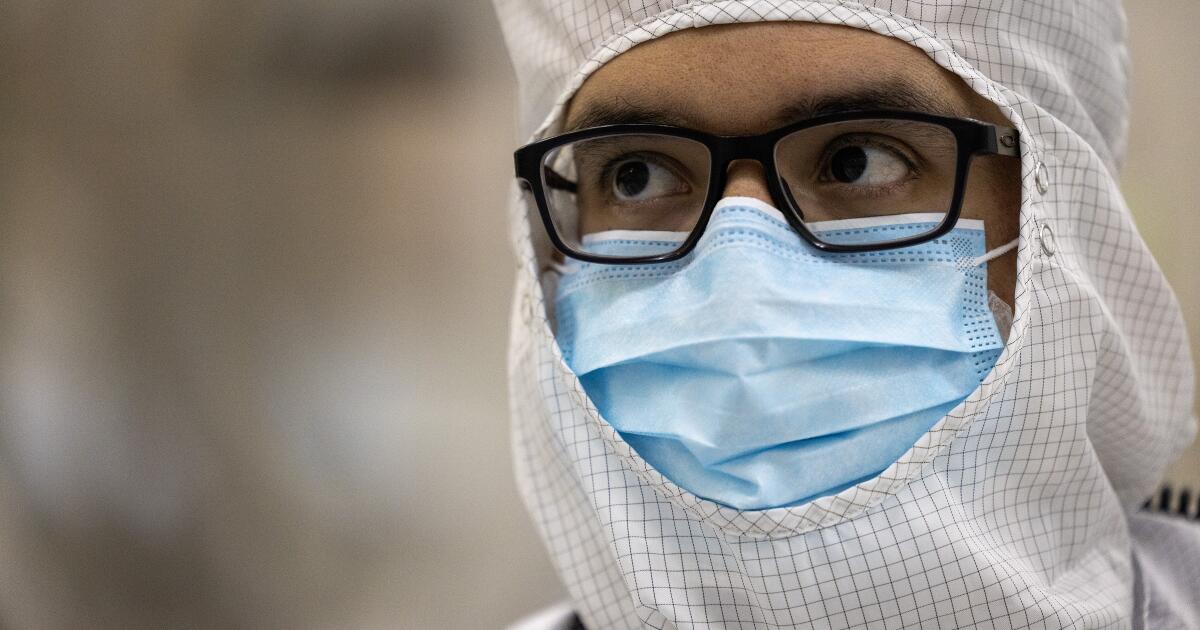
Think of meticulously handcrafted objects and certain things come immediately to mind: fine art, exotic cars, luxury timepieces.
But Pasadena native Steve Barajas spends his days building a bespoke item that’s on another level entirely: NASA’s Europa Clipper.
BUSINESS
What do you do for work?
That’s the question My L.A. Workday answers. The series takes you inside a day on the job with some of the city’s most fascinating people. Interviews are edited for length and clarity.
The 13,000-pound behemoth, with a solar-array wingspan the length of a basketball court, is one of the agency’s most ambitious efforts. It’s on an October countdown to launch to Jupiter and its moon Europa, atop a SpaceX Falcon Heavy rocket, to find out if life exists in the deep ocean believed to lie beneath Europa’s icy exterior.
The central body of the $5-billion Europa Clipper arrived in June 2022 at the Pasadena campus of NASA’s Jet Propulsion Laboratory for the painstaking final assembly of components shipped from across the U.S. and Europe. That’s where Barajas comes in.
Barajas, 35, is a mechanical engineer leading a team that, in coordination with other JPL specialists, installs crucial hardware for the ambitious mission. Barajas describes some high points with a parental flair: There’s the magnetometer that could confirm whether an ocean exists beneath the Europa ice; the mass spectrometer that will analyze gases in Europa’s atmosphere; the infrared cameras that will map the moon’s surface composition, temperature and roughness; and the solar panels that will help power the spacecraft instruments.
A model of NASA’s Europa Clipper spacecraft at the Jet Propulsion Laboratory in Pasadena.
(Brian van der Brug / Los Angeles Times)
The project’s momentum to liftoff didn’t spare the Europa Clipper team when JPL in early February laid off 530 people, or about 8% of its workforce, because of uncertainties over congressional funding for NASA. Although the job cuts, the second round this year, were felt “across the NASA family,” NASA Administrator Bill Nelson said, “the Europa Clipper mission will proceed as planned.”
In his official NASA bio, the UC Berkeley graduate recalls his childhood fascination with space. “As a kid, I remember passing the sign along the 210 Freeway that read ‘NASA-JPL Next Exit,’ thinking it was so cool that NASA was so close.”
Barajas, who joined JPL in 2016 from Aerojet Rocketdyne, said his work has taught him the art of delayed gratification. If the Europa Clipper launches on schedule from the Kennedy Space Center, Barajas will have to wait 5½ years for it to arrive at Europa, about 488 million miles from Earth, where it will perform dozens of flybys of the moon to collect data.
“I’m working on a spacecraft that will hopefully find something profound in the future, and working with people who share the same passion,” he said.
When JPL finishes the buildout, Barajas will be part of the team that flies to Florida in May for launch preparations, with liftoff scheduled for as early as Oct. 10 from Kennedy Space Center in Cape Canaveral.
The Times spent a day with Barajas on the job late last year. The interview was edited for length and clarity.
5 a.m.
Barajas starts his day studying a pile of activity reports from the previous day’s work to create a tactical schedule for the mechanical engineers on his team.
Today is a big day for the Europa Clipper team. They’ll be testing the craft’s thermal pumping system, the last major addition to the spacecraft’s vault, a thick-walled aluminum alloy box that holds the spacecraft’s “brain”: its electronics and computers.
An inside look at NASA’s Europa Clipper spacecraft.
(Brian van der Brug / Los Angeles Times)
“The thermal pump is the heart of the spacecraft,” pumping fluid through tubing to control the craft’s temperature, Barajas said. The daylong effort is hazardous because of the high pressure used to test the system with helium, a nonflammable gas.
Mechanical engineer Steve Barajas in a conference room discussing plans with colleagues for the day’s work.
(Brian van der Brug / Los Angeles Times)
7 a.m.
The Europa Clipper’s tall silvery core stands in JPL’s Space Assembly Facility in High Bay 1 clean room, surrounded by temporary scaffolding. In a nearby conference room, Barajas represents the mechanical engineering team as he compares notes for the day ahead with colleagues from the electrical engineering and systems teams.
“Some of what we are discussing are small details. It usually isn’t a massive revamp of the plan,” Barajas said. “It’s trying to get everything organized so that we can provide very clear direction when we meet with the rest of the teams at 7:30.”
Mechanical engineer Steve Barajas dons a gown to protect against contamination in preparation to enter the High Bay Clean Room harboring NASA’s Europa Clipper space probe at the Jet Propulsion Laboratory.
(Brian van der Brug / Los Angeles Times)
9 a.m.
Before any work on the spacecraft begins, Barajas and his colleagues have to don the white protective coveralls known as bunny suits. Barajas will have to repeat the procedure three times before the day ends.
Collegial chatter abounds because some people entering the clean room for the first time need help with the process.
Mechanical engineer Steve Barajas leans over to close the leg of his clean room coveralls. Next, the opening will be taped shut.
(Brian van der Brug / Los Angeles Times)
“Every time we enter the clean room, we have to first put on the bunny suit, which is a very ugly one-piece jumper,” Barajas said. “Empty your pockets; no phones or watches. Shoe covers go on your feet, then there are boots that go on top of those. If you have a beard; there’s a mask to wear for that. Then there’s a face mask and a hood that’s like a fabric helmet goes over that. Then you put on the bunny suit without letting it touch the ground. Then there’s tape on all of the separate parts, joining the legs to the shoes, gloves to the sleeves, etc.”
The process must be repeated after a worker leaves the clean room for lunch or a bathroom break — “It’s one of the daily downsides of the job” — so veterans know, “you’re not able to hydrate as you would normally.”
Next, there is something that looks like a shower stall, buts it’s dry air being blasted at the occupant, hard enough to feel like a wind storm.
On one wall of the clean room hang plaques commemorating missions that date back 63 years, to the Ranger 1 moon mission, when engineers worked on spacecraft in street clothes. But this is not 1961, a time when earthlings weren’t concerned about spreading their biological junk off planet.
“Planetary protection has evolved,” Barajas said of the strict work requirements he has to follow every day. “No one wants to be the person responsible when extra-terrestrial life is finally found and it turns out to be something we brought there from earth.”
Engineers and technicians work on the Europa Clipper, which is surrounded by temporary scaffolding.
(Brian van der Brug / Los Angeles Times)
9:30 a.m.
Inside the clean room, engineers and technicians are making sure all of the fittings on the thermal pump are sufficiently tight.
There is no chatter, no small talk. Everyone is looking intently at the work being done, a level of scrutiny that continues during the testing process. Barajas is there to ensure that members of the thermal team conducting the test have everything they need and the work is going smoothly.
“We have detectors here on the clean room floor that will read whether anything is seeping out. We do this with helium,” Barajas said. It has to be below a certain rate loss. “There will always be some seepage but as long as it’s not too much, we’re OK.”
A JPL employee inspects the Europa Clipper spacecraft during testing of its thermal pumping system.
(Brian van der Brug / Los Angeles Times)
10:30 a.m.
There are two thresholds for success. One is a vacuum test using a wand spraying helium to see if it it is being sucked into the system. The other is the high-pressure test in which helium is pumped through the system to see if gas leaks out.
Any significant leaks will interrupt the tight choreography of the spacecraft’s assembly and testing schedule, less than a year away from launch time.
“We are physically putting the spacecraft together. We are the end of the line,” Barajas said, trying to explain the serious atmosphere in the room. “It’s up to us to verify that the parts we have been sent are working the way they should. Humans aren’t infallible. We’re always looking over each other’s shoulder to make sure we’re doing the job right.”
“I think that’s where the stress comes from, right? That we feel the pressure and the burden of building this vehicle that has been the life’s work of some and years of work for many others.”
The atmosphere is serious during the potentially hazardous thermal pump pressure test, except for “High Bay Bob,” a bunny suit-clad mannequin in the High Bay Clean Room.
(Brian van der Brug / Los Angeles Times)
1 p.m.
It’s lunchtime. You might think that the pressure of tight deadlines would cause Barajas and others on the project to push through to stay on schedule. Bad idea, Barajas said.
“We always make time for lunch,” he said. “What we don’t want is to have hungry people on the floor. Sometimes we cycle people in and out so that the work can continue. Other times we just take a 45-minute break, so the folks can stay focused on the floor when we are having a long day like this.”
Children look through a window into the clean room at JPL where the Europa Clipper spacecraft is assembled.
(Christina House / Los Angeles Times)
2 p.m.
Barajas steps out of the clean room to catch up with phone calls and email.
“In my particular role, the brunt of the day is a lot of behind-the-scenes work,” Barajas said. “To keep things moving, looking ahead to the next job.”
There’s the occasional startling interruption of tour guides speaking in the hall outside his office as they lead groups through JPL’s Spacecraft Assembly Facility. The main attraction is the window into the clean room, where tours can see the spacecraft itself.
“There’s a constant stream of tours during the day. It’s like working in a fishbowl,” Barajas laughs.
3 p.m.
The work day comes to the 3 p.m. change of shift. But Barajas isn’t knocking off; he’s back to the clean room as testing continues. Barajas needs to make sure that the second shift is able to pick up where the first shift left off.
Engineers and technicians under a high gain antenna work on the Europa Clipper.
(Brian van der Brug / Los Angeles Times)
4 p.m.
The tests are done and the teams determine that there were no leaks. But there isn’t even the briefest of celebrations for this achievement.
“We’ve got so much still to do. Interim steps don’t really get much of a response from us,” Barajas said.
Barajas and colleagues turn their focus to the next few days, when they will fill the system with freon and then close the spacecraft’s aluminum vault for good.
“That will be a milestone, not just for us, but for the whole project,” he said.
That might even get a high-five.


new video loaded: NASA Announces Artemis III Crew
transcript
transcript
NASA Announces Artemis III Crew
NASA announced the crew of Artemis III mission, which will fly to low-Earth orbit to test rendezvous and docking maneuvers with one or two lunar landers.
-
“I am excited to welcome you as the next crew in the Artemis journey to successfully return to the moon — this time to stay.” “I’m honored by the role that I’ve been given. I’m also very humbled by the task in front of us. But first and foremost, I’m grateful.” “So with that, the Artemis II crew, comrade, hands you the baton. You got the controls.” “As you know, we had a significant anomaly at our Launch Complex 36A on May 28. We’ve redoubled our efforts and are moving forward.”
By Alisa Shodiyev Kaff
June 9, 2026
Science
Santa Monica Mountains’ last steelhead trout survived the Palisades fire — and even had babies

Scientists feared the Santa Monica Mountains’ last remaining steelhead trout were dead, smothered by debris flows unleashed by the Palisades fire.
But the endangered fish surprised them: A team of biologists recently spotted 30 of the rare trout — and 21 babies — in Topanga Creek.
“There was a lot of happy dancing in the creek,” said Rosi Dagit, principal conservation biologist for the Resource Conservation District of the Santa Monica Mountains, which works with public and private landowners to conserve natural resources.
That’s because the steelhead here are endangered, at both the state and federal levels. Once, they swam in most streams of the Santa Monicas, but their numbers plummeted amid overfishing and coastal development. Increasingly frequent wildfire has further stressed their habitat. Topanga Creek, a biodiversity hot spot, is home to their last known population in the mountains that stretch from the Hollywood Hills to Point Mugu in Ventura County.
The trout that were spotted, including this one, are part of a distinct Southern California population that’s listed as endangered at the state and federal levels.
(RCDSMM Stream Team)
The California Department of Fish and Wildlife spearheaded a complex mission to rescue trout threatened by the Palisades fire that sparked in January 2025.
Time was of the essence. The fire hadn’t yet been fully contained. But rain was on the way, which would sweep massive amounts of sediment from the denuded hillsides into the water. Fish are often killed this way.
Crews stunned the fish with electricity, scooped them up in buckets, trucked them to a hatchery and ultimately moved them to Arroyo Hondo Creek in Santa Barbara County.
Within days, Topanga Creek was choked with mud. Some assumed the fish left behind were goners.
But in March, the conservation district’s team found four. The following month, when water conditions were clearer, they saw more.
“These fish continue to amaze me,” said Kyle Evans, environmental program manager for the state Department of Fish and Wildlife, who had seen the damage to the creek. “I had seen populations get wiped out in similar situations. So when I heard, I was thrilled.”
Evans surmises the fish that survived were in an area of the creek where less charred material and sediment were swept in.
“These fish likely hunkered down, were hiding under some rocks or places to try to get away from the main concentration of flow,” he said. “And luckily they weren’t buried.”
The ones that were spotted were fairly small, around 6 to 14 inches. Rainbow trout and steelhead trout are the same species, but with different lifestyles. If the fish remain in freshwater, they’ll be considered rainbows. However, they can migrate to the ocean and become steelhead, where they typically grow larger before returning to their natal waters to spawn.
Topanga Creek hasn’t fully recovered from the damage it sustained, but scientists say it’s looking better. Surveys last year were “so depressing,” Dagit said, with very few animals, and stretches that were essentially transformed into flat roads from all the sediment buildup. Some of the riparian canopy burned right down to the creek.
Then came 32 inches of rain over the last nine months, scouring out and moving sediment, creating deeper pools. Dagit said they recently found newt egg masses for the first time in years, as well as a few adult newts and many frogs. Plants that provide cover are starting to recover.
She provided photos comparing certain pools last year and this year, some dramatically transformed. In September 2025, the Shrine Pool could have been an overgrown hiking trail. This April, it was filled with shallow water.

The Shrine Pool in September 2025, left, and the same location in April 2026, right, with RCDSMM’s Isaac Yelchin donning a wetsuit.
(RCDSMM Stream Team)
Topanga Creek is home to another endangered fish, the small but hardy northern tidewater goby, often described as cute. Not long before the trout operation, Dagit led a rescue of hundreds of these fish too. Many were repatriated to the lagoon at the mouth of the creek in a moving ceremony last June.
There’s still the matter of what to do with the trout that were moved to Santa Barbara County last year. Evans would like to bring them home to the Santa Monicas at some point, but isn’t sure if it will happen. On one hand, they could bolster the small, genetically isolated surviving population. On the other, they might inadvertently bring in a disease or bacteria. There is some time to decide. Evans estimates the creek still needs to recover for two to three more years.
For now, the fish are functioning fine in their adopted creek. Experts worried the trauma wrought by the move would disrupt their spawning process, but they had babies that spring. This year, they spawned again.

The Pacifica Municipal Pier was shut down and taped off Thursday after city workers noticed cracks running through the landmark structure and concrete chunks falling into the ocean.
It’s just one of many coastal California structures that have recently crumbled under pressure from a rising and relentless ocean.
Officials from the small, beach city south of San Francisco said the pier was closed due to “cracking, separation, and displacement of the concrete walkway and structural elements.”
It will stay closed while structural engineers asses its safety.
Photos taken by city employees show a wide crack that runs from top to bottom and across the structure as well. Other photos show a large horizontal crack under the foundation of a small restaurant on the pier, the Chit Chat Cafe.
The cafe was also shut down.
This is not the first time the 53-year-old pier has shown signs of stress. In 2021, part of it was shut down after handrails along the edge collapsed. And in 2023, after a series of storms pummeled the Central California coast, damaging parts of the pier, the structure was partially closed for more than year.
Those same storms caused extensive damage in Aptos and Capitola, 70 miles south, where piers and waterfront infrastructure were swept away or damaged.
In 2024, a 150- to 180- foot section of the Santa Cruz wharf was ripped off by powerful waves.
At least 10 of the state’s dozens of coastal public piers were closed for part or all of 2024 due to structural damage sustained in winter storms since 2022. At least five others have longer-term upgrades planned to address structural issues.
“These things are costly to maintain,” said Zach Plopper, senior environmental director at Surfrider. “They are a part of our California coastal culture in many ways, but we’re going to need to reckon with, one, the state that they’re in, and two, the continuous and worsening threats they’re going to experience,”
He said most of the piers were constructed in the early 1900s, and they weren’t built to withstand decades of rough seas, storms and rising sea level.
“With this incoming El Niño, which is forecasted to be significant, and this marine heat wave we’re in the midst of, we’re kind of in uncharted waters as far as what this winter could bring in terms of storms and swells to the California coast, and we’re likely going to see a lot more damage,” he said. “Not just piers, but roads and other coastal infrastructure up and down the state.”
There was no storm in Pacifica earlier this week, so no single event could be blamed for the destruction.
However, a 2025 report from an outside engineering firm, GHD, found that several sections of the pier were in “poor” or “serious” condition, and they recommended closure before anticipated storms or events that could “subject the piles to high winds, swells and large waves.”
The firm found several areas of the pier where concrete was missing and rebar was exposed and corroding.
“The pier has continued to experience high winds and large waves in a harsh marine environment,” the engineers wrote in the report, noting that continuous exposure to seawater or marine spray was “detrimental” to the structure.
A 2023 city report estimated it would cost $19 million to repair.
That same year, a state law was enacted to require local governments along the California coast to plan for sea level rise in the coming decades.
Sea level has risen some 8 inches, on average, along the coast in the past 150 years, Plopper said, and researchers anticipate another foot in the next 25 years.
“We’re going to see profound shifts on our coastline, none that we have ever experienced before, and building static structures on the coast just doesn’t work all that well,” he said. “We’re going to have to make some really hard decisions.”
-

 San Francisco, CA11 minutes ago
Bay Area artists celebrate Wong Kim Ark’s legacy in San Francisco’s Chinatown
-

 Dallas, TX14 minutes ago
Plano’s new tax increment reinvestment zone could allocate $700M for Dallas Stars arena
-

 Miami, FL19 minutes ago
Home intruder shot and killed in Miami Gardens
-

 Boston, MA26 minutes ago
Rays hold on to beat Tolle, Red Sox 4-3
-

 Denver, CO29 minutes ago
The steep price the Denver Nuggets must pay to get off Zeke Nnaji’s contract
-

 Seattle, WA34 minutes ago
Baltimore Orioles fall to Seattle Mariners 6-5 for their fourth loss in a row
-

 San Diego, CA41 minutes ago
San Diego City Council OKs compromise spending plan, capping a contentious budget season
-

 Milwaukee, WI44 minutes ago
Milwaukee apartment theft; woman says puppy, sister’s ashes stolen

