Politics
Opinion: Nikki Haley can still beat Trump. Just not by winning the nomination

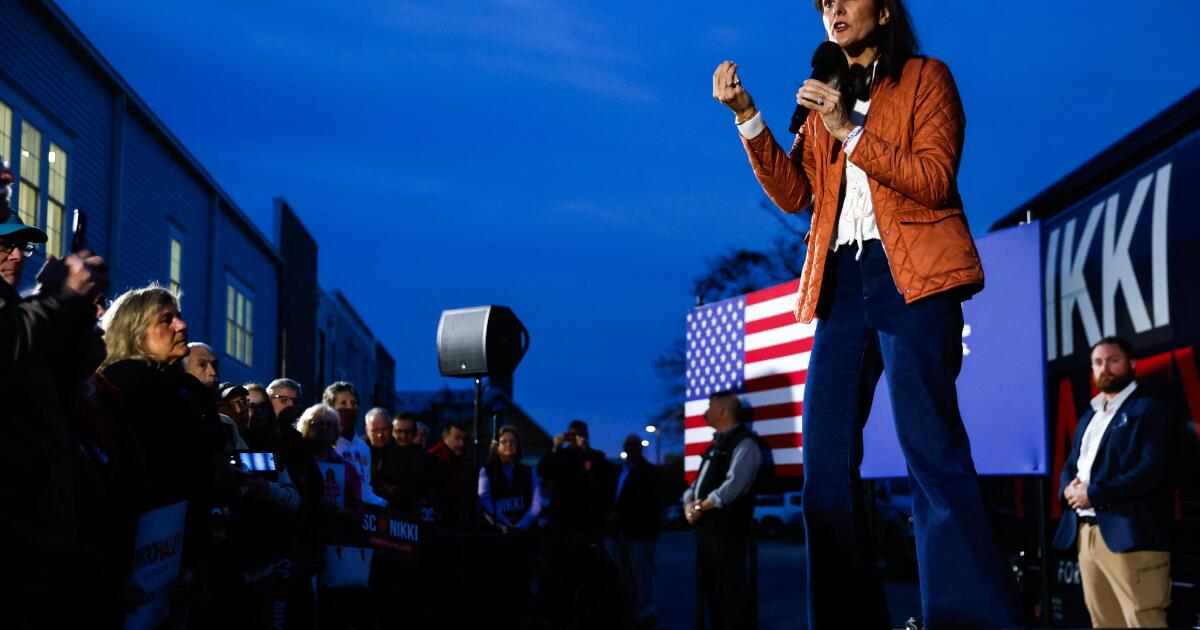
Former South Carolina Gov. Nikki Haley reached a decision point after her loss in January’s New Hampshire Republican primary. She could travel the path of Sen. Bernie Sanders (I-Vt.), the Democratic presidential candidate who congenially yielded to the eventual party nominee in 2020. Or she could follow the road of Sen. Bernie Sanders, the Democratic presidential candidate who dogged the party nominee for months in 2016, bruising her, draining her resources and damaging, fatefully, her standing with the party base. Which would Haley choose?
She had waffled in New Hampshire, offering a convoluted message in a race in which Donald Trump, and Trumpism, are the paramount issue. Her recent, sharp attacks on Trump, and her vow to stay in the race even after her 20-point defeat by Trump in the South Carolina primary Saturday, suggest that she has achieved greater clarity. For now, she’s opted to take the less hospitable road — more Bernie ’16 than ’20.
That could be very bad news for Trump.
In 2020, Joe Biden won about 87% of Sanders supporters in November, according to estimates by Vanderbilt University political scientist John Sides and two colleagues. In 2016, by contrast, only about 79% of Sanders supporters voted for Hillary Clinton in the general election. Worse, Sanders received a much larger share of votes in 2016 — more than 4 in 10 — than he did in 2020. So Clinton’s November shortfall was even more significant.
“We found in 2016 that Sanders supporters had a less favorable view of Clinton as the campaign went on,” Sides told me.
Every race involving Trump is sui generis. (White nationalist demagogues under multiple federal and state indictments are tough on standard political models.) But it’s not hard to imagine that a miniature version of Bernie-mentum may be taking hold in the 2024 GOP presidential race. Haley is giving anti-Trump Republicans, many of them women, a place to go. The question is whether she will also give enough of them a place to stay — even after Trump is the party’s official nominee.
“She’s not going to win the nomination. But she’s going to pull in over 20% in most of the primaries that she’s involved in,” said Mike Madrid, a former political director of the California Republican Party who is an anti-Trump activist. If a sizable minority of those GOP voters refuse to support Trump in the general election, his path to victory is all but impossible. “He’s got a very hard ceiling,” Madrid said. “If Haley can move that ceiling three or four points downward, that’s devastating.”
Is that Haley’s goal? It’s hard to tell. Haley shuns the “Never Trump” label and casts herself only as a truth teller who has “no fear of Trump’s retribution” and no desire to “kiss the ring.” Squeezed between the mutually loathing camps of MAGA and Never Trump, however, she has found a path of her own. She is joined there by a consistent minority of the primary electorate, a community of exiles that translates into political leverage that no Trump supplicant can muster. It’s still possible that Haley could endorse Trump. But she would gain nothing, and lose much, by capitulating.
“She may be the first Republican politician of this era to realize that, with Trump in this arena, she has no future,” Madrid said. “If Trump wins, the next nominee is either going to be Trump himself or his son or his daughter. He’s putting his daughter-in-law in charge of the Republican National Committee.”
The longer Haley stays in, the more she becomes a rallying point for Republicans who do not wish to be ruled by a degenerate cult. And the more Republicans grow accustomed to opposing Trump, the more precarious his situation becomes. A wave of Democratic voters might be needed to swamp Trump. But only a trickle of Republicans, withholding their support, can achieve a similar result.
Trump has grown more authoritarian and vindictive, but he has not crushed the resistance — even within the GOP. Donors have ignored his threats and continued to fund Haley without genuine hope of victory. In Washington recently, while Haley was losing her home-state primary, pro-democracy conservatives gathered for the Principles First Summit, featuring a range of Never Trump luminaries. Last year, the conference drew about 400 attendees. This year, more than 700 registered. Former Republican Rep. Liz Cheney has given pro-democracy conservatives a backbone. Now Haley is giving them an electoral voice.
Faced with Haley’s intransigence, a Trump campaign official told Semafor’s David Weigel that MAGA’s march to victory would not be diverted by Haley’s “delusion.” It would indeed be delusional for Haley to believe she can seize the Republican nomination for president. If the goal, however, is to destroy Donald Trump, and repel the political pathologies that he embodies, Haley appears to be on the right road.
Francis Wilkinson is a columnist for Bloomberg Opinion. @fdwilkinson


Secretary Burgum condemns vandalism targeting National Mall amid new threats
Interior Secretary Doug Burgum reacts to a disturbing pattern of vandalism targeting the National Mall, including the Lincoln Memorial Reflecting Pool, which suffered significant damage. Burgum details the restoration efforts, the deployment of security and the arrest of seven individuals involved. He stresses that such acts are an attack on the country and will be prosecuted to the full extent of the law.
NEWYou can now listen to Fox News articles!
President Donald Trump and his Interior Department are declaring an America 250 victory over algae in the Lincoln Reflecting Pool.
Trump shared photos on Truth Social on Sunday showing the pool and the reflection of the Washington Monument appearing clear and blue, and made a call out with a “Wanted” poster for vandals.
“The U.S. Park Police is seeking the public’s assistance in identifying the individual in the notice below in connection with a Destruction of Government Property investigation related to the Reflecting Pool,” Trump wrote Sunday on Truth Social.
Trump also shared an Interior Department statement crediting “advanced nanobubbler technology” and National Park Service cleanup work.
FORMER US OLYMPIAN DAVID HEARN INDICTED IN ALLEGED REFLECTING POOL VANDALISM
President Donald Trump is touting the algae cleanup and the prosecution of vandals from the Lincoln Reflecting Pool, with the water proving clear and refective in this July 3 photo. (Finn Gomez/Getty Images)
“The advanced nanobubbler technology very effectively killed the algae that has plagued every Lincoln Reflecting Pool reopening — most infamously Obama’s reopening — since 1922,” Dei Gratia Minerals founder Greg Wischer, Interior’s deputy assistant secretary for land and minerals management, wrote in a letter shared with Interior Secretary Doug Burgum and Trump.
“The Reflecting Pool water is crystal clear, and our National Park Service team is now vacuuming up the dead algae resting on the bottom of some parts of the Reflecting Pool — just like the destroyed Iranian Navy resting on the bottom of the Persian Gulf.”
The photos shared by Trump show the Reflecting Pool stretching toward the Washington Monument under blue skies. One image appears to show the pool from the Lincoln Memorial end, while a second closer view shows the Washington Monument reflected in the water.
Trump also shared a U.S. Interior Press social media post hailing the technological success, quoting that Wischer memo.
YOSEMITE, GRAND CANYON LEAD NOTABLE LIST OF NATIONAL PARK CAMPGROUNDS FOR AMERICA’S 250TH
Pete Folch carries an American flag during a morning run past the Reflecting Pool as the city prepares for July 4th festivities on July 3, 2026, in Washington, D.C. (Joe Raedle/Getty Images)
“The vacuuming is the final maintenance step after refilling the pool, and it will be complete in a few days,” his memo continued. “Already, the section of the Reflecting Pool closest to the Lincoln Memorial has been vacuumed up, and the beautiful American Flag Blue coating on the bottom of the pool can be seen clearly.”
Trump’s Interior Department has praised the technology for overcoming past challenges in keeping the pool clear, including dunking on former President Barack Obama.
“Previous administrations — most notably under Obama — failed to maintain the Reflecting Pool, and after refilling the pool, the water would quickly become murky and thick with massive clumps of algae floating on the surface,” the memo concluded.
INTERNAL EMAILS EXPOSE HOW JULY 4TH BASH IS BEING DERAILED BY DEM-RUN COUNTY: ‘OFFENSIVE’
Police said the incident happened on Friday at around 3:36 p.m. at the Reflecting Pool on the grounds of the Lincoln Memorial in the nation’s capital. (U.S. Park Police)
“The photos below show how the nanobubbler technology and vacuuming have been incredibly effective, making the water crystal clear with the American Flag Blue coating shining brightly on the bottom of the pool.
“As our National Park Service team noted, the Reflecting Pool is now so ‘blue’ that the Fake News Media, which has been staked out at the Reflecting Pool for weeks, has fled!”
The 6.75 million-gallon pool has been targeted by Trump critics and leftist anti-Trump activists for attacks both verbally and physical, Burgum discussed with ABC’s “This Week” on Sunday.
“The Reflecting Pool has been a big success,” he said. “And we’ve got 340 million people in this country that are celebrating 250. We did have a few vandals, but all that’s going to be repairable, and that’ll all be fixed in the coming weeks as we go forward.”
People look out at the Reflecting Pool and Washington Monument from the steps of the Lincoln Memorial ahead of July 4 festivities on July 03, 2026, in Washington, D.C. (Joe Raedle/Getty Images)
Burgum now believes that the pool might not require a full draining after its “multiple gashes that add up to 350 feet,” he added.
“We don’t know if we need to drain the whole thing or not because, you know, the cutting happened on the edge, and, of course, it slopes from the edge,” according to Burgum.
“We may be able to partially drain it and do the repair. To be able to fix it, we may not have to drain the whole thing, but it could go very quickly.”
CLICK HERE TO DOWNLOAD THE FOX NEWS APP
While the media and Trump critics are pointing to added costs of the reflecting pool refurbishment, Burgum pointed to the vandalism causing that.
“We weren’t expecting that we were going to have a small group of people that wanted to try to destroy effectively what is part of the Lincoln Memorial,” Burgum told ABC. “There’s plenty of cameras around the Lincoln statue and around the memorial, but the Reflecting Pool had gone for, you know, decades without vandalism.”

America 250” is no “Spirit of ‘76.”
For those of us who remember the bicentennial, the semiquincentennial is a complete and utter dud. Many fine festivities will take place on and around July 4, but compared with the years-long nationwide celebration that marked this country’s 200th anniversary, 250 feels like a nonevent.
Perhaps it was inevitable. Semiquincentennial (meaning half of a 500-year anniversary) certainly doesn’t roll off the tongue as easily as bicentennial and our current president isn’t making it any catchier. Mostly because he seems to think 250 is the new 80 (the birthday President Trump recently marked with his UFC Freedom 250 cage match on the White House lawn).
As many have noted, Trump’s method of honoring this country’s birthday involves making it all about him by demolishing parts of the White House (to install a new bunker-like ballroom), attempting to set up a $1.8-billion slush fund for pardoned Jan. 6 rioters, seeking to build a triumphal arch that a majority of Americans oppose and trying to slap his name and/or image on any surface he can think of (including a proposed $250 bill). No wonder so many artists have dropped out of the concert series planned for the Great American State Fair in Washington, D.C.
To be fair, the federal government’s involvement in bicentennial planning also got bogged down with political and personal hubris. The national commission, originally created by President Lyndon B. Johnson, was reformed under President Richard Nixon. Plagued by criticism and scandal, it was eventually dissolved by Congress and replaced by a new commission that decided to mostly fund community celebrations.
There was much hand-wringing over missed opportunities at the time, but for more than a year, state and local governments staged reenactments, parades and patriotic events all over the country while the commercial sector star-spangled the crap out of everything: T-shirts, bell-bottoms and bathing suits; curtains, bedspreads and throw rugs; dishware, glassware and Tupperware.
The Declaration of Independence appeared on highball glasses, tea towels and collectible plates. Beginning in 1974, CBS ran mini-history lessons called “Bicentennial Minutes,” which were then sent up on shows as diverse as “Hee Haw” and “Maude.” George Washington and other Founding Fathers graced Pez dispensers, coasters and the cover of Mad Magazine. There was a bicentennial Barbie and a colonial Campbell’s Soup doll. McDonald’s sold red, white and blue milkshakes, Burger King offered a flag-bedecked series of glass tumblers, Disney characters wore tricorn hats for a line of park merchandise.
Some called it the “buy-centennial” but for a kid who daily rocked Stars and Stripes sneakers, and, thanks to a year’s worth of American-history-themed “Schoolhouse Rock!,” could, and would, sing the preamble to the Constitution or the anthem “No More Kings” at the drop of a hat, it was great fun.
Now, of course, “No More Kings” is an anti-Trump protest theme, and the right has so co-opted patriotism that wearing a flag-emblazoned T-shirt can feel somehow partisan. American history itself has become a bone of contention, with the left accusing the right of whitewashing this country’s inarguable sins — Native American displacement, slavery, gender inequality and racist policies — while the right insists that the left is obsessed with undermining our nation’s power and legacy by “woke”-shaming it.
The only thing each end of our divided political spectrum can agree on is that democracy is under mortal threat from the other.
That’s one good reason to feel less than festive, and there are plenty of others, including increased political violence, the war in Iran, tariffs, surging gas prices, civil rights rollbacks, Immigration and Customs Enforcement tactics, artificial intelligence’s threat to jobs, the resurgence of measles, the rising cost of just about everything and the fact that some critics are claiming that Steven Spielberg’s “Disclosure Day” is less full of wonder than “Close Encounters of the Third Kind.”

But things weren’t so great heading into the bicentennial either. I was 12 at the time, born nine months after Alabama Gov. George Wallace gave his infamous “segregation now, segregation tomorrow, segregation forever” speech and less than two months before President Kennedy was assassinated. I hadn’t been alive a year when civil rights activists James Chaney, Andrew Goodman and Michael Schwerner were murdered in Mississippi by members of the Ku Klux Klan and hadn’t turned 5 when the Rev. Martin Luther King Jr. and then-Sen. Robert F. Kennedy were also assassinated.
Sure, it was that now-wistfully remembered time when kids went out in the morning and played, mostly unmonitored, until nightfall (with the inevitable trips to the doctor for stitches and tetanus shots for those wounds too obvious to hide from parents). But by the time the bicentennial rolled around, my life had played out against the backdrop of civil unrest and the Vietnam War, both spilling from our black-and-white television almost nightly.
I was 9 when Wallace, then a presidential candidate, was shot and 10 when I learned what OPEC and gas siphoning meant as my family spent hours in an un-air-conditioned car, inching toward the gas pump after the 1973 “Yom Kippur” Arab-Israeli War resulted in oil shortages.
That same year, Vice President Spiro Agnew resigned from office, pleading “no contest” to charges of tax evasion but avoiding prosecution for charges of bribery and criminal conspiracy, and Nixon appointed House Minority Leader Gerald Ford (R-Mich.) to Agnew’s place. In 1974, Nixon, faced with impeachment for his part in the Watergate scandal, became the first president in U.S. history to resign.
The bicentennial’s tall ships festivals, fife and drum parades and Old Glory consumer fest occurred in a country reeling from more than a decade of history-changing assassinations, civil unrest, economic anxiety and high-level political corruption (not to mention a collective fear of the ocean brought on by the 1975 release of Spielberg’s “Jaws”). Democracy was celebrated under Ford, the first, and thus far only, president to come to office through the provisions of the 25th Amendment rather than a national election.
A president who, after being regularly and ruthlessly lampooned by comedian Chevy Chase on the nascent “Saturday Night Live,” reacted by becoming friends with Chase instead of, you know, forcing the network to fire him.
If the bicentennial roiled with some of the same tensions Americans feel today, it did benefit from a cultural cohesion that no longer exists. The year 1976 saw the founding of Apple and the introduction of VHS tapes, but the national audience was still very much a reality. Back then, you couldn’t escape the songs of the summer — “Silly Love Songs” (Wings), “Don’t Go Breaking My Heart” (Elton John and Kiki Dee) and “Afternoon Delight” (Starland Vocal Band) — any more than you could miss those “Bicentennial Minutes.” We all listened to the radio, watched TV, went to the movies and bought books, and our preferences revealed the country’s desire for both comfort and change.
On the bestseller lists, Agatha Christie’s final Hercule Poirot and Miss Marple books marked the end of an era, toggling in the No. 1 spot with the political turbulence of Gore Vidal’s “1876” and Leon Uris’ “Trinity.” “Rocky” beat “All the President’s Men,” “Taxi Driver,” “Network,” “Marathon Man” and “The Omen” at the box office and, later, in the best picture Oscar race.
On television, Americans sought the nostalgic comfort food of “Happy Days,” “The Waltons” and “Little House on the Prairie” amid the more pointed social comedies of “All in the Family,” “The Jeffersons” and “MASH,” all of which had nightly averages of 20 million or more viewers.
In today’s cultural landscape, defined by social media bubbles, streaming services and Spotify libraries, the gap between mass audience and cultural significance is much wider than it was 50 years ago (“The Super Mario Galaxy Movie” may be the highest-grossing movie of the year, but it’s hard to imagine it winning best picture) and mass audience has become a relative term for pretty much everything that is not the Super Bowl.
Even so, we too find ourselves rooting for the little guy (“Project Hail Mary”) and reaching into the past for inspiration (a new “Little House on the Prairie” debuts next week on Netflix) even as we contemplate the future of tech (“The Six Billion Dollar Man” has become every computer genius who can leap a firewall).
I don’t know what it was like to be an adult in 1976, but I remember my parents fretting over the grocery budget, nixing travel plans because of the price of gas and worrying about the future of a country that seemed so irreparably divided. To paraphrase the Diana Ross hit of the time, did we know where we were going to? Not at all. The bicentennial occurred during an election year, with all the partisan denunciations that entails (though when Jimmy Carter narrowly beat Ford, no one thought of contesting the results).
Even so, most Americans were still ready to party, to celebrate the 200th anniversary of a long-shot revolution that resulted in the United States of America.
So does it stink that the semiquincentennial has been such a flop? Yes, it does. But, as is written in its very singable preamble, the Constitution was written “in order to form a more perfect union.” Not “perfect,” but “more perfect.” As in better.
Even in the most troubled times, the cornerstone of our democracy is the understanding that we will always need to do better and there is a living document that allows us to do so.
And 250 years’ worth of that is definitely worth celebrating.

NEWYou can now listen to Fox News articles!
Mallory McMorrow announced Sunday that she is suspending her campaign for the U.S. Senate in battleground Michigan.
The Michigan state senator’s decision leaves her party’s primary as a two-way race between moderate Rep. Haley Stevens, who is backed by longtime Senate Democratic leader Sen. Chuck Schumer and the establishment, and former Wayne County Health Department Director Abdul El-Sayed, a left-wing candidate endorsed by progressive champions Sen. Bernie Sanders of Vermont and Rep. Alexandria Ocasio-Cortez of New York
McMorrow’s name will remain on the ballot for the Aug. 4 primary as ballots have already been printed and distributed to absentee voters, according to Bridge Michigan.
The eventual Democratic nominee will face off in the midterms with former Republican Rep. Mike Rogers, who is on a glide path to the GOP nomination, in a crucial midterm race to succeed retiring Sen. Gary Peters, a Democrat.
MICHIGAN SENATE CANDIDATE ABDUL EL-SAYED TAKES HEAT FOR KHAMENEI COMMENTS, HASAN PIKER EVENT
Michigan state Sen. Mallory McMorrow speaks on the first day of the Democratic National Convention in Chicago on Aug. 19, 2024. (Andrew Caballero-Reynolds/AFP via Getty Images)
The seat is a top Republican target and is a must-hold for the Democrats as they aim to win back the Senate majority from the GOP, which currently controls the chamber 53-47. The leading nonpartisan political handicappers rate the Senate race in Michigan as a toss-up.
In a video posted on X announcing her decision, McMorrow did not provide a specific reason for ending her campaign. She instead thanked her staff and supporters for helping build what she described as a campaign powered by small-dollar donations and no corporate PAC money.
But McMorrow, who has seen her national profile expand in recent years and was running as a progressive in an ideological space between El-Sayed and Stevens, suspended her campaign amid faltering polling numbers and fundraising that weren’t keeping pace with her two main rivals.
McMorrow also pledged to fully support whichever Democrat wins the primary and faces off with Rogers, who is running for the Senate for a second straight cycle and lost in 2024 to now-Sen. Elissa Slotkin by a razor-thin margin.
“So here’s what we do next. Every day through November 3rd. We win this Senate seat and send Mike Rogers back to Florida for good,” she said. “Whoever wins this primary on August 4th will have my full support.”
MICHIGAN DEMOCRATIC SENATE CANDIDATE CLAIMS ISRAEL ‘JUST AS EVIL’ AS HAMAS
Rep. Haley Stevens, D-Mich., speaks during the House Democrats’ news conference in the Capitol on Feb. 6, 2025. (Bill Clark/CQ-Roll Call, Inc via Getty Images)
Following McMorrow’s announcement, Stevens praised her fellow Democrat by calling her an “important voice” for policies that benefit Michigan families.
Stevens then argued that she is the strongest Democratic candidate to win the primary and defeat Rogers in November.
“As we enter the final month of the primary election, I’m excited to continue to make my case to Michiganders why I’m the strongest Democrat to defeat Mike Rogers this November, lower costs, protect manufacturing jobs, and stand up to Trump’s abuses of power.”
MAMDANI-BACKED SOCIALISTS LOOK TO TAKE NEW YORK PLAYBOOK NATIONWIDE AFTER PRIMARY VICTORIES
Abdul El-Sayed, speaks before Sen. Bernie Sanders and takes the stage at Mumford High School on May 3, 2026, in Detroit, Michigan. (Sarah Rice/Getty Images)
In his statement, El-Sayed praised McMorrow for having the “courage” to challenge what he described as a rigged political system, accusing Democratic Party insiders of spending millions to influence the primary. While he did not name specific groups, the remarks appeared to reference corporate PACs and party leaders such as Senate Minority Leader Chuck Schumer, D-N.Y., who has endorsed Stevens.
He then invited McMorrow’s supporters to join his progressive movement to combat big money in politics and defeat the political establishment.
“Throughout this campaign, Senator McMorrow showed what it looks like to fight back against politics that rigs the system against too many of us. While we have policy disagreements, I never questioned whether Senator McMorrow would fight for a better America for my daughters and hers,” he said.
“The same party insiders she had the courage to challenge have been bullying anyone who opposes their chosen candidate. After spending $30 million to drown Senator McMorrow and me out, they’re now spending even more to attack me. It’s everything we are standing up against.”
“I welcome her supporters to our movement to stand up against money in politics, to put money back in pockets, and pass Medicare for All. We cannot allow the establishment to decide our nominee for us.”
U.S. Sen. Bernie Sanders (I-VT) stands with Senate candidate Abdul El-Sayed after speaking at Mumford High School on May 3, 2026 in Detroit, Michigan. (Sarah Rice/Getty Images)
El-Sayed, who, if elected would make history as the nation’s first Muslim senator, is an epidemiologist who unsuccessfully ran for governor as an insurgent candidate in 2018. He has made support for “Medicare-for-all” a major component of his campaign.
El-Sayed also calls for abolishing ICE, and he’s a vocal critic of Israel in its war with Hamas. He has characterized Israel’s actions in Gaza as “genocide” against Palestinians. And El-Sayed, who served as a top surrogate on Sanders’ 2020 presidential campaign, has also vowed not to accept PAC donations.
Schumer and the party establishment view Stevens as more electable than El-Sayed, who has sparked controversy with his past comments. They worry that El-Sayed as the party’s nominee would jeopardize the Democrat-controlled Senate seat by pushing the party too far to the left in a state that President Donald Trump carried two years ago.
Meanwhile, Stevens has been backed by millions in super PAC spending, including big bucks from Israel-aligned groups.
AOC JOINS BERNIE SANDERS IN BACKING SENATE CANDIDATE OPPOSED BY SCHUMER
Former Rep. Mike Rogers, seen speaking with Fox News Digital, is on a glide path for the 2026 Republican Senate nomination in Michigan, as he campaigns for the Senate a second straight time. (Paul Steinhauser – Fox News )
The National Republican Senatorial Committee (NRSC), in a statement reacting to McMorrow’s move, pointed to the burgeoning battle between the far left and the establishment for the future of the Democratic Party.
CLICK HERE TO DOWNLOAD THE FOX NEWS APP
“Bernie Sanders’ radical socialist flank is completely taking over the Democrat Party. It is now up to Chuck Schumer to combat Abdul El-Sayed’s clear momentum and get Haley Stevens over the finish line in their messy primary,” NRSC Regional Press Secretary Samantha Cantrell argued in a statement.
Greg Manz, the Michigan GOP senior communications adviser, said in a statement that “Michigan’s Senate Democrat primary has shifted from a three-car pileup to a head-on collision.”
-

 New York5 minutes ago
How a Museum Security Guard and Artist Lives on $51,000 in Parkchester
-

 Los Angeles, Ca8 minutes ago
Heat advisory issued as Southern California temps near triple digits this week
-

 Detroit, MI28 minutes ago
Detroit Battery Safety Provider Reaches to the Skies with Med Hawk
-

 San Francisco, CA38 minutes ago
A Locals-Approved Modern Guide to Fisherman’s Wharf: Seafood, Beer Gardens + Iconic Bay Views
-

 Dallas, TX43 minutes ago
New glitzy Houston steakhouse Juliet opens next to Delilah this summer
-

 Miami, FL50 minutes ago
Allapattah man faces charges over armed robbery after crash in Miami’s Liberty City
-

 Boston, MA53 minutes ago
Somehow, This is a Fitting, Confusing End to Jaylen Brown’s Boston Celtics Career
-

 Denver, CO58 minutes ago
Denver Broncos 2026 schedule

