Lifestyle
These viral L.A. 'head spas' will show you what's been hiding in your scalp (Ew!)

I’ve never given much thought to my scalp. Aside from the occasional subconscious scritch-scratch or vigorous shampooing, it’s kind of just … there. A necessary but often-overlooked cranium cover.
But the humble scalp is the focus of an increasingly popular wellness trend: elaborate Chinese and Japanese-inspired treatments at so-called head spas. At these businesses, visitors receive a scalp analysis followed by head and neck massages and repeated deep cleanses. Ogling the inner workings of the scalp, an otherwise forgotten body part — and addressing its needs through blissful hydrotherapy treatments — has driven the hashtag #headspa to draw attention on Tiktok for more than a year now. In one viral video of an L.A.-area head spa, a towel-clad influencer claims it will “change your life.”
I was intrigued. Which is how I came to find myself sitting in a salon chair at Cai Xiang Ge, or “CXG,” in San Gabriel, with a practitioner weaving a tiny digital camera through my hair. I faced a 250-times-magnified view of my scalp on a nearby screen. And what I saw resembled an eerie underwater kelp forest, with dark, swaying stalks growing out of a glistening, spongy field dotted with red patches. It looked like something out of a sci-fi film. Ew.
Deborah Vankin undergoes a scalp exam to determine the direction of her treatment at Cai Xiang Ge head spa.
The process was embarrassingly revealing. Turns out I have an oily scalp with bits of dandruff, CXG owner Ning Chen told me. “And see these red parts? You’re not getting enough sleep. Stress,” she said.
But there’s also a strange delight in examining your dirty scalp up close. As humans, we are nothing if not fascinated by our own bodies, whether that’s picking a scab, prodding a canker sore or popping a pimple. (You know you’ve done it.) The shock factor of scalp treatments is integral to its appeal, according to Sara Hallajian, a Santa Monica-based trichologist and hair loss and scalp specialist at Âme Salon.
“It’s about: ‘Oh, let’s look at your dandruff up close and how dirty your scalp is before and how clean after,’ because it’s not something you see with the naked eye,” Hallajian said.
After my scalp’s close-up, Chen led me into a dimly lighted room with multiple spa beds and traditional Chinese harp music. Birds chirped on the soundtrack as I changed into a robe and reclined on the bed. On one end was a shampoo basin, at the other a foot bath, filled with warm water steeped with Chinese herbs. It was early February, and I generally appreciate rituals around renewal this time of year, cliche as it may seem.
The $135 Royal Treatment scratched that itch. For 90 minutes, CXG’s Alyssa Nevins repeatedly scrubbed my scalp and washed my hair as part of a six-step process. The aromatherapy head massage was a dry one, in which Nevins rubbed tingly feeling tea tree oil into my scalp and then applied an electronic, cephalopod-like device, its multiple arms whirling away tension. That was followed by four shampooings, each with a head and neck massage.
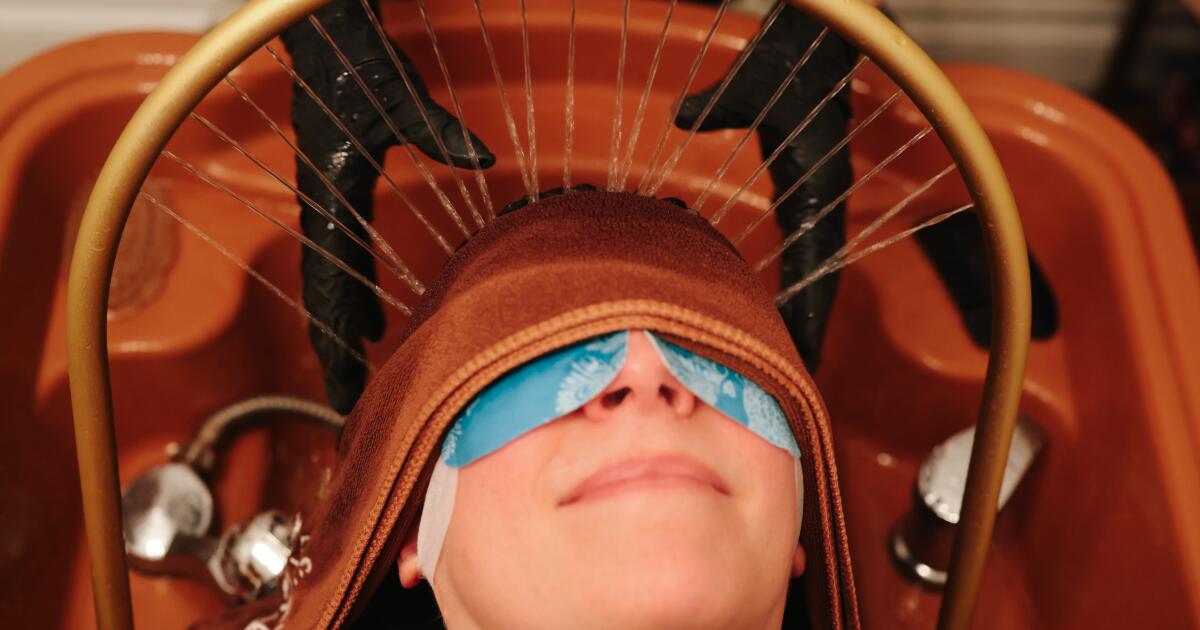
The highlight: Nevins left me lying there for 10 minutes with a circular, waterfall-like device bathing my head and neck in herb-treated water. I wore a heated eye mask, my head was tilted backward and my face was immersed in plumes of steam. Thin jets of water massaged my neck and shoulders. It was heavenly; I nearly fell asleep. I also got a hydrating, collagen-boosting facial, an herbal hair steam and a conditioning hair masque.
Deborah Vankin receives a hydrating, collagen-boosting facial during her 90-minute Chinese scalp treatment at Cai Xiang Ge.
(Dania Maxwell / Los Angeles Times)
The experience ended in the salon, with tea and sweets and an “antihair loss treatment.” Nevins sprayed an herbal serum all over my scalp. She then used a high frequency scalp therapy device to disinfect my pores, a treatment the spa said would fortify hair follicles.
Head spas claim that scalp treatments promote circulation and detoxify, calm and hydrate skin, all of which help prevent dandruff, itchiness, dryness, inflammation and hair loss. I wasn’t sure whether that was true or not, but it sure beats injecting my own plasma into my scalp at $1,500 per session, another recently en vogue beauty treatment aimed at promoting hair growth.
Tea and light snacks are offered after the cleanse, and before the blowout, at Cai Xiang Ge.
(Dania Maxwell / Los Angeles Times)
The claims that head spas make are “fundamentally correct,” said Dr. Carolyn Goh, a dermatologist at UCLA Health. “A deep clean and massage can help with circulation and reduce inflammation. My first recommendation to anyone suffering from hair loss is to make your scalp clean. But if you have psoriasis or eczema, it’s not going to help. I’d also caution if you’re sensitive and using essential oils — you can develop an allergy.”
The treatment stimulates acupressure points in the head, particularly one called bai hui, where the so-called meridians meet, according to Dr. Ka-Kit Hui, director of the UCLA Health Center for East-West Medicine. “That may help people with insomnia, anxiety, headaches. It’s costly, but it’s relaxing.”
Scalp treatments have been an integral part of wellness culture for centuries in many parts of Asia, including in China, Japan, Vietnam and Korea.
In China, head spas are so common that “there’s one on every street,” Chen said. They caught on here in L.A. around 2020 and have proliferated in the last year and a half. Now, Chen says, there are about two dozen in the L.A. area, with “about four new ones opening nearby in the past two months alone.” Most of them are in San Gabriel, Temple City, Arcadia and Rosemead — hubs for Asian communities. In addition to CXG, other popular local head spas include Yang Si Guan in San Gabriel, Tou Dao Tang in Temple City and M Head Spa in Rosemead, all of which have opened within the last year and a half.
Cai Xiang Ge owner Ning Chen at the front desk of her head spa.
(Dania Maxwell / Los Angeles Times)
Chen said her head spa helped kick off the trend in L.A. when CXG opened in mid-2021. CXG plans to expand into Beverly Hills within the next year.
Like many head spas, CXG serves one-timers as well as members who visit weekly or biweekly to relax and maintain scalp health. Chen’s clientele was initially 70% Asian and 30% non-Asian; by summer 2023, it was the opposite, which she said is due to social media promotion.
Videos of Chinese scalp treatments on social media are popular among seekers of ASMR — autonomous sensory meridian response — in which certain sounds promote tingling, goosebumps and other relaxing sensations.
In person, the ASMR experience is even more pronounced. Throughout the treatment, there are the sounds of repeated brush swooshes, shampoo lathering and sloshing water. This was especially evident at Tou Dao Tang when I visited.
Tou Dao Tang originated in China, where it has more than 9,000 locations. But in fall 2022, the company launched its first U.S. outlet in Temple City. It has plans to expand into Glendale later this year. Openings are also in the works for Tustin, Las Vegas, San Francisco and New York.
“It’s the new thing,” manager Hannah Lin says of scalp treatment’s growing popularity. “And people want to try the new thing.”
My scalp analysis, conducted by Tou Dao Tang’s Sherry Zhu, again suggested oily skin, dandruff and sleep deprivation as well as a possible nutrition deficiency, Zhu said. The latter was suggested by a few pale-colored hairs.
The subsequent $108 Classic Scalp treatment was a five-step process. It was especially massage-oriented, with repeated scalp kneading, hair combing and cleansing over 90 minutes, and involved five teas, or “herbal soups,” each infused with different organic herbs. The rounds of tea-washing focused, respectively, on detoxification, rejuvenation and stress relief, nourishment and calming, repairing PH balance and hair loss prevention.
These treatments have become so essential for some patrons of Tou Dao Tang that members often keep their own combs and brushes at the spa, labeled with their names, for practitioners to use when they visit.
Deborah Vankin receives a Chinese scalp treatment from Tou Dao Tang head spa.
(Dania Maxwell / Los Angeles Times)
A close-up of Deborah Vankin’s squeaky clean scalp after her treatment at Cai Xiang Ge.
(Dania Maxwell / Los Angeles Times)
Deborah Vankin after her Cai Xiang Ge treatment, which ended with a blowout and styling.
(Dania Maxwell / Los Angeles Times)
“In China, the head spa is so popular,” Lin said. “We wanted to bring it to the U.S. and let people know about our culture.”
The head spas I visited were very different experiences. CXG’s environs were especially luxurious, complete with multicolored lights, aromatherapy and a warm foot bath, while Tou Dao Tang’s home-brewed, organic “tea bath” washings felt more down to earth. They both left me feeling squeaky clean and relaxed — so much so that at Tou Dao Tang, I accidentally floated out the door without paying. (I called back later and took care of the bill.)
After both treatments, my hair was shiny and extra-soft for days.
Needless to say, the itch I had for a feeling of renewal was sufficiently scratched.


Lifestyle
Vintage-obsessed millennial parents are driving L.A.’s booming kids’ clothing resale market

Kids’ vintage clothing sales are experiencing a remarkable boom at in-person markets and online, where prices for clothes for little ones have shot up on websites including Depop and Poshmark. Millennial parents are looking to outfit their kids in the clothes and TV and film characters they loved (or coveted) when they were kids.
The result? There’s a new generation of kiddos hitting the playground looking incredibly cool. Take Amari Case, a SoCal toddler who spent a Sunday afternoon this spring ambling around a vintage market in a West Hollywood warehouse clad in baggy jeans and a ’90s-era tee emblazoned with the “Dragon Ball Z” character Son Goku.
When she wasn’t scribbling on a Lorax coloring sheet, she’d been cruising around the market with her dad, Aaron Munoz Case, snapping up new pieces destined to make her the flyest kid at the preschool playground.
Neil Wright, from left, Kristine Nite Scalzo and Brandon Rosenblatt, co-founders of Elemeno Kids Vintage Market.
Showing off Amari’s new vintage satin L.A. Raiders jacket and tiny teal Grant Hill Detroit Pistons jersey, Munoz Case, who was also impeccably dressed, noted that while Amari went through a phase at about 18 months where she wanted to dress herself, eventually she gave up and went back to letting her dripped-out dad dictate her wardrobe.
Munoz Case found Amari’s first vintage piece at the Rose Bowl Flea Market and got the bug, going back every month to pick up something to add to his little’s wardrobe.
Trendspotters and researchers say Munoz Case isn’t alone in his quest. The market for kids’ vintage clothing has heated up precipitously over the last few years, perhaps hitting a boiling point in January when an Eeyore romper from the ’90s sold for over $3,000 on EBay. (It was new with tags, but one without tags still went for almost a grand about a month later.)
The thirst for tiny throwbacks is so popular that first-ever, all-kids market Elemeno — named after the “L-M-N-O” bit of “The Alphabet Song” and where Amari was toddling and shopping — drew 17 vendors and over 2,000 attendees over a single weekend in March. (There are plans for another Elemeno Kids Vintage Market pop-up later this year in New York, as well as plans to bring the event back to L.A. sometime next year.)

2

1. Cameron Scalzo, wearing a vintage McDonald’s T-shirt from the ‘90s, and mom Kristine Nite Scalzo. 2. Cameron Scalzo rocks an Avirex jacket from the ‘90s.
Eye Speak Vintage’s Kristine Nite Scalzo, who co-organized the event and is opening an all-kids vintage store in Pasadena this month, says she fell under the kids vintage spell in 2020 when she was pregnant with her son. She’d always been a vintage shopper for herself, so she knew she wanted to pass the passion down to the next generation. She started filling up her son’s closet, and soon enough, she found herself selling her other finds out of a bodega in her garage.
She has a by-appointment space in Pasadena now, where she draws everyone from Rihanna’s stylist to out-of-town moms who make a point to stop by on their way to Disneyland. “The community around kids vintage has really skyrocketed on Instagram over the past six years,” Scalzo says. “We want to know who we’re buying from. We want to know that we’re doing good with buying secondhand. And it’s a hobby for people that can turn into a possible business on the side. Because knowing there’s a big group that’s interested in vintage kids clothes, you can always pass an item [your kid outgrows] to someone else or resell it.”
Scalzo says some parents are out digging through bins at the Goodwill Outlet looking for the perfect piece, while others are content to pay up for, say, a ’90s Simpsons T-shirt or a mini-size Harley-Davidson jacket. Scouring the racks at the Elemeno market, most pieces cost $15 to $40, though there were special pieces pulled to the side in some booths with price tags that could make a parent’s eyes pop. (Think $275 for a set of well-worn Spider-Man overalls from the ’00s or $150 for a pair of Cross Colours denim shorts from the ’90s.)
In kids and adult vintage alike, mint condition is highly valued. No matter the era in which they were raised, kids tend to be messy. They get strawberry juice on their shirts or scuff up the knees on their Bugle Boy jeans. Vintage kids clothes that look pristine are more expensive, and while plain kids clothes do sell, items with characters on them or cool prints tend to draw more attention and dollars.
Brandon Rosenblatt, another of the Elemeno organizers, says he’s had his eye on a specific kids “Back to the Future” shirt for some time, but notes that it typically sells for about $1,000. He’s partial to McKids clothes for his daughter, from McDonald’s short-lived kids clothing brand, noting that he’s even snagged her a vintage official McDonald’s-themed aloha shirt from Hawaii, something he says he’s never seen anywhere else.
1

2

1. Siblings Amora and Milo Castilo wear vintage cowboy hats, jackets and chaps. 2. Thalia Castilo and her kids Amora and Milo.
Other collectors, he says, might be a little less obscure, leaning into mainstream characters such as Strawberry Shortcake or from ’80s and ’90s properties including “The Land Before Time” and “Rugrats.”
“A lot of millennials are having kids — like everyone who’s in their 30s and 40s — and they all want to put their kids in the same IP they grew up in,” Rosenblatt says.
“It’s the thrill of the hunt that gets everyone so excited,” Scalzo says. “Once you find that perfect nostalgic piece, you’re like ‘Holy s—,’ and you just want to chase that feeling again and again.”
Mia De La Rosa, a reseller who was at the Elemeno market, says that like Scalzo, she started buying kids vintage clothes when she was pregnant with her daughter, Liv, who’s 6 now, very into everything on PBS Kids and has a closet full of thrifted vintage garb covered in characters such as D.W., the annoying little sister from the ’90s show “Arthur.”
Everything Liv wears is “completely her style,” De La Rosa says. “She dresses herself every day and she gets compliments on what she’s wearing at school all the time.”
Other vintage-wearing kids — and in particular younger ones — might simply be sporting what their parents like or might just like the look of the shirt even if they don’t know what it’s advertising. (An 8-year-old boy at the Elemeno market, for instance, chose to wear a pristine T-shirt highlighting the ’90s Jim Carrey movie “The Mask” because it featured his favorite color: green.)
Derrick Broaster, a vintage enthusiast turned full-time reseller, says that while he chooses to put himself in clothes from the ’60s and ’70s, he outfits his two sons in clothes from the 2000s. (“How Bow Wow used to dress when he was a kid,” he says.)
Although his younger son tends to rebel against Broaster’s vintage picks, opting for whatever Spider-Man shoes happen to be in his eyeline, his older son has leaned in, letting his dad advise him on what vintage pieces could work and what would be the most stylish.
1

2

1. Julian, left, and Javier Gutierrez show off their vintage clothing. Javier says his mom always tells him to keep his vintage outfits clean. 2. Mom Priscilla Guzman, clockwise, Dad Javier Gutierrez and sons Julian and Javier Gutierrez enjoy the vibe of vintage clothing. Guzman says she’s been buying and selling kids’ vintage since her oldest son was born eight years ago.
Rosenblatt says a good portion of what vintage finds he sees in the market now has returned to the U.S. from places in Central America and South America or Asia where those pieces were likely sent decades ago after they were donated or given away.
“There’s a real underbelly of this vintage game with rag houses getting access to bulk product overseas and letting people sort through it,” he says. “There are companies now that rip through 20, 30 or 40,000 pieces of vintage clothing a week. It’s a really interesting ecosystem.”
For many kids vintage sellers, finding their stock is just as fun and interesting as getting it back into consumers’ hands. “Anywhere we can find clothes, we’re there,” says Matthew Carlos, owner of Long Gone Youth. He started selling vintage clothes 11 years ago, when he was 15, switched to kids vintage at 20 and has spent the last six years scouring flea markets, websites and swap meets.
“The kids market is definitely growing,” he says, “but I still feel like we haven’t even gotten close to where we can go. It’s just getting popular now, but the more events [like Elemeno] we can do, the more it’ll go mainstream.” Even now, some major brands like Gap and OshKosh B’gosh have recognized the interest in some of their styles from the ’80s and ’90s, moving to re-release the looks in limited runs.

Jackie and Frank Oropeza with daughter Rumi Mae shop at Elemeno Kids Vintage Market.
Kids resale is also leaning into streetwear culture. Rosenblatt, who worked in the streetwear industry, says that he’s noticed that a good portion of those interested in kids vintage — particularly, male shoppers — tend to be fans of streetwear brands like Supreme, Fear of God Essentials and Bape. At Elemeno, for instance, a good portion of the parents we saw pushing strollers were well-dressed dads seemingly on solo missions, something you don’t always see at kid-centric events.
“I just want my son to feel like I did as a kid,” said Justin Nguyen, while watching his toddler, Jayden, play with bubbles. “I want him to be happy, carefree and joyful, and I want to be able to spend time with him. My mom and dad were always working, even on the weekends. Now that I’m a dad, taking my son out on weekends to do stuff like this just seems like a blessing.”

Author Julia Elliott won for her short story collection Hellions.
Forrest Clonts/Tin House
hide caption
toggle caption
Forrest Clonts/Tin House
Writer Julia Elliott has won this year’s Carol Shields Prize for Fiction for her short story collection Hellions. The award honors work by women and nonbinary authors in the U.S. and Canada.
Elliott, who also authored the novel The New and Improved Romie Futch and the short story collection The Wilds, is known for blending elements of Southern gothic horror, surrealism and fairy tale. Hellions, published in 2025, includes stories set against backdrops like a plague-stricken medieval convent, a feminist art colony, and small Southern towns.
“This eerie, eclectic, genre-leaping collection takes no half-measures; every sentence of Hellions crackles or crawls,” wrote the prize jury in a statement. “Here, human folly moves against a backdrop of horror and magic … But for all its wildness, there is tremendous control.”
The prize, named after a Pulitzer Prize-winning novelist, awards $150,000 to one winner each year. Novels, short story collections, and graphic novels by women and nonbinary authors are eligible.
This year’s finalists included Quiara Alegría Hudes (The White Hot), Lee Lai (Cannon), Megha Majumdar (A Guardian and a Thief), and Sonya Walger (Lion). They will each receive $12,500.
The Carol Shields Prize went to writer Canisia Lubrin in 2025.
You can listen to actor Donna Lynne Champlin read Elliott’s story “Hellion” on the Death, Sex & Money podcast here.
-

 South-Carolina3 minutes ago
WATCH: Gov. McMaster signs bill protecting SC police animals
-

 South Dakota10 minutes ago
South Dakota primary results leave Legislature seats in limbo
-
 Tennessee13 minutes ago
Franklin police ticket 13-year-old after e-bike crash, and a new Tennessee law brings more changes July 1
-

 Texas19 minutes ago
National Democrats aim to flip 12 Texas House seats under newly expanded target list
-

 Utah25 minutes ago
Utah’s wonderful women took Kevin O’Leary to school over his…
-

 Vermont28 minutes ago
Hundreds of housing units in the works at closely-watched project in Burlington’s South End – VTDigger
-

 Virginia33 minutes ago
Crews put out house fire in Bristol, Virginia
-

 Washington40 minutes ago
Deputies use drone to catch man wanted for damaging car in Washington County

