Politics
In the crowded race for D.A., who can break out of the pack to challenge George Gascón?


The candidates vying to become L.A. County’s next district attorney could barely fit on stage together for a debate.
Scrunched into a dozen studio chairs that left political foes and ideological opposites inches apart at the Waldorf Astoria Beverly Hills, the largest field of contenders ever to run for the office spent close to an hour slogging through opening statements. The candidates — mostly longtime judges and prosecutors — challenging Dist. Atty. George Gascón cried out for microphone time, which they mainly used to deliver messages as similar as their resumes.
Former federal prosecutor Jeff Chemerinsky said his “No. 1 priority is public safety.” Deputy Dist. Atty. Jonathan Hatami is running to “make sure your children are safe.” L.A. County Superior Court Judge Debra Archuleta asked if voters were “safer now than they were three years ago.”
Challenger Deputy Dist. Atty. Jonathan Hatami.
(Francine Orr / Los Angeles Times)
Between the packed stage and a feisty crowd that occasionally interrupted the discussion, the Feb. 8 event left little room for substantive policy discussion.
In some ways, the forum reflected the state of the race: crowded, chaotic and confusing for voters. Recent polls indicate many Angelenos are fed up with Gascón and anxious about crime, yet two-thirds of voters remain undecided in the March primary, according to a recent USC/Dornsife poll.
Though Gascón is likely to glide into the general election, observers believe he is vulnerable in November. But the tight pack has made it hard for a true threat to emerge, with no challengers rising above single digits in polls.
“I think a lot of the other candidates smell blood in the water, hence they are hopping in this thing just to see what would happen,” said political consultant Brian Van Riper, who is not involved in the race. “The interesting question is: How do they pop through?”
Nearly all of the challengers want to roll back some or all of Gascón’s restrictions on the use of the death penalty, sentencing enhancements and prosecuting juveniles as adults. The test is to find a way to stand out not from the district attorney but one another — without pulling too far right of an increasingly progressive L.A. electorate.
Standing head and shoulders above the pack in fundraising is Nathan Hochman, the onetime Republican candidate for state attorney general who is now running as an independent to “get politics out” of the D.A.’s office. Hochman has raised well over $1.5 million and bought television advertisements that often prove key in communicating with L.A. County’s more than 5 million registered voters.
Hochman is a longtime federal prosecutor and defense attorney who once served as president of the L.A. Ethics Commission, and his fundraising prowess could prove pivotal in a November matchup with Gascón, who pulled in $12.4 million when he ousted Jackie Lacey in 2020.
Challenger Nathan Hochman.
(Robert Gauthier / Los Angeles Times)
Arguing that he’s been miscast as the conservative in the race, Hochman described his politics as “socially moderate” and his approach to criminal justice as “the hard middle.”
He said his approach requires figuring out “who the true threats are to public safety and have to go to jail, and quite honestly the ones that aren’t.” A first time, nonviolent offender, he said, “still has to be held accountable for their actions, but community service or diversion might be the play.”
Hochman wears his defense background as a mark of distinction in a race against many experienced prosecutors. He has called for expanded use of mental health and drug courts to push lower level offenders into treatment, but has also made aggressive prosecution of fentanyl dealers a hallmark of his campaign message.
Hochman bristles at any suggestion that he’s too conservative for L.A.’s electorate. He says he’s never voted for Donald Trump, but he sometimes talks about crime in apocalyptic terms that echo right-wing criticisms of California, frequently comparing L.A. to “Gotham City.” He has accused Gascón of ushering in “the golden age of criminals.”
Gerard Marcil, a Republican mega-donor who pumped significant funds into campaigns to recall Gov. Gavin Newsom and Gascón, has given a quarter of a million dollars to a committee supporting Hochman. Hochman‘s campaign has also paid more than $100,000 to the Pluvious Group, a Republican firm that organized Trump fundraisers in 2020.
“My campaign employs a bipartisan mix of Democrat and Republican fundraisers, which reflects the independent approach that I’ll bring to the D.A.’s office. Criminals don’t ask for your party registration when they rob you,” said Hochman, who estimates half of his major donors are Democrats or independents.
Rival candidates have been quick to try to paint Hochman as incapable of beating Gascón one on one.
During a January debate, Deputy Dist. Atty. Eric Siddall referenced Hochman’s 2022 defeat to Rob Bonta in the attorney general election. “There is no way in God’s green earth that he is going to beat George Gascón in a general election,” Siddall said.
In 2020, Gascón swept into office on a raft of endorsements from national Democrats after a summer of protests demanding criminal justice reform. But his first term has been marked by legal battles with his own prosecutors, two failed recall bids and controversial decisions that have led opponents to blame him for acts of violence. Some of his reform policies were blocked by a judge early in his term.
Participants show unanimous support in response to a question posed at the D.A. debate in October.
(Robert Gauthier / Los Angeles Times)
Polls show voter anxieties about crime are surging, and several polls show more than 50% of voters have an unfavorable view of Gascón’s job performance.
Van Riper, the political consultant, said such a low rating can be a political “death sentence” in a competitive race. “People typically don’t change their minds about who they don’t like,” he said.
Gascón scoffed at the polling during a recent interview.
“During my campaign in 2020, I was polling around 27%. I got 54% of the vote,” he said. “The reality is the poll that counts is the one on election day.”
The field, the incumbent D.A. said, has failed to make any substantive “policy argument” to voters beyond a promise to erase his tenure.
Of the four members of Gascón’s office in the race, Hatami might have the best chance of unseating his boss. The USC poll placed Hatami in second in the primary, with support from 8% of voters compared with Gascón’s 15%. Hochman was third with 4%, and no other candidate garnered more than 2% support.
Hatami is one of only three candidates to raise over half a million dollars in the race and has been a thorn in Gascón’s side, frequently challenging the D.A. in public and on television. A longtime prosecutor of crimes against children, he is best known for winning convictions in the gruesome torture murders of Anthony Avalos and Gabriel Fernandez. He has built up a base of crime victims frustrated with what they perceive as leniency from Gascón.
“I think sometimes when you vote for a D.A. it’s not just policies, I think people want a leader,” he said. “I think people want someone who is going to fight for them.”
Promising to govern “with a heart,” Hatami has promised to be flexible on some public safety issues: He believes most juveniles should not be tried as adults and rejects the idea of prosecuting in a way in which every defendant “is getting slammed with the most severe punishment.”
Hatami cozied up to conservative talk radio host Larry Elder and former Sheriff Alex Villanueva during the recall campaigns against Gascón, which could turn off some general election voters.
“I don’t run from them or hide from them,” Hatami said of those connections. “I’ve joined forces with a lot of people that I don’t politically agree with.”
At a recent debate, when asked to rate how safe he felt in L.A. County on a scale of 1 to 10, Hatami said “zero.”
In L.A. County, violent and property crime are up roughly 8% from 2019 to 2022, according to California Department of Justice data. Criminologists say it is disingenuous to solely blame, or credit, crime trends on a district attorney’s policies. LAPD records show homicides and robberies trending down in recent years.
That’s the kind of nuance Chemerinsky hopes will carry him to the November ballot. The most progressive of Gascón’s top challengers — with a war chest second only to Hochman’s — the former federal prosecutor is hoping to scoop up Angelenos unhappy with the incumbent but squeamish about an overcorrection that would erase reforms they demanded four years ago.
“I believe strongly in criminal justice reform,” he said. “I think we need reform at each and every stage of the process.”
Chemerinsky says he would undo all of Gascón’s initial policies except for his ban on the use of the death penalty. Like Hatami, he believes “juveniles should be treated as juveniles” outside of extreme cases, but rejects Gascón’s initial blanket ban on seeking to try some teens as adults. (Gascón retreated from his absolutist policy on juveniles in 2022.)
But Chemerinsky is more measured on the use of sentencing enhancements in gang crimes. In an interview, he noted flaws in law enforcement databases tracking gang members, and said that the use of such enhancements should be carefully considered.
“I think [gang enhancements] have been abused in a couple of ways. … Are we talking about actual gang-related conduct as opposed to a gang-related individual?” he asked.
Comments like that have opened Chemerinsky up to attack. Siddall labeled him “mini-Gascón,” and other critics have noted his father, legal scholar Erwin Chemerinsky, was on Gascón’s transition team in 2020. The elder Chemerinsky says he had no hand in drafting Gascón’s policies.
Also running as a moderate but struggling to match Chemerinsky in fundraising, Siddall has taken up the role of attack dog in the race, labeling Hochman as too right-leaning and Chemerinsky as a Gascón sequel.
Claiming to represent a “new generation of prosecutors,” Siddall rejects the death penalty and wants to refocus the office on prosecuting what he believes to be the true drivers of violent crime — gang leaders and enforcers, as well as those who organize “smash and grab” retail thefts.
But he thinks others in the field are giving unrealistic assessments of crime in L.A.
“I think it is overblown to say that we live in Gotham,” he said. “The idea that we’re at a zero [safety level] is absurd and it doesn’t bear out in reality.”
With less than three weeks before the primary, the rest of the field is fighting for air and tends to echo itself.
Archuleta and Deputy Dist. Atty. Maria Ramirez have both struggled to raise money. While Ramirez has cast herself as a steady hand whose wealth of management experience can restore confidence in the office, Archuleta has leaned heavily into concerns about public safety and dismissed statistics that show crime is down.
Deputy Dist. Atty. John McKinney is the longtime major-crimes prosecutor who convicted Nipsey Hussle’s killer in 2022, but it’s unclear how his record of trial success helps him stand out in a field replete with courtroom veterans.
Superior Court Judge Craig Mitchell, founder of the Skid Row Running Club, says he is uniquely qualified to help tackle L.A.’s spiraling homelessness crisis. Another judge, David Milton, frequently champions the death penalty and has proudly invoked his Republican bona fides in a county where most registered voters are Democrats and independents.
Dan Kapelovitz, a defense attorney running to Gascón’s left, refers to the rest of the field as “mass incarcerators,” but has spent more time on debate stages making jokes than offering policy solutions.
The last to enter the race was a cold case prosecutor named Lloyd “Bobcat” Masson, who believes his focus on property crime and made-for-prime-time moniker will give him a boost with voters who find themselves dazed and confused by the long list of alternatives.
“Each candidate saw there was no one coalescing, and for different reasons they all thought they could do it better,” he said of the primary.
Masson sounds confident for a complete unknown in the race. But after 10 challengers threw their hat into the ring, he figured, why not him, too?
“If it’s a party, I’m coming,” he said.

Politics
Mamdani blasts ICE agents, Elon Musk and ‘supremacy’ in America 250 speech ahead of July 4 weekend

NEWYou can now listen to Fox News articles!
New York City Mayor Zohran Mamdani took aim at U.S. Immigration and Customs Enforcement (ICE) agents, Elon Musk and what he described as the “arena of supremacy” in the United States during an immigration-themed America 250 speech on Friday ahead of Fourth of July weekend.
Flanked by eight recently naturalized U.S. citizens, Mamdani invoked the Statue of Liberty, Ellis Island and America’s history of immigration before turning his rhetoric on elements of today’s U.S. Mamdani also blasted the “world’s first trillionaire” — a milestone Musk achieved with the long-awaited Initial Public Offering (IPO) of SpaceX last month.
“We see the wealthiest country in the history of the world, one where children go to sleep hungry while the world’s first trillionaire hungers for more,” Mamdani said, without naming Musk. “We see monopolies that dominate every industry, and oligarchs who buy elections. We see masked agents terrorizing our streets, eating food cooked by our undocumented neighbors before spiriting them away in unmarked vans.”
“We see a nation whose immense wealth has been built by those with calloused, dirt-streaked hands, those who toil on factory floors and chisel into stone. And we see a nation that has allowed so much of that wealth to be held instead in the soft hands of a precious few,” he added.
Mamdani, who was sitting at George Washington’s desk during the remarks, also praised the legacy of immigrants, claiming that they have overcome riots “aimed at their very existence,” to create lives in New York.
FETTERMAN WARNS MAMDANI RISKS ‘CONSTITUTIONAL CRISIS’ BY VOWING TO DEFY SCOTUS IMMIGRATION RULING
New York City Mayor Zohran Mamdani delivers a speech to mark the 250th anniversary of the United States of America at City Hall on July 3, 2026. (Anna Connors/Pool via REUTERS)
“Over the years that followed, despite laws enacted by the federal government to bar their entry, despite sweatshop fires that killed hundreds of women, despite riots aimed at their very existence, immigrants made homes here in New York City, and they helped to make New York City,” the mayor said.
“That legacy of every generation of Americans insisting that the right to life, liberty and the pursuit of happiness extends to them, too, is no relic of the past. It carried millions of Black Americans north during the Great Migration. It drew hundreds of thousands of Puerto Ricans to New York City after the Second World War. It invited countless others from the West Indies and South Asia and West Africa and across the world. And it is what brought my family to this city when I was seven years old,” he continued.
ZOHRAN MAMDANI PRAISED FOR ‘FANTASTIC’ QUESTION-DODGING ON PRESIDENTIAL ELIGIBILITY
Mamdani did not mention his own family’s wealth in the speech. His father was an elite Harvard academic, and his mother and acclaimed film director.
“My family did not arrive by boat, although we saw the Statue of Liberty from the window of the plane. Even from the air, we could make out the promise of America, the promise of the beautiful patriotic work of rendering America, year after year, a little more faithful to its founding ideals,” he said.
The Statue of Liberty stands in the foreground as Lower Manhattan is viewed at dusk, Sept. 8, 2016, in New York City. (Drew Angerer/Getty Images)
In his speech, Mamdani blasted those with “power and influence,” who he lamented have written American history.
“There is a term so often used to describe our nation and those who have shaped it. American exceptionalism. American exceptionalism, the conventional wisdom tells us, makes our freedom a little more free. It is how we dug the Erie Canal and irrigated the West. Is why children in faraway lands grow up dreaming of one day moving here. And yet, the irony is that the story of America has so often been written by those who were told by others with power and influence and wealth, that they were anything but exceptional,” Mamdani said. “For generation after generation, we have been told that when the world has sent its people to our shores, it has not sent its best.”
“It sent Puritans and Sikhs and Quakers and Muslims and Jewish people who were banished for praying the wrong way, worshiping the wrong gods, angering the wrong people. It sent peasants and serfs from slums and shuttles, who were treated as less because they hardly owned clothes, let alone land. It sent immigrants from whom power was something someone else had,” he continued. “We are told that America is exceptional because we are richer, stronger, more powerful than everyone else. The truth, my friends, is that America is exceptional because here nothing is fixed into place.”
New York City Mayor Zohran Mamdani delivers a speech to mark the 250th anniversary of the United States of America at City Hall on July 3, 2026. (Anna Connors/Pool via REUTERS)
Mamdani referenced how he became a naturalized U.S. citizen in 2018. Mamdani was born in Uganda in 1991 and moved to New York when he was 7. The mayor is a dual U.S.-Ugandan citizen.
“Nearly a decade ago, I too felt what you feel the joy of no longer being just a New Yorker, but an American too. You each hold a special power. The power to determine what America means,” the mayor said, speaking to the recently naturalized citizens by his side.
“The powerful have always known their answer. America, in their view, is an arena of supremacy where only a select few are allowed freedom,” Mamdani said. “Where not all are created equal. America, if you ask them, becomes less the more people it welcomes. America, they will tell you, belongs only to those with the right accent or the right shade of skin. The rest of us, they insist, should be grateful for merely being allowed to visit. How small they are, how weak, how unoriginal. At every moment in our past, those who led through exclusion and isolation have tried to win power and enrich themselves by turning us against one another.”
New York City Mayor Zohran Mamdani delivers a speech to mark the 250th anniversary of the United States of America at City Hall in New York on July 3, 2026. (Anna Connors/Pool via REUTERS)
CLICK HERE TO DOWNLOAD THE FOX NEWS APP
Mamdani also claimed ICE were invading New York neighborhoods.
“We see America each time neighbors link arms with neighbors without asking how long they have lived here or what papers they have as ICE invades our neighborhoods,” he added. “We see America each time those young and old stand in the beating rain or the stifling heat to cast their ballots. We see America each time working people demand more not just for themselves, but for their fellow Americans.”
“There are some who respond to those who ask for more from America with a simple refrain. ‘Love it or leave it,’ they say. But patriotism has never been about pretending our nation is without flaws. Patriotism is every act of righteous dissent,” Mamdani said. “It is every March led under the heavy sun. It is every protest held a decade before its time. It is precisely because we love this nation that we will not leave it.”
Mamdani ended his speech with a rousing call to America’s greatness.
“What power each of us holds to bring America ever closer to the greatness so many have seen when they looked upon these shores. The greatness that for 250 years has been America. Thank you. God bless America. God bless New York City. And happy Fourth of July,” he concluded.
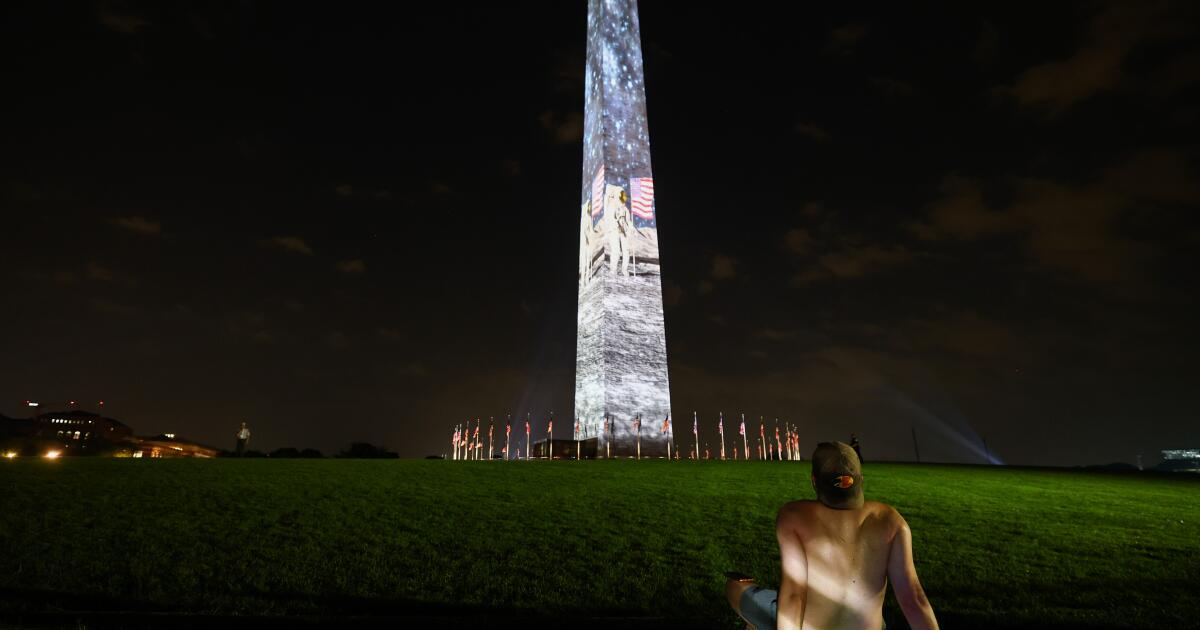
WASHINGTON — Small towns across America had big plans to celebrate the nation’s semiquincentennial this weekend. Local historical societies scheduled town square readings of the Declaration of Independence, hired bands to play patriotic tunes, organized parades and set up themed baking contests.
But many of their most ambitious plans were scrapped after the Trump administration cut $100 million in federal funding for humanities nonprofits and state councils at the start of its term. The decision severely hampered local planning for America’s 250th anniversary, disrupting history projects, museums and educational programs nationwide.
Instead, the Trump administration funneled tens of millions in federal dollars to Event Strategies, the firm behind Trump’s infamous rally at the Ellipse on Jan. 6, 2021, to organize anniversary events throughout the nation’s capital centered on President Trump.
The result, historians say, has become a centralized, more politicized spectacle, marking the national milestone as a celebration of an imperial presidency rather than a revolution from kingly rule.
The spectacular show that Americans will see features Trump at its center, culminating a year of concerted efforts by the president to put his face on passports and currency, national park passes and government buildings.
Members of the Dance4Life studio in Claymont, Del., prepares to march ahead of the Red, White, & Blue To-Do Pomp & Parade on July 2, 2026, in Philadelphia.
(Al Drago / Getty Images)
Yet, beyond the noise of the nation’s capital, historians and teachers, docents and curators, archivists, tour guides and reenactors have sustained the messy, organic discourse of the American story, less funded but no less vocal in their patriotism.
“The way history has been argued since Trump returned to office has been a reminder that governments and political figures have remarkable power to shape a society’s historical memory,” said David Ekbladh, a history professor at Tufts University and author of “Look at the World: The Rise of an American Globalism in the 1930s.”
Trump’s effort to control the anniversary narrative has reminded Ekbladh of one of George Orwell’s most famous quotes: “Who controls the past controls the future. Who controls the present controls the past.”
“The administration’s clear signals that it can and will restrict funding to institutions seems to have muted the way many institutions, like museums and universities, have approached the anniversary,” Ekbladh added. “With this said, Trump’s own direct, personal use of the 250th has been less about articulating a clear view of the nation’s history than using the moment itself to keep attention on him.”
The White House has taken a more active role in the festivities than initially planned, setting up its own Freedom 250 project to supplement America250, a bipartisan congressional effort to celebrate the occasion.
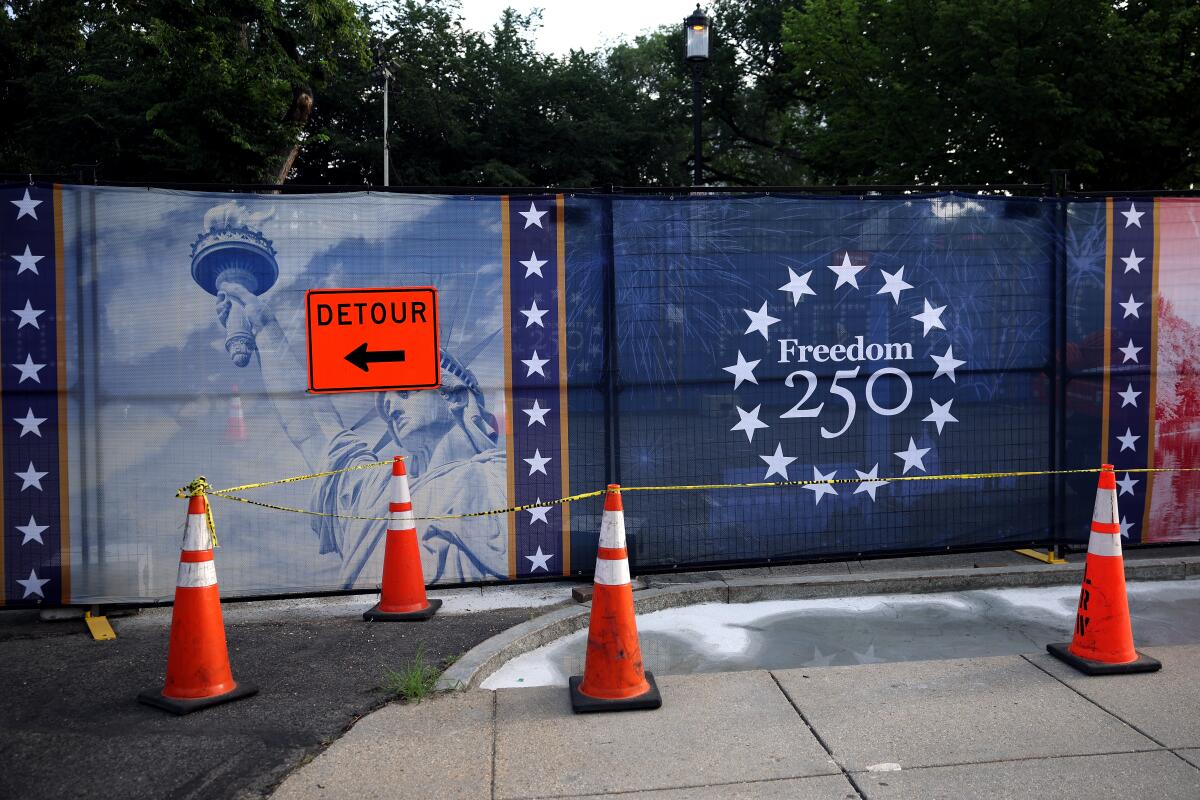
Fencing is seen around the Great American State Fair on the National Mall on Thursday.
(Kevin Dietsch / Getty Images)
The Trump administration has directed funding to events centered on the president’s attendance, primarily around Washington, and partnered with conservative organizations such as PragerU and Hillsdale College to present the country’s founding story through a conservative Christian lens.
Historians are in broad agreement that this year’s celebration has garnered far less attention than the bicentennial, marked in 1976, which generated blanket media coverage and widespread national excitement.
Andrew Rudalevige, a professor of government at Bowdoin College and author of “The New Imperial Presidency,” attributed the lack of enthusiasm this time in part due to a more fragmented media landscape than existed 50 years ago, denying the country a “core curriculum” and a shared story.
“I don’t think it’s a lack of patriotism, so much as a determination that no presidential administration should be able to center itself as the focus of that patriotism,” Rudalevige said.
“There’s a lot to celebrate in the text of the declaration. But that’s not where the focus of the Freedom 250 efforts has been,” Rudalevige said. “It would have been interesting to see what the bipartisan America250 initiative could have come up with if its funding and energies had not been diverted.”
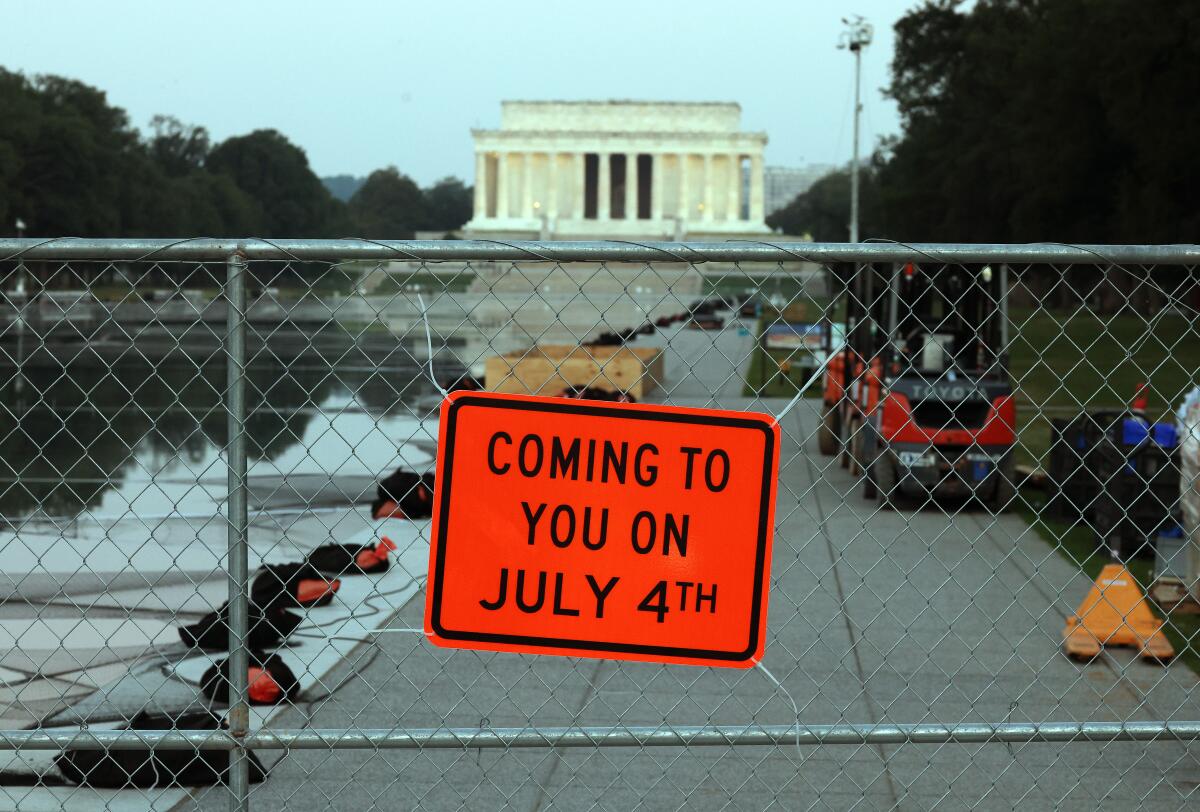
The Lincoln Memorial Reflecting Pool is fenced off in preparation for Fourth of July fireworks.
(Kevin Dietsch / Getty Images)
Trump has scheduled little national travel around the anniversary, visiting North Dakota this week for an event that allowed him to debut a new version of Air Force One, donated by Qatar and outfitted to the president’s tastes. Trump intends to keep the plane after leaving office for his personal use.
The jet will fly over the National Mall alongside the Defense Department’s most impressive equipment on Saturday, before the president delivers a speech in what is forecast to be a blistering heat wave. The evening will end, according to administration officials, with the largest fireworks display in U.S. history.
“The fundamental challenge that we face now is the fight between the historians — people who have been studying the past and who have been thinking about how to tell that story to the public — and government leaders over who gets to control that story,” said Peter Kastor, chair of the history department at Washington University in St. Louis.
“The people who are really on the front lines are museum professionals, the operators of historic sites and schoolteachers,” he said. “They face the responsibility for explaining the past to a general audience on a day-to-day basis, and they are the ones who most often face the backlash from people who want the story to be told differently.”

NEWYou can now listen to Fox News articles!
Lawmakers on Capitol Hill had split reactions to the Supreme Court’s ruling to strike down President Donald Trump’s bid to end birthright citizenship, further allowing children born in the United States to be recognized as U.S. citizens.
“It’s a terrible decision,” Rep. Byron Donalds, R-Fla., told Fox News Digital.
“Regulate folks before they come in — in terms of not coming here just to have a baby and leave,” Rep. Ro Khanna, D-Calif., said.
“In terms of the immigration process coming in, there should be regulation. Not that once you’re born here that we’re going to denaturalize you,” he continued.
REPUBLICAN ACCUSES SCOTUS OF BETRAYING US, PUSHES BILL RESTRICTING BIRTHRIGHT CITIZENSHIP, PREGNANT VISITORS
Rep. Ro Khanna, the U.S. Supreme Court and Rep. Byron Donalds weighed in after the high court rejected President Donald Trump’s bid to end birthright citizenship. (Shannon Finney/NBC via Getty Images; Li Rui/Xinhua via Getty Images; Nathan Posner/Anadolu via Getty Images)
The case, which left many Republicans and Democrats divided, challenged Trump’s executive order to detach birthright citizenship from the 14th Amendment. Most Democrats who Fox News Digital spoke to argued that if the ruling had gone the other way, it would have been considered unconstitutional.
“I think they got it right,” Rep. Christian Menefee, D-Texas said. “The Supreme Court said that the Constitution says what it says. That if anybody even has a question about what the 14th Amendment says, I think it’s a little embarrassing. So I’m glad they got it right.”
TRUMP SUFFERS MAJOR SUPREME COURT DEFEAT AS JUSTICES UPHOLD BIRTHRIGHT CITIZENSHIP
Rep. Christian Menefee (D-TX) speaks onstage during DJ Michael 5000 Watts King’s Day at The Bell Tower on 34th on February 16, 2026 in Houston, Texas. Watts passed away on January 30, 2026 at the age of 52. (Marcus Ingram/Getty Images)
“I believe in the Constitution,” Rep. James Clyburn, D-S.C., said when asked about the ruling.
“The Constitution is the Constitution. If you don’t like the Constitution, you can try to change it,” Rep. Seth Magaziner, D-R.I., said. “But honestly, I think we’ve got much bigger problems as a country than Americans trying to live their lives as birthright citizens.”
The 6-3 decision highlights a significant loss for Trump’s immigration agenda as he has criticized birthright citizenship as a “magnet for illegal immigration.”
ICE SURGES ENFORCEMENT, MAKES 10,000 ARRESTS IN FIVE DAYS AMID SUPREME COURT BIRTHRIGHT CITIZENSHIP DECISION
“I think the president has an obsession with immigrants in this country,” Rep. Sarah Elfreth, D-Md., said. “He’s hell bent on making it as uncomfortable as possible. We’ve seen that time and again with ICE, we’ve seen this with an attack on the 14th Amendment .”
Justice Clarence Thomas, Justice Neil Gorsuch and Justice Samuel Alito were the three to dissent — arguing the 14th Amendment does not guarantee birthright citizenship to all children born to parents who are unlawfully and temporarily in the country. Alito cited that the ruling fails to recognize the rise of “birth tourism,” the concept that foreigners come to America just to give birth, potentially opening the door to national security threats.
CLICK HERE TO DOWNLOAD THE FOX NEWS APP
Rep. Ilhan Omar, D-Minn., and Rep. Maxine Waters, D-Calif., declined to comment on the ruling to Fox News Digital.
“Americans should be happy, because the Constitution means more than one guy’s opinion,” Rep. Bennie Thompson, D-Miss., said.
-

 Ohio5 minutes ago
Where and when to see fireworks in Central Ohio
-

 Oklahoma12 minutes ago
The Under-the-Radar Oklahoma State Football Transfer Generating Preseason Buzz
-

 Oregon15 minutes ago
Oregon lawmakers pushed to secure sensitive data from ICE. How does the law work?
-

 Pennsylvania20 minutes ago
A rare albino bird was found in Pennsylvania. It was a
-

 Rhode Island27 minutes ago
Water worries mount, outdoor water use banned in some parts of RI
-

 South-Carolina30 minutes ago
Tennessee Football 2026 SEC Opponent Summer QnA Preview: South Carolina | Rocky Top Insider
-

 South Dakota35 minutes ago
Trump at Mount Rushmore: Speech time, how to watch live
-

 Tennessee42 minutes ago
Too hot to handle? Cool off at these Middle Tennessee ice cream shops

