Politics
Long before he took on Trump, Adam Schiff's pursuit of tough justice defined his career


When Rep. Adam B. Schiff stood before the U.S. Senate on the final day of President Trump’s first impeachment trial, he reprised a familiar role: prosecutor.
The former assistant U.S. attorney hadn’t tried a case in more than a decade, but he was surprised how quickly the muscle memory came back. Wearing a crisp blue suit, the Burbank Democrat launched into a lacerating closing argument, trying to convince senators that Trump lacked the integrity, morality and temperament to remain in the White House.
“He has betrayed our national security, and he will do so again. He has compromised our elections, and he will do so again,” Schiff said. “You will not change him. You cannot constrain him. He is who he is. Truth matters little to him. What’s right matters even less. And decency matters not at all.”
The Senate ultimately voted to acquit Trump. But Schiff’s leading role in the historic proceeding has become etched in the nation’s political psyche, lionizing him among fellow Democrats, demonizing him among Republicans and seeding his 2024 campaign for the U.S. Senate.
Schiff, a federal prosecutor, campaigned in the 1990s as a law-and-order Democrat, eventually winning a seat in the state Senate.
(David Bohrer / For The Times)
The roots of Schiff’s tough-on-Trump persona go back to the 1990s, when the former federal prosecutor won a seat in the California Legislature as a law enforcement Democrat. In his earliest days in Sacramento, he pushed to increase some penalties, including for young offenders — an approach to criminal justice that is anathema to many progressives today.
Though the pursuit of justice has always been a driving force for Schiff, his attitude toward how justice should be applied, and to whom, has changed. In Congress, he has worked on gun control, police misconduct and investigations into Russia’s support for Trump’s 2016 campaign and into the Jan. 6, 2021, insurrection at the U.S. Capitol.
His time as a federal prosecutor, the 63-year-old Schiff said this week, taught him “the importance of upholding the rule of law.”
“That’s been a core conviction for me,” he told The Times in a phone interview. “And that training came in much more handy than I would have ever imagined during the era of Trump.”
After the 1993 murder of Polly Klaas, a 12-year-old from Petaluma who was kidnapped by a man with a long criminal history, California enacted harsher sentencing requirements. In 1994, Republican Gov. Pete Wilson signed the so-called three-strikes law, which doubled the normal sentence for an offender’s second felony conviction and raised the penalty for a third conviction to 25 years to life. More than 70% of California voters supported the three-strikes law at the ballot box that fall.
Back then, Schiff was working as an assistant U.S. attorney in Los Angeles. He handled several high-profile cases, including the third trial of Richard Miller, a former FBI agent who was convicted of passing classified documents to the Soviet Union.
Schiff talks with members of Long Beach Firefighters Assn. Local 372 in Signal Hill last weekend.
(Irfan Khan / Los Angeles Times)
The experience taught Schiff how to conduct a complicated investigation into a white-collar crime. In a not-too-subtle jab at Trump, Schiff said he also learned the ways of Russian tradecraft, including “how they target people who are of poor moral character, who are philanderers, who are obsessed with money.”
::
During his race for the state Senate in 1996, Schiff fought his well-funded Republican opponent’s attempts to paint him as soft on crime. He campaigned on his support for the three-strikes law and the death penalty. His election was a victory for California Democrats, who increased their majority in the Legislature, as well as a personal victory: Schiff had run for office, and lost, three times before.
He arrived in Sacramento in 1997 as the youngest member of the Senate — determined, he said, to deter crime rather than just prosecute crimes that had already been committed.
Nearly 40% of the 142 bills Schiff introduced during his four-year term were related to policing, criminal procedure and public safety, including efforts to stiffen penalties for some offenses by children, to build and renovate juvenile halls, and to expand crime-prevention services for at-risk teenagers, a review of his legislative history shows.
Schiff in 1999, two years after joining the state Senate with the aim of deterring rather than just prosecuting crimes.
(Ringo H.W. Chiu / For The Times)
“Like many Democrats, including President Biden, we wouldn’t strike the same balance today,” Schiff said. “My priority then, and my priority now, has always been to keep Californians safe and keep our communities safe. … Some of the sentencing policies of the ’90s didn’t do much to reduce crime, but they did a lot to increase incarceration. I don’t think that’s the right balance.”
Schiff’s long legislative history is both an advantage and a liability as he vies for an open U.S. Senate seat following the death of Dianne Feinstein. His evolution on criminal justice issues hews with the leftward swing of California Democrats, who have signaled through statewide ballot initiatives and the election of progressive prosecutors that the state’s “tough on crime” era is over.
But after decades of public opinion steadily shifting away from the policies of the ’90s, the pendulum “seems to be swinging slightly back,” said Dan Schnur, a former Republican strategist who teaches political communication at USC and UC Berkeley. He pointed to recent debates over changes to Proposition 47, the 10-year-old law that reduced some felonies to misdemeanors — discussions that he said “would not have taken place several years ago.”
If the Senate race had occurred in 2020, amid the nationwide upheaval and demands for criminal justice reform that followed the Minneapolis police murder of George Floyd, Schiff’s background as a prosecutor and a self-described law enforcement Democrat “might end up being much bigger issues,” Schnur said.
Progressive criminal justice advocates have accused Schiff of pushing policies that were overly punitive, even by the standards of the ’90s.
In early 2021, Schiff supporters began floating his name as a possibility for California attorney general after then-Atty. Gen. Xavier Becerra was tapped to become Biden’s secretary of Health and Human Services. When criminal justice activists caught wind of the effort, they sent a searing open letter to Gov. Gavin Newsom decrying Schiff’s track record and describing him as “not only supportive of, but deeply invested in, creating our current system of incarceration.” Newsom instead picked state Assemblymember Rob Bonta, an advocate for abolishing the death penalty and eliminating cash bail.
Schiff speaks with community activists in August as he tours Inland Empire neighborhoods affected by giant warehouses.
(Gina Ferazzi / Los Angeles Times)
But Schiff was far from being out of step with his party, said former San Fernando Valley lawmaker Bob Hertzberg, who chaired the Assembly’s Public Safety Committee at the time. He said Schiff was “middle of the road” among the Democrats of the late ’90s.
“Everybody was doing tough-on-crime stuff. It was a different world,” Hertzberg said. Their constituents were worried about surging crime, fueled in part by the crack cocaine epidemic. In the early ’90s, the city of Los Angeles alone saw more than 1,000 homicides a year.
Some of Schiff’s earliest and most punitive bills didn’t become law, including one that sought to try children as young as 14 as adults in criminal court in murder and rape cases. Nor did a bill that would have required that children who committed serious offenses at school be sent to juvenile detention or military-run “boot camps.”
“He wasn’t just a bystander in the ’90s, getting swept along in the punitive approach to public safety,” said USC law professor Jody Armour. “He was really at the vanguard — one of the leading voices in promoting those kinds of policies.”
Schiff also introduced bills to clarify and expand the state’s three-strikes policy and lift the five-year limit on sentencing enhancements for nonviolent crimes, opening the door to longer prison sentences. Both became law.
In 2000, Schiff’s last year in Sacramento, Democratic Gov. Gray Davis signedthe Schiff-Cárdenas Juvenile Justice Crime Prevention Act. The bill, which set aside $121.3 million annually for local policing and another $121.3 million for programs aimed at curbing youth crime and delinquency, was believed to be the country’s largest source of funding at the time for youth crime prevention and intervention.
Democrats in Sacramento had decided that juvenile justice reform was “an area where the voters would be with us,” even if the state didn’t support overhauling the three-strikes law, said then-Assembly Speaker Antonio Villaraigosa. Efforts to pay for anything other than incarceration were “progressive stuff,” he said.
U.S. Rep. Tony Cárdenas, then a member of the state Assembly representing the San Fernando Valley, said that when he backed juvenile justice reform, some of his colleagues ribbed him for supporting what they called “hug-a-thug” programs. Cárdenas, who has endorsed Schiff in the Senate race, said he wanted Schiff to co-sponsor the bill because his background as a prosecutor would help deflect criticisms that alternatives to incarceration were soft on crime.
Counties used the funding for gang-intervention efforts, drug counseling, mental health screenings and a wide array of other services, including after-school and nonprofit programs. Studies later found that children in those programs were less likely to be arrested or incarcerated and more likely to complete any court-ordered community service.
::
As lead manager in former President Trump’s first impeachment trial, Schiff urged senators to convict Trump, saying he “has betrayed our national security, and he will do so again. He has compromised our elections, and he will do so again.”
(Senate Television via AP)
Since he arrived in Washington in 2001, after what was then the most expensive House race in history, Schiff has mostly left behind courtroom issues in favor of bills focused on broader law enforcement and criminal justice policies, including police accountability.
In 2011, he pushed the FBI to widen its use of familial DNA — in which investigators trying to identify crime suspects through their genetic material search for potential relatives in government databases. And after a national scandal erupted over a years-long backlog of more than 13,000 rape kits at the Los Angeles Police Department and the Los Angeles County Sheriff’s Department, Schiff secured funding to help process them.
As grainy cellphone videos of police shootings began to appear, shocking “the conscience of the country,” Schiff said, he became convinced that the U.S. needed police reform. After Michael Brown was shot to death by a Ferguson, Mo., police officer in 2014, Schiff led members of Congress in pushing for a federal grant program to equip police departments with body-worn cameras.
In the summer of 2020, amid the mass protests calling for criminal justice reform after Floyd was killed by police, Schiff made the rare move of withdrawing his endorsement of then-L.A. County Dist. Atty. Jackie Lacey in her contentious reelection fight against progressive challenger George Gascón. Since his election, Gascón has faced two failed recall attempts. Schiff has not endorsed Gascón’s bid for reelection.
Schiff voted for bills that would have decriminalized marijuana nationally and ended the federal sentencing disparity between drug offenses involving crack and powder cocaine. He was also one of 190 original co-sponsors of the George Floyd Justice in Policing Act, which would ban no-knock warrants in federal drug cases and create a national database of complaints and records of police misconduct.
Schiff’s view on the death penalty is among his biggest changes since his days as a federal prosecutor. He said he wrestled with the issue for years and no longer supports capital punishment.
“There was certainly a time when I supported the death penalty for those who killed cops and those who killed kids,” Schiff said this week. But over time, he said, he “came to lose confidence” in how the law was applied, in part because DNA evidence showed that “too many people on death row were innocent,” and because executions disproportionately affected people of color.
::
Those difficult issues, however, were not what launched Schiff into national prominence.
Schiff, then the ranking member of the House Intelligence Committee, earned both admiration and animosity for his role in Trump’s first impeachment.
(Saul Loeb / AFP via Getty Images)
After Democrats took back the House in 2018, he became chairman of the Intelligence Committee. He developed a national profile through his clashes with Trump and regular appearances on cable news shows.
Then-Speaker Nancy Pelosi appointed Schiff as lead manager of Trump’s first impeachment trial. Democrats had accused Trump of abusing his office when he asked Ukrainian President Volodymyr Zelensky to investigate Biden and his son Hunter while Trump was withholding crucial military aid. A second article of impeachment accused Trump of obstructing Congress’ investigation into the alleged scheme by refusing to release subpoenaed documents or to allow current and former aides to testify.
Rep. Zoe Lofgren (D-San Jose), who worked as an impeachment manager alongside Schiff, said he was thorough and professional, and had a “tremendous command of the facts.” Trump’s animosity and the death threats that the team received, she said, “steeled [Schiff] to stand up for the truth.”
Not visible during the televised hearings, Lofgren said, was that Schiff was in excruciating pain due to a dental emergency. Schiff said he alternated between Tylenol and Advil every four hours until he could make it to the dentist for a root canal the weekend before closing arguments. At one point, he recalled, fellow impeachment manager Rep. Hakeem Jeffries (D-N.Y.) gave him a pep talk: “Hey, this is like an NBA championship. You got to play through the pain.”
Republicans reclaimed the House majority in 2020, and in 2023 removed Schiff from the Intelligence Committee.
He had said publicly that there was “significant” and “compelling” evidence of collusion between Trump’s campaign and the Kremlin in the 2016 election.
Robert S. Mueller III, the Justice Department’s special counsel in that case, found that Russia had intervened on the Trump campaign’s behalf, and that the campaign had welcomed the help. But Mueller did not recommend that the Justice Department charge any Americans.
Reporters question Schiff in June about Republicans’ move to censure him. “I wear this partisan vote as a badge of honor,” he said after the resolution passed on a party-line vote.
(Kent Nishimura / Los Angeles Times)
Last year, the GOP-led House voted to censure Schiff, approving a resolution that said he had “misled the American people and brought disrepute upon the House of Representatives.” As then-Speaker Kevin McCarthy read out the vote count — 213 to 209, along party lines — Democrats crowded the House floor, chanting: “Shame! Shame! Shame!”
Republicans continue to accuse Schiff of being unfit to hold public office. During Senate candidates’ first debate last month, GOP hopeful Steve Garvey told Schiff: “Sir, you lied to 300 million people. You can’t take that back.”
But to Schiff, the censure is proof of a job done right.
After its passage, he rose before his colleagues and said:
“Today, I wear this partisan vote as a badge of honor, knowing that I have lived my oath, knowing that I have done my duty to hold a dangerous and out-of-control president accountable, and knowing that I would do so again, in a heartbeat, if the circumstances should ever require it.”


new video loaded: Steve Hilton Holds Slim Early Lead in California Governor’s Race
transcript
transcript
Steve Hilton Holds Slim Early Lead in California Governor’s Race
Steve Hilton, a Republican and former Fox News host, held a narrow lead in early votes over two Democratic opponents in California’s nonpartisan primary for governor. The top two candidates will advance to the general election in November.
-
“Change is coming to California, and it’s long overdue. I want to just say something from my heart to every single person who’s voted for me. We’re not — We’re not there yet, but it’s looking good.” [cheers] “Tonight, the people of the great state of California, in the greatest nation on earth, have spoken. [cheers] Loudly and proudly. [cheers] And while I take nothing for granted, there are lots of ballots left to be counted, it appears that we are on track to advance to November.” [cheers] “It might take some time to figure out where this is going. We’re going to wait until every ballot is counted. We’re going to give democracy a time to work, and we know we finished really strong.” [cheers]
By Axel Boada
June 3, 2026
Politics
Spencer Pratt surges to runoff in LA mayor’s race after angry voters send message to Karen Bass

NEWYou can now listen to Fox News articles!
Reality television personality Spencer Pratt appears on track to clear a key hurdle in Los Angeles’ mayoral race as he seeks to unseat incumbent Mayor Karen Bass in November.
Bass, who has led the city since 2022 amid a turbulent stretch rocked by her response to wildfires, advanced to a runoff after failing to secure a majority of the vote in Tuesday’s primary election. With no candidate surpassing the 50% threshold, the top two finishers will face off in a November runoff.
The anticipated runoff is a symbolic blow to Bass, who was endorsed by Gov. Gavin Newsom, D-Calif., and former Vice President Kamala Harris and has spent decades serving California in a series of elected Democratic offices.
Pratt, a first-time candidate known for the MTV reality show “The Hills,” was running in second place as of Wednesday morning.
Los Angeles Mayor Karen Bass attends the Women for Bass Phone bank event in the Baldwin Hills area of Los Angeles on June 1, 2026. (Louise Barnsley/Splash for Fox News Digital)
REALITY TV STAR SPENCER PRATT TESTS LA VOTERS’ APPETITE FOR POLITICAL OUTSIDER
“Obviously, God wanted five more months of me exposing the failures of our mayor,” Pratt gloated to reporters as the returns came in Tuesday evening.
Pratt has relentlessly hammered Bass on issues that have long plagued the city, including fire recovery, street homelessness and crime. The insurgent candidate holds Bass personally responsible for devastating wildfires that destroyed more than 18,000 structures in the city, including his Pacific Palisades home.
Pratt’s surge appears to have shut out Los Angeles City Council member Nithya Raman, a former ally of Bass who challenged the incumbent from the left and was once viewed as a threat to her bid for a second term. Raman is a member of the Democratic Socialists of America and has argued for steering the city in a more progressive direction.
Raman has not yet conceded despite running well behind Bass and Pratt as of Wednesday morning.
Pratt, a registered Republican, faces an uphill battle to defeat Bass in November if he advances to the runoff election.
Less than 20% of voters in the heavily Democratic city identify with the GOP, though Los Angeles’ mayoral contest is officially nonpartisan.
Media personality and independent candidate Spencer Pratt, left, pictured alongside LA mayor Karen Bass, right. (Robert Gauthier/Los Angeles Times via Getty Images; Justin Sullivan/Getty Images)
KAREN BASS GRILLED OVER BROKEN HOMELESSNESS PROMISE, BLAMES BUREAUCRACY FOR SLOWED PROGRESS
Rep. Darrell Issa, R-Calif., who represents a San Diego-anchored seat, told Fox News Digital that Pratt has won a following in the mayoral contest due to widespread voter discontent with Bass’ leadership.
“He’s catching fire among ardent historic Democrat voters because Karen Bass has been so ineffective,” Issa said in an interview. “And every time she opens her mouth, she’s talking about more of the same to people who have seen their streets, both crime-ridden and in fact … ineffectively managed.”
Bass, conversely, argues that her leadership is leading Los Angeles in the right direction.
“Los Angeles is at a turning point. After decades of rising homelessness, under-built housing and a shrinking police force, it’s Mayor Karen Bass who finally stepped up to change how City Hall works,” Bass’s website reads.
Los Angeles City Councilmember Nithya Raman appears likely to finish in third place, keeping her out of the November runoff. (Eric Thayer/Getty Images)
CLICK HERE TO DOWNLOAD THE FOX NEWS APP
“Homelessness is down, more housing is being built, and the LAPD is hiring new officers,” it also claims.
Fox News Digital’s Leo Briceno contributed reporting.
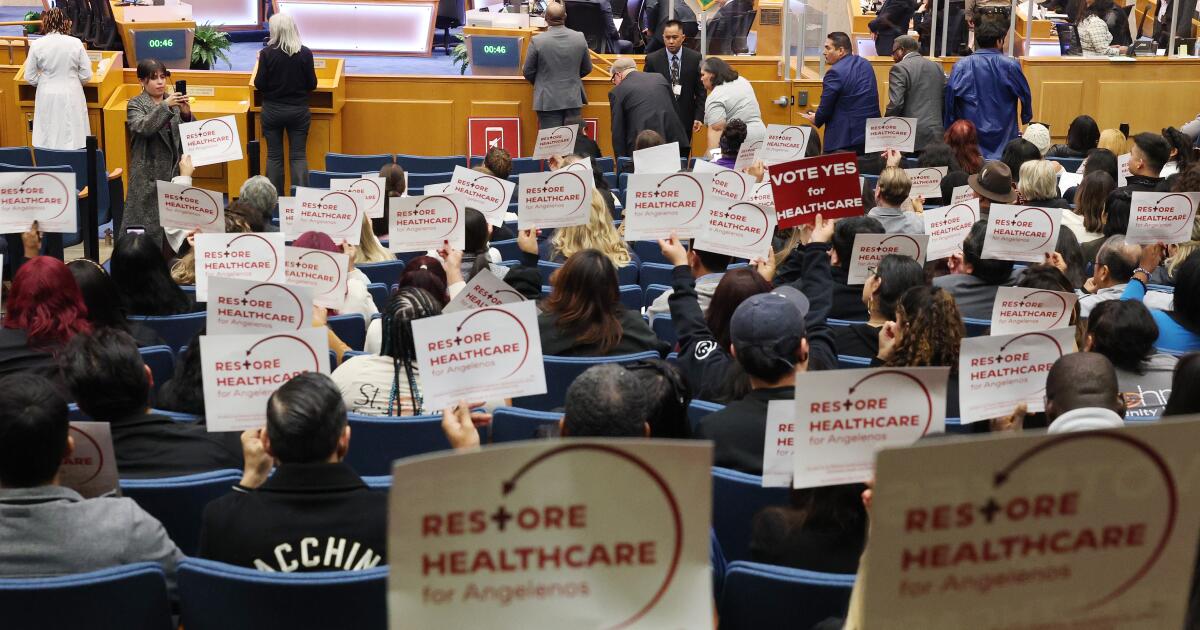
Los Angeles County’s half-cent sales tax to fund healthcare services was trailing Tuesday, with early returns showing a majority of voters rejecting the measure.
The tax — a half-penny of every dollar spent in the county — is meant to prop up local hospitals and clinics that are hemorrhaging funding after recent federal cuts.
The sales tax, which needs a simple majority to pass, would take effect Oct. 1 and last five years. Officials say it would pull in $1 billion annually to help plug the budget holes hitting local hospitals and clinics.
L.A. County health officials anticipate the One Big Beautiful Bill Act, signed into law by President Trump last summer, will slash more than $2 billion from the county’s health services budget within the next three years. Due to eligibility changes, the county will no longer be able to get reimbursements for many Californians who have lost Medi-Cal.
The measure was championed by a coalition of healthcare advocates called Restore Healthcare for Angelenos who warned that mass layoffs and emergency room closures could be imminent if new funding didn’t come fast. The Department of Public Health recently closed seven clinics — a grim sign, supporters said, of service cuts to come.
Voters haven’t rejected a sales tax hike since 2012, when a transportation measure fell just short with 66.1% support. It needed 66.7% to pass.
A majority of county supervisors had supported the new tax proposal, voting 4 to 1 this February to put it on the ballot. But the measure faced significant opposition from local cities, with opponents arguing the sales tax hike would unfairly burden the poorest county residents and encourage people to spend their dollars across the county line.
Supervisor Kathryn Barger, the board’s lone opponent of the tax, said she was concerned it was a “general” tax, meaning the money wouldn’t be earmarked for healthcare costs. Instead, she argued, politicians would have final say over how the money gets spent.
The supervisors have created a plan for spending the tax money, with the largest chunk of the money meant to cover the costs for patients without insurance. The measure also asked voters to sign off on a nine-member oversight committee.
The county currently has a base sales tax rate of 9.75%, and cities impose local taxes on top of that.
-

 Wyoming5 minutes ago
Wyoming Town Rivalries – Feuds & Hate
-

 Crypto8 minutes ago
Cryptocurrency is money, rules South African court – African Law & Business
-

 Finance13 minutes ago
How can I illustrate our financial position to a spouse who shows little interest?
-

 Fitness20 minutes ago
Fitness coach debunks 8 ‘crazy’ exercise myths women still believe: From periods and workouts to weightlifting
-

 Movie Reviews28 minutes ago
Movie Review: ‘Sacred Heart: His Reign Has No End’ – Catholic Review
-

 World38 minutes ago
Video: A Death at the Epicenter of Ebola
-

 News43 minutes ago
Map: 5.1-Magnitude Earthquake Strikes off the Coast of California
-

 Politics50 minutes ago
Video: Steve Hilton Holds Slim Early Lead in California Governor’s Race

