Politics
It’s over, and other takeaways from Trump's defeat of Haley in New Hampshire

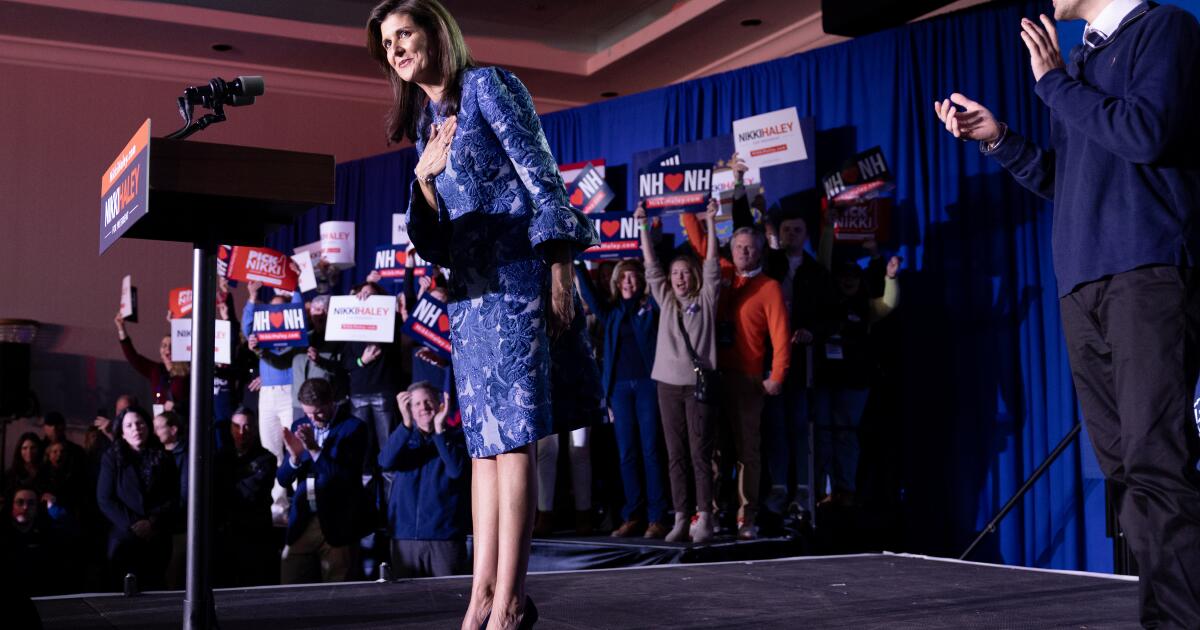
Former President Trump won the first Republican primary Tuesday in New Hampshire over his closest competitor, former South Carolina Gov. Nikki Haley, according to a projection by the Associated Press. Though the outcome was expected, it was significant.
Here are some takeaways.
It’s over
Yes, Haley remains in the race, for now. But Trump’s victory in the first primary state — which happens to have one of the more moderate and least Trump-friendly electorates in the GOP — all but seals hisparty’s nomination, setting up an expected rematch with President Biden.
The not-terribly-competitive nominating contest has underscored how much the GOP has become Trump’s party.
Trump left office with low approval ratings and two impeachments that followed an unprecedented attempt to overturn a lawful election. But he entered the nominating fight with many of the advantages of an incumbent, then scored wins in both Iowa and New Hampshire, a rare feat for a Republican presidential hopeful.
Endorsements tell part of that story. They don’t often matter, but two recent nods from former opponents demonstrate why Trump has been the default choice from the beginning. Florida Gov. Ron DeSantis and South Carolina Sen. Tim Scott both got behind Trump soon after they left the race.
Neither man had much personal reason to embrace Trump. The former president relentlessly targeted DeSantis, who entered the race with high approval ratings, calling him “Desanctimonious” and mocking his appearance, among other insults. But both men endorsed Trump for the same reason they held back from attacking his vulnerabilities during the race: GOP voters still adore him. The two believe that if they want to have a future in the party, at least in the near term, they need to stay with Trump.
Does Haley drop out with her home state looming?
Haley has said repeatedly that she will not depart the race after New Hampshire — as she did again Tuesday night after the race was called for Trump.
“New Hampshire is first in the nation, it is not last in the nation. This race is far from over,” she told supporters.
Most candidates make similar statements until the moment they leave the race. Haley’s underdog strategy depended on winning New Hampshire, which is filled with highly educated Republican and independent voters whom Haley has been seeking.
The race next heads to Nevada and the Virgin Islands, which hold Republican caucuses Feb. 8.
Polls show Haley down by nearly 40 percentage points to Trump in South Carolina, her home state, which holds its Republican primaryFeb. 24. A big loss there would be damaging to her prospects, though not fatal. Florida Sen. Marco Rubio drew only 27% against Trump in his home state in 2016; though he soon exited the presidential race, he won reelection easily to his Senate seat that fall.
But many candidates, including Kamala Harris when she was a California senator, choose to avoid the potential stain on their resume that would come from losing in their home state. They dropped out before any ballots were cast in the 2020 race. In Harris’ case, it paid off with a nomination for vice president, though Haley seems unlikely to get the nod from Trump.
Nikki Haley supporters listen as the candidate speaks after her primary defeat.
(Gina Ferazzi / Los Angeles Times)
Another historic moment for a twice-impeached president
Trump’s win Tuesday, coupled with last week’s caucuses victory in Iowa, marked another historic moment: It was the first time he faced voters since leaving office, still refusing to accept the election results while encouraging an angry mob that stormed theCapitol.
He’s facing 91 criminal charges and has threatened, among other things, to terminate the Constitution and give himself dictatorial powers for a day, while claiming that presidents enjoy absolute immunity from prosecution, even for acts that “cross the line.”
The question is a dividing line for many voters. In preliminary network exit polling, 85% of Haley’s voters said Trump, if convicted of a crime, is unfit to be president. Only 11% of Trump’s voters said that.
Democrats hope voters will start comparing Biden to ‘the alternative’
Biden for months has repeated the aphorism “Don’t compare me to the Almighty, compare me to the alternative.” He argues that his low approval rating — below 40% — will matter less once people zero in on the binary choice between him and Trump.
That process is likely to intensify as Trump gets closer to securing the nomination. The big question is whether the election, now forecast as close, will shift to Biden’s favor when voters take a closer look at Trump. Historically, Trump’s approval rating in polls has dropped as he gets more public exposure.
Turnout for a Trump-Biden rematch could fade
Voters showed up in huge numbers in 2018, 2020 and, in some states, 2022, in part because Trump inspires such strong positive and negative feelings. Abortion also played a large role in 2022, after the Supreme Court’s decision to overturn a constitutional right to the procedure.
Will that fervor persist in November, or are voters too fatigued and uninspired for a likely rematch that has turned off many? That’s one of the biggest questions and one that both parties will pursue now that the general election is taking shape.
Biden needs to shore up support from younger and Black voters, key groups for him in 2020 whose excitement has waned, polls show. Trump needs to minimize losses in the suburbs, where educated Republican women have defected.
What happens to third parties? Will they fade as usual or play spoiler?
Robert F. Kennedy Jr. has been drawing double digits in some polls as an independent candidate. A centrist group called No Labels has been floating a third-party ticket, though no one has signed up to run.
History shows that these candidacies tend to fade by the time voters cast ballots. But they have had an impact, including in 1992, when Ross Perot drew 19% of the vote. Debate continues over which of the two major candidates he hurt worse: Bill Clinton defeated George H.W. Bush with a mere 43% of the popular vote. In 2000, Ralph Nader may have tipped the balance for George W. Bush in his race against Al Gore.
Conventional wisdom holds that Biden will be hurt by a third-party candidate because Trump’s core base is so loyal. But that is unclear, especially in the case of Kennedy, whose conspiratorial views on vaccines and other topics align with those of many Trump supporters.


NEWYou can now listen to Fox News articles!
LOS ANGELES — Outside a Bristol Farms market in LA’s Westchester neighborhood, residents who spoke to Fox News Digital all agreed that homelessness is a top problem facing the city, but disagreed on which mayoral candidate is the right choice to clean it up.
“Love him,” Shelley Zuckerman said about reality television star and independent candidate Spencer Pratt, adding that homelessness is a main motivator of her support for the reality TV star’s mayoral run.
“The fact that he’s not a politician, so he may or may not be a liar, we don’t know that yet, and I know that he wants to do something for LA that the politicians have been saying they’re going to do and then don’t,” Zuckerman added. “And I know politics works, that once you get in there you can’t always do what you want to do, but at least he’s got the passion.”
SPENCER PRATT SAYS HIS POLICY WILL FORCE HOMELESS OUT OF LA AND INTO CITIES LIKE SEATTLE
Los Angeles residents say homelessness is the top problem facing the city as they head to the polls for the mayoral primary. (Fox News Digital)
When asked if crime was a motivating factor to vote for Pratt, Zuckerman’s husband Saul responded, “Of course.”
The couple says they are supporting Republican Steve Hilton for governor.
Patrick Reynolds, who lives in the neighborhood, said he is “not happy with any of the candidates” and called Pratt a “clown” before saying he voted for incumbent Mayor Karen Bass “a little reluctantly.”
Homelessness has been a top-of-mind concern for voters in Los Angeles, and despite Bass being mayor for the last four years, Reynolds said he believes she’s the best choice on that front.
Reynolds, who said he is supporting billionaire Democrat Tom Steyer for governor, spoke at length about the problems with homelessness, including a local park he said has become “too dangerous” to visit in recent years.
KAREN BASS GRILLED OVER BROKEN HOMELESSNESS PROMISE, BLAMES BUREAUCRACY FOR SLOWED PROGRESS
Mayoral candidate Spencer Pratt hosts a campaign block party on 10th Avenue in Los Angeles on May 20, 2026. (Robert Gauthier/Los Angeles Times)
“Homelessness for sure,” a woman named Diane, who said she voted for Bass, told Fox News Digital, “That’s number one on my list, and I think she’s tried very hard to fix that problem. It’s a big problem, I know. And I just think she is down to earth. She’s not some rich billionaire, which I appreciate.”
Diane said she is supporting former Department of Health and Human Services Secretary Xavier Becerra, a Democrat who served in the Biden administration, for governor because he is a “good guy.”
“I like that he is an immigrant and that he has worked his way up in this world,” Diane said. “I think he has a good sensibility. I like also that he isn’t a billionaire. I can relate to him.”
Dan Madden, a resident of nearby Manhattan Beach, told Fox News Digital that if he could vote in LA proper, he’d go with Pratt.
WHO IS TOM STEYER? ANTI-ICE BILLIONAIRE IN CA GOVERNOR’S RACE FACES SCRUTINY OVER DETENTION INVESTMENTS
A Los Angeles city councilwoman and progressive candidate for mayor Nithya Raman, left, pictured alongside incumbent mayor Karen Bass, right. (Ronaldo Bolaños/Los Angeles Times via Getty Images; Justin Sullivan/Getty Images)
“That’d be my man,” said Madden, who added that he is voting for Hilton for governor. “The last 20 years in Los Angeles has been screwed.”
“It’s getting worse,” Madden said about the homeless situation in the Los Angeles area. “They cleaned up here and there. Spots, especially along the beach, coastline, you see it cleaned up. Two months later, everybody’s back.”
CLICK HERE TO DOWNLOAD THE FOX NEWS APP
Pratt, a registered Republican running as an independent, faces off in a nonpartisan mayoral primary against incumbent Mayor Karen Bass, a Democrat, and City Councilmember Nithya Raman, a socialist.
Tuesday’s election will determine which two candidates advance to the November general election. If a candidate receives more than 50% of the vote, they will automatically be named the next mayor.
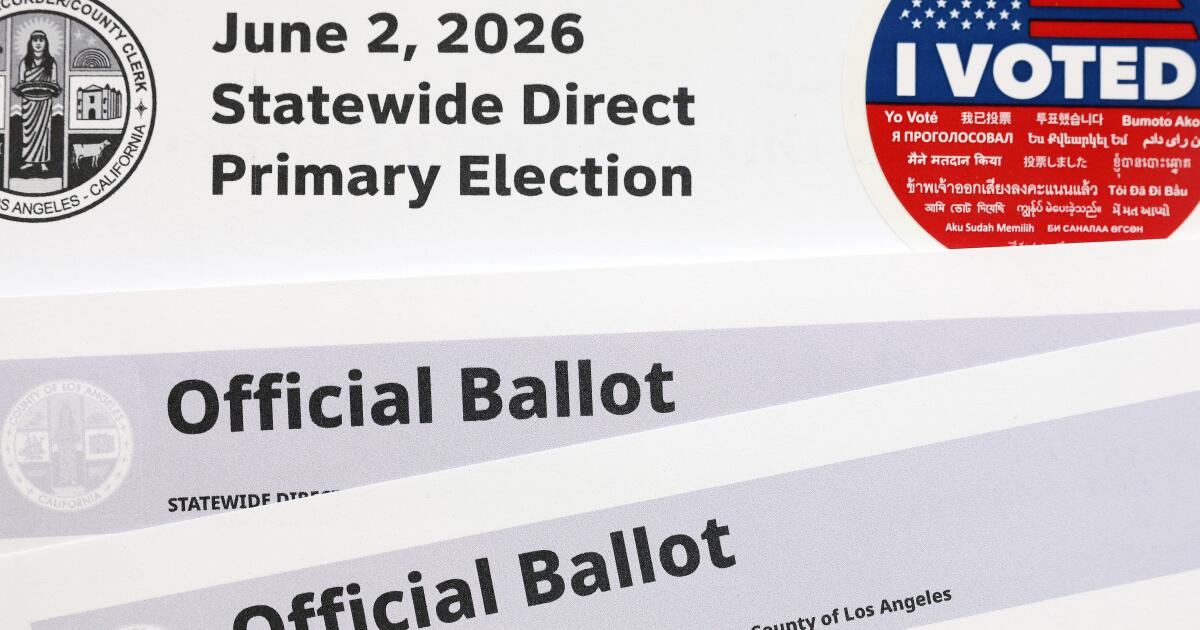
If the last few weeks have shown us anything, it’s that the gubernatorial primary is an unexpectedly close race among a trio unlikely leaders: MAGA Republican Steve Hilton, and Democrats Xavier Becerra and Tom Steyer.
Though Trump endorsed Hilton, a former Fox News host, a Hilton loss may be just what Trump wants — more fuel to fire up his MAGA base with false claims of rigged elections.
“Whether Hilton finishes first, second, or third, Trump will declare with zero evidence that there is voter fraud.,” Matt Barreto told me. He’s a professor of political science at UCLA and a founder of its Voting Rights Project, meant to promote free and fair elections.
And since California will probably take days or weeks to count all the ballots, a tight race will be fertile ground for those fraudulent fraud claims. President Trump has already started, clearly planning to use our primary to further his push to assert federal control of state-run elections.
“You have a really rigged vote in California,” Trump said last week, when asked about Hilton and Los Angeles mayoral candidate Spencer Pratt, another unlikely right-wing contender. “California’s one of the most dishonest states for voting.”
California is not, of course, dishonest in its voting, and Trump has whined about elections for so long that this rhetoric might elicit little more than a shrug from most. But California elections matter at this pivotal moment only months before the midterms. Fraud claims here will further erode trust in our electoral system and could provide Trump with ammunition for interference across the country.
Voter fraud claims may also test a new California law meant to protect real election integrity and trust — a law (Senate Bill 73, signed by Gov. Gavin Newsom last week) that has received little notice but one that could provide a model of protection for the rest of the U.S. It stops law enforcement agents, including federal agents, from “providing unauthorized access, disruption, modification, or seizure of voter rolls, voter lists, or certified voting technology,” without a court order.
Call it the Sheriff Chad Bianco Act.
Bianco, another MAGA gubernatorial hopeful, seized hundreds of thousands of ballots from a recent election, claiming he was investigating the kind of wrongdoing Trump constantly alleges without proof. State Sen. Tom Umberg (D-Santa Ana), a former federal prosecutor, said the warrant Bianco obtained from a friendly judge was “woefully deficient.”
So Umberg helped pass the measure to “protect the integrity of California elections” from “rogue law enforcement officials,” he said.
And he’s not just talking about Bianco.
“I am worried about interference in the election by federal authorities,” Umberg said. “I believe Donald Trump when he says, ‘I’m going to interfere in the election.’”
Umberg is so concerned that he has two other bills in the works he hopes will be law by November. One would stop Immigration and Customs Enforcement agents from being present at polling places. The other would make it illegal for anyone running for a third term as president to appear on the California ballot.
The buildup of fraud claims around California elections and the pushback from legislators like Umberg is a background battle that hasn’t received much attention, but one that is real and consequential.
Trump, through demands for voter rolls by the U.S. Department of Justice, the promotion of the SAVE Act, vague threats of ICE or other federal agents at polls, and the placement of election deniers in key federal rolls has gutted safeguards for voting on the national level.
States have been slow to meet the threat, largely waiting for November to see how it plays out. California, to it’s credit, isn’t so complacent.
The strange circumstances of this particular California election may be a test for both sides. Barreto, the UCLA voting expert, said he thinks “Hilton has the highest probability of finishing first on Tuesday with Becerra close by in second, and Steyer in third.”
But that could — and probably would — change as more ballots are counted.
By Thursday, Barreto said, it’s probable (far from certain) that Becerra is in the lead and Hilton is second.
“There will definitely be millions more ballots counted on Wednesday and Thursday and they will be disproportionately Democratic and contribute to both Becerra and Steyer numbers,” he said.
Maybe pushing Steyer into second? Again, a long shot. But possible.
Democrats have been holding on to their ballots until the last minute this year, with a huge number waiting until just the last few days to vote. It’s possible (though unlikely) that by sheer numbers, Democratic voters will propel both Steyer and Becerra toward November.
We do know that Republicans, despite their smaller numbers, have been voting, and trusting the postal service with their ballots this time around at a fairly high rate. That’s despite Trump’s claims that mail-in voting is inherently fraudulent.
So at the same time that we are expecting a big influx of Democratic ballots in coming days, Republicans may be closer to their voting peak, meaning Hilton’s numbers could top out on election night.
If Hilton doesn’t make the top three, after having been in the lead during in-person voting, MAGA will most certainly lose its collective mind.
And Trump will have something just as good as a Republican governor in the Golden State — “proof” we cheated.
Politics
Jared Kushner’s overseas luxury resort project faces anti-corruption investigation amid violent protests

NEWYou can now listen to Fox News articles!
Albanian anti-corruption prosecutors are investigating changes to the protected status of a coastal wetland where a luxury resort project linked to Jared Kushner, the son-in-law of U.S. President Donald Trump, has drawn environmental opposition and protests, according to Politico.
SPAK, Albania’s special anti-corruption prosecution office, has opened a probe into changes made to the status of the Vjosa-Narta protected landscape in Zvërnec, Politico reported. The coastal wetland area is home to flamingos, Mediterranean monk seals, and sea turtle nesting sites, Politico reported.
IVANKA TRUMP BREAKS DOWN IN EMOTIONAL INTERVIEW TALKING ABOUT HER MOTHER IVANA’S DEATH, OTHER CHALLENGES
Jared Kushner and Steve Witkoff participate in a charter announcement for President Donald Trump’s Board of Peace initiative in Davos, Switzerland, on Jan. 22, 2026. (Denis Balibouse/Reuters)
In 2024, Kushner publicly discussed plans for his firm, Affinity Partners, to develop luxury tourism projects in Albania, including in the Zvërnec area. Earlier this year, he visited the area with his wife, Ivanka Trump.
Albanian Prime Minister Edi Rama recently confirmed to Politico that talks were ongoing between the government and Kushner over the deal, which is expected to include roughly 10,000 hotel rooms and villas.
EUROPEAN CAPITAL ROCKED BY VIOLENT PROTESTS AS GOVERNMENT CORRUPTION PROBE FUELS UNREST
Albanian Prime Minister Edi Rama speaks during a press conference following the EU-Albania Intergovernmental Conference in Brussels, Belgium, on May 26, 2026. (Daniel Gnap/NurPhoto)
“I want to make Albania a country that is a destination to be envied in the region, and this project is part of this effort,” Rama said Monday.
Fox News Digital has reached out to Affinity Partners and SPAK for comment.
Protests by Albanian citizens and nonprofit groups began in May when large, barbed-wire-topped fences were erected at the proposed site, preventing locals and tourists from accessing the beach. On Sunday, protesters assembled outside government offices to demand an end to the project as well as Rama’s resignation.
Jared Kushner speaks during the inaugural meeting of the Board of Peace at the Donald J. Trump Institute of Peace in Washington, D.C., on Feb. 19, 2026. Kushner is facing pushback in Albania over a luxury development project. (Chip Somodevilla/Getty Images)
CLICK HERE TO DOWNLOAD THE FOX NEWS APP
Following Sunday’s protests, footage emerged showing private security guards appearing to assault and drag a protester along a cliff. Some guards allegedly threatened other demonstrators who were attempting to remove fences and halt construction.
The licenses of two private security companies were revoked following the incident. Meanwhile, around 15 protesters have been charged, and the local police chief has been stripped of his duties.
-

 World5 minutes ago
Fireworks reportedly trigger mass horse stampede through Rome streets, injuring several soldiers
-

 Politics8 minutes ago
SEE IT: LA voters split on Pratt’s mayoral bid as one issue dominates Election Day
-

 Health13 minutes ago
Could cancer vaccines be next? New treatment cuts melanoma risk by nearly 50%
-

 Sports20 minutes ago
Naomi Osaka offers uninspiring response about her mindset following French Open loss to Aryna Sabalenka
-

 Technology23 minutes ago
Identity theft rarely announces itself: 6 signs you missed
-
 Business28 minutes ago
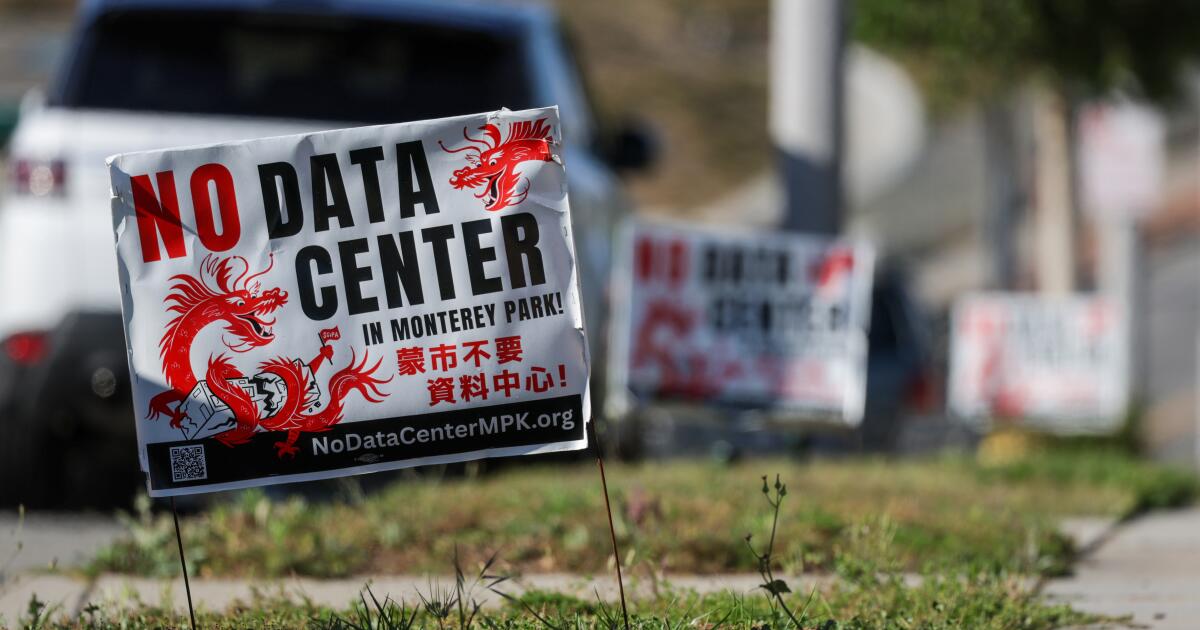
Monterey Park takes landmark vote on banning data centers
-
 Entertainment35 minutes ago
6 drama actors on learning to say no, what shooting in L.A. means to them and more
-
 Lifestyle38 minutes ago
Inside the all-masc lesbian and translesbian revue electrifying L.A. nightlife

