Science
A California panel is holding up studies on psychedelics. Some researchers want it gone

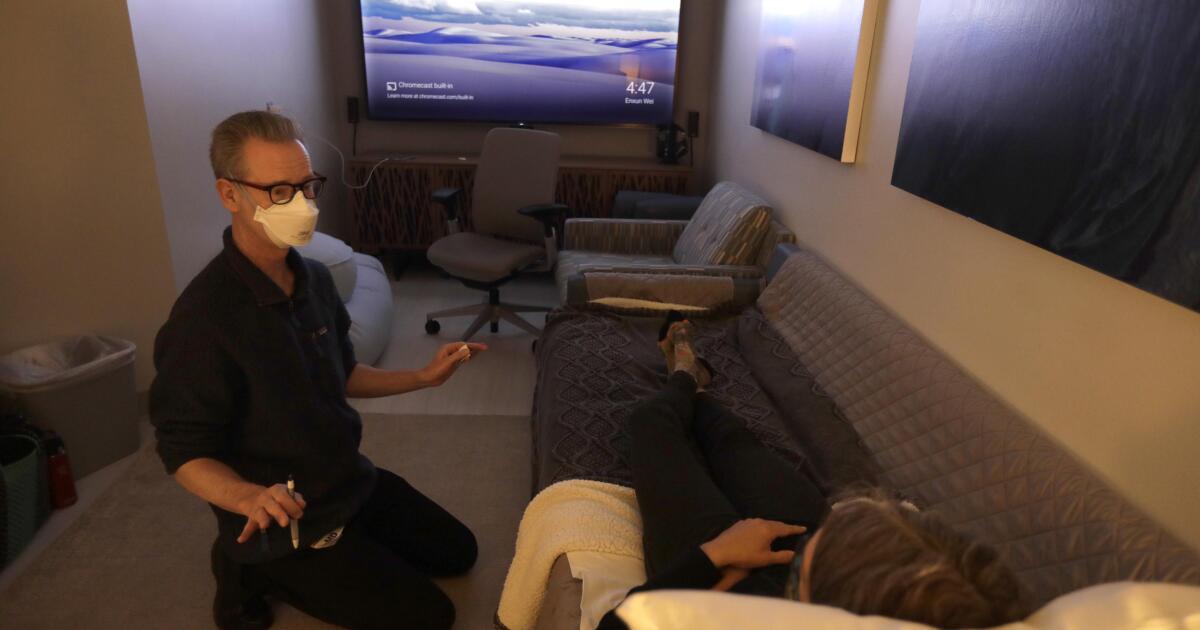
At the Pacific Neuroscience Institute in Santa Monica, scientists are eager to explore whether a psychedelic chemical found in a toad could help people whose depression has not eased with typical treatments. Patients regularly call or send emails about joining clinical trials to test that and other compounds, but the research center is turning them away.
“We have to tell them we don’t have any studies enrolling right now,” said Dr. Keith Heinzerling, director of the institute’s TRIP Center, which focuses on treatment and research on psychedelics. “We’ve been put on hold by the state.”
Across the state, dozens of such studies are in limbo thanks to a little-known government panel that monitors research on federally restricted drugs and addiction treatment.
The holdup, tied to a state law requiring government meetings to be held in public, has dragged on since the fall and galvanized some scientists to push for the panel to be dissolved.
Lawmakers in Sacramento established the Research Advisory Panel of California more than half a century ago to vet studies involving cannabis, hallucinogens and treatments for “abuse of controlled substances,” according to the state’s health and safety code.
The panel, which includes representatives of state agencies and universities, has the power to reject studies if they are poorly conceived, would produce little of scientific value, or would expose Californians who sign on as research subjects to excessive risk. It also monitors ongoing research and can revoke its approval if studies veer from what it approved.
Getting the panel’s blessing is a crucial hurdle for researchers working in the state to find better ways to treat drug addiction, a crisis leading to more than 100,000 overdose deaths across the country each year. The panel also has oversight over research in the burgeoning field of psychedelics, which is developing potential treatments for depression, substance use disorder and other conditions.
The panel typically meets every other month, but gatherings scheduled for October and December were canceled with little explanation. Scientists waiting for the go-ahead to launch their studies say they’ve received no information about when meetings will resume.
Among those frustrated by the standstill is David, a 50-year-old grappling with post-traumatic stress disorder. The Los Angeles resident, who asked not to be identified by his full name to protect his medical privacy, reached out to the Pacific Neuroscience Institute to ask about upcoming clinical trials.
“I’ve been in search of a treatment that will alleviate symptoms of PTSD for a long time,” David said. Some existing treatments “have worked pretty well, but there are still times where there’s challenges and episodes that can be pretty destabilizing,” including prolonged bouts of insomnia.
Researchers use a quiet room to test psilocybin therapy at the Pacific Neuroscience Institute in Santa Monica.
(Genaro Molina / Los Angeles Times)
The potential of a psychedelic compound like psilocybin is appealing, but since he’s in recovery for alcohol use, David wants to try it only if it’s administered by medical professionals in a therapeutic environment. The Santa Monica center told him their next possible trial was being held up indefinitely.
“It just seems like the gears of bureaucracy conspire against meaningful solutions,” he said.
At UC San Francisco, Dr. Josh Woolley said two of his planned studies on psilocybin are on indefinite hold. One of them is for young adults with anorexia, a disorder that can significantly ramp up the risk of death if left untreated. Now “we don’t know when it will be approved,” said Woolley, director of the Translational Psychedelic Research Program at UCSF.
The holdup has also interrupted plans for Dr. Charles Grob, a psychiatrist doing research with the Lundquist Institute at Harbor-UCLA Medical Center to examine whether psilocybin could help patients suffering from existential anxiety and demoralization near the end of life.
“Just when things are ready to take off with more research, the field is frozen,” Grob said.
Just when things are ready to take off with more research, the field is frozen.
— Dr. Charles Grob, a psychiatrist with the Lundquist Institute at Harbor-UCLA Medical Center
Several current or former members of the panel declined to comment or did not respond to messages. Dr. Tanveer Khan, the panel’s executive officer, referred questions to the California attorney general’s office.
In a statement, the office said the panel was created to ensure that research involving addiction or certain controlled substances is tracked by the state and proceeds safely in line with “best medical practices and California law.” It attributed the interruption in its meetings to concerns about how a state law requiring public meetings might apply to the panel, but declined to clarify whether those concerns were prompted by recent changes to the Bagley-Keene Open Meetings Act or a new interpretation of existing rules.
Before it stopped meeting altogether, the Research Advisory Panel routinely convened behind closed doors. Scientists argued that meeting in public would be a nonstarter with funders who wanted to protect their intellectual property.
“Realistically, the pharmaceutical companies are not going to allow their stuff to be reviewed in public, unless there’s a very well-thought-out process that protects their interests,” Heinzerling said.
The backlog of studies awaiting review and approval has ballooned since the panel last met in August. By December, 33 new proposals were on ice, as were 13 amendments to existing research projects, according to the attorney general’s office.
The attorney general’s office said it was working with lawmakers and the governor’s office on a legislative solution to resolve the problem but declined to give specifics.
The impasse, first reported in the newsletter Psychedelic Alpha, has deepened longtime frustrations among scientists who argue that even when the panel is meeting normally, it is an outdated and unnecessary entity that slows down vital research.
Dozens of researchers in a newly formed consortium are now calling for the panel to be eliminated. They argue that studies involving controlled substances and addiction treatment are vetted by other oversight boards and that the California panel often rehashes issues that were already decided by other regulators.
Dr. Keith Heinzerling holds a ceramic bowl containing one psilocybin pill that will be used by a study volunteer to try to treat her alcoholism.
(Genaro Molina / Los Angeles Times)
Psychologist Steven Shoptaw, director of the Center for Behavioral and Addiction Medicine at UCLA, said there was a time when such experiments were conducted on people in jails and other settings who could not freely consent. But the rigorous scrutiny from institutional review boards, the Food and Drug Administration, the National Institutes of Health and others now makes the California panel obsolete, he said.
“I’ve never understood why this was not dismantled decades ago,” said Shoptaw, who has studied possible treatments for people who use methamphetamine.
Stanford University clinical psychologist Keith Humphreys said he was asked to join the panel years ago by then-Gov. Jerry Brown, but he declined “because I could see no purpose to it.”
“I just thought, ‘We have an FDA. We have an NIH. Why is the state doing this?’” Humphreys said.
We have an FDA. We have an NIH. Why is the state doing this?
— Stanford clinical psychologist Keith Humphreys
Even without hiccups, undergoing the state review can delay a study for upward of five months, researchers complained. That means wasting $100,000 or more on “unnecessary staff expenditures” during that time, they argued in a letter sent Thursday to Gov. Gavin Newsom and other decision makers.
Such delays can also shut Californians out of multi-state trials of emerging treatments, scientists argue. The lag time now looms larger as medication studies are expected to be run more quickly — within as little as a year instead of five, they said.
“If you’re competing against other states where they don’t have this delay, the industry is going other places,” said Woolley of UC San Francisco.
Dr. Phillip Coffin, director of the Center on Substance Use and Health at the San Francisco Department of Public Health, wanted to join a federally funded study on whether ketamine could help people struggling with methamphetamine addiction. But he said his site and others in California were excluded because of the panel’s delays.
Losing out on the ketamine study and other research opportunities means that “I won’t be able to hire or I will have to let go of staff,” Coffin said.
Compass Pathways, a London biotech firm developing psilocybin treatments, decided not to establish a new “centre of excellence” in San Diego. In an email sent in 2019 to a San Diego researcher, company co-founder George Goldsmith cited the “incredibly slow” state panel as a reason. (A Compass representative reached this week said the company’s clinical trials for depression treatments underway in California had not encountered any delays.)
Many researchers are frustrated that the panel has been reviewing trials for addiction treatment even if they involve ordinary medications. For instance, the panel vetted a study Coffin undertook on mirtazapine — an FDA-approved antidepressant — as a treatment for people who use meth.
In 2022, the panel reviewed 52 new applications plus two submitted the previous year, according to its most recent available annual report. Among those 54 applications, three were either not approved or withdrawn. The reasons weren’t given in the report.
By the end of that year, the panel was monitoring 132 ongoing research projects, including studies on whether cannabis use affects antiretroviral therapy and how psilocybin helps people suffering from phantom limb pain.
Michiel van Elk, who studies altered states of consciousness at Leiden University in the Netherlands, said he wasn’t familiar with the California panel, but could understand the need for a specialized review board because assessing research procedures for psychedelics poses some unique challenges.
“It is really difficult to evaluate the risks of the drug itself, because it always interacts with the mind-set of the person and also with the setting in which it’s administered,” Van Elk said. In general, “our current system is not set up for dealing with those type of challenges.”
Not all researchers who interact with the panel are joining the calls to eliminate it. Grob said going through the panel is “extra work, but it’s been positive,” praising its members as astute and helpful.
“California has this extra layer of regulatory oversight, but the problem is not the committee itself,” he said. “It’s that the committee is unable to do its job.”


new video loaded: NASA Announces Artemis III Crew
transcript
transcript
NASA Announces Artemis III Crew
NASA announced the crew of Artemis III mission, which will fly to low-Earth orbit to test rendezvous and docking maneuvers with one or two lunar landers.
-
“I am excited to welcome you as the next crew in the Artemis journey to successfully return to the moon — this time to stay.” “I’m honored by the role that I’ve been given. I’m also very humbled by the task in front of us. But first and foremost, I’m grateful.” “So with that, the Artemis II crew, comrade, hands you the baton. You got the controls.” “As you know, we had a significant anomaly at our Launch Complex 36A on May 28. We’ve redoubled our efforts and are moving forward.”
By Alisa Shodiyev Kaff
June 9, 2026
Science
Santa Monica Mountains’ last steelhead trout survived the Palisades fire — and even had babies

Scientists feared the Santa Monica Mountains’ last remaining steelhead trout were dead, smothered by debris flows unleashed by the Palisades fire.
But the endangered fish surprised them: A team of biologists recently spotted 30 of the rare trout — and 21 babies — in Topanga Creek.
“There was a lot of happy dancing in the creek,” said Rosi Dagit, principal conservation biologist for the Resource Conservation District of the Santa Monica Mountains, which works with public and private landowners to conserve natural resources.
That’s because the steelhead here are endangered, at both the state and federal levels. Once, they swam in most streams of the Santa Monicas, but their numbers plummeted amid overfishing and coastal development. Increasingly frequent wildfire has further stressed their habitat. Topanga Creek, a biodiversity hot spot, is home to their last known population in the mountains that stretch from the Hollywood Hills to Point Mugu in Ventura County.
The trout that were spotted, including this one, are part of a distinct Southern California population that’s listed as endangered at the state and federal levels.
(RCDSMM Stream Team)
The California Department of Fish and Wildlife spearheaded a complex mission to rescue trout threatened by the Palisades fire that sparked in January 2025.
Time was of the essence. The fire hadn’t yet been fully contained. But rain was on the way, which would sweep massive amounts of sediment from the denuded hillsides into the water. Fish are often killed this way.
Crews stunned the fish with electricity, scooped them up in buckets, trucked them to a hatchery and ultimately moved them to Arroyo Hondo Creek in Santa Barbara County.
Within days, Topanga Creek was choked with mud. Some assumed the fish left behind were goners.
But in March, the conservation district’s team found four. The following month, when water conditions were clearer, they saw more.
“These fish continue to amaze me,” said Kyle Evans, environmental program manager for the state Department of Fish and Wildlife, who had seen the damage to the creek. “I had seen populations get wiped out in similar situations. So when I heard, I was thrilled.”
Evans surmises the fish that survived were in an area of the creek where less charred material and sediment were swept in.
“These fish likely hunkered down, were hiding under some rocks or places to try to get away from the main concentration of flow,” he said. “And luckily they weren’t buried.”
The ones that were spotted were fairly small, around 6 to 14 inches. Rainbow trout and steelhead trout are the same species, but with different lifestyles. If the fish remain in freshwater, they’ll be considered rainbows. However, they can migrate to the ocean and become steelhead, where they typically grow larger before returning to their natal waters to spawn.
Topanga Creek hasn’t fully recovered from the damage it sustained, but scientists say it’s looking better. Surveys last year were “so depressing,” Dagit said, with very few animals, and stretches that were essentially transformed into flat roads from all the sediment buildup. Some of the riparian canopy burned right down to the creek.
Then came 32 inches of rain over the last nine months, scouring out and moving sediment, creating deeper pools. Dagit said they recently found newt egg masses for the first time in years, as well as a few adult newts and many frogs. Plants that provide cover are starting to recover.
She provided photos comparing certain pools last year and this year, some dramatically transformed. In September 2025, the Shrine Pool could have been an overgrown hiking trail. This April, it was filled with shallow water.

The Shrine Pool in September 2025, left, and the same location in April 2026, right, with RCDSMM’s Isaac Yelchin donning a wetsuit.
(RCDSMM Stream Team)
Topanga Creek is home to another endangered fish, the small but hardy northern tidewater goby, often described as cute. Not long before the trout operation, Dagit led a rescue of hundreds of these fish too. Many were repatriated to the lagoon at the mouth of the creek in a moving ceremony last June.
There’s still the matter of what to do with the trout that were moved to Santa Barbara County last year. Evans would like to bring them home to the Santa Monicas at some point, but isn’t sure if it will happen. On one hand, they could bolster the small, genetically isolated surviving population. On the other, they might inadvertently bring in a disease or bacteria. There is some time to decide. Evans estimates the creek still needs to recover for two to three more years.
For now, the fish are functioning fine in their adopted creek. Experts worried the trauma wrought by the move would disrupt their spawning process, but they had babies that spring. This year, they spawned again.

The Pacifica Municipal Pier was shut down and taped off Thursday after city workers noticed cracks running through the landmark structure and concrete chunks falling into the ocean.
It’s just one of many coastal California structures that have recently crumbled under pressure from a rising and relentless ocean.
Officials from the small, beach city south of San Francisco said the pier was closed due to “cracking, separation, and displacement of the concrete walkway and structural elements.”
It will stay closed while structural engineers asses its safety.
Photos taken by city employees show a wide crack that runs from top to bottom and across the structure as well. Other photos show a large horizontal crack under the foundation of a small restaurant on the pier, the Chit Chat Cafe.
The cafe was also shut down.
This is not the first time the 53-year-old pier has shown signs of stress. In 2021, part of it was shut down after handrails along the edge collapsed. And in 2023, after a series of storms pummeled the Central California coast, damaging parts of the pier, the structure was partially closed for more than year.
Those same storms caused extensive damage in Aptos and Capitola, 70 miles south, where piers and waterfront infrastructure were swept away or damaged.
In 2024, a 150- to 180- foot section of the Santa Cruz wharf was ripped off by powerful waves.
At least 10 of the state’s dozens of coastal public piers were closed for part or all of 2024 due to structural damage sustained in winter storms since 2022. At least five others have longer-term upgrades planned to address structural issues.
“These things are costly to maintain,” said Zach Plopper, senior environmental director at Surfrider. “They are a part of our California coastal culture in many ways, but we’re going to need to reckon with, one, the state that they’re in, and two, the continuous and worsening threats they’re going to experience,”
He said most of the piers were constructed in the early 1900s, and they weren’t built to withstand decades of rough seas, storms and rising sea level.
“With this incoming El Niño, which is forecasted to be significant, and this marine heat wave we’re in the midst of, we’re kind of in uncharted waters as far as what this winter could bring in terms of storms and swells to the California coast, and we’re likely going to see a lot more damage,” he said. “Not just piers, but roads and other coastal infrastructure up and down the state.”
There was no storm in Pacifica earlier this week, so no single event could be blamed for the destruction.
However, a 2025 report from an outside engineering firm, GHD, found that several sections of the pier were in “poor” or “serious” condition, and they recommended closure before anticipated storms or events that could “subject the piles to high winds, swells and large waves.”
The firm found several areas of the pier where concrete was missing and rebar was exposed and corroding.
“The pier has continued to experience high winds and large waves in a harsh marine environment,” the engineers wrote in the report, noting that continuous exposure to seawater or marine spray was “detrimental” to the structure.
A 2023 city report estimated it would cost $19 million to repair.
That same year, a state law was enacted to require local governments along the California coast to plan for sea level rise in the coming decades.
Sea level has risen some 8 inches, on average, along the coast in the past 150 years, Plopper said, and researchers anticipate another foot in the next 25 years.
“We’re going to see profound shifts on our coastline, none that we have ever experienced before, and building static structures on the coast just doesn’t work all that well,” he said. “We’re going to have to make some really hard decisions.”
-

 Minneapolis, MN3 minutes ago
Minneapolis Cafe Cuts Prices to Zero in Protest—and Profits Rise
-

 Indianapolis, IN6 minutes ago
FBI task force arrests suspect in Indianapolis shooting that injured boy, man
-

 Pittsburg, PA11 minutes ago
Etna pizzeria working to
-

 Augusta, GA18 minutes ago
ARC’s Beman headlines CSRA field at Georgia Amateur
-

 Washington, D.C21 minutes ago
Croatia arrives in Northern Virginia as World Cup excitement builds
-

 Cleveland, OH26 minutes ago
Yankees Take Another in Cleveland
-

 Austin, TX33 minutes ago
CMRA Brings Inaugural Moto-Texas Superbike Challenge to COTA Fourth of July Weekend
-

 Alabama36 minutes ago
Federal judge orders stop to nitrogen gas execution in Alabama

