Lifestyle
Need to get rid of your junk and your consumer guilt? There's a subscription for that

Since her usual hazardous waste disposal site closed last year, Dashiel St. Damien has accumulated 20 pounds of batteries and a bag full of lightbulbs.
St. Damien, 46, a designer who lives in Mount Washington, knows these items shouldn’t go into her usual curbside bins, but has struggled to find a new, convenient place to drop them off. So the months ticked by, and the bulbs kept piling up.
This week, for a small fee, her mess will finally be cleared. St. Damien has scheduled her first pickup with Ridwell, a subscription service that picks up and disposes of hard-to-recycle trash. For $18 a month, a driver will come to her home biweekly and collect her batteries, light bulbs, plastic mailers and even clothes.
Paying for the service on top of her usual trash collection, she said, is worth it for the positive environmental impact — plus her own feelings of relief. “It’s such an easy thing to do,” St. Damien said. “There are so many big problems that I feel so helpless about, but this is just one small thing.”
Ridwell is part of a new class of businesses, catering to environmentally-conscious consumers, that position themselves as middlemen that can help keep waste out of landfills, and — as a positive side effect — make consumers feel better about the junk they generate.
Ridwell is expanding its services across L.A. as the country is emerging from its peak holiday waste season, where shipping boxes and their foam innards are filling trash bins and unwanted holiday gifts clutter homes.
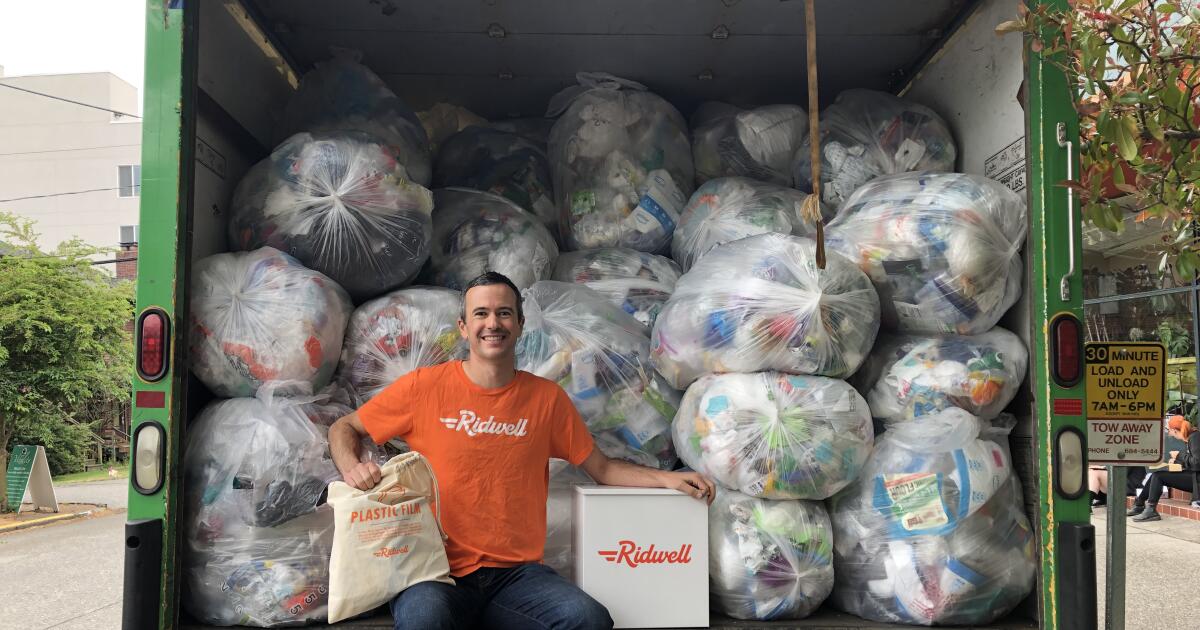
Ridwell specializes in collecting and safely disposing of hard-to-recycle items including batteries, light bulbs and plastic film.
(Ridwell)
A Ridwell subscription starts at $14 a month for biweekly pickups, and the company promises that goods get “sustainably reused or recycled.” Tricky trash finds its way to specialized plants for safe disposal, while items with the potential to be reused are donated to organizations that need them. There are more expensive tiers for those with more waste and complicated materials to recycle; the plan that recycles foam costs $24 a month.
“People are starting to ask more questions, like, ‘Where did the stuff come from to produce my stuff?’” said Ryan Metzger, Ridwell’s CEO.
Metzger had the idea for Ridwell in 2018 after he initiated a modest “recycling carpool” with neighbors in Seattle. Faced with the challenge of finding disposal options for batteries, Metzger took the initiative to gather batteries from neighbors and call around to find a facility that could safely get rid of them. That first pickup quickly expanded to include trips to recycle light bulbs, electronics, plastic bags and Halloween candy. Word spread beyond the neighborhood.
“It’s often up to consumers to drive change in a positive way,” Metzger said.
Ridwell now has more than 90,000 members and offers its services in the Seattle, San Francisco, Atlanta, Austin, Minneapolis-St. Paul, Portland and Los Angeles metro areas. The company is expanding into a dozen more Los Angeles neighborhoods this week, including West Hollywood, Studio City and Central L.A.
The company finds community partners for goods that have the potential to be reused, like toys, clothes and pet supplies. In Los Angeles, these partners include Wags & Walks, Out of the Closet and Baby2Baby, among others. “Our model is to seek out partners that have specific needs,” Metzger said.
Hard-to-break-down plastics — think Amazon mailers, chip bags and pet food bags — usually have to travel farther to special plants .
There is growing consumer awareness that not every plastic with the chasing arrows symbol on it is created equal. Many plastics put into citywide recycling bins go to landfills. St. Damien said subscribing to a service like Ridwell can help curb the common practice of what she calls “wishcycling,” or tossing something into the recycling that might not actually be recyclable. (“I fret about these things terribly,” she said.)
Linda Sanoff, 69, who lives in Hancock Park, has noticed her fair share of wishcyling in her neighborhood. “The city doesn’t take Styrofoam and I know people are putting Styrofoam in their blue bins and it doesn’t get recycled.”
January is a big month for trash. Waste haulers for the city of Los Angeles collected 2.04 tons of cardboard in December 2022; in January 2023 that number soared to 16.42 tons, according to data from the city’s sanitation department. In the weeks after Christmas, Ridwell sees a spike in its collection of batteries, holiday lights and many types of plastics.
Eco-conscious consumers know that the ideal way to deal with waste is to generate less of it to begin with, but most have a hard time reaching a true net-zero lifestyle. Some subscribers said Ridwell is helping them close that gap.
“I think we just owe it to our children’s future to just keep as much out of the landfills as possible,” said Bonnie Zucker, 52, who lives in Pacific Palisades. “In some ways, it’s unfortunate that companies like Ridwell have to exist, because we do have so much waste.”
Zucker prioritizes making eco-conscious choices in her everyday life. Outside of her day job as a psychologist, she volunteers with Resilient Palisades, a local environmental group. Most of her Ridwell pickups so far have consisted of multilayer plastics from packaging, plastic film and empty bags of the Pirate’s Booty her teenage son likes to snack on.
She has been impressed with the range of items that Ridwell will rehome. “They’ll do old eyeglasses and give them to, say, veterans organizations, or old pet supplies to give to animal shelters,” she said.
Although California is a national leader in its efforts to reduce plastic trash, experts agree there is more to be done. The state banned single-use plastic grocery bags in 2014 and will go further with a broader phase-out of plastics starting next year. But in 2021, Californians still generated 76.7 million tons of trash, 46 million of which ended up in a landfill, according to estimates from CalRecycle.
Similar waste disposal businesses are cropping up nationwide in response to consumers’ growing awareness, and guilt, about their own consumption habits and the shortcomings of our current systems. Rabbit Recycling, which works in the Philadelphia metro area, operates similarly to Ridwell and also offers one-time pickups.
TerraCycle, a New Jersey-based company, uses an a-la-carte business model. The company sends its customers boxes they can fill with certain types of waste for a fee. These boxes can either be left at a company drop-off point or shipped back to TerraCycle to dispose of.
Perhaps the best selling point of all is the convenience of a door-to-door service. “I mean, the city, thank goodness, has a recycling program, but it doesn’t take so much stuff that Ridwell does,” said Sanoff. “And now I don’t have to drive to UCLA to recycle batteries.”


Since leaving office, former Vice President Mike Pence founded the policy and advocacy organization Advancing American Freedom.
Drew Angerer/Getty Images
hide caption
toggle caption
Drew Angerer/Getty Images

Since leaving office, former Vice President Mike Pence founded the policy and advocacy organization Advancing American Freedom.
Drew Angerer/Getty Images
Former Vice President Mike Pence played a key role in bringing President Trump to power in 2016. By putting his name on the Republican ticket, he helped reassure the Republican establishment and evangelical voters who were wary of Trump’s brash brand of populism.
Pence’s departure from Trump’s leadership of the Republican party began when Trump called on Pence to refuse to certify the results of the 2020 election — pressure Pence rejected.
“For four years, we had a close working relationship. It did not end well,” Pence wrote in his memoir So Help Me God, which was released in 2022.
In the years since leaving office, Pence has been advocating for an ideological restructure of the Republican party, and founded the policy and advocacy organization Advancing American Freedom. Pence builds on the theme of reimagining the Republican party in his new book What Conservatives Want, which provides a critique of the second Trump administration and what he terms the “populist right.”
In an interview with Morning Edition, Pence detailed to NPR’s Steve Inskeep his critique of the second Trump administration, shared his perspective on civil rights legislation and challenged Trump’s tariffs and other interventions in the economy.
Listen to the full interview by clicking on the blue play button above; and read highlights from the conversation below.
‘The populist right’ does not represent conservative beliefs
Pence believes that Trump has embraced “the populist right” over traditional conservatives in the Republican party.
The sale of economic American company U.S. Steel to Nippon Steel in Japan exemplifies this shift, Pence said.
In his first term, President Trump opposed the sale. But in his second term, he approved the sale and took a golden share — a class of shares in which a government can own a very small percentage of the company but has outsized voting rights.
Pence said that he was taken aback by Trump’s decision to take a golden share.
Free trade is essential to American conservatism
Pence takes umbrage with his former boss’ tariff-laden economic policy.
Pence said it violates conservatism’s bedrock belief in the power of free trade, and Trump has gone about granting exceptions to tariffs in an unfair way.
Granting waivers to large corporations from certain tariffs is “one of the lesser reported aspects of the tariff regime that’s been imposed by the administration,” Pence added.
Trump and Pence ran in 2020 on a mission to “drain the swamp,” rooting out government corruption and wasteful spending. However, Pence said Trump appears to have shifted from those goals.
“There’s maybe nothing more swampy than the battle over getting tariff waivers for big business,” Pence said.
Women’s rights on the right
There is a debate among the ultraconservative right about the role of women in civic life.
The concept of “household voting,” has become a familiar talking point for ultra-right-wing communities online. Supporters of “household voting” advocate that every American household should get one vote, the vote being that of the husband’s. This concept has been promoted by figures such as Abby Johnson, a prominent anti-abortion activist who spoke at the 2020 Republican National Convention. When asked about whether he supported household voting, Pence said he is not aligned
“It’s one person, one vote in this country. And people have bled and died for that principle throughout the years of our history,” Pence said.
He added that American families don’t need to be propped up by government programs to boost childbirth. “What American families need is an application of the kind of principles that will create higher wages, more opportunities, more jobs,” Pence said.
Should conservatives stand for civil rights?
Pence said he was an admirer of senator and one-time presidential candidate Barry Goldwater.
Notably, Goldwater voted against the Civil Rights Act of 1964.
“Should conservatives stand for civil rights?” asked Inskeep.
Pence responded that civil rights are important to conservatives, but that equality of opportunity is what legislation ought to enshrine, not equality of outcome.
Pence added that he stood by the Supreme Court’s decision to ban partisan gerrymandering on the basis of race, rendering ineffective a key provision of the Voting Rights Act of 1965.


Milly Alcock in Supergirl.
Warner Bros. Pictures
hide caption
toggle caption
Warner Bros. Pictures
Hollywood’s newest Supergirl is kind of a dirtbag — in the good way. Fearless and grumpy, Supergirl (Milly Alcock) sets out on a quest to support a new pal’s revenge journey and to make a point that should be clear by now: Never mess with a lady’s dog. Also featuring David Corenswet and Jason Momoa, is Supergirl a worthy follow up to Superman?
If you want more DC superhero action, check out these episodes:
‘Superman’ takes off and nails the landing
‘The Batman’ puts the emo in emote
Connect with Pop Culture Happy Hour:
Letterboxd / Facebook
Our weekly newsletter
Support Pop Culture Happy Hour+
-

 Detroit, MI3 minutes ago
No. 23 overall pick in the 2026 NHL draft | Detroit Red Wings
-

 San Francisco, CA12 minutes ago
San Francisco Pride kicks off with rainbow lasers, ValQueeries celebrate at Valkyries Pride Night
-

 Dallas, TX18 minutes ago
How to buy Egypt vs. Australia World Cup soccer tickets
-

 Miami, FL25 minutes ago
Helping Venezuela: Miami search-and-rescue team prepares to deploy
-

 Boston, MA28 minutes ago
How to buy Paraguay vs. Germany 2026 World Cup tickets in Boston
-

 Denver, CO33 minutes ago
Denver Broncos Roster Breakdown: Center—The Depth Question
-

 Seattle, WA40 minutes ago
Iran-Egypt: Seattle World Cup Pride match updates
-

 San Diego, CA43 minutes ago
PFL San Diego ‘McKee vs. Isbulaev’ play-by-play, results & round scoring

