Arizona
Arizona Gov. Hobbs to give 2024 State of the State address today

By Howard Fischer
Capitol Media Services
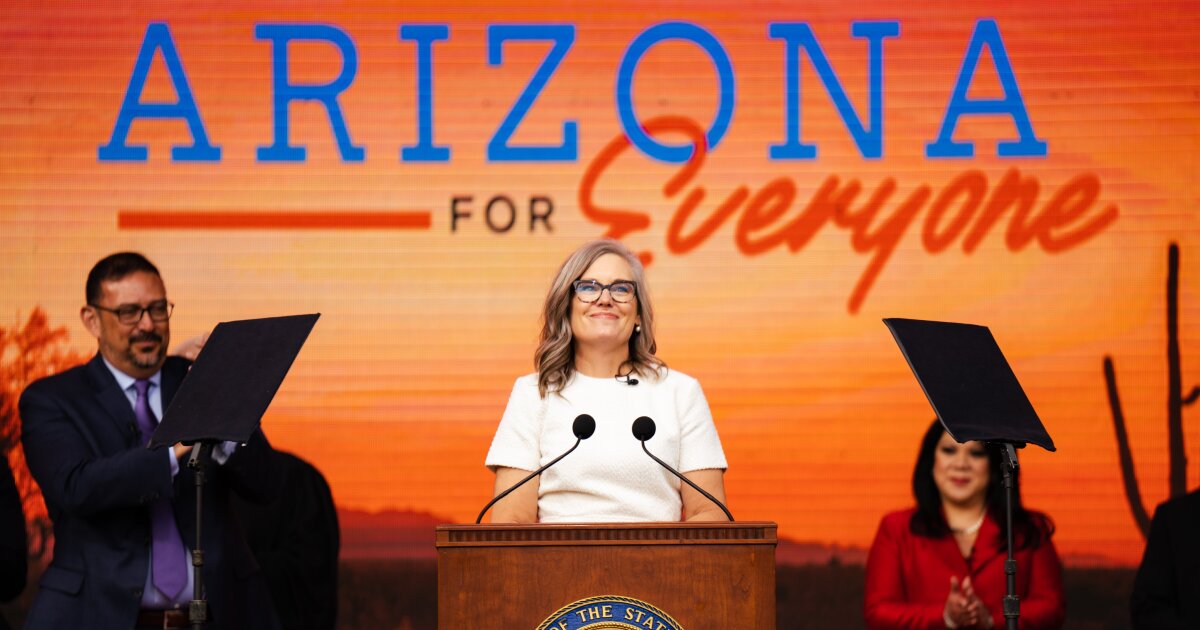
PHOENIX — Arizona Gov. Katie Hobbs says she is “optimistic” about working with the Republican-controlled Legislature as she gives her second State of the State speech Monday.
The governor acknowledged what she called “the divisiveness and the vitriol” of the 2023 session. And that included a record-shattering 143 vetoes — more than 40% of the bills sent to her desk.
“I think we’ve proven that we can work together on important things,” she said.
But in an interview with Capitol Media Services, Hobbs already is sending messages to GOP lawmakers they would be sadly mistaken if they think her willingness to cooperate and all that optimism means she’s willing to give her blessing to many of their programs in the name of cooperation.
“I’m going to continue to keep my promise of vetoing legislation that doesn’t protect fundamental freedoms or solve tough problems,” she said. “So if that’s what they want to send me, that’s what I’ll keep on doing.”
And the governor already has a list of what will end up meeting her well-used veto stamp, saying she’s prepared to break her own record if it becomes necessary.
Election law changes?
Hobbs said she wants to solve the problem created by a change in federal election laws that ultimately could result in the state not meeting the deadline for submitting the results of the 2024 presidential race, a move that would mean Arizona’s 11 electoral votes would not be counted, regardless of who wins the race here.
But the governor made it clear she would not accept any fix it if it is tied to various other changes that some have been pushing under the banner of election integrity, ranging from hand counting ballots to who gets an automatic early ballot and new signature verification requirements.
“I’m not going to sign something that’s bogged down with a bunch of other stuff that the Republicans want on this,” she said.
The governor also said she is ready to use her veto stamp — again — to deal with “culture wars” measures advanced by some GOP lawmakers, ranging from banning the teaching of critical race theory to using public funds for diversity, equity and inclusion programs.
Hobbs also said she has no interest in signing legislation being pushed by some GOP lawmakers to block the citizens and corporations of certain foreign countries from leasing or owning farm land in Arizona.
She called it unnecessary, noting the state already is terminating its leases with Fondomonte, a Saudi company growing alfalfa in La Paz County for dairy farms in the kingdom. And all that, the governor said, can be done based on deciding what is the “highest and best use” of state land — and without regard to the nationality of the tenant.
Whether the governor gets a chance to break her veto record this year will largely depend on the actions of the Republican legislative majority and, more to the point, whether they are just voting to send measures to the Democratic governor knowing she will reject them.
“There’s a lot less interest this time around in just sending a bill out just to get a veto,” said House Speaker Ben Toma.
“I think it’s pretty clear at this point where everybody is politically on some hot-button issues,” said the Peoria Republican. “So there’s really no reason to continue that.”
Senate President Warren Petersen said there’s been no formal decision made by his caucus. But it has been discussed.
“We have talked about the obvious, which is: same product, same people, same outcome,” said the Gilbert Republican.
“I don’t know what members are going to do,” he continued. “But I feel like you won’t see as many of the same bills introduced.”
Still, Petersen said that doesn’t mean he will use his powers to sideline legislation by other GOP lawmakers just because it might be a sure-fire veto.
“If there’s a reason or a benefit for them where they feel like they want to continue to push their bills, if their constituents have asked them to run a bill or push a bill, that’s a member decision,” he said.
But Hobbs, even before the session begins Monday, already is picking a fight with the GOP majority.
She announced this past week a list of changes she wants in the system of universal vouchers that allows any student to get taxpayer funds — the typical grant is $7,300 — to attend private or parochial schools or have home-schooled children use the dollars for other educational expenses. The governor was unapologetic.
“I don’t think this is a new fight,” she said, noting she was a first-term lawmaker when the whole concept of vouchers became law. At that time is was limited to students with special needs. Since then eligibility has been broadened to youths in foster care, reservation residents, students attending schools rated D or F — and in 2022, removing all restrictions
“And one of the things we said is, this is the camel’s nose under the tent, it’s going to keep expanding every year until we get to this point,” Hobbs said. “And here’s where we are.”
But the governor is not the only one spoiling for a fight.
Hobbs is being sued by the state Senate over her maneuver to convert all of her agency directors — the ones that the Senate has failed to confirm — to deputy executive directors, a move she said allowed them to continue to serve despite legislative inaction. Senate President Warren Petersen claims that violates state law.
Hobbs, however, said she is ready to do battle.
“We will be filing a motion to dismiss their very flimsy lawsuit against us,” she said.
“Arizonans want sanity, not chaos,” Hobbs said. “We need state government to run well and state agencies are a key part of that.”
Still, the governor does have some things in her own basket of ideas she hopes will get approval in the Republican-controlled Legislature. And one of the biggest issues is water.
The most visible part of the problem has been in rural areas, exempt from the provisions of the state’s 1980 Groundwater Management Act that are designed to achieve “safe yield” to the point where the amount of water being pumped is no greater than the rate of recharge. That is causing particular problems in Mohave County where Kingman officials are questioning whether the pumping by agriculture in the same basin will leave the city without the water it needs.
Current law does allow residents to vote to form their own “active management area” to control pumping. And residents of the Douglas area did just that in 2022.
But a similar plan for Willcox failed. So Hobbs is weighing a proposal advanced by her Water Policy Council that would authorize setting up state-designated but locally run rural groundwater management areas.
“I don’t think we’re trying to dilute the process,” Hobbs said.
Hobbs also is looking for a work-around to the decision last year of the Department of Water Resources to deny new housing permits to developers in areas of Buckeye and Queen Creek, lands within the Phoenix Active Management Area that could not show the legally required 100-year assured water supply. That resulted in national headlines about whether Arizona was running out of water.
The governor defended the agency.
“The national sensationalism aside, ADWR was following the law,” she said.
But Hobbs governor acknowledged that the status quo is unacceptable. And now she is throwing her support behind another Water Policy Council recommendation for an interim solution: Allow developers to continue their work based on the use of “alternative water supplies,” but without gutting the 1980 Groundwater Act.
And one key benefit of that idea is it doesn’t require legislative approval.
That issue of the building moratorium in Queen Creek and Buckeye is closely tied to the issue of affordable housing.
“We are in a housing crisis,” she said.
“One part of the solution is to build more housing,” the governor continued. “So we’re trying to find a short-term way for that to continue.”
Still, that deals with just one issue — and in just one area of the state.
Hobbs managed last session to get lawmakers to put $150 million into the state Housing Trust Fund. Those dollars can be used to leverage federal cash to construct affordable housing.
Hobbs said, though, more changes are needed.
“You’ll hear a proposal in our State of the State around mortgage assistance which obviously is not going to assist in building new houses but (is for) first-time home buyers and middle class families that are being priced out of purchasing homes right now,” she said. Still, Hobbs acknowledged, even leveraging the Housing Trust Fund might not provide a lot of relief in a market where median home prices exceed $500,000 and mortgage rates are hovering close to 7%.
“It buys some,” she said.
“It’s clear that Arizona needs relief right now and there’s more that can be done,” the governor continued. “We’re utilizing the tools we have at our disposal right now.”
Hobbs also said she is a fan of the actions of some cities like Phoenix and Tucson that have authorized the construction of small “accessory dwelling units” — also called casitas — adjacent to existing homes that can be rented out, regardless of zoning.
Still, the governor said she might warm up that veto stamp if lawmakers seek to impose similar requirements on all cities and counties statewide.
“I’ve never been a fan of usurping local control,” Hobbs said. She also has been cool to some other efforts to override local regulations like “zoning by right” which would have allowed some landowners to convert the use of their property from how it was zoned to something else without having to first get city approval.
Hobbs also has her own plan to raise the salaries of educators.
It is similar to what Republican lawmakers proposed last year, extending the life of Proposition 123 which allows the state to tap the proceeds of the land trust. The GOP promises $4,000 pay hikes for teachers.
Hobbs said that doesn’t go far enough.
“We have a proposal that addresses not just teacher pay but more broadly educational support professionals as well,” she said, people like librarians, aides and counselors left out of the Republican plan. “They’re part of the equation.”
And the governor said there are ways of adjusting the annual withdrawals from the land trust to generate enough money for all that.
-30-
On X and Threads: @azcapmedia



Your language, your news, sign up for La Voz newsletter
If you want to stay informed and connected with the best information in Spanish, sign up for the La Voz newsletter: straight to your email.
Leer en español
What affects our families and our future deserves to arrive straight to your email inbox. That is the principle behind the newsletter from La Voz Arizona, a publication dedicated to serving the state’s Spanish-speaking community since 2000.
The weekly digest, now available for subscription, is designed specifically for the Latino community, providing useful information on education, immigration, sports, entertainment, health, technology and comprehensive coverage of events in Arizona, across the country, and the most newsworthy moments from Mexico and Latin America.
La Voz Arizona’s focus has always been to connect, share, and contribute to the development of its communities by providing accurate and timely information .
The team, Nadia Cantú, Claudia Núñez and Paula Soria also highlights the work of Latino residents who shape Arizona, from restaurant owners offering a taste of home to artists beautifying Valley streets and local festivals important to Mexican, Colombian, and Salvadoran communities .
If you want to stay informed, make better decisions, and stay connected with the best information in Spanish, this newsletter is for you. La Voz: straight to your email, with what you need to know, when you need it.
Subscribe today at azcentral.com/newsletters and click on La Voz.

The Washington Huskies saw one of their few remaining uncommitted targets in the 2027 class go elsewhere on Thursday afternoon when three-star cornerback Evan Mack announced his commitment to Jedd Fisch’s former program, the Arizona Wildcats.
The 6-foot-3, 175-pound product of Crean Lutheran High School in Southern California chose coach Brent Brennan’s team out of a final three that also included the Huskies and Arizona State, after official visits to all three programs.
After taking an unofficial visit to Seattle for spring practice in April, Mack took his first official visit, a trip to Arizona State, on May 1. Then, he returned to Montlake on June 5, before wrapping things up in Tucson on June 19, which made enough of an impact for the Wildcats to win the battle for his services.
As a junior, the nation’s No. 613 overall prospect and No. 64 cornerback, according to the 247Sports Composite, tallied 49 tackles, 10 pass breakups, and 2 interceptions, while showcasing the promising athleticism and ball skills that secondary coach John Richardson is looking for on the outside.
If he were to have chosen the Huskies, Mack, who has plenty of room to add weight to his frame for the physicality of the Big Ten, would’ve had a long route to the field. Behind projected starters Dylan Robinson and Emmanuel Karnley, who both have eligibility to return in 2027, Washington’s coaching staff is expecting a contribution from four-star freshman Rahsjon Duncan on the outside, while his classmate Jeron Jones and sophomore Elias Johnson both stood out during spring practice.
The Huskies currently have one commit at cornerback in three-star Maurice Williams; however, the Huskies also hold several projections to reel in coveted four-star IMG Academy product Censere Gaylord.

The Arizona Chamber of Commerce & Industry has installed Monica Coury, vice president of external affairs at Arizona Complete Health, as chair of its board of directors, as the organization begins its new fiscal year.
Coury officially assumed the chairmanship during a ceremonial passing of the gavel at the Chamber’s June 26 board meeting. She succeeds Ted Geisler, president and CEO of APS, who served as board chair over the past two years.
As chair, Coury will lead the Chamber’s board while helping guide the organization’s efforts to advance policies that strengthen Arizona’s economy, improve the state’s business climate, and promote long-term prosperity.
“It is an incredible honor to serve as chair of the Arizona Chamber of Commerce & Industry,” Coury said. “I want to thank my fellow board members for the confidence they’ve placed in me, and I’m grateful for the opportunity to work alongside the Chamber’s outstanding team. The Chamber has long been one of Arizona’s most effective and respected advocates on behalf of the state’s job creators, and I look forward to building on that legacy as we continue working to make Arizona the best place in the nation to live, work, and do business.”
Coury has served on the Chamber’s board for several years. She previously chaired the Public Affairs Committee and most recently served as chair-elect. In her role at Arizona Complete Health, she oversees one of the state’s leading health plans and has been a prominent voice on issues involving healthcare access, workforce development, and Arizona’s economic competitiveness.
“Monica is an exceptional leader whose collaborative approach, strategic vision, and deep commitment to Arizona make her the ideal person to lead our board,” said Danny Seiden, president and CEO of the Arizona Chamber of Commerce & Industry. “She understands that a strong economy depends on smart public policy, and she has consistently brought thoughtful leadership and sound judgment to the Chamber. I look forward to working closely with Monica as we continue advancing policies that help Arizona employers create jobs, invest, and grow.”
Seiden also thanked Geisler for his leadership during a period that included significant legislative successes and continued growth for the Chamber.
“Ted has been an outstanding chairman, a trusted partner, and a friend,” Seiden said. “His steady leadership, business acumen, and unwavering commitment to Arizona’s economic future have helped position the Chamber for continued success. We are grateful for his service and look forward to his continued counsel and involvement on our board.”
The Chamber also installed the following governing board officers:
- Chair-elect: Jimmy Lindblom, Willmeng Construction
- Vice-chair, audit & finance: Don Isaacson, Isaacson Law Firm
- Vice-chair, manufacturing: Angela Creedon, Intel
The Arizona Chamber of Commerce & Industry is Arizona’s leading statewide business advocacy organization, representing employers of every size and industry across the state. The Chamber’s mission is to advance Arizona’s competitiveness through policies that foster economic growth, job creation, and opportunity for all Arizonans.
-
 Minneapolis, MN7 minutes ago
‘Threads of Us’ explores how Minnesota immigrants hold onto home
-

 Indianapolis, IN10 minutes ago
Police advise against celebrating Fourth of July by shooting in the air
-

 Pittsburg, PA15 minutes ago
Fireworks Near Me: July 4th Events Around USC, Pittsburgh For 2026
-

 Augusta, GA22 minutes ago
As temps rise, Augusta officials open May Park cooling center
-

 Washington, D.C23 minutes ago
What’s that noise? What you need to know about D.C. flyovers Friday and Saturday – WTOP News
-

 Cleveland, OH30 minutes ago
Extreme heat warning ends Friday evening: What to expect
-

 Austin, TX37 minutes ago
Texas May Have the Best Defensive Back Class in America
-

 Alabama40 minutes ago
American Village to host Alabama’s official America 250 celebration in Montevallo

