Politics
Inside Kamala Harris and Doug Emhoff's L.A.

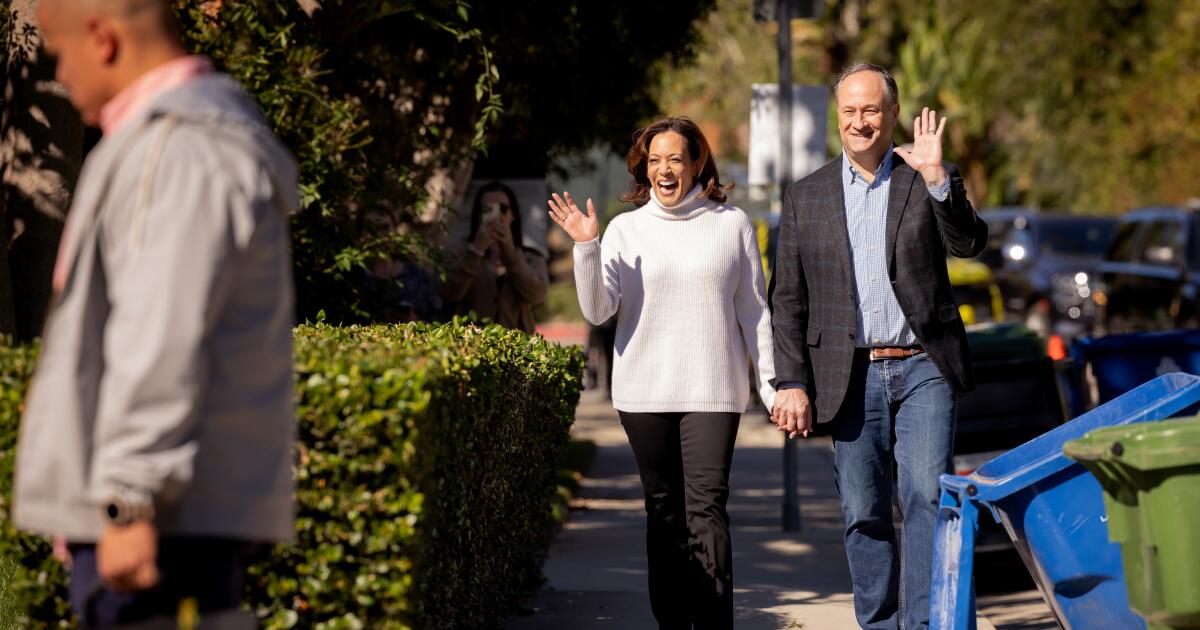
The headaches begin the moment Air Force Two touches down at LAX. A trail of black SUVs exits the Los Angeles airport and snakes along the 405 Freeway, choking traffic with rolling road closures across West Los Angeles as it makes its way to the tony neighborhood of Brentwood. Inside the quiet enclave, the motorcade rolls to a stop in front of the home of one of the country’s most famous political couples.
In a city full of celebrities and A-listers, Vice President Kamala Harris and Second Gentleman Doug Emhoff’s presence is hard to escape.
On a mid-October weekend, the couple came to town to celebrate the marriage of Emhoff’s 29-year-old son, Cole Emhoff, to his longtime girlfriend, Greenley Littlejohn, 28. Two days after the wedding, the pair was snacking on guacamole, salsa and chips in a dimly lighted vinyl booth upstairs at one of their favorite Mexican haunts, El Cholo in Santa Monica, when Emhoff received a text message from a friend.
The second gentleman’s buddy was just saying hello: He knew Emhoff was in town because he’d seen the motorcade speed by. (So much for sneaking into town).
“It’s just really an amazing thing for this town to have a vice president based here,” Emhoff told The Times in the couple’s first joint interview since taking office. “It’s intense. I’m from this area and I’m like, ‘Wow.’ This is incredible for our neighborhood.”
Vice President Kamala Harris and Second Gentleman Doug Emhoff are photographed in Los Angeles in November.
(Christina House / Los Angeles Times)
For Harris, the impulse to escape Washington — where she faces Republican scorn and criticism within her own party — for downtime at home has been difficult to satisfy over the last few years. While President Biden has made a near weekly habit of returning home to neighboring Delaware, the taxpayer-funded, cross-country flight to L.A. is harder to justify unless it includes official business. Harris’ trips home to L.A. are often camouflaged with an event to celebrate a local small business or a stop to raise awareness about one of her policy focuses such as Black maternal healthcare or reproductive rights. The vice president was also anchored to Washington during the first half of her term to cast tiebreaking votes in an evenly divided Senate.
But the Brentwood home, largely concealed by its verdant surroundings, has become a sanctuary for one of the world’s most visible figures. The four-bedroom, 3,500-square-foot house, less than a mile from Sunset Boulevard and roughly a 10-minute drive from the Will Rogers State Historic Park, is off-limits to reporters. In October, a group of protesters pulled up in cars outside to call for a cease-fire in the Israel-Hamas war, though Harris wasn’t there to hear their pleas.
As vice president, Harris is briefed multiple times a day, and reporters often follow her from event to event. But at home, Harris can avoid the scrutiny to recharge, cooking and chatting with her family as they watch from the kitchen table.
“Ask anybody who has ever worked in D.C. — in Congress or the Senate or at the White House — the trip from California, it’s not easy. It doesn’t matter if you’re on Air Force Two or on a United flight,” said Brian Brokaw, a former advisor to Harris. “When she’s home, she wants to enjoy that comfort and to the extent that she sees a very small and tight circle.”
Vice President Kamala Harris, left, and Second Gentleman Doug Emhoff order food at El Cholo Mexican restaurant in Santa Monica in October.
(Christina House / Los Angeles Times)
The Vice President’s Residence at the Naval Observatory, where she and Emhoff reside in Washington, provides some respite from the well-trodden White House complex where she keeps an office, but friends and aides say she considers it the people’s house — not home. In keeping with tradition of her predecessors, she redecorated the Victorian mansion — adding her own Californian touches — but the residence is on “borrowed time,” said Sen. Laphonza Butler (D-Calif.), a close friend and former advisor to Harris’ 2020 presidential campaign.
“At the end of day, home is home. The mattress that hugs just right is a different kind of rest,” Butler told The Times in an interview last summer. “The community that embraced you and trusted you to serve them as the first Black woman as attorney general, then as a U.S. senator and then as their vice president — that is meaningful. To know that you will get that kind of support and kindness and welcome is a place that, you know, if I were her I would run to every chance I got.”
Visits home frequently center on one of Harris’ most sacred traditions: Sunday family dinner. Harris begins planning the meal midweek, staging a choreographed spread in which everyone has a role.
Emhoff is in charge of cocktails, his son, Cole, curates the music playlist and his 24-year-old daughter, Ella, is tasked with making her signature guacamole. Cole’s new wife, Greenley, has taken on responsibility for dessert. While the couple host a regular rotation of foreign dignitaries, lawmakers, reporters and administration officials at the Vice President’s Residence (they hosted thousands of people at nearly two dozen holiday parties this year), Sunday dinner is strictly a private affair for Harris, who’s had the same core group of friends for decades. When Harris is in town, Sunday is off-limits for travel, according to an aide.
“It’s just a way to stay connected, reconnect and have some sense of normalcy in a world that sometimes isn’t,” Emhoff said. “We’re back in our city, back in our home. And then of course you go outside, and there’s all the Secret Service and everything that reminds you that it’s still a little bit different.”
The guest list is a regular rotation of family — Emhoff’s parents and Harris’ nieces are frequent guests — and close friends who live nearby or are in town for the weekend. The group cleans up while cooking, using “Uncle Freddy” as a shorthand for the process that Harris said she picked up as a child when visiting her parents’ close friend at his basement apartment in Harlem. Inside Uncle Freddy’s tiny kitchen, which “was the size of this table,” he would clean any utensil as soon as he finished using it, an efficiency she has encouraged Cole and Ella to incorporate into their blended family’s own elaborate meals.
Vice President Kamala Harris and Second Gentleman Doug Emhoff are photographed in Los Angeles in November.
(Christina House / Los Angeles Times)
The menu often features a dish that takes at least five hours to prepare, Harris said, which varies from a simmering Bolognese to a roast chicken using herbs from her backyard garden.
She’s also tried to incorporate her international travel into the end-of-week ritual, making time to speak to hotel chefs about local recipes and where to stop to find ingredients on the way to the airport. The day before our interview, Harris selected a recipe she picked up during a November 2022 visit to Bangkok for the Asia-Pacific Economic Cooperation summit: a pork dish marinated in coriander root and served with lemongrass over coconut rice.
“I freaked the Secret Service out because they’re kind of used to going to, like, golf courses with their principal,” she said, laughing at the memory of directing her motorcade to a Bangkok market. “With me, they’re going to the fish market.”
If the schedule allows, Harris will stop for ingredients, whether that’s detouring to a market in Kauai, Hawaii, for a certain type of fish or finding the right spices in Bangkok, according to a former Secret Service agent on her detail who spoke on condition of anonymity in order to discuss sensitive security information.
“We’ve got a whole motorcade, we’ve got a whole American delegation and we’ve got all this Thai security and she’s rolling through this market to find these particular spices,” he recalled of Bangkok.
But she tries to return the favor by inviting the Secret Service agents tasked with protecting her inside the Brentwood home, the only outsiders seemingly allowed to puncture the sanctuary. On the Fourth of July, Harris and Emhoff grill in the backyard for the agents forced to spend the holiday in L.A., handing out plates of hot dogs, hamburgers, potato salad, baked beans and other barbecue favorites. Unlike previous White House protectees, Harris not only cooks the food but serves it, the agent said.
Before Secret Service sweeps, security detail and motorcades, Harris and Emhoff had a routine, as much as a politician and an entertainment lawyer could. Harris, a proud Bay Area native, permanently relocated to L.A. in 2014 after marrying Emhoff. She was closing out her reelection bid for attorney general, a statewide campaign that entailed an exhaustive travel schedule outside of L.A. But L.A. was a “second city” to Harris, according to her close friend Chrisette Hudlin, an Angeleno who introduced her to Emhoff. Though Harris was firmly rooted in San Francisco, as attorney general she spent considerable time in L.A., where she had another office. As godmother to Hudlin’s children, she attended soccer games and debates and even once stood in for Hudlin at her son’s school birthday party.
“That made the transition rather seamless,” Hudlin said of Harris’ move to L.A. “That was a big decision for her because she loves San Francisco so much. That’s where she began her career. [The Bay] is where she grew up.”
Harris’ political identity is tied to the Bay Area, where she forged a career as San Francisco’s first Black and South Asian female district attorney and first woman of color elected as California’s attorney general. Though she was living in Brentwood, when she launched her U.S. Senate and presidential bids, she rarely spoke of L.A., instead emphasizing her Oakland roots on the campaign trail.
Harris is still fiercely loyal to the Bay Area, but she insists she loves L.A. One of the biggest adjustments she had to make was “that it is normal in L.A. to drive within the same city for an hour to go to a restaurant,” she said.
“I had to wrap my head around that,” she said. “It took a little adjustment.”
“But then what happened, you turned the corner,” Emhoff interrupted.
“I turned the corner,” Harris agreed. “I do love it here.”
Harris has internalized local frustration with her long tail of security, often choosing to limit travel around L.A. while she’s in town to spare drivers waiting for her motorcade to pass by. In grappling with her California split personality, Harris said she coined a term to describe herself: “Sangeleno,” a hybrid identifier combining San Francisco and Los Angeles that does not appear destined to catch on.
For the record:
8:01 a.m. Jan. 7, 2024An earlier version of this article incorrectly said that Harris purchases produce at the Brentwood Country Mart. She buys her produce at a nearby farmers market. It also said California Sen. Alex Padilla’s staff ordered 250 candles. The order was for 125 candles.
The pair are wistful about their life before the national stage, recalling shows at the Hollywood Bowl or seeing movies at the now shuttered Cinerama Dome on a Sunday afternoon. The couple would slowly make their way back west, stopping at Huntington Meats next to the Grove or the Brentwood farmers market to pick up provisions for dinner, or strolling through the Brentwood Country Mart. Harris likes to go to Gearys, the luxury homeware and jewelry store in Beverly Hills, for special occasion gifts (she bought Cole and Greenley’s wedding gift there). Zankou Chicken holds a special place in Emhoff’s heart, while Harris speaks fondly of going to Guelaguetza for mole near her office in Koreatown when she was attorney general. As a Westside entertainment lawyer, Emhoff enjoyed dinner at Toscana and Craig’s, where he took Harris on their first date. He is a former member of Hillcrest, a historically Jewish country club.
Vice President Kamala Harris arrives at Los Angeles International Airport for a flight back to Washington, D.C., with Second Gentleman Doug Emhoff, not pictured.
SUVs arrive at Los Angeles International Airport with Vice President Kamala Harris and Second Gentleman Doug Emhoff in November.
Emhoff has tried to replicate some of his routine in Washington, trading in the Santa Monica stairs for the Georgetown University steps made famous by “The Exorcist.” On visits home, Harris stuffs bags full of herbs from her garden, doling them out to staff members and military aides on Air Force Two on the five-hour ride back to Washington. She also brings kumquats from two trees in her backyard.
Harris and Emhoff agreed that Mexican food is required eating while they’re home, whether that’s ordering takeout from Frida’s or sneaking away to El Cholo (Washington’s Mexican food scene “is just different,” Harris politely declares). Although Emhoff used to eat at the original El Cholo on Western Avenue as a lawyer and USC law student, he said the couple have grown accustomed to going to the Santa Monica location because of its proximity to the house.
Music is their other passion. But while Emhoff and Harris are only a week apart in age (Emhoff’s birthday is Oct. 13 and Harris’ birthday is Oct. 20), they have vastly different tastes.
“I’m hip-hop, he’s Depeche Mode,” Harris said as the two laughed.
The two have compromised on “chill hotel lobby music” such as the English trip-hop duo Zero 7. On the April evening of Prince’s death in 2016, the two huddled together on the couch on their back patio, dancing and talking for three hours as twilight faded into the evening.
Although they compromised on music, they haven’t on sports. She’s held onto the Golden State Warriors, while he’s passionate about the Lakers.
“There’s a lot of s— talking and gloating,” Harris said.
Some of that has carried over to social media, where they playfully bet on who has to wear the other team’s jersey.
Emhoff once made the mistake of donning Harris’ San Francisco Giants hat while he was in town visiting her. The pair snapped a photo while at a Giants game that circulated online, a fleeting decision that Emhoff said his L.A. friends refuse to let him forget.
“It turned out to be forever like the one picture of us as a couple that was used,” he said.
Harris has an acute understanding of what it’s like to live in L.A. even when she’s 2,600 miles away. During the Getty fire of 2019, Harris and Emhoff had to twice evacuate their Brentwood home. (That’s L.A. living: In 1961, future President Nixon was renting a house on Bundy Street when a devastating fire swept through the Bel-Air and Brentwood neighborhoods. Nixon leapt onto the roof of his house and was photographed watering down the shingles with a garden hose.)
During the Getty fire, Harris was sitting in a Senate committee meeting on natural disasters when she learned of one of the evacuations through a passed note. She left the meeting, called Cole, and asked him to go to the house and collect their personal belongings. Harris and the younger Emhoff had very different perspectives on what is considered valuable, she said as she laughed (Emhoff didn’t seem to treasure photographs the way she did). Three weeks after the scare, she introduced a bill in the Senate to set aside $1 billion in annual funding to help communities with wildfire preparedness.
“It’s such a gut-wrenching feeling,” Emhoff recalled of seeing images of the inferno burning behind the Sunset sign along the 405 Freeway while he was away in Washington. “That’s our exit. And you’re looking at it in flames.”
Vice President Kamala Harris, top right, and Second Gentleman Doug Emhoff board Air Force Two at Los Angeles International Airport in November.
(Christina House / Los Angeles Times)
Emhoff’s brother, who recently retired as a firefighter in Santa Cruz, was always on his mind.
“It’s a hard feeling because when you’re not there, you just want to be there,” he added.
In Washington, Harris has tried to bring the comforts of home to her sprawling residence at the Naval Observatory. She created a signature candle, scented with notes of jasmine, with Melanie Apple Fields, a candlemaker who owns Studio City-based Voyage et Cie.
Harris gives the candles as gifts, emblazoned with the vice president’s seal in gold, to dinner party guests and to dignitaries, including the president of El Salvador and King Abdullah II of Jordan, Apple Fields said. Each candle is accompanied with a short description of the business.
“She always says to me, ‘I just want you to be successful,’” Apple Fields said of her phone conversations with the vice president.
Harris first encountered Apple Fields’ candles at the Peninsula before she sought out the candlemaker at her Studio City storefront. The two bonded over the scent both their mothers wore, Nina Ricci’s L’Air du Temps, and Harris began placing orders for batches of Apple Fields’ candles. Two weeks after the 2020 presidential election was called for Biden, Harris phoned Apple Fields to ask her to scent the Vice President’s Residence.
She has since made thousands of candles for Harris, along with lotions, soaps and bubble baths that are displayed in rooms throughout the Vice President’s Residence and for Harris to take on the road. Apple Fields produces candles for First Lady Jill Biden, who prefers the scent of gardenia, and Sen. Alex Padilla (D-Calif.), whose staff called and asked her to produce 125 candles using Harris’ scent for an event he was hosting. Harris’ office gave Padilla permission to produce a similar candle but asked that he use a different scent. Padilla settled for one of the brand’s signature scents.
When the motorcade arrives in Brentwood next time Harris is in town, she and Emhoff will probably have some homeowner issue to deal with: no running hot water, no heat or a broken stove, all of which happened on recent trips home. Once she’s dealt with that, she’ll relax — maybe pour a glass of wine, or draw a bath — and begin planning her next Sunday dinner.

Politics
DOJ expands indictment against SPLC, alleging $4M secretly funneled to KKK and extremist groups

NEWYou can now listen to Fox News articles!
The Department of Justice last month announced an indictment against the Southern Poverty Law Center (SPLC), alleging that the civil rights nonprofit defrauded donors by secretly paying informants associated with extremist organizations, including the Ku Klux Klan.
A federal grand jury in the Middle District of Alabama returned an 11-count indictment in April charging the SPLC with six counts of wire fraud, four counts of making false statements to a federally insured bank and one count of conspiracy to commit concealment money laundering, according to the Justice Department.
The superseding indictment retains those charges while expanding on the alleged misconduct.
According to the DOJ, the SPLC “secretly funneled” more than $3 million in donor funds between 2014 and 2023 to numerous individuals associated with extremist organizations, including the Ku Klux Klan, United Klans of America, the National Socialist Movement, participants in the Unite the Right rally and the Aryan Nations-affiliated Sadistic Souls Motorcycle Club.
NEO-NAZIS, ‘SADISTIC’ BIKERS AND CHARLOTTESVILLE ORGANIZER: 5 OF THE MOST SHOCKING SPLC INFORMANTS
The Southern Poverty Law Center has widespread influence in education. FILE: Acting Attorney General Todd Blanche, left, and SPLC interim President and CEO Bryan Fair are shown in a split image as the Justice Department pursues charges against the Southern Poverty Law Center. (Nathan Posner/Anadolu via Getty Images; USA TODAY Network via Imagn Images)
The original indictment alleged approximately $3 million in payments between 2014 and 2023.
“The SPLC’s paid informants (‘field sources’) engaged in the active promotion of racist groups at the same time that the SPLC was denouncing the same groups on its website,” the indictment states.
Prosecutors further allege the SPLC opened bank accounts tied to fictitious entities in order to conceal donor funds that were allegedly routed to confidential sources.
MIKE DAVIS: SOUTHERN POVERTY LAW CENTER: A TALE OF A RACISM SCAM
The Southern Poverty Law Center (SPLC) building seen in March 2020 in Montgomery, Alabama. (Barry Lewis/InPictures via Getty Images)
According to the indictment, the SPLC began operating a covert informant network in the 1980s, and between 2014 and 2023 allegedly paid those sources in a clandestine manner.
The DOJ alleges an SPLC employee instead encouraged the pair to remain involved and offered them a monthly salary of $1,200.
The two subsequently agreed to remain in the organization, according to the indictment.
DR. BEN CARSON: I KNOW HOW BAD THE SPLC WAS, IT CAME AFTER ME AND PUT ME AT RISK
Acting Attorney General Todd Blanche spoke during a press conference alongside FBI Director Kash Patel at the Department of Justice on April 21, 2026, in Washington, D.C., following the indictment of the Southern Poverty Law Center. (Nathan Posner/Anadolu via Getty Images)
Prosecutors allege an SPLC employee instructed the individuals to claim they worked for a company called Rare Books and helped college students with research and writing assignments if anyone questioned the source of their income.
The indictment alleges donor funds were used to pay both individuals through SPLC accounts.
According to prosecutors, the pair were also reimbursed for expenses related to Ku Klux Klan activities, including cross-burning events and associated costs such as wood and fuel.
One of the individuals is also accused of recruiting new members using donor-funded payments. The indictment further alleges the SPLC knew donor funds were used to purchase materials for Ku Klux Klan garments.
In a statement to Fox News Digital, attorney Abbe Lowell, who represents the SPLC, denied the allegations.
A composite image shows Acting Attorney General Todd Blanche overlaid on photographs of the Department of Justice and FBI headquarters in Washington, D.C. (Valerie Plesch/Bloomberg via Getty Images; Graeme Sloan/Bloomberg via Getty Images)
“This apparent superseding indictment attempts to shore up the flaws in the initial charges, but it changes nothing,” Lowell said.
“The SPLC did not lie to its donors, it did not mislead banks it did business with, and its informant program prevented violence and saved lives,” he continued.
“It appears the Justice Department shared the indictment with media before it was unsealed by the court – another example of the government’s troubling handling of this case.”
“We will be addressing these irregularities with the court and look forward to presenting the truth at trial,” he added.
NONPROFIT REVENUE TOTALS SURGE AMID GROWING SCRUTINY AFTER MAJOR FRAUD CASES
SPLC interim President and CEO Bryan Fair speaks during a wreath-laying ceremony at the Southern Poverty Law Center Civil Rights Memorial in Montgomery, Ala., on March 5, 2026. (Jake Crandall/Advertiser / USA TODAY NETWORK via Imagn Images)
The superseding indictment also notes that the SPLC’s reported revenue increased from roughly $38.7 million in 2010 to more than $129 million in 2023, an increase of approximately 233%.
According to the filing, the organization’s net assets grew from approximately $238 million to nearly $787 million during the same period.
The SPLC is a longtime nonprofit organization that says it combats white supremacy and extremism through research, reporting and monitoring efforts intended to assist law enforcement and the public.
During a news conference announcing the original indictment, Acting Attorney General Todd Blanche alleged the SPLC paid members of extremist groups so it could generate “work product” documenting their activities.
CLICK HERE TO DOWNLOAD THE FOX NEWS APP
“To that end, [SPLC] was doing the exact opposite of what it told its donors it was doing – not dismantling extremism but funding it,” Blanche said.
Fox News Digital’s Alexandra Koch, David Spunt, Jake Gibson and Alec Schemmel contributed to this report.
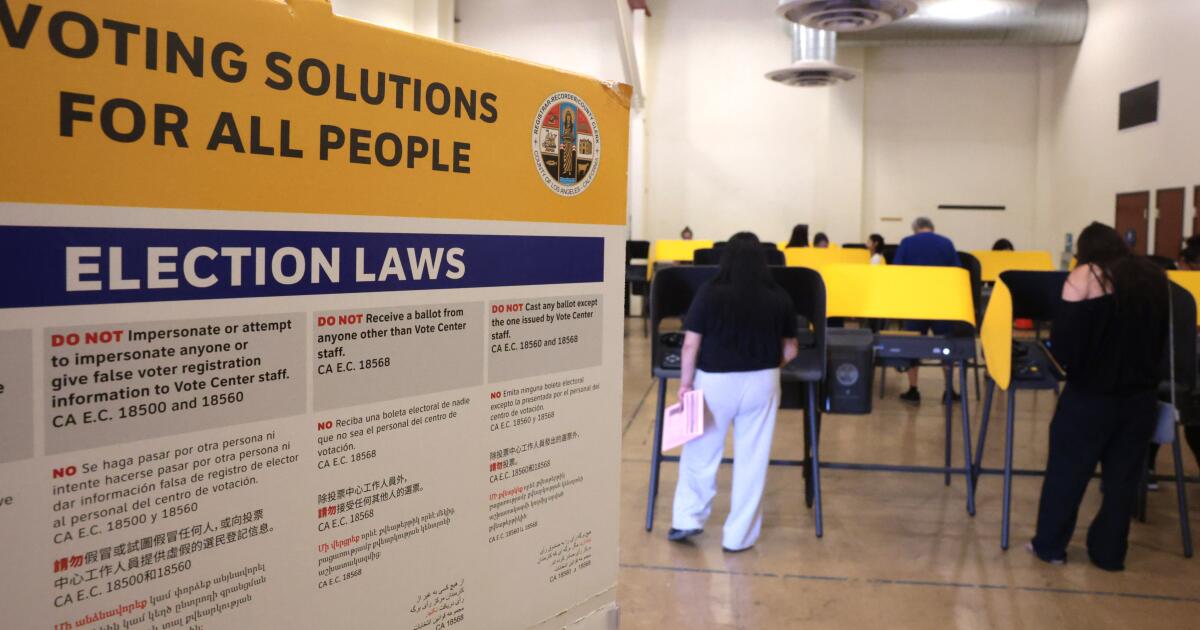
Buoyed by a new Congressional map favoring their party, California Democrats were eyeing Tuesday’s primary elections as a critical first step toward flipping a handful of House seats and taking back power in Washington.
Results from California’s massive and slow-moving election process were not immediately clear late Tuesday, as polls closed and mail ballots continued to be processed and counted. Still, Democrats were bullish about their chances of advancing candidates to November’s general election in all five districts that were redrawn in their favor as a result of last year’s Proposition 50 ballot measure.
“The path to winning back the House starts with voting in the June 2nd primary,” the California Democratic Party posted online Monday.
Meanwhile, California Republican Party Chairwoman Corrin Rankin urged Republican voters to make their own voices heard too.
“Like President Trump said, we need to make it too big to rig,” Rankin said on “The Benny Show.” “We need to swamp the vote.”
One of the most closely watched races was in the redrawn 22nd Congressional District in the Central Valley, where incumbent Rep. David Valadao (R-Hanford) is facing challenges from moderate Assemblymember Jasmeet Kaur Bains (D-Delano) and progressive college professor Randy Villegas.
Another closely watched race was in the redrawn 48th Congressional District in San Diego and Riverside counties, where Rep. Darrell Issa (R-Bonsall) decided to retire rather than run for reelection, and where Republican San Diego County Supervisor Jim Desmond — who is endorsed by Trump — is running against a pack of Democrats.
Prop. 50 — which Californians passed with nearly 65% of the vote a year ago — was California Democrats’ response to Texas Republicans redrawing their state’s Congressional maps in the GOP’s favor, at President Trump’s behest. It was also the only major Democratic counterpunch in the wider mid-decade redistricting brawl that has spread across the country in the last year.
Experts expect the redistricting battle to deliver a net gain of a handful or more House seats to Republicans. But Democrats could gain even more ground given Trump’s lousy approval ratings and the long history of midterm election losses for the president’s party.
Combined, those factors make the battle for control of the House incredibly close, which in turn makes the five seats up for grabs in California pivotal — and potentially decisive.
Tuesday’s primaries won’t determine if any of those five seats will indeed flip parties in November. However, the primaries will define those head-to-head races to come and better inform the odds of Democrats toppling Republican incumbents, experts said.
In addition to flipping the seats currently held by Valadao and Issa, Democrats are hoping to pick up three additional seats.
In the 1st Congressional District — which after Prop. 50 lost rural reaches of northeast California and picked up liberal North Bay communities — various candidates were vying for the seat long held by the late Rep. Doug LaMalfa (R-Richvale), who died in January. They include Democratic state Sen. Mike McGuire and Republican Assemblymember James Gallagher, who is endorsed by Trump.
Voters from the existing district are also voting in a special election Tuesday to fill the remainder of LaMalfa’s term.
In the 3rd Congressional District, which lost an eastern rural stretch along Nevada and now holds more tightly to the Sacramento suburbs, Rep. Ami Bera (D-Elk Grove) — who currently represents a different district — is running to remain in Congress in a new seat.
Meanwhile, the 3rd Congressional District’s incumbent, Rep. Kevin Kiley (I-Rocklin), is seeking to do the opposite. He quit the Republican Party, became an independent and is now running for Bera’s current seat in Congressional District 6, which includes the city of Sacramento and Placer County suburbs.
In the 41st Congressional District, which became more liberal after Prop. 50 by losing voters in Riverside County and gaining them in Los Angeles County, a slate of candidates — including Rep. Linda Sánchez (D-Whittier), who currently represents a different district — are running to replace Rep. Ken Calvert (R-Corona). Calvert, a 17-term incumbent, decided to run in the neighboring 40th Congressional District instead.
In the 40th Congressional District, which covers a swath of inland Orange County and portions of San Bernardino and Riverside counties, incumbent Rep. Young Kim (R-Anaheim Hills) is now going head-to-head with Calvert, while also facing several Democratic challengers.
Other districts that were not part of the Prop. 50 shuffle are also attracting attention.
In the 11th Congressional District in San Francisco, several Democratic candidates are vying to replace Rep. Nancy Pelosi (D-San Francisco), the retiring former House Speaker, including state Sen. Scott Wiener; tech millionaire and Democratic political operative Saikat Chakrabarti; and Connie Chan, a member of the San Francisco board of supervisors who Pelosi endorsed.
Democrats are also closely watching several races where younger Democrats and progressives are challenging older incumbent Democrats, and where newer Democratic incumbents are seeking to hold onto their seats in relatively competitive districts.

NEWYou can now listen to Fox News articles!
LOS ANGELES — Outside a Bristol Farms market in LA’s Westchester neighborhood, residents who spoke to Fox News Digital all agreed that homelessness is a top problem facing the city, but disagreed on which mayoral candidate is the right choice to clean it up.
“Love him,” Shelley Zuckerman said about reality television star and independent candidate Spencer Pratt, adding that homelessness is a main motivator of her support for the reality TV star’s mayoral run.
“The fact that he’s not a politician, so he may or may not be a liar, we don’t know that yet, and I know that he wants to do something for LA that the politicians have been saying they’re going to do and then don’t,” Zuckerman added. “And I know politics works, that once you get in there you can’t always do what you want to do, but at least he’s got the passion.”
SPENCER PRATT SAYS HIS POLICY WILL FORCE HOMELESS OUT OF LA AND INTO CITIES LIKE SEATTLE
Los Angeles residents say homelessness is the top problem facing the city as they head to the polls for the mayoral primary. (Fox News Digital)
When asked if crime was a motivating factor to vote for Pratt, Zuckerman’s husband Saul responded, “Of course.”
The couple says they are supporting Republican Steve Hilton for governor.
Patrick Reynolds, who lives in the neighborhood, said he is “not happy with any of the candidates” and called Pratt a “clown” before saying he voted for incumbent Mayor Karen Bass “a little reluctantly.”
Homelessness has been a top-of-mind concern for voters in Los Angeles, and despite Bass being mayor for the last four years, Reynolds said he believes she’s the best choice on that front.
Reynolds, who said he is supporting billionaire Democrat Tom Steyer for governor, spoke at length about the problems with homelessness, including a local park he said has become “too dangerous” to visit in recent years.
KAREN BASS GRILLED OVER BROKEN HOMELESSNESS PROMISE, BLAMES BUREAUCRACY FOR SLOWED PROGRESS
Mayoral candidate Spencer Pratt hosts a campaign block party on 10th Avenue in Los Angeles on May 20, 2026. (Robert Gauthier/Los Angeles Times)
“Homelessness for sure,” a woman named Diane, who said she voted for Bass, told Fox News Digital, “That’s number one on my list, and I think she’s tried very hard to fix that problem. It’s a big problem, I know. And I just think she is down to earth. She’s not some rich billionaire, which I appreciate.”
Diane said she is supporting former Department of Health and Human Services Secretary Xavier Becerra, a Democrat who served in the Biden administration, for governor because he is a “good guy.”
“I like that he is an immigrant and that he has worked his way up in this world,” Diane said. “I think he has a good sensibility. I like also that he isn’t a billionaire. I can relate to him.”
Dan Madden, a resident of nearby Manhattan Beach, told Fox News Digital that if he could vote in LA proper, he’d go with Pratt.
WHO IS TOM STEYER? ANTI-ICE BILLIONAIRE IN CA GOVERNOR’S RACE FACES SCRUTINY OVER DETENTION INVESTMENTS
A Los Angeles city councilwoman and progressive candidate for mayor Nithya Raman, left, pictured alongside incumbent mayor Karen Bass, right. (Ronaldo Bolaños/Los Angeles Times via Getty Images; Justin Sullivan/Getty Images)
“That’d be my man,” said Madden, who added that he is voting for Hilton for governor. “The last 20 years in Los Angeles has been screwed.”
“It’s getting worse,” Madden said about the homeless situation in the Los Angeles area. “They cleaned up here and there. Spots, especially along the beach, coastline, you see it cleaned up. Two months later, everybody’s back.”
CLICK HERE TO DOWNLOAD THE FOX NEWS APP
Pratt, a registered Republican running as an independent, faces off in a nonpartisan mayoral primary against incumbent Mayor Karen Bass, a Democrat, and City Councilmember Nithya Raman, a socialist.
Tuesday’s election will determine which two candidates advance to the November general election. If a candidate receives more than 50% of the vote, they will automatically be named the next mayor.
-
 Maine3 minutes ago
Opinion: Owen McCarthy offers Maine Republicans real change
-

 Maryland10 minutes ago
Maryland Dem lawmaker runs taxpayer-funded nonprofit with audit struggles
-

 Michigan13 minutes ago
Residents in Taylor, Michigan, fight against possible rezoning
-

 Massachusetts18 minutes ago
Massachusetts high school under investigation after teachers diagnosed with breast cancer
-

 Minnesota25 minutes ago
Medical services in limbo for thousands of providers amid Minnesota fraud crisis
-

 Mississippi28 minutes ago
Mississippi Lottery Mississippi Match 5, Cash 3 results for June 2, 2026
-
Missouri33 minutes ago
Missouri Lottery Mega Millions, Pick 3 winning numbers for June 2, 2026
-

 Montana40 minutes ago
In eastern Montana, Brian Miller wins Democratic primary for U.S. House • Daily Montanan

