Science
Questions about NASA's Mars Sample Return mission put JPL jobs in jeopardy

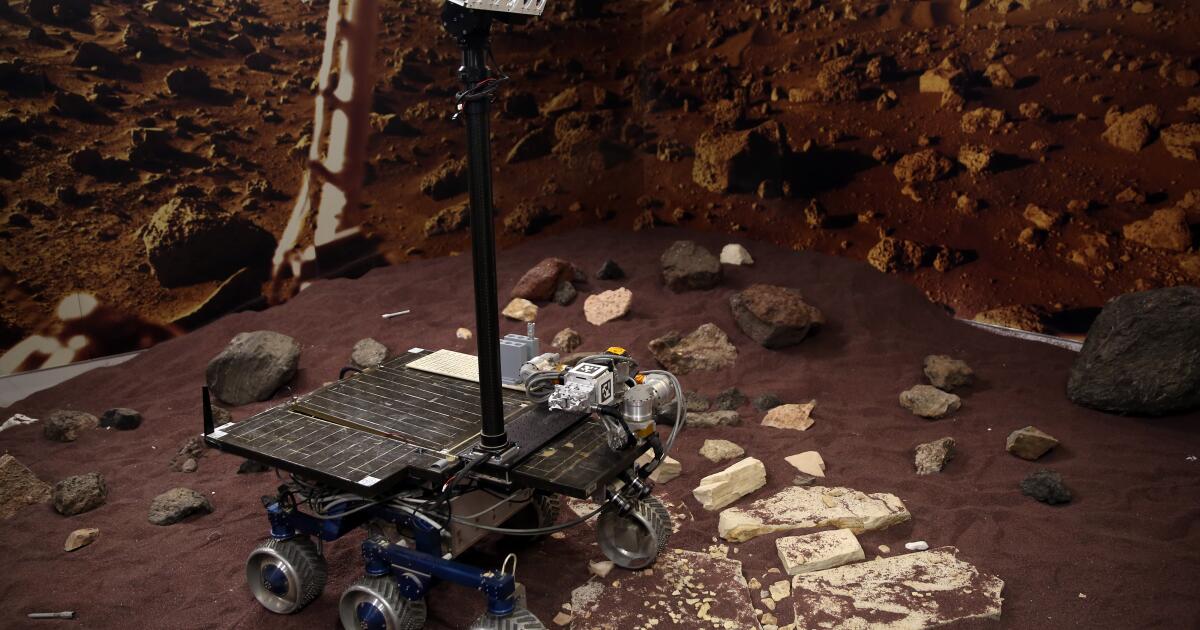
The Jet Propulsion Laboratory laid off 100 contractors last week and will scale back part of the first-ever effort to bring pieces of Mars to Earth, after a cost-cutting order from NASA that lawmakers called “short-sighted and misguided.”
In an email to staff on Thursday, JPL director Laurie Leshin said that NASA is bracing for a federal budget that could cap spending on the Mars Sample Return mission at $300 million this fiscal year — just 36% of the previous year’s $822-million budget and less than one-third of the $949 million the Biden administration requested for the program.
“Adjusting to such a large budget cut in one year will be painful,” Leshin wrote to employees at the federally funded La Cañada Flintridge research institution. “It is also becoming more likely that there will be JPL workforce impacts in the form of layoffs, and the way such JPL workforce actions are implemented means that the impact would not be limited to MSR.”
This week’s layoffs of contract employees along with a hiring freeze are part of a lab-wide effort to reduce spending, Leshin wrote. In addition, NASA has ordered JPL to cease operations at the end of this month on a key project within the mission to bring a piece of Mars back to Earth, a joint project with the European Space Agency and one of the biggest and most complex missions undertaken at the lab.
Work on Mars Sample Return’s Capture, Containment and Return System will be paused while an independent review team analyzes the overall design of the much-anticipated mission to collect dust and rocks from Mars and bring them to Earth for study, Leshin wrote.
“These are painful but necessary adjustments as we work through the current budget environment while striving to maintain our unique skills and world-class workforce for NASA and our nation,” JPL said in a statement.
The cuts come while Congress is still debating how it’s going to parcel out the 2024 fiscal year budget.
Lawmakers have criticized the agency’s decision to scale back on staff and science on the Mars effort before final numbers are in.
“NASA’s unilateral and unprecedented decision to cut funding for the Mars Sample Return mission, before Congress has finished its appropriations process, is having devastating real world consequences,” Rep. Adam Schiff said on Friday. “This critical mission was identified as NASA’s highest scientific priority by the decadal survey, and to back away now will relinquish important American leadership in space science.”
The sample retrieval lander was originally scheduled to take off in 2028, with a planned return to Earth in 2033 after the first-ever rocket launch from another planet.
An independent review of the project that NASA commissioned last year found that the mission was “not arranged to be led effectively,” and that there was a “near zero probability” that it would make its 2028 launch date. Even meeting a postponed launch date of 2030 would require more than $1 billion a year for at least three years starting in 2025.
The mission’s final price tag could be nearly $10 billion, the review concluded — more than double the $4.4 billion estimated in 2020.
California lawmakers have lobbied to preserve JPL’s funding, citing the need to protect jobs and keep the U.S. space program competitive. China has announced a sample return mission of its own to launch in 2028 or 2030 — a prospect, the review stated, that would “challenge the USA’s technical, engineering, and scientific leadership in Mars exploration.”
In a November letter to NASA Administrator Bill Nelson, a bipartisan group of six California lawmakers in the U.S. House and Senate said they were “mystified” by NASA’s preemptive belt-tightening before a final budget was announced.
Implementing the cuts ordered by NASA means JPL “will not be able to meet the 2030 launch window, billions of dollars in contracts supporting American businesses will be subject to cancellation, and hundreds of highly skilled jobs in California will be lost,” they wrote. “If this uniquely talented workforce is lost to the private sector, it will be near impossible to reassemble.”
In the most recent planetary science decadal survey, a report prepared for NASA every 10 years by the National Academy of Sciences, Engineering, and Medicine, planetary scientists named the Mars Sample Return mission as the “highest scientific priority of NASA’s robotic exploration efforts this decade” and argued that the program should be completed “as soon as is practicably possible with no increase or decrease in its current scope.”
But the authors cautioned that the ambitious mission shouldn’t come at the cost of other planetary science.
“Mars Sample Return is of fundamental strategic importance to NASA, U.S. leadership in planetary science, and international cooperation and should be completed as rapidly as possible,” the report stated. “However, its cost should not be allowed to undermine the long-term programmatic balance of the planetary portfolio.”
These tubes hold samples of rock cores and regolith (broken rock and dust) collected by NASA’s Perseverance rover for the Mars Sample Return campaign, which aims to bring Martian samples to Earth for closer study.
(NASA/JPL-Caltech/MSSS)


new video loaded: NASA Announces Artemis III Crew
transcript
transcript
NASA Announces Artemis III Crew
NASA announced the crew of Artemis III mission, which will fly to low-Earth orbit to test rendezvous and docking maneuvers with one or two lunar landers.
-
“I am excited to welcome you as the next crew in the Artemis journey to successfully return to the moon — this time to stay.” “I’m honored by the role that I’ve been given. I’m also very humbled by the task in front of us. But first and foremost, I’m grateful.” “So with that, the Artemis II crew, comrade, hands you the baton. You got the controls.” “As you know, we had a significant anomaly at our Launch Complex 36A on May 28. We’ve redoubled our efforts and are moving forward.”
By Alisa Shodiyev Kaff
June 9, 2026
Science
Santa Monica Mountains’ last steelhead trout survived the Palisades fire — and even had babies

Scientists feared the Santa Monica Mountains’ last remaining steelhead trout were dead, smothered by debris flows unleashed by the Palisades fire.
But the endangered fish surprised them: A team of biologists recently spotted 30 of the rare trout — and 21 babies — in Topanga Creek.
“There was a lot of happy dancing in the creek,” said Rosi Dagit, principal conservation biologist for the Resource Conservation District of the Santa Monica Mountains, which works with public and private landowners to conserve natural resources.
That’s because the steelhead here are endangered, at both the state and federal levels. Once, they swam in most streams of the Santa Monicas, but their numbers plummeted amid overfishing and coastal development. Increasingly frequent wildfire has further stressed their habitat. Topanga Creek, a biodiversity hot spot, is home to their last known population in the mountains that stretch from the Hollywood Hills to Point Mugu in Ventura County.
The trout that were spotted, including this one, are part of a distinct Southern California population that’s listed as endangered at the state and federal levels.
(RCDSMM Stream Team)
The California Department of Fish and Wildlife spearheaded a complex mission to rescue trout threatened by the Palisades fire that sparked in January 2025.
Time was of the essence. The fire hadn’t yet been fully contained. But rain was on the way, which would sweep massive amounts of sediment from the denuded hillsides into the water. Fish are often killed this way.
Crews stunned the fish with electricity, scooped them up in buckets, trucked them to a hatchery and ultimately moved them to Arroyo Hondo Creek in Santa Barbara County.
Within days, Topanga Creek was choked with mud. Some assumed the fish left behind were goners.
But in March, the conservation district’s team found four. The following month, when water conditions were clearer, they saw more.
“These fish continue to amaze me,” said Kyle Evans, environmental program manager for the state Department of Fish and Wildlife, who had seen the damage to the creek. “I had seen populations get wiped out in similar situations. So when I heard, I was thrilled.”
Evans surmises the fish that survived were in an area of the creek where less charred material and sediment were swept in.
“These fish likely hunkered down, were hiding under some rocks or places to try to get away from the main concentration of flow,” he said. “And luckily they weren’t buried.”
The ones that were spotted were fairly small, around 6 to 14 inches. Rainbow trout and steelhead trout are the same species, but with different lifestyles. If the fish remain in freshwater, they’ll be considered rainbows. However, they can migrate to the ocean and become steelhead, where they typically grow larger before returning to their natal waters to spawn.
Topanga Creek hasn’t fully recovered from the damage it sustained, but scientists say it’s looking better. Surveys last year were “so depressing,” Dagit said, with very few animals, and stretches that were essentially transformed into flat roads from all the sediment buildup. Some of the riparian canopy burned right down to the creek.
Then came 32 inches of rain over the last nine months, scouring out and moving sediment, creating deeper pools. Dagit said they recently found newt egg masses for the first time in years, as well as a few adult newts and many frogs. Plants that provide cover are starting to recover.
She provided photos comparing certain pools last year and this year, some dramatically transformed. In September 2025, the Shrine Pool could have been an overgrown hiking trail. This April, it was filled with shallow water.

The Shrine Pool in September 2025, left, and the same location in April 2026, right, with RCDSMM’s Isaac Yelchin donning a wetsuit.
(RCDSMM Stream Team)
Topanga Creek is home to another endangered fish, the small but hardy northern tidewater goby, often described as cute. Not long before the trout operation, Dagit led a rescue of hundreds of these fish too. Many were repatriated to the lagoon at the mouth of the creek in a moving ceremony last June.
There’s still the matter of what to do with the trout that were moved to Santa Barbara County last year. Evans would like to bring them home to the Santa Monicas at some point, but isn’t sure if it will happen. On one hand, they could bolster the small, genetically isolated surviving population. On the other, they might inadvertently bring in a disease or bacteria. There is some time to decide. Evans estimates the creek still needs to recover for two to three more years.
For now, the fish are functioning fine in their adopted creek. Experts worried the trauma wrought by the move would disrupt their spawning process, but they had babies that spring. This year, they spawned again.

The Pacifica Municipal Pier was shut down and taped off Thursday after city workers noticed cracks running through the landmark structure and concrete chunks falling into the ocean.
It’s just one of many coastal California structures that have recently crumbled under pressure from a rising and relentless ocean.
Officials from the small, beach city south of San Francisco said the pier was closed due to “cracking, separation, and displacement of the concrete walkway and structural elements.”
It will stay closed while structural engineers asses its safety.
Photos taken by city employees show a wide crack that runs from top to bottom and across the structure as well. Other photos show a large horizontal crack under the foundation of a small restaurant on the pier, the Chit Chat Cafe.
The cafe was also shut down.
This is not the first time the 53-year-old pier has shown signs of stress. In 2021, part of it was shut down after handrails along the edge collapsed. And in 2023, after a series of storms pummeled the Central California coast, damaging parts of the pier, the structure was partially closed for more than year.
Those same storms caused extensive damage in Aptos and Capitola, 70 miles south, where piers and waterfront infrastructure were swept away or damaged.
In 2024, a 150- to 180- foot section of the Santa Cruz wharf was ripped off by powerful waves.
At least 10 of the state’s dozens of coastal public piers were closed for part or all of 2024 due to structural damage sustained in winter storms since 2022. At least five others have longer-term upgrades planned to address structural issues.
“These things are costly to maintain,” said Zach Plopper, senior environmental director at Surfrider. “They are a part of our California coastal culture in many ways, but we’re going to need to reckon with, one, the state that they’re in, and two, the continuous and worsening threats they’re going to experience,”
He said most of the piers were constructed in the early 1900s, and they weren’t built to withstand decades of rough seas, storms and rising sea level.
“With this incoming El Niño, which is forecasted to be significant, and this marine heat wave we’re in the midst of, we’re kind of in uncharted waters as far as what this winter could bring in terms of storms and swells to the California coast, and we’re likely going to see a lot more damage,” he said. “Not just piers, but roads and other coastal infrastructure up and down the state.”
There was no storm in Pacifica earlier this week, so no single event could be blamed for the destruction.
However, a 2025 report from an outside engineering firm, GHD, found that several sections of the pier were in “poor” or “serious” condition, and they recommended closure before anticipated storms or events that could “subject the piles to high winds, swells and large waves.”
The firm found several areas of the pier where concrete was missing and rebar was exposed and corroding.
“The pier has continued to experience high winds and large waves in a harsh marine environment,” the engineers wrote in the report, noting that continuous exposure to seawater or marine spray was “detrimental” to the structure.
A 2023 city report estimated it would cost $19 million to repair.
That same year, a state law was enacted to require local governments along the California coast to plan for sea level rise in the coming decades.
Sea level has risen some 8 inches, on average, along the coast in the past 150 years, Plopper said, and researchers anticipate another foot in the next 25 years.
“We’re going to see profound shifts on our coastline, none that we have ever experienced before, and building static structures on the coast just doesn’t work all that well,” he said. “We’re going to have to make some really hard decisions.”
-

 Minneapolis, MN3 minutes ago
Minneapolis Cafe Cuts Prices to Zero in Protest—and Profits Rise
-

 Indianapolis, IN6 minutes ago
FBI task force arrests suspect in Indianapolis shooting that injured boy, man
-

 Pittsburg, PA11 minutes ago
Etna pizzeria working to
-

 Augusta, GA18 minutes ago
ARC’s Beman headlines CSRA field at Georgia Amateur
-

 Washington, D.C21 minutes ago
Croatia arrives in Northern Virginia as World Cup excitement builds
-

 Cleveland, OH26 minutes ago
Yankees Take Another in Cleveland
-

 Austin, TX33 minutes ago
CMRA Brings Inaugural Moto-Texas Superbike Challenge to COTA Fourth of July Weekend
-

 Alabama36 minutes ago
Federal judge orders stop to nitrogen gas execution in Alabama

