Connect with us

Missouri

Missouri lawmakers propose a major change in overseeing child abuse claims

Published

on

Missouri lawmakers propose a major change in overseeing child abuse claims


Missouri lawmakers are proposing a significant change to the state’s child welfare system, moving oversight of juvenile officers from judges to the state attorney general’s office.

Supporters of the move say it would remove what they see as a conflict of interest for those who make critical decisions about abuse and neglect claims. Juvenile officers strongly oppose it.

In Missouri, the state’s Children’s Division is responsible for investigating abuse and neglect claims made through the state’s hotline. If Children’s Division investigators believe abuse or neglect occurred, they provide a written referral to juvenile officers.

The juvenile officer then determines whether the report supports a petition alleging abuse and neglect. If so, a petition will be filed and the child likely will come under state care.

Advertisement

Currently, judges oversee juvenile officers — though their direct supervisors are not judges who hear child custody cases. Some legal and political leaders have been critical of this arrangement, contending it violates the principle around separation of powers. Josh Gupta-Kagan, a professor at Columbia Law School, wrote in 2014 that having judges oversee juvenile officers “differs from the American norm of executive branch agencies and lawyers filing and prosecuting civil and criminal cases on behalf of the government.”

“By granting juvenile officers, who are subject to judges’ supervision, exclusive power to file child abuse and neglect and juvenile delinquency cases, Missouri law concentrates power into the hands of one branch of government,” Gupta-Kagan wrote. “Missouri law thus empowers individual judges to set child welfare and juvenile justice policy by managerial decree. Subordinate judicial branch officials face pressure to file and litigate cases to please their boss, the judge, who hired them, supervises them, and has power to fire them.”

Tim Bommel

/

Advertisement

Missouri House of Representatives

Rep. Travis Fitzwater, photographed here in 2022, recently won his primary to become the Republican candidate for Missouri’s 10th Senate district. Facing a Libertarian candidate in November, Fitzwater is likely to win.

Sen. Travis Fitzwater, R-Callaway County, filed legislation in December that would have the state’s attorney general office oversee juvenile officers by mid-2027. It’s part of a multifaceted bill that also seeks to expand guardian ad litem coverage for children.

“Once I got into the Senate, I started getting calls from constituents dealing with foster care issues, and the judicial system, and judicial officers and guardian ad litems,” Fitzwater said. “And it just kind of feels like the system is failing kids.”

Fitzwater said having the attorney general oversee juvenile officers could give the officials more leeway to make difficult decisions.

“I hold that there is an inherent conflict of interest, because … obviously they have an interest in their own job and being on the side of the judges,” Fitzwater said. “That’s why on the bill, we’re putting juvenile officers in under the attorney general’s office and they can have oversight.”

Advertisement

One of the people who has been pushing for years to have an agency other than judges oversee juvenile officers is Children’s Division director Darrell Missey. He’s quoted in Gupta-Kagan’s paper describing some of the problems with the arrangement. A spokeswoman for the Department of Social Services said that Missey is not taking an active role in pushing for Fitzwater’s bill.

“We have way too many kids in the system, we need to do better, like a lot better, to fight for these kids,” Fitzwater said. “And I just think that’s one change that probably is monumental, especially to the juvenile officers.”

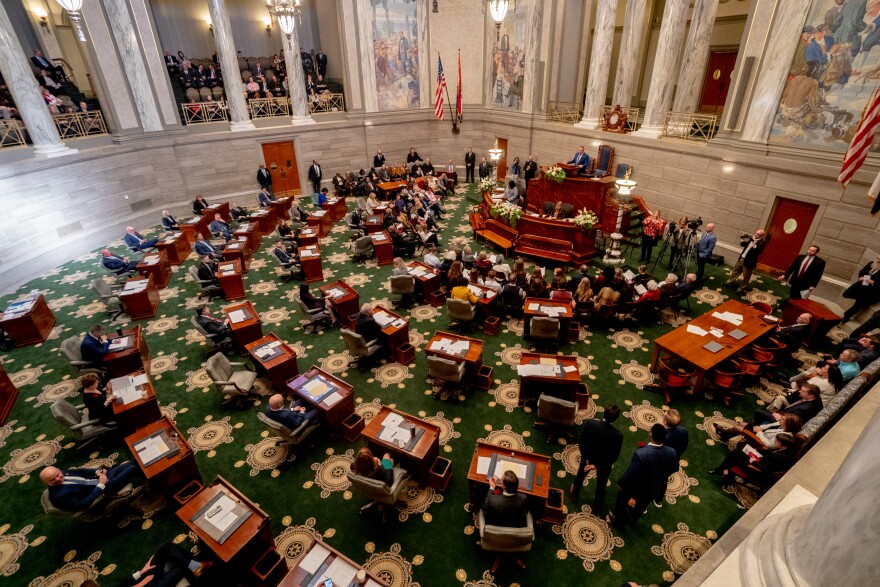
The Missouri Senate on Wednesday, Jan. 4, 2023, during the first day of the legislative session in Jefferson City.

Brian Munoz

/

Advertisement

St. Louis Public Radio

The Missouri Senate on Wednesday, Jan. 4, 2023, during the first day of the legislative session in Jefferson City.

Pushback from officers

Some juvenile officers, including Bill Prince, have taken a dim view of Fitzwater’s legislation.

Prince, the chief juvenile officer for Greene County, said that making juvenile officers state employees will be expensive — especially since some juvenile officers get paid from a mixture of county and state funds. He also disputed the idea that juvenile officers lack the ability to make independent decisions since they’re overseen by judges.

“I kind of firmly believe that one of the beauties of the juvenile system as it exists in Missouri is that it is very localized, and that each local juvenile office can kind of adapt its programs and services to the unique needs of the community and the youth that live in that community,” Prince said. “We are not part of a large centralized state bureaucracy. And I think most people would agree that making bureaucracies bigger seldom results in better performance outcomes.”

The Children’s Division is struggling to recruit and retain investigators, especially in the St. Louis region. That’s led to a sizable backlog in cases and a push from a bipartisan group of lawmakers to try to raise pay in the Children’s Division to recruit more people and prevent turnover.

Advertisement

“I feel for the Children’s Division and those investigators, because that is an extremely tough job,” Prince said. “The way that gets solved is more people and more pay so that they can do their job appropriately.”

Fitzwater said he’s aware that some juvenile officers aren’t thrilled with his proposal but added that it’s an important component of a longer conversation about transforming Missouri’s approach to vulnerable children.

“It’s worth the discussion, and maybe we get some momentum on it,” Fitzwater said. “At a minimum, we ought to be giving these kids the right to counsel and then adding maybe some other pieces to it.”

Copyright 2024 St. Louis Public Radio. To see more, visit St. Louis Public Radio.

Advertisement


Source link

Continue Reading
Click to comment

Leave a Reply

Your email address will not be published. Required fields are marked *

This site uses Akismet to reduce spam. Learn how your comment data is processed.

Missouri

UPDATE: Well-known mid-Missouri attorney charged after sting expected to request home detention | 93.9 The Eagle

Published

on

UPDATE: Well-known mid-Missouri attorney charged after sting expected to request home detention | 93.9 The Eagle


A prominent mid-Misssouri attorney has pleaded NOT guilty to a felony charge of enticement or attempted enticement of a child.

56-year-old Daniel Walter Follett is charged in Boone County Circuit Court. He had served as the Missouri Department of Revenue’s (DOR) general counsel until he was fired after last week’s arrest.

Court documents filed by Boone County prosecutors say Follett was allegedly using a prostitution website “to solicit sexual services from a person whom he believed to be a 16-year-old child.” The Boone County Sheriff’s Department’s probable cause statement says Follett allegedly arrived at an address in Boone County last week to pay money to have sex with a female whom he believed was under the age of 17.

56-year-old Daniel Follett of Columbia is currently jailed without bond (June 2026 mug shot courtesy of the Boone County Sheriff Department’s website)

Follett, who is currently jailed without bond, is scheduled to appear in court Tuesday afternoon before Judge Kimberly Shaw and is expected to request home detention, based on online court records.

Advertisement

939 the Eagle News contacted the Missouri Department of Revenue (DOR) after Follett’s arrest. DOR released a statement about Follett’s arrest and status last week. It reads: “The Department is aware of an out-of-office incident involving a staff member who was arrested and charged with criminal activity. Following departmental procedures, employment has been terminated with the individual.”

What’s next: Follett is scheduled to appear in Boone County Circuit Court on Tuesday at 1 pm for a bond hearing before Judge Kimberly Shaw. Follett is represented by defense attorney Jessica Caldera, a former Boone County assistant prosecutor. Follett is expected to request home detention from the court until his trial. Boone County prosecutors have described Follett in a court filing as a flight risk.


Source link

Advertisement
Continue Reading

Missouri

Missouri parent groups organize with school funding concerns

Published

on

Missouri parent groups organize with school funding concerns


Sarah Laub tried everything to get her son with learning disabilities a better education.

She drove him to a private school an hour and a half away from their home in rural Missouri before being directed to the local public school. When he continued to struggle, she tried homeschooling.

The local school district in Stockton, a town with a population under 2,000, just couldn’t provide everything her son needed, despite teachers’ best efforts.

Advertisement

“They really did not have the funds to provide him with everything he needed, and he really, really struggled,” Laub told The Independent.

As her son approached high school, she researched schools near Kansas City and decided to move her family to Blue Springs, a growing suburb with 20 schools awarded a National Blue Ribbon by the U.S. Department of Education. There, her son learned to enjoy his education and immerse himself in activities like theater.

“Seeing the difference that funding made and the difference in resources that a rural school versus a suburban school had was so infuriating,” Laub said. “All kids deserve to have access to those resources.”

For years, she fought for her son to get what he needed, but now she’s bringing her anger to a larger fight — one she believes has vast implications for public schools statewide.

Advertisement

Laub is part of a coalition called Parents for Missouri Public Schools that is organizing families against a proposed constitutional amendment that would allow state lawmakers to raise sales and use taxes in order to repeal the state’s income tax. Fueled by parents worried about the future of their kids’ schools, the organization is one of many groups labeling Amendment 5 an affront to public education.

The fight over Amendment 5 has largely been framed as a tax debate, with those in favor of the proposal pitching it as a way to drive more business to Missouri. But for public school advocates, the central question is what happens to classrooms if the state phases out a tax that supplies a major share of general revenue and replaces it with sales taxes under the purview of the state legislature.

“Amendment 5 could dramatically harm the bottom line of public education funding in a time in which public schools cannot take another hit,” Molly Fleming, a professional organizer behind Parents for Missouri Public Schools, told The Independent.

State funding of public schools came up $138 million short this fiscal year due to the state budget’s overreliance on lottery and gaming taxes, reducing the amount of per-pupil funding by a couple hundred dollars. The discrepancy has a disproportionate effect on schools who rely more heavily on state support, which tend to be Missouri’s rural districts.

The budget lawmakers passed this spring, which has yet to be signed by Gov. Mike Kehoe, keeps funding flat, coming $190 million under what the state’s formula for determining aid to public schools called for. And officials are predicting lean years ahead as the state reserves dwindle.

Advertisement

“The cut to public-school funding was a very serious thing for me to want to be able to get involved,” Sierra Kilpatrick, a mother of five in North Kansas City and regional organizer with Parents for Missouri Public Schools, told The Independent. “I need to do something, so I don’t feel helpless. I can go out and talk about this.”

Supporters of Amendment 5 argue Missouri should move away from taxing income and toward a system they say would make the state more competitive, attract investment and let residents keep more of what they earn. They have framed the proposal as a way to force lawmakers to modernize the tax code while giving them flexibility to replace lost revenue.

“Other states with no income tax have grown at a pace much faster than Missouri,” Gov. Mike Kehoe said in a recent radio interview. “We’re losing population, they’re gaining population. That isn’t sustainable.”

But opponents say the measure asks voters to trust lawmakers to replace the state’s largest revenue source without guaranteeing that public schools will be protected if the math does not work.

A woman at a pro-Amendment 5 town hall in Grandview earlier this month asked if public schools would face additional cuts, saying she worried lawmakers might not prioritize stable education funding if given more control over taxation.

Advertisement

Republican state Rep. Bishop Davidson of Republic, who sponsored the tax cut amendment, said he thinks public education would benefit from revenues being tied to consumption rather than income.

“States that rely on consumption taxes rather than income tax revenue have more stable budgets and more predictable budgets,” he said.

Davidson’s claim is largely true, with research showing that income tax revenues decline faster in a recession than sales taxes. But policy analysts have varying recommendations to fight volatility, advising states to plan ahead with large reserves or diversify its tax portfolio by not leaning too heavily on one tax system.

Amendment 5 calls for local governments to cut tax rates to keep revenue neutral, since it assumes more goods and services will be subject to both state and local sales tax. It includes a provision barring municipalities from lowering local funding of public schools under these clawbacks, but it does not prescribe any protections at the state level.

The Missouri Budget Project, a left-leaning public policy think tank opposing Amendment 5, estimates that the change could cut school budgets by 18%.

Advertisement

“It really does feel like a tax break for billionaires and millionaires versus safeguarding funding for public schools,” Fleming said. “There are a lot of parents who also are worried about their own bottom line, or worried about increased gas taxes, or whatever it may be.”

Fleming has an extensive background in organizing work, including the formation of a group called Parents for KC Kids which advocated for the passage of Kansas City Public Schools’ bond measure last year. Voters widely approved the $474 million bond, the first capital improvement bond to pass in the city since the 1960s.

Around 90% of those involved in Parents for KC Kids had never campaigned before, Fleming said. The group raised just over $11,000, according to Missouri Ethics Commission filings, contributing to a decisive victory through volunteer efforts and word of mouth.

The families who got involved in the campaign kept their advocacy work going, helping lay the foundation for Parents for Missouri Public Schools.

“When the bond passed, it was like a trigger went off in everyone’s head that, oh my gosh, we can do important things,” said LaNeé Bridewell, a mom in the district. “It is kind of like a bug. We got bit by the bug, and that first one gave us momentum and clarity about our ability to make change.”

Advertisement

Kathryn Evans, a Kansas City mom and nonprofit consultant, was used to helping charitable organizations advocate for themselves but hadn’t yet gotten involved in school matters apart from the parent teacher association. She joined the bond fight to help secure better facilities for neighborhood schools. But after the win, she hasn’t stopped seeing needs.

“Once we won that campaign, I became more aware that there are a lot of threats,” she told The Independent. “We just won a lot of money for our schools so that we can have nicer buildings and facilities, but there are plenty of threats to public education fundamentally.”

Across the state, parents in the Francis Howell School District in St. Charles County took on a similar battle this year.

In April, the county voted on a proposed property tax freeze, which would have stalled local revenue that public schools rely on, with 59% of voters rejecting the measure. The proposal was part of a bill passed by state lawmakers last year that also sought to incentivize sports teams to stay in Missouri.

Jamie Martin, who is president of a group called Francis Howell Forward, partnered with Fleming to educate her neighbors on why frozen property tax rates could harm local schools.

Advertisement

“Because of the property tax fight, I had learned a lot about taxes and how they’re divided up and how they work and how they fund schools,” Martin told The Independent. “So when I saw Amendment Five come on the horizon, I was like, ‘Oh, that is going to have major impacts for public schools,’ and public schools are something I care a lot about.”

Earlier this month, Martin led a training for parents in St. Charles to learn about Amendment 5. Her profession as an education researcher has put her at the front of countless training sessions, but the energy in this room stood out.

“These parents are ready, not just to hear the information and to complain, but these parents are ready to act,” she said.

Over the past few weeks, volunteers with Parents for Missouri Public Schools have held regional meetings in community centers, homes and restaurants. They ask attendees to spread information in a way that fits their schedule, whether it be in social media posts, play dates or more formal campaigning by flyering or making calls.

“The goal is to educate people on this so that they can go out into their communities and educate more people by word of mouth,” Kilpatrick said.

Advertisement

Although summer schedules are busy, Evans said, volunteers are finding ways to work advocacy into their schedules, motivated by the hope of helping their kids’ education.

“We as parents have the highest stakes, but we also have a lot of agency to make a difference in the outcome because of our relationships with each other,” she said. “We are going to be connected as a parent community because we all care about our kids.”

The coalition is also working to influence school boards to pass resolutions warning about potential impacts of Amendment 5. In the past week, school boards in Lee’s Summit and Kansas City have adopted such statements.

Parents for Missouri Public Schools has not taken a partisan stance, instead focusing on the impact to school funding and parents’ personal budgets.

“We are not affiliated in any way with any party,” Evans said. “There is a shared interest in protecting public schools, and that spans all kinds of differences.”

Advertisement

So far, the group has reported one contribution large enough to trigger 48-hour disclosure requirements: a $10,000 contribution from St. Louis-based Missouri Wins Investor Network. Smaller donations will be included in the committee’s July 15 report.

“It is pretty rare that we have an opportunity in Missouri to bring people together across such broad differences to all walk together towards something that we want to protect,” Evans said. “In this case, it is protecting public schools, protecting everyday Missourians.”



Source link

Continue Reading

Missouri

Children receive custom playhouses at Habitat for Humanity’s first-ever playhouse build event

Published

on

Children receive custom playhouses at Habitat for Humanity’s first-ever playhouse build event


Children in the Jefferson City area received custom-built playhouses Saturday during River City Habitat for Humanity’s first Playhouse Build event at Capital Mall.

Local businesses, volunteers and community organizations spent the day assembling and decorating the playhouses. Each playhouse was designed around a child’s favorite colors, hobbies and interests.

The children and their families were presented with the finished playhouses at the end of the event.

Advertisement

River City Habitat for Humanity said the event was created to give children a special place to imagine and play while bringing the community together in support of the organization’s mission.

“A playhouse may seem like a simple structure, but to a child it’s a castle, a clubhouse, a fort, or a place where their imagination can come to life,” Susan Cook, the executive director of River City Habitat for Humanity, said in a news release. “We hope this becomes a tradition that our community looks forward to each year.”

Nine teams participated in the inaugural event, including Hitachi, Samco Business Products, Jefferson City Medical Group, the Home Builders Association, Capital City Business Builders BNI, Jefferson City Parks, Habitat Women Build and community volunteer teams.

Hitachi served as the event’s presenting sponsor.

“Our team was super excited about sponsoring it because we are giving back to the community and we are giving back to little people,” Leanna Ritter, a Hitachi Energy employee, said. “What’s better than little people?”

Advertisement

Scruggs Lumber donated the plywood used to build the playhouses, and Sherwin-Williams donated the paint.

River City Habitat for Humanity has partnered with local families, volunteers, businesses and community organizations since 1993. The nonprofit says it has helped build more than 138 affordable homes in the Jefferson City area.


Source link

Advertisement
Continue Reading
Advertisement

Trending
