World
What’s Happening In Myanmar’s Civil War?


Myanmar’s military staged a coup in 2021, strangling democratic reforms and jailing much of the country’s civilian leadership. Three years on, the Southeast Asian nation is teetering on the brink of failed statehood. Insurgent groups, including pro-democracy forces and ethnic militias, are battling the junta’s soldiers. Tens of thousands of people have been killed, and millions more are displaced.
Source: Special Advisory Council for Myanmar (SAC-M)
The resistance now controls more than half of Myanmar’s territory
The fighting, in forests and towns across Myanmar, gets little of the international attention claimed by the conflicts in Ukraine and Gaza. Yet a decade ago, this nation wedged between India and China was touted as a rare example of a country peacefully transitioning from military dictatorship toward democratic rule. The army putsch ended any illusion of political progress. Myanmar has returned to a military reign of terror and the fractured reality of civil war. The lawlessness that thrives in conflict areas has radiated outward, with transnational crime networks using Myanmar as a base and exporting the products of their illicit activity worldwide.
Soldiers from 8th Battalion of the Karenni Nationalities Defense Force, an armed insurgent group, during their graduation ceremony in Karenni State in February.
Adam Ferguson for The New York Times
Why is there a civil war in Myanmar?
The short answer: The military coup was met by widespread peaceful protests. Then the junta, led by Senior Gen. Min Aung Hlaing, quickly reverted to its old playbook: jail, terrorize, kill.
Pro-democracy forces took up arms, joining with militias that for decades had been fighting for the rights of ethnic minorities.
The longer answer: Myanmar has been in turmoil practically since gaining independence from British rule in 1948. Some of the world’s longest-running armed conflicts have simmered in the country’s borderlands, where ethnic militias are seeking autonomy or simply freedom from the Myanmar military’s repression.
A brief period of political reform, with a civilian government led by Daw Aung San Suu Kyi, the Nobel laureate, did not make life much better for many ethnic minorities. After her political party trounced the military-linked party in Myanmar’s 2020 elections, a junta grabbed full control of the country again.
Myanmar’s decades of political turmoil
A common goal of overthrowing the junta has led to unity between pro-democracy militias and armed ethnic groups. Together, these resistance forces have claimed significant territory from the Myanmar military. On April 11, they captured a key border town from the junta’s forces, their biggest victory yet.
Who exactly is fighting the Myanmar military? 
Hundreds of pro-democracy militias, ethnic armies and local defense forces. The sheer diversity of resistance groups battling the junta makes Myanmar the most fractured country on Earth, according to the Armed Conflict Location and Event Data Project, which tracks 50 high-level conflicts worldwide. Complicating matters, some of the rebel groups fight one another, too.
More than 20 militias representing various ethnic minorities have been fighting for autonomy for decades. Some of these insurgent groups control territory in Myanmar’s resource-rich periphery.
Ethnic militias exert control in different parts of Myanmar
When ousted politicians and democracy advocates fled arrest after the coup, they found sanctuary in these ethnic rebel-held areas and formed a shadow authority called the National Unity Government.
Tens of thousands of young people — among them doctors, actors, lawyers, teachers, models, Buddhist monks, D.J.s and engineers — escaped from the junta-held cities and formed more than 200 People’s Defense Forces, pledging allegiance to the shadow government.
Often trained by the ethnic militias, the P.D.F. is now fighting in more than 100 townships across the country.
Source: Myanmar Peace Monitor
Hundreds of militias groups make up the People’s Defense Forces
How successful have the rebels been?
Since an alliance of three ethnic armies, backed by the P.D.F., began an offensive on Oct. 27, the resistance has gained significant ground. Rebels now control much of Myanmar’s border region, including a strategic trading town that was captured on April 11. A few days later, they fired rockets at the nation’s top military academy. Some of the fighting is taking place within striking distance of Naypyidaw, the bunkered capital that the generals built early this century.
This year could be a turning point in Myanmar’s war, military analysts say. With each week, the junta’s forces abandon more outposts. Myanmar’s military is overstretched and underprovisioned. Even at the best of times, its biggest asset has been numbers, not expertise. In February, the military brought in a draft, signaling its desperation for fresh recruits.
Resistance soldiers riding in the back of a pickup truck in southern Karenni State in January.
Adam Ferguson for The New York Times
How are civilians affected?
The Armed Conflict Location and Event Data Project says that the war in Myanmar is the most violent of the 50 conflicts it tracks. Since the coup, at least 50,000 people have been killed there, including at least 8,000 civilians, the group says.
Note: Data as of March 15
Source: The Armed Conflict Location and Event Data Project
The military’s deadly attacks against civilians
More than 26,500 people have been detained for opposing the junta, according to the Assistance Association for Political Prisoners (Burma), a rights group.
Myanmar’s military has bombarded the country with airstrikes on over 900 days since the coup, according to the Myanmar Peace Monitor, an exile group that tracks the war. Since the rebels’ October offensive, there has been a fivefold increase in aerial bombardment, according to Tom Andrews, the United Nations Special Rapporteur for human rights in Myanmar.
By the end of last year, more than 2.6 million people had been driven from their homes in a country of about 55 million, according to the United Nations human rights office. Nearly 600,000 of those internally displaced people fled after the fighting intensified in October. More than 18 million people are in desperate need of humanitarian assistance, according to the United Nations, which says that a million had required such aid before the coup.
Source: Myanmar Peace Monitor Note: Data as of April 2
Each month, hundreds of thousands of people are displaced by the fighting
United Nations investigators say that the junta’s forces should be investigated for war crimes and crimes against humanity, and they cite reports of organized sexual violence, village burnings and the indiscriminate use of landmines. Such abuses predate the coup. In 2017, the military conducted what the United States says was a genocidal campaign against the Rohingya Muslim minority.
Who lives in the country?
Myanmar is an extraordinarily diverse nation whose borders were shaped by British imperialism rather than ethnic boundaries. Officially, 135 ethnic groups live in the country, and practically the only thing they agree on is that this figure is wrong.
Note: The Karenni are also known as the Kayah, the Karen as the Kayin, the Rakhine as the Arakan, and the Ta’ang as the Palaung. Source: General Administration Department, Myanmar
Myanmar has extraordinary ethnic diversity
Some ethnic minorities have more in common with people in China, India and Thailand than with the Bamar, Myanmar’s largest ethnicity. Others come from princely states that were not under the full authority of a central administration until the middle of the last century. Still others, such as over a million Rohingya, have been rendered stateless because the military refuses to recognize them as rightful inhabitants of the country.
What Myanmar’s ethnic minorities, particularly non-Buddhist ones, share is a long record of persecution by the military.
Myanmar’s ethnic diversity is concentrated in the foothills of the Himalayas and the forested border regions that cradle the delta and lowlands through which the Irrawaddy River flows.
Is it Myanmar or Burma?
It’s both.
In 1948, the Union of Burma declared independence from British rule. In the Burmese language, the root of the words Burma and Myanmar are the same. In 1989, a year after the violent crushing of a pro-democracy movement, a junta renamed the country internationally as Myanmar, the name by which it is known locally. The generals argued that Myanmar was a more inclusive name, because it was not so explicitly linked to the nation’s Bamar ethnic majority.
Nevertheless, the pro-democracy front, led by Ms. Aung San Suu Kyi, tended to refer to the country as Burma to show opposition to the military regime. Ethnic minority groups often called the country Burma when speaking English. The United States still officially calls the country Burma, but most foreign governments use Myanmar. After the 2021 coup, some exiled politicians and other pro-democracy activists who once called it Myanmar switched to Burma with an international audience.
Most people, however, still refer to Myanmar.
There is no commonly accepted word for the inhabitants of the country. Some refer to the Burmese of Myanmar, which seems a usage at cross-purposes. In Myanmar, the citizens are generally referred to as Myanmar, the word serving as both a nation and a nationality.
Will Myanmar hold together?
Three years after the coup, the center of Myanmar remains mostly under junta control, but the rest of the country is a kaleidoscopic array of competing influences, fiefs, democratic havens and drug-lord hideouts. Ethnic armed groups govern some areas. Administrators aligned with the National Unity Government have set up schools and clinics in others. No one is in charge in still other parts of the country, leaving residents lacking basic services and vulnerable to life in the margins.
A soldier from the Pa-O National Liberation Army was treated at a secret hospital in Karenni State in January. Adam Ferguson for The New York Times
The junta forces’ widespread use of landmines has made parts of Myanmar off limits. Within areas under the regime’s control, more than 100,000 civil servants refuse to turn up for work as part of a long-running civil disobedience campaign. Many of Myanmar’s most educated people are in exile or living in the jungles. Others are in prison.
The military is still the country’s largest and most influential institution, and a militarized culture pervades many areas that ethnic minorities control. The question is whether the Myanmar military will jettison Senior General Min Aung Hlaing, its supreme commander, if he is judged to be an impediment to the armed forces’ survival — Myanmar’s history is filled with military men being pushed aside for other military men. With more and more of its soldiers dying, the military is facing an existential threat.
It’s possible that a junta, perhaps not even the current one but a new coterie, will try to negotiate cease-fires with the many armed groups arrayed against it. But given the Myanmar military’s history of turning its guns against its own people, trust will be difficult to find.
The future of Myanmar will likely remain fractured, with no single authority in charge. Such a splintered state is likely to breed more chaos that will not be contained by national borders. Myanmar is again the world’s top opium producer, displacing Afghanistan. Some ethnic armed groups survive by churning out methamphetamine and other synthetic drugs. And the country is at the center of a cyber-scam industry that steals billions of dollars from unsuspecting people and kidnaps others to forcibly work the cons.



new video loaded: Pakistan Launches Airstrikes on Afghanistan
By Monika Cvorak
February 27, 2026

Denmark’s Prime Minister Calls For a Snap Parliamentary Election
1:36

Marco Rubio Says U.S. Is Probing Deadly Cuban Shooting
0:45

Amid Chaos in Mexico, False Images Stoked Fears
2:45

Violence in Mexico After Cartel Boss Is Killed
1:40

Violence Erupts Across Mexico After Cartel Boss Killed
0:58

The Japanese Airport That Doesn’t Lose Bags
2:59
Today’s Videos
U.S.
Politics
Immigration
NY Region
Science
Business
Culture
Books
Wellness
World
Africa
Americas
Asia
South Asia
Donald Trump
Middle East Crisis
Russia-Ukraine Crisis
Visual Investigations
Opinion Video
Advertisement
SKIP ADVERTISEMENT
World
State Dept authorizes non-essential US Embassy personnel in Jerusalem to depart ahead of possible Iran strikes

Deadline looms for Iran-US nuclear deal
U.S.-Iran nuclear talks intensify in Switzerland as President Trump’s deadline approaches. Vice President JD Vance states there’s ‘no chance’ of endless war in the Middle East.
NEWYou can now listen to Fox News articles!
The State Department is allowing non-essential personnel working at the U.S. Embassy in Jerusalem to leave Israel ahead of possible strikes on Iran. The embassy announced the decision early Friday morning and said that “in response to security incidents and without advance notice” it could place further restrictions on where U.S. government employees can travel within Israel.
The decision came after meetings and phone calls through the night Thursday into Friday, according to The New York Times, which reviewed a copy of an email that U.S. Ambassador to Israel Mike Huckabee sent to embassy workers.
The Times reported that the ambassador said in his email that the move was a result of “an abundance of caution” and that those wishing to leave “should do so TODAY.” He reportedly urged them to look for flights out of Ben Gurion Airport to any destination, cautioning that the embassy’s move “will likely result in high demand for airline seats today.”
The U.S. has authorized non-essential embassy personnel to leave Israel amid escalating tensions with Iran. (Al Drago/Bloomberg via Getty Images; Iranian Leader Press Office/Anadolu via Getty Images)
In the email, Huckabee also said that there was “no need to panic,” but he underscored that those looking to leave should “make plans to depart sooner rather than later,” the Times reported.
“Focus on getting a seat to anyplace from which you can then continue travel to D.C., but the first priority will be getting expeditiously out of country,” Huckabee said in the email, according to the Times.
Former Arkansas Gov. Mike Huckabee, U.S. President Donald Trump’s nominee to be ambassador to Israel, arrives to testify during his Senate Foreign Relations Committee confirmation hearing at the Dirksen Senate Office Building on Mar. 25, 2025, in Washington, D.C. (Kevin Dietsch/Getty Images)
TRUMP MEETS NETANYAHU, SAYS HE WANTS IRAN DEAL BUT REMINDS TEHRAN OF ‘MIDNIGHT HAMMER’ OPERATION
The embassy reiterated the State Department’s advisory for U.S. citizens to reconsider traveling to Israel and the West Bank “due to terrorism and civil unrest.” Additionally, the department advised that U.S. citizens not travel to Gaza because of terrorism and armed conflict, as well as northern Israel, particularly within 2.5 miles of the Lebanese and Syrian borders because of “continued military presence and activity.”
It also recommended that U.S. citizens not travel within 1.5 miles of the Egyptian border, with the exception of the Taba crossing, which remains open.
“Terrorist groups, lone-actor terrorists and other violent extremists continue plotting possible attacks in Israel, the West Bank, and Gaza. Terrorists and violent extremists may attack with little or no warning, targeting tourist locations, transportation hubs, markets/shopping malls, and local government facilities,” the embassy said in its warning. “The security environment is complex and can change quickly, and violence can occur in Israel, the West Bank, and Gaza without warning.”
Israeli and U.S. flags are placed on the road leading to the U.S. consulate in the Jewish neighborhood of Arnona, on the East-West Jerusalem line in Jerusalem, May 9, 2018. (Corinna Kern/picture alliance via Getty Images)
CLICK HERE TO DOWNLOAD THE FOX NEWS APP
While the embassy did not specifically mention Iran in its warning, it referenced “increased regional tensions” that could “cause airlines to cancel and/or curtail flights into and out of Israel.”
Fox News Digital reached out to the State Department and the White House for comment on this matter.
Related Article

Pakistan has accused Afghanistan’s Taliban of serving as a “proxy” for India, amid escalating hostilities between Islamabad and Kabul.
Just hours after Pakistan bombed locations in Kabul early on Friday, Pakistan’s Minister of Defence Khawaja Asif wrote on X that after NATO forces withdrew from Afghanistan in July 2021, “it was expected that peace would prevail in Afghanistan and that the Taliban would focus on the interests of the Afghan people and regional stability”.
list of 3 itemsend of listRecommended Stories
“However, the Taliban turned Afghanistan into a colony of India,” he wrote and accused the Taliban of “exporting terrorism”.
“Pakistan made every effort, both directly and through friendly countries, to keep the situation stable. It carried out extensive diplomacy. However, the Taliban became a proxy of India,” he alleged as he declared an “open war” with Afghanistan.
This is not the first time that Asif has brought India into tensions with Afghanistan.
Last October, he alleged: “India wants to engage in a low-intensity war with Pakistan. To achieve this, they are using Kabul.”
So far, Asif has presented no evidence to back his claims and the Taliban has rejected accusations that it is being influenced by India.
But India has condemned the Pakistani military’s recent actions in Afghanistan, adding to Islamabad’s growing discernment that its nuclear rival and the Taliban are edging closer.
Earlier this week, after the Pakistani military carried out air raids inside Afghanistan on Sunday, India’s Ministry of External Affairs said in a statement that New Delhi “strongly condemns Pakistan’s airstrikes on Afghan territory that have resulted in civilian casualties, including women and children, during the holy month of Ramadan”.
After Friday morning’s flare-up between Pakistan and Afghanistan, India’s foreign ministry spokesperson Randhir Jaiswal again said New Delhi “strongly” condemned Pakistan’s air strikes and also noted that they took place on a Friday during the holy month of Ramadan.
“It is another attempt by Pakistan to externalise its internal failures,” Jaiswal said in a statement on X.
Has India’s influence in Afghanistan grown under the Taliban and what is India’s endgame with Afghanistan?
Here’s what we know:
How have relations between India and the Taliban evolved?
When the Taliban first rose to power in Afghanistan in 1996, India adopted a hostile policy towards the group and did not recognise its assumption of power. India also shunned all diplomatic relations with the Taliban.
At the time, New Delhi viewed the Taliban as a proxy for Pakistan’s intelligence agencies. Pakistan, together with Saudi Arabia and the United Arab Emirates, were the only three countries to have also recognised the Taliban administration at that point.
Then, in 2001, India supported the US-led invasion of Afghanistan, which toppled the Taliban administration. India then reopened its embassy in Kabul and embraced the new government led by Hamid Karzai. The Taliban, in response, attacked Indian embassies and consulates in Afghanistan. In 2008, at least 58 people were killed when the Taliban bombed India’s embassy in Kabul.
In 2021, after the Taliban returned to power, India closed its embassy in Afghanistan once again and also did not officially recognise the Taliban as the government of the country.
But a year later, as relations between Pakistan and the Taliban deteriorated over armed groups which Pakistan accuses Afghanistan of harbouring, India began engaging with the Taliban.
In 2022, India sent a team of “technical experts” to run its mission in Kabul and officially reopened its embassy in the Afghan capital last October. New Delhi also allowed the Taliban to operate Afghanistan consulates in the Indian cities of Mumbai and Hyderabad.
Over the past two years, officials from New Delhi and Afghanistan have also held meetings abroad, in Kabul and in New Delhi.
In January last year, the Taliban administration’s Foreign Minister Amir Khan Muttaqi met India’s Foreign Secretary Vikram Misri in Dubai, the United Arab Emirates.
Then, in October 2025, he visited New Delhi and met Indian foreign minister Subrahmanyam Jaishankar.
After this meeting, Muttaqi told journalists that Kabul “has always sought good relations with India” and, in a joint statement, Afghanistan and India pledged to have “close communication and continue regular engagement”.
Besides beefing up diplomatic ties, India has also offered humanitarian support to Afghanistan under the Taliban’s rule.
After a magnitude 6.3 earthquake struck northern Afghanistan in November last year, India shipped food, medicine and vaccines, and Jaishankar was also among the first foreign ministers to call Muttaqi and offer his support. Since last December, India has also approved and implemented several healthcare infrastructure projects in Afghanistan, according to a December 2025 report by the country’s press information bureau.
Praveen Donthi, senior analyst at the International Crisis Group, told Al Jazeera that the costs of avoiding engagement with the Taliban in the past have compelled the Indian government to adopt strategic pragmatism towards the Afghan leadership this time.
“New Delhi does not want to disregard this relationship on ideological grounds or create strategic space for India’s main strategic rivals, Pakistan and China, in its neighbourhood,” he said.
Raghav Sharma, professor and director at the Centre for Afghanistan Studies at the OP Jindal Global University in India, added that the current engagement also stems from New Delhi’s pragmatic realisation that the Taliban is now in charge in Afghanistan and that there is no meaningful opposition.
“States engage in order to protect and further their interests. While there is little by way of ideological convergence, there are areas of strategic convergence, which is what has pushed India to engage with the Taliban, some of their unpalatable policies notwithstanding,” he said.
Is this a new stance towards Afghanistan?
No. India’s growing influence and engagement with Afghanistan began well before the Taliban returned to power in August 2021.
Between December 2001 and September 2014, during the US presence in Afghanistan, New Delhi was a strong supporter of the Karzai government, and then of his successor, Ashraf Ghani’s government, which was in power from September 2014 until August 2021, when the US withdrew from the country.
In October 2011, under Karzai, India and Afghanistan renewed ties by signing an agreement to form a strategic partnership. New Delhi also pledged to support Afghanistan in the face of foreign troops in the nation as a part of this agreement.
Under both Karzai and his successor, Ghani, India invested more than $3bn in humanitarian aid and reconstruction work in Afghanistan. This included reconstruction projects like schools and hospitals, and also a new National Assembly building in Kabul, which was inaugurated in December 2015 when Indian Prime Minister Narendra Modi visited Afghanistan for the first time.
India’s Border Road Organisation (BRO) also assisted Afghanistan in the development of infrastructure projects like the 218km Zaranj-Delaram highway in 2009 under Karzai’s government.
Under Ghani, New Delhi undertook building the Salma Dam project to help with irrigating Afghanistan. In June 2016, when Modi visited Afghanistan once again, he inaugurated this $290m dam project. In May 2016, Iran, India and Afghanistan also signed a trilateral trade and transit agreement on the Chabahar port.
During this period – 2001-2021 – Pakistan’s unease with New Delhi and Kabul’s new partnership grew.
In October 2011, after signing a strategic agreement with India, Karzai had assured Islamabad that while “India is a great friend, Pakistan is a twin brother”.
But Karzai was critical of Pakistan’s support for the Taliban. In his last speech as president of Afghanistan in Kabul in September 2014, he stated that he believed most of the Taliban leadership lived in Pakistan.
In a 2011 report by a Washington, DC-based think tank, the Center for Strategic and International Studies, Amer Latif, former director for South Asian affairs in the US Office of the Undersecretary of Defense for Policy, noted that Karzai was walking a “fine line between criticising Pakistan’s activities while also referring to Pakistan as Afghanistan’s ‘twin brother’.”
“It is in this context that Karzai appears to be looking to solidify long-term partnerships with countries that will aid his stabilisation efforts,” he said, referring to Karzai’s visit to India and his efforts to improve relations with the subcontinent.
When Ghani rose to power in September 2014, he tried to reset ties with Pakistan and also visited the country in November that year. But his efforts did not result in improved ties due to border disputes with Pakistan continuing until his administration was overthrown by the Taliban in August 2021.
So why has India maintained ties with Afghanistan under the Taliban?
Initially, when the Taliban returned to power in 2021 following the withdrawal of the US, political analysts largely expected Pakistan to lead the way in recognising the Taliban administration as the official government of Afghanistan, improving bilateral relations which had turned icy under Karzai and Ghani.
But relations turned hostile, with Pakistan repeatedly accusing the Taliban of allowing anti-Pakistan armed groups like the Pakistan Taliban (TTP) to operate from Afghan soil. The Taliban denies this.
Then, the deportation of tens of thousands of Afghan refugees by Pakistan in recent years further strained ties between the two neighbours.
India has ultimately taken a pragmatic approach to the Taliban in order to maintain the good relations it built with Afghanistan from 2001 to 2021, and has somewhat leveraged poor relations between Pakistan and Afghanistan to cement these.
“With Pakistan’s increasingly strained relations with Afghanistan, the logic of ‘enemy’s enemy’ is acting as a glue between Kabul and New Delhi,” International Crisis Group’s Donthi said.
He added that despite the fact that India’s Bharatiya Janata Party (BJP)-led government opposes Islamist organisations, “the strategic necessity to counter Pakistan has led it to engage with the Taliban proactively”.
India and Pakistan are nuclear-armed rivals which engaged in a four-day conflict in May 2025 after armed rebels killed Indian tourists in Pahalgam, a popular tourist spot in Indian-administered Kashmir, last April. New Delhi accused Pakistan of supporting rebel fighters, a charge Pakistan strongly denied.
For its part, Afghanistan took the opportunity to strongly condemn the Pahalgam attack and the Indian Ministry of External Affairs expressed “deep appreciation” to the Taliban for its “strong condemnation of the terrorist attack in Pahalgam … as well as for the sincere condolences”.
India has also condemned Pakistani military action in Afghanistan and has provided aid to thousands of Afghan refugees displaced from Pakistan.
So what is India’s endgame in Afghanistan?
Sharma, the OP Jindal Global University professor, said India wants to ensure that Pakistan and China, whose influence has grown in South Asia in recent years, “do not have a free run”, as “there is a divergence of interest on Afghanistan” with both Pakistan and its ally, China.
“There are security interests New Delhi is keen to further and protect for which engagement [with the Taliban] is the only option,” he added.
Anil Trigunayat, a former Indian diplomat, noted that while Afghanistan and Pakistan relations have their own dynamic, currently the Taliban leadership, even if not a monolith, refuses to play to the tunes of the Pakistan military and its intelligence agency.
“Hence they [Pakistan] accuse Indian complicity in Taliban actions in Pakistan,” he said.
But the Taliban, he said, “understands and appreciates India’s intent, policies and [humanitarian] contributions”, making its leaders keen to continue collaboration with New Delhi.

Video: Pakistan Launches Airstrikes on Afghanistan

Video: The Web of Companies Owned by Elon Musk
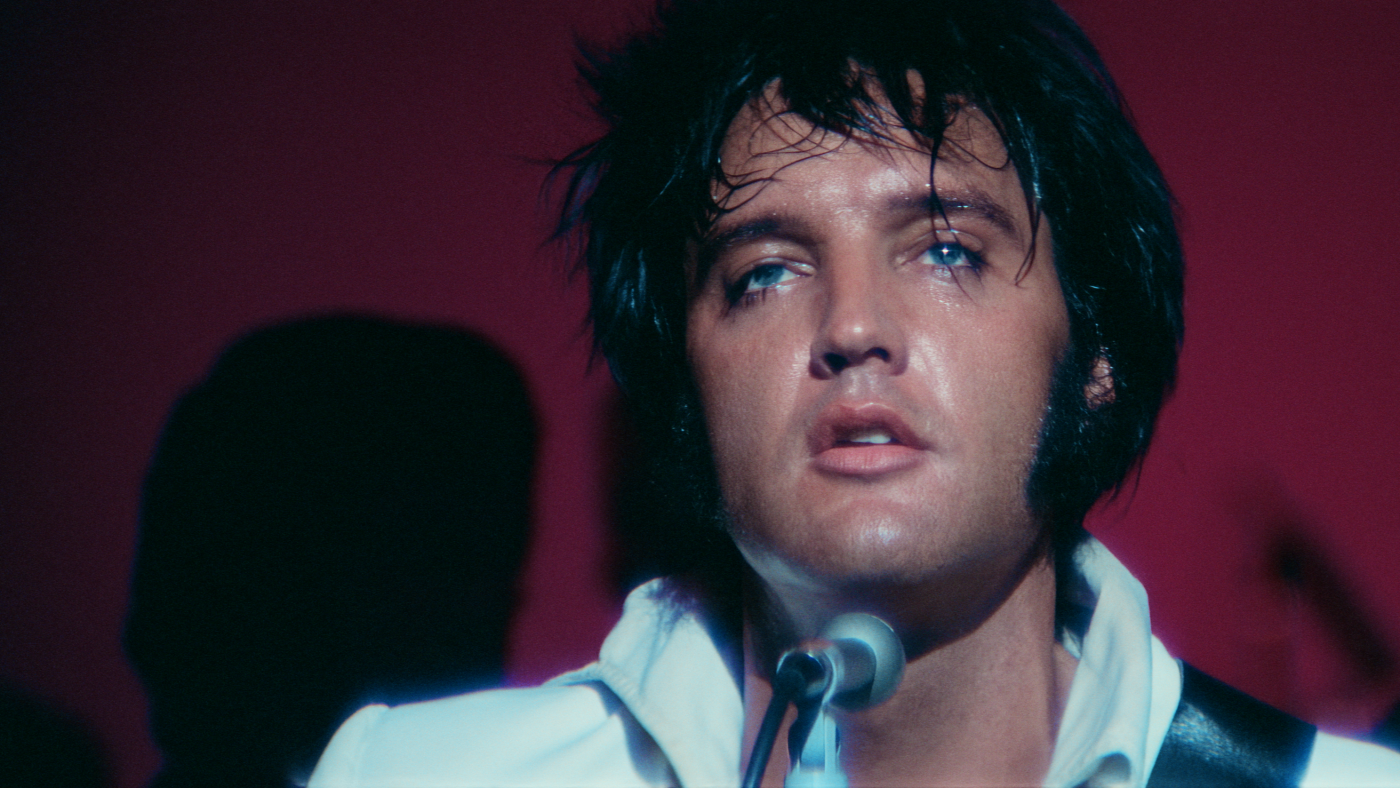
Baz Luhrmann will make you fall in love with Elvis Presley

Here’s your first look at Kratos in Amazon’s God of War show

State Dept authorizes non-essential US Embassy personnel in Jerusalem to depart ahead of possible Iran strikes

Florida High School Football Rankings: Top 25 teams – Oct. 21

Cleary's 21 help Le Moyne down Central Connecticut State 69-64 in OT

How old is Bo Nix? What to know about Oregon quarterback ahead of 2024 NFL Draft

99th annual Pony Swim held in Virginia

Indiana Members Credit Union announced as new anchor tenant at Bottleworks District

Where Iran’s ballistic missiles can reach — and how close they are to the US

Has India’s influence in Afghanistan grown under the Taliban?

Bill Clinton to testify before House committee investigating Epstein links

Read Judge Schiltz’s Order

Vulnerable House Dem lashes out at Trump’s ‘racist’ SOTU challenge: ‘That was uncomfortable’
-

 World2 days ago
Exclusive: DeepSeek withholds latest AI model from US chipmakers including Nvidia, sources say
-

 Massachusetts2 days ago
Mother and daughter injured in Taunton house explosion
-

 Montana1 week ago
2026 MHSA Montana Wrestling State Championship Brackets And Results – FloWrestling
-

 Oklahoma1 week ago
Wildfires rage in Oklahoma as thousands urged to evacuate a small city
-

 Louisiana4 days ago
Wildfire near Gum Swamp Road in Livingston Parish now under control; more than 200 acres burned
-

 Technology6 days ago
YouTube TV billing scam emails are hitting inboxes
-

 Denver, CO2 days ago
10 acres charred, 5 injured in Thornton grass fire, evacuation orders lifted
-

 Technology6 days ago
Stellantis is in a crisis of its own making