World
NATO has upped vigilance amid suspected Russian sabotage – Stoltenberg


A string of recent suspected sabotage operations across allied countries has the military alliance on the alert.
NATO has upped its “vigilance” amid an increase in “Russian intelligence activity” across its member countries, the military alliance’s secretary-general acknowledged on Tuesday
Asked about recent suspected Russian sabotage and arson attempts targeted at warehouses, shopping centres and households across EU and NATO countries, Stoltenberg refrained from directly pinning responsibility on the Kremlin.
But he clearly indicated the alliance was monitoring the events and underlined the importance of criminal investigations at national level.
“We have seen increased Russian intelligence activity across the alliance, therefore we have increased our vigilance, we have our own services who are closely monitoring what the Russians are doing,” Stoltenberg – who is due to step down in October after a decade at NATO’s helm – said.
“It is important that also nations are taking action (with) the arrests and the legal processes that have now started in the UK, in Germany, in Poland and in other countries,” he added.
“We need to be ready and we need to share intelligence (…) to counter these different types of hybrid acts aimed at undermining the ability of NATO allies to provide support to Ukraine.”
Russian attempts to ‘intimidate’
Over the weekend, a New York Times report citing US and allied security officials claimed some of the recent hybrid attacks – notably attempted arson – in Europe were the work of the GRU, Moscow’s military intelligence arm.
The incidents include recent arson attempts on sites across Poland which led to nine individuals being arrested on suspicion of Russian sabotage last Tuesday.
Speaking to Polish broadcaster TVN24 last week, Polish Prime Minister Donald Tusk said the suspects – allegedly Ukrainian, Belarusian, and Polish citizens – had “engaged directly on behalf of the Russian services in acts of sabotage in Poland,” including physical assault, arson and attempted arson.
Tusk said the attacks included an attempt to set fire to a paint factory in the western Polish city of Wroclaw, as well as other recent incidents in Lithuania, Latvia, and potentially Sweden.
A recent arson at an Ikea warehouse in Lithuania is now suspected of being linked to the Kremlin’s operations.
Speaking to local media last Wednesday, Latvian Prime Minister Evika Siliņa also warned of possible Russian operations in the country, noting that “arson is one of the most typical forms of diversion for Russian special services.”
In April, two German-Russian nationals were arrested in Germany for planning bombings and arson attacks against critical infrastructure and military bases.
Authorities in the United Kingdom, a non-EU member state but a NATO ally, also arrested two men in late April after an arson attempt on a Ukraine-linked business on an industrial estate in east London.
Speaking ahead of a meeting of EU defence ministers in Brussels on Tuesday, the Netherlands’ defence minister Kajsa Ollongren also raised the alarm: “What we’re seeing now in several European countries is Russia trying to destabilise us, also to intimidate us.”
“We are aware of this new way of working,” she added. “And, so, yes, we are vulnerable. I think all of us are. We have vital infrastructure, we have undersea bed infrastructure, we have electricity supplies, water supplies (…) We are vulnerable but we can also protect ourselves if we cooperate between partners, with industry, and with our security services,” she added.
The bloc’s top diplomat Josep Borrell said there was no evidence yet to incriminate Russia for such attacks.



Current and former Ukrainian officials are to return honours bestowed upon them by Poland after Ukrainian President Volodymyr Zelenskyy was stripped of the country’s highest state honour.
ADVERTISEMENT

ADVERTISEMENT
Tensions have been rising between Kyiv and Warsaw since Zelenskyy named a military unit after the controversial World War Two Ukrainian Insurgent Army (UPA).
In response to the move, Poland’s far-right president, Karol Nawrocki, announced that he was stripping Zelenskyy of the Order of the White Eagle.
On Saturday, Zelenskyy said he had sent the Order back to Poland, posting a photo to social media appearing to show it being packaged up ready to be shipped.
“We believed that the Order of the White Eagle, awarded in 2023, was meant for the Ukrainian People and our army,” he wrote, adding that Ukraine was “grateful to the Polish People for their support and cooperation”.
Cracks in the alliance?
Nawrocki has insisted that the decision was “not directed against the Ukrainian people” and that Poland would continue to support Ukraine.
Even so, many in Ukraine saw Nawrocki’s move as an attack.
Ukraine’s foreign minister, Andrii Sybiha, was the first to react, announcing that he would return the Commander’s Cross with Star of the Order of Merit of the Republic of Poland, which he received in 2022.
The head of the Office of the Ukrainian President, Kyrylo Budanov, and Ukraine’s ambassador to Poland, Vasyl Bodnar, followed suit by relinquishing their Officer’s Crosses of the Order of Merit of the Republic of Poland.
The second, third and fifth presidents of independent Ukraine, Leonid Kuchma (1994–2004), Viktor Yushchenko (2005–2010) and Petro Poroshenko (2014–2019), also all announced that they were giving up their Order of the White Eagle honours.
Poroshenko made it clear that he had taken the decision in reaction to the Polish president’s move, but that it was in no way directed against the Polish people.
Yushchenko also stressed that he was acting in solidarity with Zelenskyy and the Ukrainian army, while calling Nawrocki’s decision “irresponsible”.
How did the crisis begin?
On 27 May, Volodymyr Zelenskyy signed a decree naming the Independent Special Operations Centre “North” of Ukraine’s Special Operations Forces as the “Heroes of the UPA”.
He said he had taken the decision “in order to restore the historical traditions of the national army and in view of the exemplary execution of the missions assigned in the defence of the territorial integrity and independence of Ukraine”.
The Ukrainian Insurgent Army, or UPA, was a Ukrainian guerrilla force formed in October 1942 in Volhynia, in north-western Ukraine, as the military wing of the Organisation of Ukrainian Nationalists (OUN-B), an ultranationalist movement led by Stepan Bandera.
While fighting both the German army and Soviet forces, the organisation carried out massacres of the Polish population in Volhynia.
The decision has gone down particularly badly in Poland, and Nawrocki said he had learned of the move “with great sadness”.
“This is not how you build relations between nations,” he said on Friday, adding that glorifying the UPA gave Russian propaganda “a lot of oxygen for disinformation”.
The Polish president doubled down on Saturday, justifying his decision to withdraw the Order of the White Eagle from Zelenskyy by saying that his actions had overstepped the mark.
Some have argued that only Russia stands to gain from the breakdown in relations.
Poland has been one of Ukraine’s main allies since the start of Russia’s full-scale invasion in February 2022, taking in hundreds of thousands of refugees and serving as a logistical hub for Western aid bound for Kyiv.
Polish Foreign Minister Radosław Sikorski said he was convinced that, given the historical context, only Russia could profit from a Polish-Ukrainian dispute.
Sikorski shared a comment by journalist and columnist Witold Jurasz of the newspaper Onet, who argued that by stripping Volodymyr Zelenskyy of the Order of the White Eagle, Nawrocki had indeed won a moral victory but had also suffered a defeat – and, with it, so had Poland as a whole.
Polish Prime Minister Donald Tusk, whose government is at odds with Nawrocki, criticised Zelenskyy’s decision, while stressing that the Ukrainian leader had assured him that he had not intended to offend Poles. He called on the two nations not to lose their solidarity and not to let “history ruin our future”.
For his part, Ukrainian Foreign Minister Andrii Sybiha, who had earlier described the Polish president’s decision as “a strategic mistake… from which only Russia will benefit”, expressed his gratitude to Poles who do not support escalating tensions with Ukraine.
“I wish to thank every Pole who has clearly expressed their stance against escalating tensions with Ukraine. We are staunch supporters of the same approach,” he wrote on X.
“We are wise nations, always able to find a way out of a difficult situation. We are bound by a difficult history, a shared future, and the threat from our age-old enemy – Moscow,” he added.
Russian officials – who have repeatedly invoked the Second World War as a means to justify Moscow’s invasion by claiming it is a fight against “neo-Nazis” in Ukraine – have welcomed Nawrocki’s decision.
“The Polish president has finally stripped (Zelenskyy) of the Order of the White Eagle,” said former Russian president Dmitry Medvedev, now deputy chairman of Russia’s Security Council.

World
Keir Starmer reportedly considering stepping down as PM and could announce timetable for departure

British PM Keir Starmer could face leadership challenge amid internal troubles
British Prime Minister Keir Starmer faces significant internal pressure following Andy Burnham’s special election win, potentially triggering a leadership contest. Starmer is under fire for economic pressures, illegal immigration issues, and controversies surrounding his previous role in prosecuting grooming gangs. Elon Musk also accused Starmer of complicity.
NEWYou can now listen to Fox News articles!
British Prime Minister Keir Starmer is reportedly considering stepping down and could announce a timetable for his departure as early as Monday, according to a report published Saturday.
Britain’s Observer newspaper reported that Starmer was discussing his future with his wife at his Chequers country residence before making a final decision.
The outlet reported that senior Labour Party figures expect a statement addressing his future as early as next week.
A government source told Reuters that Starmer remains focused on governing and pointed to previous comments in which he vowed to remain in office.
AS EPSTEIN-LINKED APPOINTMENT SPARKS BACKLASH, UK PM STARMER FACES PARTY REVOLT AMID RESIGNATION CALLS
British Prime Minister Keir Starmer awaits Switzerland’s Federal President Guy Parmelin on the sidelines of the G7 summit, in Evian-les-Bains, France, Tuesday. (Isabel Infantes/Pool Reuters via AP)
Fox News Digital has reached out to the prime minister’s office for comment.
Pressure on Starmer has been building for months amid growing dissatisfaction within his party and concerns over the government’s handling of the economy and cost-of-living issues.
The political threat to Starmer intensified Friday after rival Andy Burnham won a seat in Parliament, positioning him to mount a formal leadership challenge.
LABOUR MP PUTS CABINET ‘ON NOTICE,’ THREATENS TO TRIGGER LEADERSHIP CHALLENGE AGAINST STARMER BY MONDAY
Britain’s Labour party candidate Andy Burnham speaks to supporters after the Makerfield by-election in Ashton in Makerfield, England, Friday. (Jon Super/AP)
Starmer congratulated Burnham following the victory, writing on X that voters, “chose Labour’s campaign of hope and optimism over division and hate.”
When asked about Burnham’s apparent ambitions to replace him, Starmer insisted he intends to remain in office.
“I’ve said repeatedly I’m not going to walk away from that,” Starmer said.
UK’S STARMER JUGGLES TROUBLE AT HOME AS HE WALKS GEOPOLITICAL TIGHTROPE WITH TRUMP
Sir Keir Starmer is battling to save his position and refusing to stand aside despite dozens of Labout MP’s demanding he resigns. (Leon Neal/Getty Images)
Starmer has led the Labour Party since 2020 and became prime minister in 2024.
Calls for his resignation intensified last month, with more than 100 Labour lawmakers publicly urging him to step aside or set out a timetable for his departure. Several parliamentary aides also resigned in protest.
The internal revolt followed a series of disappointing local election results for Labour, which lost hundreds of council seats across England, surrendered long-held ground in Wales and fell behind political rivals in Scotland.
UK Prime Minister Keir Starmer speaks a news conference at Downing Street in London, March 5. (Tolga Akmen/EPA/Bloomberg via Getty Images, File)
CLICK HERE TO DOWNLOAD THE FOX NEWS APP
Starmer’s popularity has also declined amid a persistently high cost of living, sluggish economic growth and criticism over his acceptance of gifts from wealthy donors.
Fox News Digital’s James Cirrone and Emma Bussey, and Reuters contributed to this report.
-
 Entertainment5 minutes ago
A fake mountain and real magic transform Paris’ oldest bridge
-
Lifestyle7 minutes ago
Day 1,578 of WW3: The UN Security Council will meet on Monday to address Russia's latest strikes on cultural and religious sites, including the attack on Kyiv-Pechersk Lavra. ANGH, of course. This is your Saturday Ukraine discussion
-
 Politics13 minutes ago
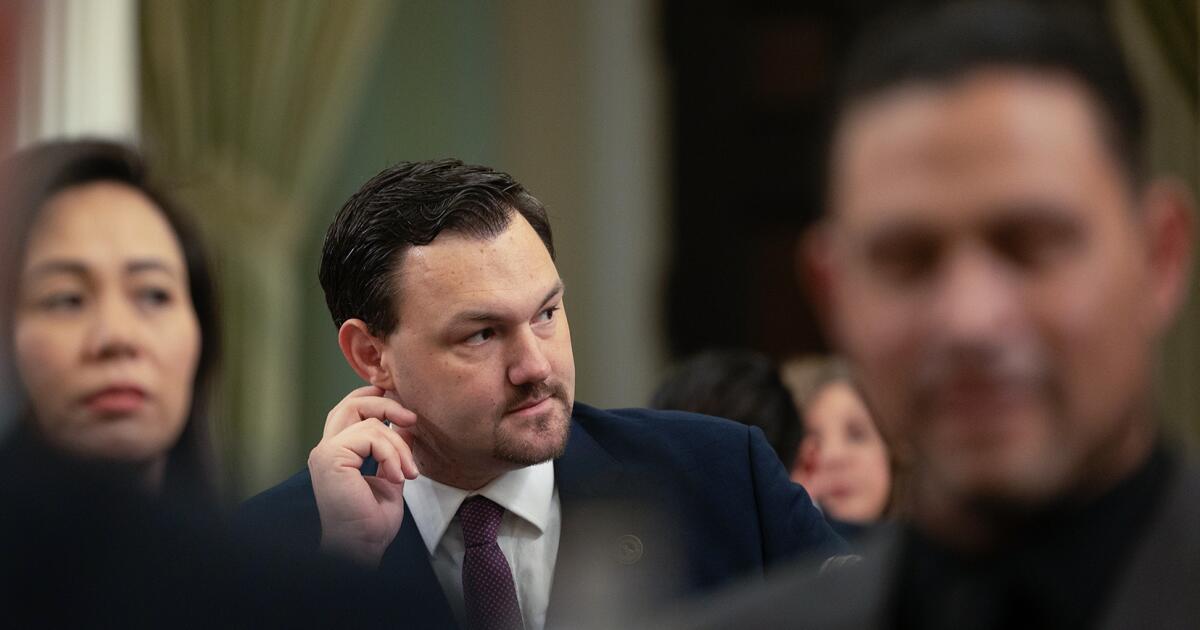
Can a new commission remedy California’s public defender crisis?
-
Sports23 minutes ago
2026 World Cup guide: Full TV schedule, game previews, results and standings
-

 World35 minutes ago
Poland and Ukraine’s ‘honours war’ intensifies
-

 News58 minutes ago
Newsom declares State of Emergency for Boyle Heights warehouse fire
-

 Los Angeles, Ca2 hours ago
Kids, teens can enjoy free lunch at over 90 parks across Los Angeles
-

 Detroit, MI3 hours ago
Metro Detroit church hosts community event to support youth: “We’re here for you”


