World
French woman shares 'scenes of barbarity' at trial accusing husband of inviting over 50 men to assault her


A French woman who faced alleged abuses at the hands of her ex-husband and more than 50 others gave her first testimony in court on Thursday.
Gisèle Pélicot, 72, was allegedly drugged and raped after her ex-husband Dominique Pélicot invited the men to participate in her abuse online. Pélicot also filmed the alleged acts, which police used ultimately to arrest him and dozens more on charges of aggravated rape after two years of investigation.
Dominique Pélicot, also in his 70s, allegedly recruited at least 72 other men from 2011 through 2020 to assault his wife. Of the suspects, police were able to track down 50 of the men before trial.
TELEGRAM BOSS’ ARREST IN FRANCE IS ‘EXISTENTIAL THREAT TO FREE SPEECH,’ TECH ENTREPRENEUR SAYS
In September 2020, Dominique landed on the police’s radar after being caught taking photos of women’s crotches at a supermarket. Officers then discovered thousands of photos and videos on his personal devices depicting aggravated assault on Gisèle’s person.
“It’s unbearable,” said Gisèle. “I have so much to say that I don’t always know where to start.”
Gisèle and Dominique were married for 50 years until 2020, when police shared the extent of alleged abuse incurred. They share three children together.
Gisele Pelicot speaks to media as she leaves the Avignon courthouse, southern France, Thursday, Sept. 5, 2024. A woman allegedly drugged by her ex-husband so that she could be raped by other men while she laid unconscious, is expected to testify before a panel of French judges. (AP Photo/Lewis Joly)
“For me, everything collapses,” testified Gisèle. “These are scenes of barbarity, of rape.”
Gisèle’s attorneys argued that she was so heavily drugged from crushed-up pills that she had no idea the alleged rapes were going on for nearly 10 years in her own home. She waived her legal right to a closed trial in the hopes her public testimony may spare survivors of similar sexual crimes.
FRENCH AUTHORITIES HUNT FOR ARSONIST WHO TARGETED SYNAGOGUE, INJURED POLICE OFFICER
A toxicologist called to testify on Thursday claimed she was administered a “cocktail” of medications which can cause unconsciousness: Temesta, Zolpidem, hypnotic, and anxiolytic drugs. Gisèle admitted there are memory holes during the years the alleged abuses occurred.
Dominique Pélicot shared with police that he had certain house rules for the alleged rapists, including wearing no scent and thorough hand-washing. Additionally, the men had to remove their clothing before entering their bedroom.
Gisele Pelicot, left, arrives in the Avignon courthouse, in Avignon, southern France, Thursday, Sept. 5, 2024. A woman allegedly drugged by her ex-husband so that she could be raped by other men while she laid unconscious, is expected to testify before a panel of French judges. (AP Photo/Lewis Joly)
She contracted no fewer than four sexually transmitted infections during the near-decade-long abuses, according to a medical expert. The alleged rapists were forced by Dominique to not wear condoms, including one allegedly HIV-positive. HIV transmission is not a criminal offense in France save for certain circumstances.
“I was sacrificed on the altar of vice,” Gisèle Pélicot testified. “They regarded me like a rag doll, like a garbage bag.”
Several of the defendants, aged 22 to 70, argued they were manipulated by Dominique Pelicot to engage in the abuse. Some of them had to wait up to 90 minutes nearby for Gisèle Pélicot to fall unconscious.
Gisele Pelicot arrives in the Avignon court house, in Avignon, southern France, Thursday, Sept. 5, 2024. A woman allegedly drugged by her ex-husband so that she could be raped by other men while she laid unconscious, is expected to testify before a panel of French judges. (AP Photo/Lewis Joly)
“These men entered my home, respected the imposed protocol. They did not rape me with a gun to the head. They raped me in all conscience,” testified Gisèle. “Why didn’t they go to the police station? Even an anonymous phone call could have saved my life.”
The trial, which began Monday, is scheduled to continue for the next four months. If found guilty, each defendant faces up to 20 years in prison.
“We will have to fight until the end,” asserted Gisèle.
The Associated Press contributed to this report.


Washington, DC – There are fisticuffs on the White House lawn, soon to be followed by a high-speed race through the National Mall. What is going on in Washington, DC?
The United States capital has been transformed in honour of the country’s 250th anniversary.
list of 3 itemsend of listRecommended Stories
Events all around the country are planned to mark two and a half centuries since the signing of the Declaration of Independence on July 4, 1776.
The nationwide bash has been dubbed the “semiquincentennial” — meaning half of 500 — and not just because Congress loves long words. The US has a history of throwing itself a party every 50 years.
But US President Donald Trump has promised a particularly noteworthy event this year, though the proceedings have been marred by a cavalcade of controversies.
Here’s what to know:
What is the history of US semicentennial celebrations?
The first 50-year anniversary, in 1826, was a considerably more muted affair than the festivities to come.
At the time, some of the original signers of the Declaration of Independence were still alive, so the mayor of Washington, DC, invited them to attend the celebration in the capital.
Former Presidents John Adams and Thomas Jefferson both demurred, citing their failing health. They died within hours of each other on the day of the semicentennial.
Fifty years later, in 1876, the US would mark its 100th anniversary by hosting its first world’s fair, an exhibition featuring displays of art, culture and technology from around the globe.
The fair was held in Philadelphia, where the Declaration of Independence was signed, and the original document was put on temporary display in the city.
Another world’s fair arrived in Philadelphia for the country’s 150th anniversary in 1926, but it was not nearly as successful. Variety magazine called it “America’s greatest flop”.
Meanwhile, the modern template for having a yearlong, cross-country celebration was set on the 200th anniversary in 1976.
A train-mounted museum of documents and historical artefacts toured the lower 48 states for 21 months. Volunteers, meanwhile, used covered wagons to travel the width of the country.
The celebrations were generally received positively, although the sale of souvenirs — from umbrella hats to mugs — earned it the pejorative “the buy-centennial”.
What is happening this year?
While the US capital may be the centre of this year’s celebration, there will be a multitude of events across the country. They include:
- UFC Freedom 250, a mixed martial arts fight on the White House lawn on June 14
- the Great American State Fair, featuring booths representing all 50 states, presented on the National Mall from June 25 to July 10
- the Freedom 250 Grand Prix, which will see IndyCars race around capital monuments from August 22 to 23
- the World Cup Fan Zone in Washington, DC, from June 11 to July 16
- a fireworks display at Mount Rushmore in South Dakota on July 3
- concerts and exhibitions in cities like New York, Los Angeles and Boston
Mobile museums, known as Freedom Trucks, will also be travelling around the country.
Another initiative is America’s Block Party, an effort to encourage communities to engage in charitable works and host their own semiquincentennial parties.
So far, however, there appears to be no government programme in the works to tackle the holiday’s most vexing and far-reaching problem: how to make the traditional July 4 potato salad less bland.
What is the controversy over the UFC fight?
One of the most scrutinised events in the semiquincentennial calendar is UFC Freedom 250, which will take place on the White House lawn on Sunday.
The timing of the event is one of the details that have wiggled eyebrows. Sunday is a holiday known as Flag Day, but it also marks Trump’s 80th birthday.
The event is also being staged by one of Trump’s most prominent political donors: Dana White, the CEO of the Ultimate Fighting Championship (UFC).
White has described Sunday’s event as designed “to tell the story of America”. There will be two title fights: a lightweight bout between Ilia Topuria and Justin Gaethje and a heavyweight interim title fight between Alex Pereira and Ciryl Gane, as well as several smaller “undercard” matches.
Despite bearing the title “Freedom 250”, the UFC event is not being organised by the White House task force of the same name.
A Freedom 250 spokesperson clarified that the presidential group “has not been responsible for the operations, logistics or funding of the UFC White House event”.
That point has been central to ongoing debates about whether the fight represents a conflict of interest for Trump, who holds stock in UFC’s parent company.
On Friday, a federal judge rejected an emergency petition to stop the fight, on the premise that Trump was using government property to promote his private business interests.
White has told the ESPN sport broadcaster that his organisation was paying for the event.

What is the difference between Freedom 250 and America250?
There are two government-backed nonprofits organising festivities for the anniversary: Freedom 250 and America250.
The former is part of a White House task force, and the latter is a bipartisan organisation created in 2016 by the US Congress.
America250 was set up in 2016 to “plan and orchestrate the 250th anniversary of the signing of the Declaration of Independence”, and it is led by private citizens.
The Freedom 250, meanwhile, is a public-private partnership within the National Parks Foundation, the charitable arm of the National Park Service, a federal agency.
It is ostensibly the public-facing side of the White House Task Force 250, which Trump established in 2025 “to plan, organize, and execute” the semiquincentennial. Trump is also the task force’s chair.
What is each side organising?
The two groups’ event-planning philosophies do not overlap much.
Freedom 250 focuses mostly on big, marquee functions, such as the IndyCar race, the World Cup Fan Zone and Sail4th 250, which will see an armada of tall ships and military vessels travel to US cities along the Atlantic coast.
The America250 organisation has been more focused on community participation through initiatives such as America’s Block Party and its Giving 4th programme, which aims to boost charitable giving on the July 4 holiday.
So Freedom 250 and America250 are not stepping on each other’s toes?
Not really, and they’re ostensibly playing nice, with America250’s chairwoman, Rosie Rios, lauding Freedom 250 as a way to advance presidential initiatives to “give the American people more ways they can celebrate America’s 250th birthday”.
But this is Washington, DC, so some elbows are being thrown.
The creation of White House Task Force 250 was widely viewed as a manoeuvre by Trump to seize control of the celebrations, outside of congressional oversight.
The launch of Freedom 250 came just two months after the appointee Trump picked to lead America250, Ari Abergel, was fired for “serious and repeated breaches” of his authority. Abergel has denied overstepping his mandate.
Who is financing the two groups?
Neither the congressionally created America250 nor the White House’s Freedom 250 are required to disclose its private donors.
But critics point out there are fewer guardrails with Freedom 250 than with America250.
America250’s parent commission is required to submit an annual report to Congress detailing funding and spending.
Freedom 250, meanwhile, lists some “sponsors” and “partners” online, but it is not subject to any independent oversight. That lack of transparency has been a recurring complaint.
In February, The New York Times reported that Freedom 250 was offering access to a reception hosted by Trump in exchange for large donations.
But the newspaper USA Today also pointed out that America250 offered packages that included invitations to events where government officials would be in attendance.
Both groups have been given taxpayer dollars. Congress appropriated $150m to the Department of the Interior for the celebrations, but it did not specify how the money was to be split between the groups.
The Interior Department allocated $100m to Freedom 250 (via the National Park Foundation) and $50m to America250, raising concerns that Trump was steering public funds away from the congressionally mandated organisation.
Critics have also questioned whether the Freedom 250 events are designed to celebrate US independence or promote Trump and his priorities.
Nearly $10m, for instance, went to supporting the Freedom Trucks, whose exhibits have been criticised for offering a whitewashed portrait of US history.
Has there been a backlash to Freedom 250?
The perception that Freedom 250 is a Trump organisation, rather than a nonpartisan one, has created snags for one of its tentpole events: the Great American State Fair.
Almost as soon as its musical lineup was announced in May, artists started dropping out. Several performers said they felt misled by the organisers’ claims that the event is nonpartisan.
Several state governments have also declined to take part, including Connecticut, Massachusetts, North Carolina, Oregon, Rhode Island, Vermont and Washington state.
A spokesperson for Oregon said in part that the fair “is shaping up to be a more partisan affair than originally presented”.
But Freedom 250 has maintained that the fair will continue with all 50 states represented on the National Mall.
Trump, meanwhile, cancelled the concert, replacing it with a “Rally to end all Rallies”, at which he will give a speech. Country musician Lee Greenwood and tenor Christopher Macchio, as well as several military bands, will also be included in the lineup.

new video loaded: Ebola Comes for Congo’s Most Vulnerable Children
transcript
transcript
Ebola Comes for Congo’s Most Vulnerable Children
The arrival of a sick newborn at Saint Nicholas Orphanage in eastern Democratic Republic of Congo set off an Ebola outbreak that quickly spread among the country’s most vulnerable. Local health authorities are now monitoring the children’s home, but at least two babies have already died.
-
These Congolese children are re-entering the world after five days of isolation. It’s the first year of their lives, and they’re at the center of a deadly Ebola outbreak. The babies are all orphans who were brought to this hospital after showing symptoms of the virus. They’ve just tested negative and are being taken to a temporary home. But at least two other babies from the same orphanage have died. What happened to them has been a worst-case scenario for health officials trying to stop Ebola from spreading to young children. The alarms went off in late May here at Saint Nicholas children’s home after the arrival of a newborn girl, Patience, who quickly developed a fever. We were given a tour of the orphanage, where nearly 70 children plus their caretakers live. A pediatrician tracked baby Patience’s mother’s case and learned that she had Ebola when she died. Days later, Patience died, too. She was 9 days old. This was one of the last photos taken of her while she was still alive. It’s unclear whether the family knew she could be infected. The relative who brought her to Saint Nicholas declined to talk to us when we reached him by phone. By the time anyone at the orphanage understood the danger, some of the staff had already held and cared for Patience. Soon, more children were showing symptoms of the virus. When we visited the Ebola treatment ward, this 10-month-old seemed to be getting better. Baby Elysée was being cared for by Sister Cecile Nube, one of three staff members at the orphanage who also tested positive. Even while sick herself, Sister Nube stayed by Elysée’s side, feeding her, giving her medicine and watching over her. Elisée died 24 hours after we met her. A reminder of how quickly the disease can turn, especially for babies. Now Saint Nicholas is under quarantine. Every day, contact tracers visit the orphanage, checking the children and their caretakers for fevers. “Some of them today are presenting a little bit higher temperature, but they are OK at the moment.” The concern is that one infection here could quickly become many. “It could have been a recipe of disaster. It’s a very classic situation where Ebola can very fastly devastate the community. They are playing together and they are spending the whole day together. So it’s spreading from one person to the next. And for zero time you’ll see the entire community being infected.” For now, the orphanage remains under watch. It’s still a refuge for children who need shelter and care even as every new symptom raises the fear that the virus could still be spreading.
By Bethlehem Feleke, Michael Anthony Adams, Yasu Tsuji and Jon Hazell
June 13, 2026
World
Mexican authorities discover body in trunk near Iranian soccer team’s World Cup training grounds: report

NEWYou can now listen to Fox News articles!
Mexican authorities discovered a decomposing corpse with “signs of violence” near Tijuana’s Caliente Stadium, where the Iranian national soccer team is training during the World Cup, according to a New York Post report.
Authorities responded to complaints about a bad smell wafting from a gray Toyota SUV with California plates parked in a grocery store parking lot near the stadium, the Post reported.
“Upon inspecting the vehicle, they found a person wrapped in a black bag in the trunk, showing signs of violence,” a spokesperson for the Tijuana prosecutor’s office told the Post.
According to the report, the car had a damaged back end and was equipped with a license plate holder from a Tijuana car dealership.
HIDDEN TUNNEL DISCOVERED IN TIJUANA MAY HAVE SUPPORTED CROSS-BORDER TRAFFICKING OPERATIONS
Forensic workers inspect a car where a body was allegedly found at a parking lot close to Caliente stadium, where Iran’s national football team trains, in Tijuana, Baja California, Mexico on June 12, 2026. (Guillermo Arias / AFP via Getty Images)
Mexican officials could be seen wearing white jumpsuits while collecting evidence from the car in photos taken from the scene.
Forensic workers inspect a car where a body was allegedly found at a parking lot close to Caliente stadium, where Iran’s national football team trains, in Tijuana, Baja California, Mexico on June 12, 2026. (Guillermo Arias / AFP via Getty Images)
TSUNAMI OF SEWAGE FROM MEXICO BARRELS TOWARD US COASTLINE, OFFICIALS WARN
Tijuana, located just across the U.S.-Mexico border from San Diego, California, is frequently rated as one of the most violent cities in the world.
Iran soccer players pose for a team photo before a friendly match against Costa Rica in Antalya, Turkey, on March 31, 2026. (Riza Ozel/AP)
CLICK HERE TO DOWNLOAD THE FOX NEWS APP
Iran’s national team is training at Caliente Stadium in preparation for their upcoming World Cup game against New Zealand in Los Angeles’ SoFi Stadium on Monday.
-

 Technology5 minutes ago
Robot soccer player dents wall with terrifying kicks
-
 Business8 minutes ago
Anthropic shuts down Mythos access after sweeping U.S. order
-
 Entertainment13 minutes ago
Washington National Opera sues the Kennedy Center to recover $17 million in donations
-
 Lifestyle20 minutes ago
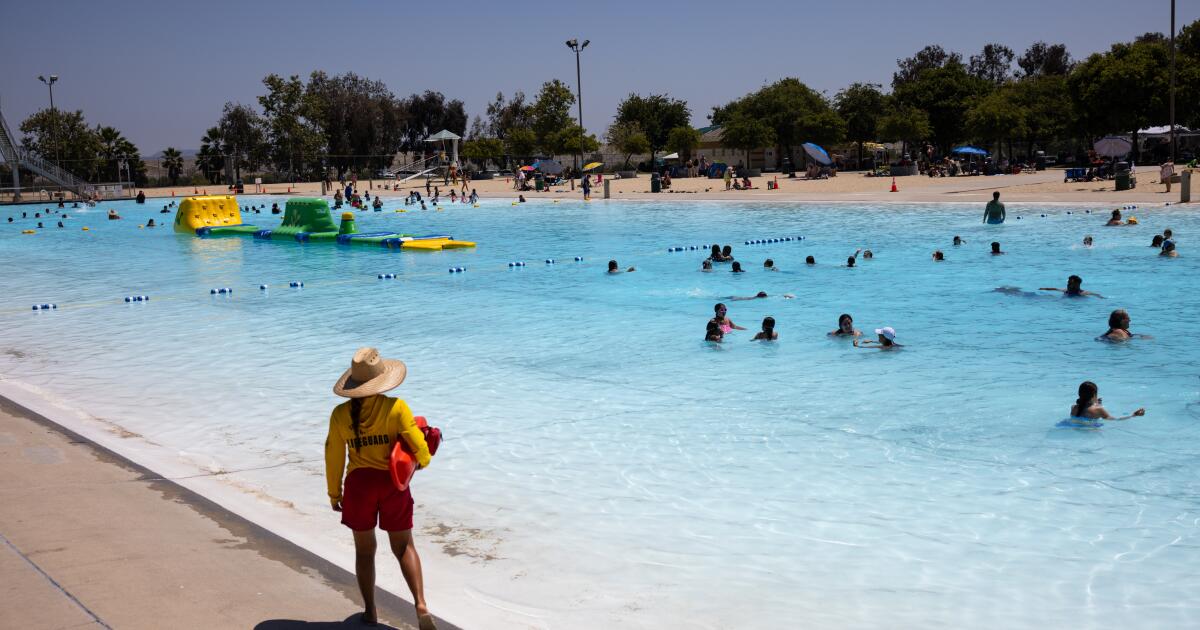
One of the largest pools in America is in L.A. It’s packed with beach vibes and fun
-
 Politics23 minutes ago
Judge orders Trump administration to restore national park signage on climate change, slavery
-
 Sports35 minutes ago
Commentary: Would Dave Roberts snub Yoshinobu Yamamoto to start Shohei Ohtani in All-Star Game?
-

 World43 minutes ago
America250 vs Freedom 250: What to know about the US’s 250th anniversary
-
 News1 hour ago
The joys of reporting on 3 teenagers chasing glory in the World Series of Birding : Consider This from NPR

