World
Armistice Day: Starmer and Macron meet in Paris


It’s the first time a British leader has been hosted for Armistice Day in France since Winston Churchill joined General Charles de Gaulle in 1944, Starmer’s office said.
British Prime Minister Keir Starmer is joining French President Emmanuel Macron at a Paris ceremony marking the 106th anniversary of the Armistice.
Their meeting signifies a celebration of the two countries’ friendship, as nations across the world pay tribute to their fallen soldiers in World War I.
The Paris ceremony echoes Franco-British commemorations that occured 80 years ago, when Allied troops liberated most of France’s territory from Nazi occupation, Macron’s office said.
This year also marks the 120th anniversary of the Entente Cordiale, the historic agreement between France and the United Kingdom.
Starmer was personally invited to Paris by Emmanuel Macron, and the two leaders are expected to discuss a number of foreign policy issues including the war in Ukraine and the Middle East.
The meeting marks a significant step in Starmer’s plans to reset relations with the European Union following the UK’s exit in 2020.
The two leaders first met at the Elysée presidential palace, before heading toward the Champs-Elysees avenue to lay wreaths at the nearby statues of Georges Clemenceau, French prime minister at the time of the Armistice, and Churchill.
They will then lead the traditional ceremony at the Arc de Triomphe monument where they will relight the flame of the Tomb of the Unknown Soldier.
The French Army Choir is to sing France’s national anthem, “La Marseillaise,” and the British anthem, “God Save the King.”
Starmer will also host veterans, defence charities and British military personnel at the ambassador’s residence, and is expected to meet the new French prime minister Michel Barnier.
“I am honoured to be in Paris to stand united with President Macron in tribute to the fallen of the First World War who made the ultimate sacrifice for the freedom we enjoy today,” Starmer said.
The prime minister also announced that the British government has earmarked more than £10 million (€12 million) for next year’s 80th anniversary of the Allied victory in Europe and the subsequent defeat of Japan which ended World War II.



new video loaded: What Tunnel Entrances Reveal About a Key Iranian Nuclear Site
transcript
transcript
What Tunnel Entrances Reveal About a Key Iranian Nuclear Site
Satellite images show how Iran has tried to bolster its defenses at parts of the Isfahan nuclear facility.
-
What you’re seeing here are buried tunnel entrances at a nuclear facility in Iran. It’s one of the most important sites in the country for U.S. and Israeli forces. U.N. inspectors think that roughly half of Iran’s highly enriched uranium is buried here. And these three entrances are the only known ways to access it. If you think about nuclear sites in Iran, three main sites come to mind. They’re pretty well known: Fordo, Natanz and Isfahan. Natanz and Fordo, They were largely taken out in U.S. strikes last year. So I’ve been focusing on Isfahan. The uranium here is still relatively accessible. It’s actually a pretty large complex. This area here was very important for uranium processing, but it was heavily hit by the U.S. and Israel last June. If you go a little bit further north, that is underground and that requires tunnels to enter. In a terrain view, it gets quite interesting. There are three roads that lead to these tunnel entrances, and these tunnel entrances have become very important, both last year, but also right now. They lead to the underground facility where U.N. inspectors say uranium is stored and a new enrichment site could be located. If this falls into the wrong hands, that would be a problem in the long term. Here’s a great example of how very recent satellite imagery gives us new insights. This is from late January of this year, and what you see here is a line of trucks. And they’re filled with soil, and they’re lining up to go to some of these tunnel entrances. If you look a little bit closer here, you see another one of these trucks that’s just unloading some of the soil and some earthmoving equipment. Iran in preparation for any possible attacks at that point. They try to protect this facility a little bit more. So this is Jan. 29. And if you just look a few days later, we go to Feb. 2. This is the completely buried tunnel entrance, completely covered in soil to protect from any attack. And this is how it still looks in mid-March. The U.S. and Israel have basically two options here: The first one is to heavily bombard the entrances to this underground complex that would block any access, at least in the near future. They haven’t done that yet. So that’s very, very interesting — a little bit surprising. And it might point towards a second option: That would be to go in with ground forces and to extract the uranium. But that would require a really large amount of troops to secure the vast area, bringing in earthmoving equipment to clear the tunnels and a lot of time in hostile territory.

By Christoph Koettl and Alexander Cardia
March 20, 2026
World
Iranian man, 2nd person arrested after allegedly trying to enter UK nuclear missile base: report

NEWYou can now listen to Fox News articles!
Two people were arrested after allegedly unsuccessfully attempting to enter HM Naval Base Clyde in Scotland on Thursday, authorities confirmed to Fox News Digital.
One suspect was an Iranian man, while the other was a woman of unknown nationality, The Telegraph reported.
“Around 5pm on Thursday, 19 March, 2026, we were made aware of two people attempting to enter HM Naval Base Clyde,” Police Scotland said in a statement to Fox News Digital. “A 34-year-old man and 31-year-old woman have been arrested in connection and enquiries are ongoing.”
The Telegraph reported that the man was Iranian, while the woman’s nationality was not immediately known. Citing the Times, the Telegraph said the suspects were turned away from the base because they lacked the correct passes and were later arrested nearby for allegedly “acting suspiciously in the vicinity.”
IRAN’S NEW SUPREME LEADER LINKED TO PROPERTIES WITH ‘LINE OF SIGHT’ INTO ISRAELI UK EMBASSY
HMS Artful, an Astute-class nuclear-powered fleet submarine, is shown at His Majesty’s Naval Base Clyde on March 4, 2025, in Faslane, Scotland. (Jeff J Mitchell/Getty Images)
A Royal Navy spokesperson said in a statement to Fox News Digital, “Police Scotland have arrested two people who unsuccessfully attempted to enter HM Naval Base Clyde on Thursday 19 March. As the matter is subject to an ongoing investigation, we will not comment further.”
HM Naval Base Clyde — commonly known as Faslane — is considered the primary base for the United Kingdom’s missile fleet.
PENCE BACKS TRUMP’S IRAN STRIKES, SAYS PRESIDENT ‘IGNORED’ GOP ISOLATIONISTS
A general view of His Majesty’s Naval Base Clyde on March 4, 2025, in Faslane, Scotland. (Jeff J Mitchell/Getty Images)
The Royal Navy says the base is home “to the core of the Submarine Service, including the nation’s nuclear deterrent, and the new generation of hunter-killer submarines.”
The U.K. Parliament says the Royal Navy currently operates a fleet of nine submarines, with the entire fleet based at HM Naval Base Clyde.
His Majesty’s Naval Base (HMNB) Clyde, also known as Faslane, hosts the U.K.’s nuclear submarines, which are armed with Trident missiles and serve as the U.K.’s nuclear deterrent. (Jeff J Mitchell/Getty Images)
“Five of those are conventionally-armed nuclear-powered attack submarines of the Astute class. A further four are ballistic missiles submarines (SSBN) of the Vanguard class that comprise the UK’s submarine-based nuclear deterrent,” it added.

Mojtaba Khamenei has not been seen in public since he replaced his slain father as Iran’s supreme leader.
Published On 20 Mar 2026
Supreme Leader Mojtaba Khamenei has said Iran’s enemies were being “defeated” in a written message for the Persian New Year, as the US and Israel continue to pound the country with attacks.
In a statement read on Iranian television on Friday, Khamenei praised the steadfastness of the Iranian people marking Nowruz, which he said ushered in the year of a “resistance economy under national unity and national security”.
list of 3 itemsend of listRecommended Stories
“At the moment, due to the particular unity that has been created between you, our compatriots – despite all the differences in religious, intellectual, cultural and political origins – the enemy has been defeated,” he said.
Khamenei has not been seen in public since he became supreme leader, following the assassination of his father, Ayatollah Ali Khamenei, at the start of the war on February 28.
Iran’s supreme leader said that while the US and Israel believed that after one or two days of attacks, the Iranian people would overthrow the government, but this was a “gross miscalculation”.
The war was launched under “the delusion that if the pinnacle of the regime and certain influential military figures were to attain martyrdom, it would instil fear and despair in our dear people … and through this means, the dream of dominating Iran and subsequently dismembering it would be realised”, he said.
Instead, “a fracture has emerged in the enemy,” he added.
Analysts have observed that the Iranian constitution itself was drafted with the spectre of a power vacuum in mind, a “survival protocol” designed to give the system the capacity to continue even at a moment of maximum shock.
Khamenei also denied that Iran or its allied forces were responsible for attacks against Turkiye and Oman.
Those were “false flag” incidents used by Iran’s enemy to “sow discord among neighbours, and it may occur in other countries as well”, he claimed.
The Turkish Ministry of National Defence last week said NATO air defences intercepted a ballistic missile launched from Iran. Two people were killed in Oman after drones came down in the Sohar province.
The supreme leader also called on Afghanistan and Pakistan to end their fighting and said he stood ready to assist.
“We consider our eastern neighbours to be very close to us”, the supreme leader said. “I appeal to our two brotherly countries, Afghanistan and Pakistan, to establish better relations with each other … and I myself am ready to take the necessary actions.”
The neighbouring countries agreed to a temporary “pause” in hostilities during the Muslim holiday of Eid al-Fitr this week, after weeks of deadly violence.

MTS releases new commute cost calculator tool amid rising gas prices

Only 30% of Milwaukee police supervisors live in the city. A new contract has an incentive

CIO 100 Leadership Live Atlanta: AI spending enters a reckoning phase

Clergy allowed to visit Minneapolis ICE holding facility in latest ruling

Indianapolis police officer charged with illegal deer harvesting

Florida High School Football Rankings: Top 25 teams – Oct. 21

How old is Bo Nix? What to know about Oregon quarterback ahead of 2024 NFL Draft

Cleary's 21 help Le Moyne down Central Connecticut State 69-64 in OT

99th annual Pony Swim held in Virginia

Indiana Members Credit Union announced as new anchor tenant at Bottleworks District

Pritzker pushes prosecutions of Trump officials as part of Dem ‘Project 2029’ agenda

Iran’s Khamenei says enemy ‘defeated’ in written Nowruz message

Gold Trump coin moves forward after Treasury invokes rare authority

Meet the longtime biz partner of Ilhan Omar’s husband as questions swirl over her skyrocketing net worth

‘Nobody can blackmail us’: Leaders excoriate Orbán’s veto
-

 Detroit, MI2 days ago
Drummer Brian Pastoria, longtime Detroit music advocate, dies at 68
-

 Oklahoma6 days ago
Family rallies around Oklahoma father after head-on crash
-

 Nebraska1 week ago
Wildfire forces immediate evacuation order for Farnam residents
-

 Georgia5 days ago
How ICE plans for a detention warehouse pushed a Georgia town to fight back | CNN Politics
-

 Massachusetts1 week ago
Massachusetts community colleges to launch apprenticeship degree programs – The Boston Globe
-

 Alaska6 days ago
Police looking for man considered ‘armed and dangerous’
-

 Colorado1 week ago
‘It’s Not a Penalty’: Bednar Rips Officials For MacKinnon Ejection | Colorado Hockey Now
-
 Southwest1 week ago
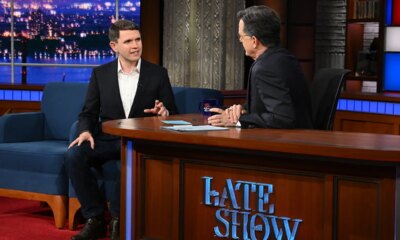
Talarico reportedly knew Colbert interview wouldn’t air on TV before he left to film it