Wyoming
Wyoming History: One Of Casper’s Most Upstanding Citizens Also A Huge Bootlegger


CASPER — When he died in 1948, the front page of one of the Oil City’s newspapers praised him as a pioneer and a man well-known around Casper.
It said nothing about his role as a bootlegger — one of Casper’s largest rum-runners. And there was nothing about the secret ingredient he infused in his version of Western moonshine.
A true renaissance man, Dave Davidson’s curriculum vitae also included sheep rancher, oilman, real estate investor, saloon owner, trophy hunter and baseball team manager. He lived a colorful life as Casper boomed into the Oil City, and later his whisky stills were busted up during Prohibition.
“One of the most colorful figures in the early day history of Casper and the Bates Hole Section, D.E. (Dave) Davidson died at his home Monday after a lingering illness,” the Casper Tribune-Herald reported Feb. 3, 1948. “He was nearly 79.”
Davidson was born in Ohio on May 2, 1869, and at 21 sought his own Manifest Destiny in the West. A favorite story he told was that he dumped the first wheelbarrow of dirt working to build the Presidio in San Francisco. He arrived in Wyoming in 1898 and in Casper and Natrona County in 1899.
The newspaper reported that he went into the sheep business in the Bates Hole section of Natrona County southwest of Casper.
Popular Guy
For a sheep rancher, Davidson became a popular man in the region.
Early newspaper accounts have him in June 1905 on a list of citizens planning to put a float in a “monster” Fourth of July parade in Casper. On Oct. 26 of that same year, the Wyoming Derrick published that he and a John Curran were headed to Cody, Nebraska, for duck hunting.
In 1907, the Thermopolis Record published Feb. 9 that, “Dave Davidson, who keeps a thirst parlor at Shoshoni, has been here for a day or two past.” And that same year on July 19, the Wind River Mountaineer mentioned Davidson’s name in conjunction with a baseball team.
“Ed Boland left on Wednesday morning for Shoshoni where he was to meet Dave Davidson, manager of the Casper baseball team, and arrange for the game of baseball to be pulled off at Shonshoni on the first anniversary of town on the forepart of August,” the newspaper reported. “The teams will play for a purse of $200.”
In 1908, the then 39-year-old Davidson was building a reputation across Wyoming as a standup citizen and businessman. The Sept. 11, 1908, edition of the Cheyenne Daily Tribune had a note that “Dave Davidson of Natrona County” was headed to Jackson Hole to hunt elk and bear — with hounds. A year later in 1909, The Casper Press reported that he sold “his saloon” in Casper.
The Elks Club was apparently part of his memberships because on Sept. 20, 1915, The Casper Daily Press reported the “Loyal Order of the Moose No. 1182 is one of the strongest secret orders in Casper fraternally, numerically, and financially.”
“The display of taxidermy in the club rooms, which is owned by Dave Davidson, is estimated to be worth $3,500 and includes specimens of elk, deer, antelope, mountain sheep, bobcats, and various kinds of birds,” the Daily Press shared.
-

Agents stand beside a still, seized in a raid. (Courtesy Churck Morrison Collection at Casper College Western History Center) -
Dave Davidson’s house at 323 S. David St. in Casper. (Natrona County Pioneer Association Collection, Casper College Western History Center)


Oil And Boots
And on Feb. 18, 1920, the Casper Herald reported that Davidson was then an officer in the Briggs Oil Co. and “returned from Newcastle where he spent several days in the interest of the concern which is carrying on extensive development of the Osage and other fields.”
Could Davidson have been pursuing other interests as well?
Prohibition arrived Jan. 17, 1920, and would continue through Dec. 5, 1933. And with it the opportunity for stand-up citizens like Davidson to prosper if they were willing to stay one step ahead of still-busing sheriffs. Or, in the case of Davidson, put them on the payroll.
In an unpublished autobiography found in files at Casper College’s Western History Center, Casper resident, World War I veteran, businessman and historian Bob David wrote that Davidson’s wide range of business enterprises included bootlegging during Prohibition.
And Natrona County was definitely not dry.
“Bootlegging was general, under the full protection of Gilbert Housely, the sheriff, who reaped a fortune,” he wrote. “The principal bootlegger was a gray, heavyset man named Dave Davidson. His stills produced whiskies which were noted for their flavor all the way down to Denver.”
The Secret Recipe
David said Davidson’s secret recipe was uncovered in a raid by federal officers.
“A large pile of worn-out rubber boots was beside the still testifying to the fact that the insides of old rubber boots gives an excellent flavor to whiskey,” he wrote.
Wanting to investigate the bootleg business, David wrote that through a friend, he was able to accompany one of Davidson’s distributors on a run through the city one night. They met in a downtown alley and the man was driving “a big, gray Cole 8 coupe.” In the back were boxes of “bottled booze.”
“We drove up to the south part of town where the bigger and richer houses stood, then went up the alleys. We would stop behind a big garage behind a fine, respectable home,” he wrote. “The garage door would open six inches. The distributor would get out, find a bottle inside the trunk, then take it over and pass it through the crack in the door. A moment later, and a white hand would reach out a bill, the door would close silently, and the ’legger would come back to drive on to another door.”
David wrote that the ride-along gave him good information on which friends “were drinking Dave’s bootleg.”
Fed Up City
By 1926, Casper was fed up with the gambling, drinking, brothels and murders going on just outside the city limits in North Casper, Evansville and Mills.
A banner headline in the Casper Daily Tribune on Wednesday, Oct. 6, 1926, reported that after raids by county, state and federal officers the previous Saturday, bootleg whiskey at 50 cents a drink and gambling tables were back operating early Sunday morning.
A front page editorial demanded action.
“Decent citizens of Casper demand that the riotous debauchery cease and cease at once. They demand that every facility of the county attorney’s office, the sheriff’s office, and the state enforcement department be mobilized to destroy the gambling devices, and the liquor, to abate the buildings in which these offenses are being daily committed, to prosecute the operators and owners of the houses,” the paper editorialized. “The time to act is now.”
But real action would not come until May 1933 when Davidson, Casper Mayor E. W. Rowell, Casper Police Chief Michael Quealy, Sheriff Housely and 32 others were indicted by a federal grand jury on liquor conspiracy charges.
-
In 1926, Casper residents were fed up with the bootleg establishments operating just outside the boundaries of the city. (Cowboy State Daily Staff) -
A huge banner headline announced the indictments handed down in a massive Casper bootlegging scandal. After a public trial, everyone was acquitted by a jury. (Cowboy State Daily Staff) -
A huge banner headline announced the indictments handed down in a massive Casper bootlegging scandal. After a public trial, everyone was acquitted by a jury. (Cowboy State Daily Staff)


The Trial
A trial in Cheyenne included testimony of payoffs to officials, an alleged incident where the city’s drunken police chief was carried out of a bootleg establishment, a beer party in the city firehouse and more.
Prosecutors charged that a house rented on Sixth Street was a Davidson property used for aging a liquor. A woman named Gertrude Kamps testified she rented it to a man named Renshaw and found that holes had been cut in the floor and her pipes allowed to freeze and burst. She went to the sheriff and complained.
“He told her she was as good as paid,” the Casper Tribune-Herald reported Wednesday, July 19, 1933. “She said she then left the sheriff’s office, and 15 minutes later Housely called her and said he had the money.”
A man named Ernest Miller, described as an itinerant pipeline worker, testified he had seen Davidson pay $900 for 100 gallons of whiskey taken to Hartville, the paper reported.
On July 24, Davidson took the stand and testified that he was in the liquor business in 1924 and 1925 “when he bought the production of Dave Greenwood, but that he went out of business in 1926 when Greenwood died and his brand of liquor could no longer be obtained,” The Casper Tribune-Herald reported.
Davidson testified he knew liquor with his name on it was sold in 1926, but claimed he “had no connection with its distribution or sold it.”
Denying he was a bootlegger, Davidson testified he was a sheep rancher. While true, stories from the time also recounted that he would put corn down after trucks carrying his illegal booze so his sheep would walk over and eat the grain, at the same time trampling the tracks.
Defense attorneys successfully attacked the federal witnesses and, in the end, the jury found everyone not guilty.
His Old Home Stands
Davidson, who also bought and sold various lots around Casper, built a home at 323 S. David St. The property had been sold before he died, but was mentioned by the Casper Tribune-Herald in the front-page article on his death.
“The home was built 30 years ago and was counted as one of the finest residences in the city at the time,” the newspaper reported Tuesday, Feb. 3, 1948. “The property is currently occupied by a business.”
Davidson sold his sheep ranch in 1938.
He left behind his wife, three sons and three daughters and is buried in Casper’s Highland Cemetery.
“Throughout his lifetime, Mr. Davidson was noted for his genial good wit and generosity and had many friends in this section of the county,” the newspaper reported.
And, with a wink and a nod, one of Wyoming’s most successful Prohibition bootleggers.
Contact Dale Killingbeck at dale@cowboystatedaily.com

Dale Killingbeck can be reached at dale@cowboystatedaily.com.

Wyoming
Wyoming Cultural Trust Fund awards $529K in grants, including several Fremont County projects


CHEYENNE, Wyo. — Wyoming is a state known for cowboys, rodeos, and beautiful plains, but is also known for being the first territory to grant women the right to vote, something historian Jennifer Helton explored in her Suffrage Stories presentation.
Helton was invited to highlight Wyoming’s remarkable role in the fight for women’s suffrage as part of the museum’s special America 250 Discover & Discuss series on Jun 18, but the recorded version was just released. This is a part of Cheyenne Frontier Days Old West Museum’s goal of exploring Cheyenne and the greater state of Wyoming’s history.
Helton’s presentation not only celebrates Wyoming’s role in suffrage, but also how the state’s pioneering women helped shape the future of voting rights across the nation.
Born and raised in Wyoming, Jennifer Helton left the state at age 18 to attend college, “which left a giant, Wyoming-sized hole in my heart,” Helton said, “and the way that I fill that hole is by conducting research on women’s suffrage.”
Upon realizing that most people outside of the state of Wyoming did not know the West’s progressive role in suffrage, she became obsessed with bridging this knowledge gap and researching the history of suffrage.
“My kids would tell you it’s an obsession, not just an interest or a hobby,” Helton said. “They always joke that I have three kids, the two of them and then Esther Morris.”
During her presentation, Helton’s admiration for Esther Morris was apparent due to her trailblazing nature as suffragist, her courage to stand up to torch-bearing mobs, and abolitionist activities.
Interestingly enough, her sons were also instrumental in shaping Wyoming’s history. E.A. Slack is known as the “Father of Frontier Days” and citizens of Wyoming can thank Robert C. Morris for Cheyenne’s public library, as he brought the Carnegie Public Library System to Wyoming.
.
” data-large-file=”https://i0.wp.com/capcity.news/wp-content/uploads/2026/06/image-2.png?fit=780%2C863&ssl=1″ alt=”” class=”wp-image-170117″ style=”aspect-ratio:0.90332473687879;width:464px;height:auto” srcset=”https://i0.wp.com/capcity.news/wp-content/uploads/2026/06/image-2.png?resize=925%2C1024&ssl=1 925w, https://i0.wp.com/capcity.news/wp-content/uploads/2026/06/image-2.png?resize=271%2C300&ssl=1 271w, https://i0.wp.com/capcity.news/wp-content/uploads/2026/06/image-2.png?resize=768%2C850&ssl=1 768w, https://i0.wp.com/capcity.news/wp-content/uploads/2026/06/image-2.png?resize=780%2C864&ssl=1 780w, https://i0.wp.com/capcity.news/wp-content/uploads/2026/06/image-2.png?resize=400%2C443&ssl=1 400w, https://i0.wp.com/capcity.news/wp-content/uploads/2026/06/image-2.png?resize=706%2C782&ssl=1 706w, https://i0.wp.com/capcity.news/wp-content/uploads/2026/06/image-2.png?w=960&ssl=1 960w, https://i0.wp.com/capcity.news/wp-content/uploads/2026/06/image-2-925×1024.png?w=370&ssl=1 370w” sizes=”auto, (max-width: 780px) 100vw, 780px”/><figcaption class=) Photo of Esther Morris, the first female justice of the peace (Cheyenne Frontier Days Old West Museum). Credit: Cheyenne Frontier Days Old West Museum (Jennifer Helton Presentation) / Cheyenne Frontier Days Old West Museum
Photo of Esther Morris, the first female justice of the peace (Cheyenne Frontier Days Old West Museum). Credit: Cheyenne Frontier Days Old West Museum (Jennifer Helton Presentation) / Cheyenne Frontier Days Old West Museum
Throughout the course of her presentation, Helton revealed the results of her research by tracing the course of American history in order to highlight the intersection between Wyoming, women, and winning the right to vote.
The talk also highlighted incredible Black women such as Lucy Phillips and Nancy Phillips, some of the first Black women to vote.
As America celebrates its 250th anniversary, the museum invites visitors to explore the stories of trailblazers like the nation’s first woman justice of the peace Esther Morris, the first woman governor, the first Black women to vote, and many other extraordinary leaders who made history.
The museum is hosting its special America 250 exhibit and allows visitors to discover the stories, artifacts, and moments that connect the community to the nation’s history. The exhibit even features six U.S. presidents who visited Cheyenne or Cheyenne Frontier Days, and is currently running at the museum. For those who cannot attend, lectures such as this are filmed and provided online.
As Helton closed her lecture, she read the words of Esther Morris, “I say do all the good you can while you do live.”
“Because women like Esther Morris, like Theresa Jenkins, had the courage to stand up and do all the good that they could in their lives we are all able to live the lives that we are living today,” Helton said.
“So, we should be grateful to them, and I think we should also be asking ourselves what is it that we need to be doing so that future generations can preserve the same opportunities we have, and perhaps more.”
Watch Jennifer Helton’s full presentation at the link provided here.
To learn more about historian Jennifer Helton visit jenniferhelton.org.
.
” data-large-file=”https://i0.wp.com/capcity.news/wp-content/uploads/2026/06/image-3.png?fit=780%2C519&ssl=1″ alt=”” class=”wp-image-170141″ srcset=”https://i0.wp.com/capcity.news/wp-content/uploads/2026/06/image-3.png?resize=1024%2C681&ssl=1 1024w, https://i0.wp.com/capcity.news/wp-content/uploads/2026/06/image-3.png?resize=300%2C200&ssl=1 300w, https://i0.wp.com/capcity.news/wp-content/uploads/2026/06/image-3.png?resize=768%2C511&ssl=1 768w, https://i0.wp.com/capcity.news/wp-content/uploads/2026/06/image-3.png?resize=1536%2C1022&ssl=1 1536w, https://i0.wp.com/capcity.news/wp-content/uploads/2026/06/image-3.png?resize=1200%2C799&ssl=1 1200w, https://i0.wp.com/capcity.news/wp-content/uploads/2026/06/image-3.png?resize=780%2C519&ssl=1 780w, https://i0.wp.com/capcity.news/wp-content/uploads/2026/06/image-3.png?resize=400%2C266&ssl=1 400w, https://i0.wp.com/capcity.news/wp-content/uploads/2026/06/image-3.png?resize=706%2C470&ssl=1 706w, https://i0.wp.com/capcity.news/wp-content/uploads/2026/06/image-3.png?w=1605&ssl=1 1605w, https://i0.wp.com/capcity.news/wp-content/uploads/2026/06/image-3-1024×681.png?w=370&ssl=1 370w” sizes=”auto, (max-width: 780px) 100vw, 780px”/><figcaption class=) Jennifer Helton’s information (Cheyenne Frontier Days Old West Museum).
Jennifer Helton’s information (Cheyenne Frontier Days Old West Museum).
Related
Wyoming
At 6,000-year-old crossing, Gov. Gordon OKs Wyoming’s first-ever designated pronghorn migration route – WyoFile

SUBLETTE COUNTY—Gov. Mark Gordon heralded Wyoming’s first-ever designation to protect a pronghorn migration corridor — a more than 2 million-acre web of habitat — at Trapper’s Point, which he called a “wonderful passageway.”
“How incredibly valuable it is that you are standing here today,” Gordon told the crowd, “to witness this remarkable moment.”
Gordon commemorated the moment with his feet planted on the narrow bulge of high country that splits the Green and New Fork rivers. Thousands of years ago, the site was a well-used hunting ground for Native Americans — it’s the earliest known killing and processing site for pronghorn in North America. Now it boasts a wildlife overpass.
No pronghorn were to be seen during the especially windy Friday afternoon gathering, which attracted 75 attendees from nearby Pinedale and other western Wyoming communities.
Now Trapper’s Point is officially classified as a “bottleneck” for the Sublette Pronghorn Herd — one of 13 such bottlenecks. That classification is supposed to prevent any surface-disturbing activity, with the intent that pronghorn can keep passing through Trapper’s Point for generations to come.

Protecting the ability of the fleet-footed, tawny-and-white ungulates to migrate is a “key factor” in sustaining their population, Wyoming Game and Fish Director Angi Bruce said.
“This becomes even more important in severe winters or extreme droughts,” Bruce said. “Pronghorn are long overdue for recognition.”
Pronghorn in Sublette, Teton, Sweetwater and Lincoln counties travel a long road — some migrate more than 200 miles to escape harsh winters, trekking south into the lower Green River Basin, a semi-arid sweep of sagebrush steppe between Pinedale and Rock Springs. Then in the spring, they retrace those paths, returning to summer ranges, lush with verdant vegetation, even going as far as Grand Teton National Park.
There was also a long road of bureaucracy to get to this point.
Nearly three decades of effort preceded the formal designation of the migration routes used by the Sublette Pronghorn Herd, which is the farthest-traveling and among the largest pronghorn herds in the West.
Jackson Hole biologists long knew that the valley’s pronghorn left in the winter. But details were hazy on where they went and how they got there until around the turn of the century. Using data from tracking collars, biologists like Joel Berger, Steve Cain, Hall Sawyer and Doug Brimeyer helped delineate the route.

In 2008, a Bridger-Teton National Forest plan amendment established a portion of the path as the nation’s first designated wildlife migration corridor.
Popularized by its branding as the “Path of the Pronghorn,” the route has received press in national publications like High Country News and the New York Times.
But the southern reaches of the migration through the energy-rich Green River Basin have faced major political opposition since the early 2000s. Wyoming first attempted to protect those travel corridors in 2019, under a policy administered by the Wyoming Game and Fish Department. That effort was halted after a coalition of industry trade groups and counties protested.
Then, in early 2020, Gordon revamped the migration policy with an executive order. Still, the Sublette Pronghorn Herd proposal gathered dust, even as development threatened the route.
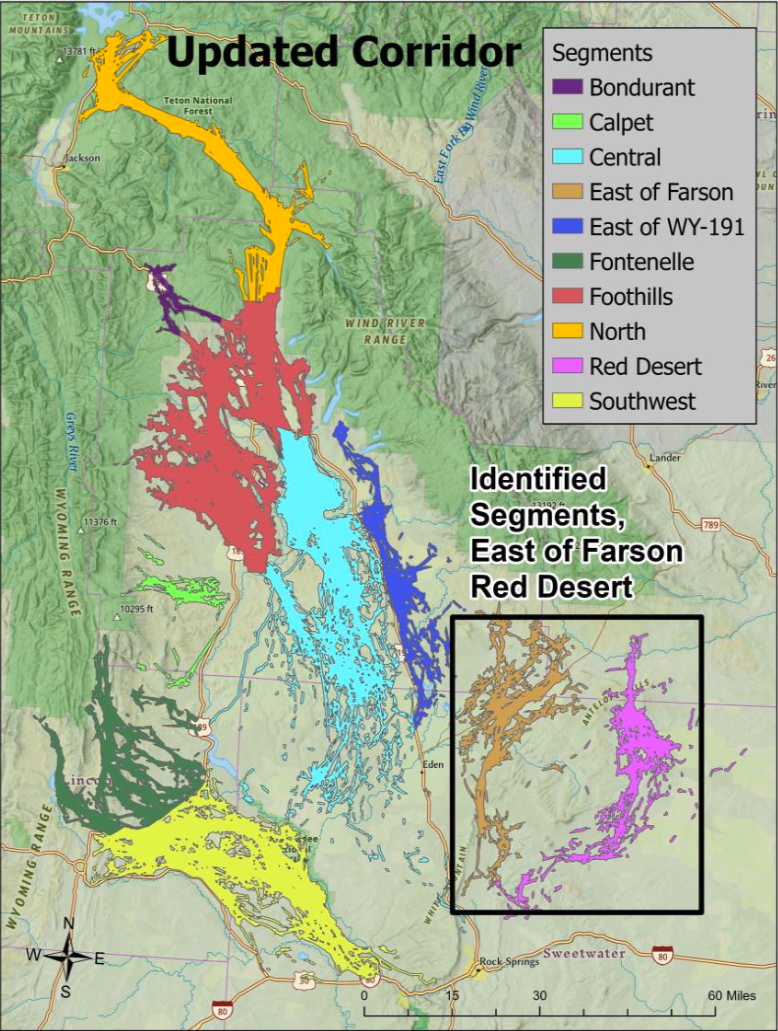
Game and Fish revived efforts to protect the migration in late 2023 and early 2024. Biologists pulled together one of North America’s most comprehensive migration datasets, benefiting from approximately two decades of GPS collar information collected from more than 400 pronghorn.
Some controversy followed the process until near the end. There was a debate about whether to designate the migration’s two easternmost segments, in the Red Desert and east of Farson. The Game and Fish Department proposed excluding the routes, but was overridden by its commission. Then Gordon upended that decision, excluding the two segments.
Vetting the migration corridor through a Gordon-appointed working group was the second-to-last step in the designation process.
“Today’s designation demonstrates that voluntary, locally driven conservation works,” said Robb Slaughter, who chaired the group, during the commemoration at Trapper’s Point.
Time will tell if that’s the case. Wyoming’s migration policy is, by design, permissive of development. Private land is exempt from protections, and designation is not an assurance that new stressors won’t be added to the landscape.

“Today is not the end of the process,” Slaughter said. “It’s the beginning of the next chapter. Continued monitoring, adaptive management, research, and cooperation will ensure these recommendations remain effective as conditions change.”
But Friday was the end of the migration designation process. The governor’s informal OK — no signature was needed — was the last step, said Sara DiRienzo, the governor’s deputy policy advisor.
Wildlife advocates celebrated the moment.
“This is historical,” Bruce said. It’s the first effort to protect the full length of a pronghorn migration corridor in the nation, she said.
-

 Indiana3 minutes ago
Its been my dream school ever since I was little Micah Mohler on receiving an Indiana scholarship offer
-

 Iowa10 minutes ago
Iowa City school board selects familiar face as interim superintendent
-

 Kansas12 minutes ago
Ghana to face either Portugal or Colombia in KC Round of 32 match
-

 Kentucky18 minutes ago
4 dead in Kentucky after heavy rain and floods put 12 state roads
-

 Louisiana25 minutes ago
Louisiana State Games boxing comes to West Monroe
-

 Maine27 minutes ago
Educators bring Maine’s Acadian heritage to life
-

 Maryland33 minutes ago
Parents of former Maryland athlete killed in 2024 car crash start foundation in his honor
-

 Michigan40 minutes ago
Michigan State hockey breaks program record with nine NHL Draft picks

