Wyoming
Tom Lubnau: Like It Or Not, Wyoming Depends On Federal Money


While coming back from the Arizona Bowl in Tucson, I noticed an airport bathroom sign says, “Do not Flush While Seated on Toilet.” The pictures that popped into my mind about the unintended consequences of not understanding the environment became graphically clear.
With the budget session of the Wyoming Legislature upcoming, a lack of understanding of just what our politicians are promising might end up with equally dire unintended consequences.
Oftentimes, politicians to tell voters what they want to hear, not what they need to hear. Some politicians depend on folks’ ignorance and unwillingness to ask the difficult questions when a subject is complicated.
The Wyoming budget is full of complicated facts and figures. This column addresses some of the high notes and shares food for thought. The time is now for us to put on our thinking caps and understand what is important and what is nonsense.
Wants Vs. Reality
As a former politician myself, I know the easiest message to attract voters in Wyoming is to say we need to lower taxes and cut the size of government. Who doesn’t like that message? Discussing the realities of the situtation gets a little harder.
Unfortunately, to live in a civilized society, consitutional taxes are a necessity. As my old friend John Hines (hardly a tax-and-spend liberal) says, “No one wants to pay taxes.”
He’s right. But neither does anyone want to have their house burn down, police not respond to a robbery, die a preventable horrible death because we don’t have health care, have our kids poorly educated, or drive on unpaved roads.
So, we mutually pay consitutional taxes.
The best way to ensure representative democracy though informed voters is to learn as much as we can about the subject about which they are talking. Then, we can applaud when they are right and call B.S. when they are blowing smoke.

How The Mooching Works
In that vein, understanding Wyoming’s finances is important for us to become educated voters.
Wyoming is a very unique state because it figured out a long time ago how to make people from out of state pay our essential taxes. In other words, we mooch off of other taxpayers to pay our bills.
Here’s how the mooching works. According to a 2022 analyis by the Wyoming Economic Analysis Division, a three-person family with an income of $68,000 and owning a home with a value of $320,000 pays about $4,340 in taxes, including sales tax, fuel tax, tobacco tax, alcohol taxes, vehicle registration and property taxes.
That same family recieves about $23,900 in local and state government services.
In other words, Wyoming people pay about 1/5 of the bill for the government services they receive. Who, then, pays the rest of the taxes?
The folks who pay Wyoming’s taxes are the people who purchase and consume Wyoming minerals and fossil fuels.
Industry in Wyoming pays the bulk of taxes, and their customers in turn make it possible for industry to pay those taxes. On the other hand, if taxes are cut, out-of-state corporations, many of which are headquarted in St. Louis and Houston, are going to get the biggest benefit of tax cuts. They then use the benefits of those tax cuts for bonuses, dividends and other corporate finance.

The High Points
Knowing that Wyoming residents are getting a largely free ride on the backs of other people and industries is key to understanding the state of Wyoming’s budget.
Who supports the bulk of Wyoming’s budget?
Decribing the Wyoming Budget in detail in an online column is nearly an impossible task. Let’s just hit some high points to ponder. If you want to examine the Wyoming budget in detail, visit the state Budget Department online.
In fiscal year 2023-24, Wyoming’s total budget was $10.68 billion. Income to the state of Wyoming arrives in several different ways. Surprisingly, the largest single funder of the state is the federal government.
Yes, that’s right. According to a 2022 study on SmartAsset.com, Wyoming receives $1.36 in federal funding for every $1 of income tax paid by Wyoming people and entities. Wyoming makes a 36% profit on the taxes its residents pay to the IRS.
About 1/3 of Wyoming’s budget is financed by the federal government. The money comes to the state as federal fund payments and also as federal mineral royalties (which are classified as part of “other funds” in the graph. If one combines the federal mineral royalties with the $2.05 billion in federal money the state receives, according to Moneygeek, Wyoming’s budget is comprised of nearly 31.87% federal funds.
It’s Obvious, Right?
Some politicians are running around and saying Wyoming should just stop taking federal funds. The obvious question, when faced with the above numbers, is how are you going to replace $3 billion per year when the state stops taking that money?
Before one answers that we don’t need those funds, it might be prudent to see where the state of Wyoming spends those federal dollars.
Remember, some of the funds are direct federal payments that are labeled “federal funds” in the graph above. The federal mineral royalties are included in the “general fund” as well as “other funds,” which are appropriated differently.
Combined, the “federal funds” and “other funds” contributions equal 31% of the state’s budget.
By Department
According to information published in the the Wyoming Legislative Service Office’s Data Book, the “federal funds” appropriation of $2.05 billion was spent on primarily on health care and education.
The Department of Health federal monies are used, in large measure, to pay for indigent heath care for youths, deliver babies, mental health and substance abuse treatment and taking care of our indigent sick and elderly.
So, when walking away from those funds, one should ask who’s going to pay for the destitute grandparents with Alzheimer’s disease who have used up all their assets paying for their care?
While the example is admittedly extreme, for those families who are faced with the $9,200 per month in average nursing home costs, it is an all-too-real crisis.
To my way of thinking, dumping our disabled elderly on the street is not an option. Nor is denying prenatal coverage to an indigent young mother.
The Department of Education grants are self-explanatory. Those funds pay for things like school lunches, education of chidren with disabilities and providing for mental health assistance as well as defraying some of the costs of education.
The Wyoming Military Department receives federal funds to support its mission to defend our country. Operation of the National Guard is an essential function of our state government, and is supported, in large measure, by the federal government. Wyoming’s military department would largely cease to function without federal funds. Walking away from those funds would be just irresponsible.
The Department of Family Services receives federal money to support needy children and families and for protection of children who are the victims of abuse and neglect, child support enforcement and low income food assistance.
While it is unfortunate there are people who needs these funds, the alternative is to turn these children and families out on the street.
One of my favorite federal appropriations is to the Attorney General’s office to support the Division of Internet Crimes Against Children.
If you don’t know what these folks do, look them up. While there are those who claim they are protecting children by persecuting librarians, these public servants are doing amazing work protecting children against exploitation.
There are pretenders and there are battle-hardened paladins. These folks are paladins doing very difficult task of interdicting disgusting efforts to exploit and blackmail our children via electronic an other means. Walking away from these federal funds would be a vote in favor of child exploitation.
Not So Easy, Right?
From these few examples, a picture starts to develop that federal funds are important to the day-to-day operations of the state of Wyoming.
Walking away from them without a tanible substitute in place would be silly and dangerous. When confronted with walking away from federal dollars, we have to ask the hard question and what ifs.
Otherwise, we end up flushing the airplane toilet while seated.
I often hear political types say, “We’ll just kick the federal government out of Wyoming, and we’ll be fine.”
Those who make that statement also often say, “And when we do, we’ll just take over F.E. Warren Air Force Base, and we’ll be a nuclear nation.”
Those statements exemplify kakistocracy at is finest. I’m sure the Air Force will just wink and give the Wyoming Legislature the nuclear codes.
When I hear that nonsense, I often think of a movie I saw as a child as at film festival called “Bambi Meets Godzilla.”
Like It Or Not, We Need Federal Money
Whether we like it or not, federal funds are an integral part of Wyoming’s reality. Before we go around chatting about divorcing the state from federal funding, and the strings that come with it, we should consciously weigh what we are giving up.
Those spouting the political rallying cry that we should give up federal funds should have a concrete plan for all the things the state of Wyoming is giving up. Failure to do so while contemplating such an action is legislative malpractice.
Some political types run around telling us that Wyoming has the greatest number of government employees per capita. (A true statement). They contend Wyoming should reduce the number of state employees so they can lower everyone’s taxes.
But before we embark on a massive cut in Wyoming government services, we should look to see where the money is spent. Total appropriations in Wyoming consist of general fund appropriations (taxes mostly paid by industry), federal funds and other funds.
The “other funds” consist of enterprise funds (charging for services like game tags), investment income (a surprisingly large portion of Wyoming government is funded by income off of Wyoming’s multiple trust funds) and forty-eight percent of the landowner’s royalty paid as a result of production on federal minerals located in Wyoming.

Where To Cut?
If we are going to cut our state budget, we should understand where the funds are currently being spent. The nearly 50% percent of the state’s budget supports the Department of Health, K-12 education, the University of Wyoming and Community Colleges.
The largest number of government workers in the state of Wyoming are educators. The next largest number of government employees are health care workers.
If the state is going to reduce the number of employees, these are the areas where the employees exist. To cut government workers, teachers and health care workers would be on the block. If a politician says they are not, the politician either does not have a plan, or is not serious about cutting government workers.
The next largest group of state government employees is law enforcement. Law enforcement funding is included in funding to cities, towns and counties in the “All Others” category.
When someone tells you we need to cut the number of government employees, ask them which teachers, doctors, nurses or law enforcement people they intend to fire.
If they give you the political two-step, ask again. Have them tell you which government employees they want to fire. Make them tell you which government services they intend to curtail. If they cannot give you specifics, it is because they are just blathering a party line and they have not thought through the consequences of their blather. They are just telling you what you want to hear to get your vote.
Trickle-Down
Here is another thing to think about. One of the unanticipated economic consequences of cutting state jobs is the ripple effect throughout the local communities.
Government spending does not exist in a vacuum. When the government spends $10 on a schoolteacher’s salary, for example, that schoolteacher might save 25% and spend the other 75%.
Assume the teacher buys food. The food dealer now has $7.50 of the teacher’s money (75% of the $10 salary). The food dealer saves 25% of his money and spends the other 75% on a truck. He spends $5.62 of the teacher’s salary on the truck.
Then the truck dealer does the same thing and so forth. Multiplier factors vary by community and assumptions, but the rule of thumb I was taught was that $1 of spending multiplies by seven times when it is spent.
The converse is true when the government does not spend the money. Assume the teacher gets laid off. The fired teacher moves to Texas because that is where most everyone is moving. The teacher does not buy food, which reduces the food dealer’s income, which in turn reduces the truck dealer’s income and so forth. The budget cut ripples through the community.
So, before you let political folks damage local economies, ask the hard questions.
All the folks who want drastic reductions in government employees never talk about the consequences of the multiplier effect. The multiplier effect may not even come into their consideration. It should. Talking about complicated economic realities is not good for telling folks what they want to hear. Understanding economic consequences is important for policy making, though.
As I have said before, when perception hits reality, reality always wins. So, political types can spout these placating theories, but when the rubber hits the road, it is going to be the people of the state of Wyoming who bear the undiscussed consequences of the political platitudes we have been hearing.
I have said this before as well: We deserve more than political slogans and fancy historical flags flying at rallies. We deserve intelligent discussion, which takes into consideration the realities of and consequences of political acts.
What we do not need is discussions that devolve into political labeling. When a politician is backed into a corner (remember, I used to be one), the easiest way out of the corner is to call the opposition a name.
If the discussion degenerates into name-calling, you know the politician does not have an answer. The politician might call himself a “true patriot,” implying that you are not, because you dare not respect his authority.
The politician might call you a name. Either way, you have gotten the information you need. When the discussion degenerates into name-calling, the politician does not have answers to the hard questions. They are just telling you what you want to hear to get your vote.
We are at a crossroads in our state. We must insist on thoughtful analytical folks with discernment to make our policy decisions. Our needs are far beyond simple political platitudes.
If we settle for slogans, we are going to get our private parts sucked into a toilet at 34,000 feet.


Scroll down for a list of fireworks restrictions across Wyoming.
I usually don’t buy fireworks for the 4th of July. I go places to watch them. But since this year is the 250th anniversary of our nation, I was going to purchase a small arsenal and have a blast, pardon the pun.
But this has been a very dry year, as happens now and then in the cycles of weather. So I figured I’d wait until things were wet again and just hold my personal celebration a little late.
Many towns across Wyoming have canceled their July 4th fireworks due to the drought. They don’t want you firing off any either.
Based on 2026 reports, several Wyoming towns and counties have canceled or significantly restricted Fourth of July fireworks displays due to high wildfire risks, drought conditions, and Stage 1 fire restrictions.
Canceled/Restricted Public Displays (2026)
- Gillette/Campbell County: The CAM-PLEX fireworks show was postponed, and the county is maintaining a Stage 1 fire restriction due to extreme drought.
- Douglas: The Volunteer Fire Department canceled the 4th of July fireworks show due to fire concerns.
- Newcastle: Fireworks show canceled due to high fire danger, according to a June 27 report.
- Pine Haven: Canceled its Fourth of July fireworks display, according to a June 27 report.
- Riverton: Passed a resolution banning personal fireworks within city limits on July 4, with only a limited, designated area for public displays at the Honeycutt Softball and Saban Baseball Complex.
- Teton County: Fireworks have been historically canceled, and fire officials are urging residents to only attend official, professional displays due to extreme fire danger (confirmed for 2026).
City-Wide Personal Fireworks Bans (2026)
- Cheyenne: Consumer fireworks are prohibited within city limits, despite the county lifting restrictions, with only small novelties allowed.
- Casper: Fireworks are prohibited within city limits and in unincorporated Natrona County.
Key Locations Under Restrictions (2026)
- BLM Land: Fireworks are prohibited on public lands managed by the Bureau of Land Management in Wyoming.
- Weston County: A county-wide ban covers Newcastle and Upton due to high drought conditions.
Even little Chugwater, Wyoming, population 175, has banned fireworks inside its little town limits.
At the State Capital in Cheyenne, however, they will go right ahead with a fireworks display, right over the capital building itself. Dry weather be dammed.
Weird Fireworks Names You’ll Find In Wyoming
Just some of the odd names we found while shopping.
Gallery Credit: Glenn Woods

Media outlets gasped last week at the socialist movement’s success in the New York congressional Democratic primary elections.
That success headed west Tuesday, to Wyoming’s southern neighbor of Colorado.
Democratic socialist Melat Kiros, 29, defeated 15-term incumbent U.S. House Rep. Diana DeGette in Tuesday evening’s primary election.
Colorado Public Radio called the ouster “a stunning blow to the Democratic establishment in Denver and continuing a run of leftist victories in major cities.”
Former Wyoming Gov. Mike Sullivan, a Dvemocrat, told Cowboy State Daily on Tuesday that he wasn’t surprised at the move by Denver voters, but he doubted the proximity of a House socialist – if Kiros wins the general election – will affect Wyoming much.
“We have our own issues, and we’re certainly more sensitive to certain issues than others,” Sullivan said. “And it doesn’t necessarily divide us or make us closer to anybody else.”
Could Deepen ‘Don’t Colorado My Wyoming’ Sentiment
Liz Brimmer, longtime Wyoming politico, agreed in general, but said having a socialist congressional neighbor could galvanize Wyoming even harder into a tendency it already has: spurning anything that looks like Colorado governance.
“I think Wyoming uniformly and strongly feels, you know, ‘Don’t Colorado my Wyoming’,” Brimmer said. “And I think if anything, it deepens that sentiment.”
Brimmer said the ouster speaks of “these times, where there’s no doubt an anti-incumbent strain.” But no one will know all the reasons, nor should presume too much, until the voter data return, she said.
The Republicans saw the anti-incumbent strain surface differently, with newcomers ousting President Donald Trump’s foes in GOP primary elections.
State Rep. Landon Brown, R-Cheyenne, who is finishing off his final legislative term, voiced fascination with the election outcome.
Brown, a self-described political junkie, lives about 14 miles from the Colorado border.
He said the ouster shows Denver is increasingly dictating the rest of Colorado’s fate, and that the state is growing more polarized.
On the Republican gubernatorial primary side, The Associated Press was showing a half-point lead for Victor Marx as of Wednesday.
“He’s just as crazy as a democratic socialist on the left,” said Brown.
As for DeGette’s defeat, it’s not as symptomatic as one would think, he added.
“She was running a ‘Hey, I’m the incumbent and I’ve been here 30 years’ (campaign),” he said.
That hurt her. As did a growing divide on the left over Israel’s approach to its many foes — and Congress’ funding of Israeli war and defense efforts, said Brown.
Israel was also a fulcrum in the May primary loss of libertarian-leaning incumbent Rep. Thomas Massie, of Kentucky. But the Republican voters took the inverse approach on that one, nominating the candidate who supports funding Israeli war efforts.
Jack Speight, the GOP strategist who helped Wyoming Gov. Stan Hathaway to victory in 1966, told Cowboy State Daily Kiros’ win is alarming.
Speight was a Democrat when he graduated from the University of Wyoming law school. But the allure of capitalism and the prevailing logic of his good friends pulled him to the Republican side, he said in another interview last month.
The socialist victories of 2026 are “sad for this country. It may well affect the results of this fall, and nationwide,” he said. He called it a shift of California transplants into the Rockies, and a symptom of a growing entitlement.
Look North
Colorado isn’t the only Wyoming neighbor with socialist momentum.
Sam Forstag, a smoke jumper endorsed by Sen. Bernie Sanders, I-Vermont, and Rep. Alexandria Ocasio Cortez, D-New York, won his primary bid for Montana’s U.S. House District 1 on June 2.
Forstag may be less favored than Kiros going into the general election: No Democrat has won that Montana House district this century.
The New York Times called Forstag’s candidacy a “test for left-leaning politicians” who have been arguing for a populist surge in the blue party.
Clair McFarland can be reached at clair@cowboystatedaily.com.

LARAMIE, Wyo. — A bull moose was spotted roaming the streets of Laramie early Tuesday morning before being safely tranquilized and relocated by the Wyoming Game and Fish Department.
Photos from the University of Wyoming Police Department and Laramie residents show the creature curiously wandering through the university campus, where he was tranquilized before heading to a strip mall along Grand Avenue and taking a nap.
“Biologists got the call this morning that the moose was wandering in the UW Apartments neighborhood,” Laramie Region Game and Fish Information and Education specialist Hannah Smith said. “They responded to the scene and were able to dart the moose.”
While he was darted near the apartments, he didn’t stand around and wait for the tranquilizer to take effect. Smith said he worked his way east for about 20 minutes before ending up, coincidentally, in front of Sportsman’s Warehouse.
Lilly Avila, a Laramie resident working at a nearby coffee shop, told Cap City News the animal was sluggishly wandering the parking lot and rubbing against cars before the tranquilizer got to him.
“They brought him to the office and got him cooled down,” Smith said. “They don’t want to be in town. It’s a stressful situation for them, too. They can overheat really easily, so we get them cooled down before we transport them.”
Game and Fish couldn’t say as of Tuesday where the moose came from. Smith said he could have come east from the Pole Mountain area between Laramie and Cheyenne or up the Laramie River from the Snowy Range. Either way, his new home will be around Medicine Bow Mountain.
He also shouldn’t be feeling the effects of the tranquilizer for too much longer. Biologists gave him a reversal drug that should have prepared him to return to the wild.
“He should be pretty normal in terms of the medication. I think, in terms of his day, hopefully he goes back to living his happy moose life munching on some willows and doesn’t go for too many more walkabouts,” Smith said.


Related
-
 Politics2 minutes ago
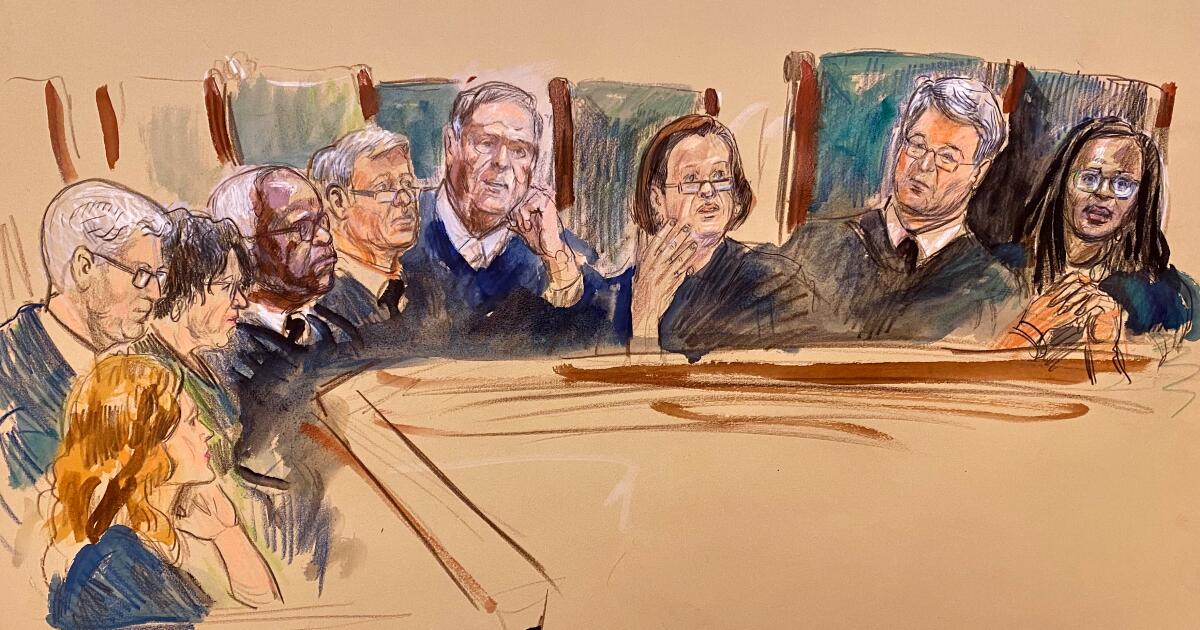
How Roberts led a fractured Supreme Court to wins for the right and defeats for Trump
-
 Science7 minutes ago
Contributor: Alcohol should be stigmatized like smoking
-
 Sports14 minutes ago
Thousand Oaks native Claire Liu finally reaches Wimbledon’s third round, will face Coco Gauff
-

 World22 minutes ago
Could water become a flashpoint between Islamabad and New Delhi?
-
 News47 minutes ago
Ukraine latest / Limits of military might / Can major powers regain dominance? : Sources & Methods
-

 Los Angeles, Ca2 hours ago
Juvenile charged with murder after 4-month-old Claremont infant thrown to her death
-

 Detroit, MI2 hours ago
Silence from Jalen Duren’s camp is what the Pistons want to hear
-

 San Francisco, CA3 hours ago
Jury deadlocked on 2 counts for Golden Gate Bridge pro-Palestinian protesters

