Wyoming
Supreme Court rejects Utah, Wyoming claims on federal public lands – WyoFile


It took the U.S. Supreme Court 12 words and one period to dismiss more than 300 pages of legal arguments in which Utah, Wyoming and other Western states sought to establish control and ownership of millions of acres of federally managed public land.
Utah, Wyoming’s lone U.S. Rep. Harriet Hageman, state legislators, Gov. Mark Gordon and many others sought an emergency hearing to argue that the federal government illegally owns property that rightfully belongs to Western states. Wyoming and other parties filed briefs of their own supporting the Beehive State’s assertion that federal ownership was detrimental to those commonwealths.
The filings appear to be unappreciated by the justices.
“The motion for leave to file a bill of complaint is denied,” the court said in an order filed Monday.
Utah’s petition generated another 424 pages of legal entreaties by its supporters and critics, a count that includes rebuttals by the United States and the Ute Tribe.
Utah claimed the federal government could not own and control “unappropriated lands,” which are those not specifically designated for use by an enumerated federal power. Utah targeted 18.5 million acres of Bureau of Land Management property belonging to all Americans.
Beehivers first said they wanted the court to “dispose” of the BLM property, then clarified that the state just wanted the court to say it is unconstitutional for the government to hold “unappropriated” acreage.
Hageman claimed that federal ownership is an occupation equivalent to a casus belli, a situation that justifies war or conflict between nations. “[T]he standard is whether the federal government’s actions would amount to an invasion and conquest of that land if—assuming a counterfactual—Utah were a separate sovereign nation,” Hageman’s filing states.
Twenty-six Wyoming lawmakers also saddled up for Utah, urging the court to take up the case and saying their support does not mean they will not seek other federal property for the Equality State. The perturbed posse said its claims could extend to “all former federal territorial lands … now held by the United States … [including] parks, monuments, wilderness, etc.”
Six of the sympathetic signatories — Sens. Tim French (R-Powell), Larry Hicks (R-Baggs), Bob Ide (R-Casper), John Kolb (R-Rock Springs), Dan Laursen (R-Powell) and Cheri Steinmetz (R- Lingle) — voted for a draft bill that would allocate $75 million for the Legislature, independent of the executive branch or other state entities, to litigate against the federal government. Senate File 41 “Federal acts-legal actions authorized” will be considered when the Legislature convenes today.
Gordon was more reserved in Wyoming’s official state plea, alleging “harms that federal ownership … uniquely imposes on western States on a daily basis” as a reason for the Supreme Court to immediately take up the case.



The top boys’ basketball players in Wyoming for Classes 1A and 2A were chosen for the 2026 high school season. The Wyoming Coaches Association has unveiled the all-state awards for this year, as voted on by the head coaches in the two classifications, respectively. The Wyoming Coaches Association only recognizes one team for all-state, and only these players receive an award certificate from the WCA. WyoPreps only lists all-state players as defined by the WCA.
WCA 1A-2A BOYS BASKETBALL ALL-STATE SELECTIONS IN 2026
Each class selected 14 players for all-state, reflecting a broad recognition of talent across Wyoming. Notably, congratulations go to Hulett’s Kyle Smith, Brady Cook from Lingle-Fort Laramie, and Carsten Freeburg from Pine Bluffs, who earned all-state honors for the third straight year. In addition, eight more players achieved all-state status for the second time in their prep careers.
Class 1A
Paul McNiven – Burlington
Bitner Philpott – Burlington
Ammon Hatch – Cokeville (All-State in 2025)
Hudson Himmerich – Cokeville
Kyle Smith – Hulett (All-State 2024 & 2025)
Anthony Arnusch – Lingle-Ft. Laramie
Brady Cook – Lingle-Ft. Laramie (All-State 2024 & 2025)
Tymber Cozzens – Little Snake River (All-State in 2025)
Corbin Matthews – Lusk
Max Potas – Meeteetse (All-State in 2024)
Jace Westring – Saratoga
Hazen Williams – Saratoga
TJ Moats – Southeast (All-State in 2024)
Nic Schiller – Upton
Read More Boys Basketball News from WyoPreps
WyoPreps 1A-2A State Basketball Scoreboard 2026
WyoPreps 3A-4A Regional Basketball Scoreboard 2026
WyoPreps Coaches and Media Final Basketball Poll 2026
1A-2A Boys Basketball Regional Scoreboard 2026
WyoPreps Boys Basketball Week 11 Scores 2026
WyoPreps Coaches and Media Basketball Polls 2-25-26
WyoPreps Boys Basketball Week 10 Scores 2026
WyoPreps Coaches and Media Basketball Polls 2-18-26
WyoPreps Boys Basketball Week 9 Scores 2026
WyoPreps Coaches and Media Basketball Polls 2-11-26
WyoPreps Boys Basketball Week 8 Scores 2026
WyoPreps Coaches and Media Basketball Polls 2-4-26
Class 2A
Caleb Adsit – Big Horn
Chase Garber – Big Horn
Carsten Freeburg – Pine Bluffs (All-State 2024 & 2025)
Mason Moss – Rocky Mountain
Oakley Hicks – Shoshoni
Kade Mills – Sundance
Cody Bomengen – Thermopolis (All-State in 2025)
Zak Hastie – Thermopolis
Ellis Webber – Thermopolis (All-State in 2025)
Joseph Kimbrell – Wright
Mitchell Strohschein – Wright (All-State in 2025)
Adriano Brown – Wyoming Indian
Heeyei’Niitou Monroe-Black – Wyoming Indian (All-State in 2025)
Cordell Spoonhunter – Wyoming Indian
The 2026 state champions were the Saratoga Panthers in Class 1A. They beat Lingle-Fort Laramie, 50-45, in the championship game. The 2A winners were the Thermopolis Bobcats, who repeated as champions, after a 45-38 victory over Wyoming Indian in the title game.
Lusk versus Rock River high school basketball 2026
Game action between the Tigers and Longhorns
Gallery Credit: Courtesy: Lisa Shaw

A pair of bills signed into law last week aim to build out a more comprehensive system of literacy education across Wyoming’s public schools.
One mandates evidence-based practices and requires regular screenings for dyslexia, while the other enables the Wyoming Department of Education (WDE) to hire a dedicated literacy professional to oversee statewide compliance.
Gov. Mark Gordon’s signing of both bills on Friday was the latest accomplishment of an ongoing push for improved literacy standards. That push has been spearheaded by State Superintendent of Public Instruction Megan Degenfelder.
“Wyoming is not going to let a single child fall through the cracks,” Degenfelder said during a public bill signing last week. “We are not going to fall behind when it comes to ensuring that our children can read at grade level.”
The primary bill, Senate File 59, establishes a statewide K-12 program for teaching students to read that is built on “evidence based language and literacy instruction, assessment, intervention and professional development that supports educators, engages families and promotes literacy proficiency for all Wyoming students.”
The bill defines evidence-based strategies as those that conform to the science of reading, a term that will be defined and updated by Degenfelder’s office. Nationwide, it generally means putting academic research into practice in classrooms. SF 59 specifically prohibits the exclusive use of “three-cueing” — a strategy once widely employed to teach reading but which education experts now say is outdated and less effective than other strategies.
It also requires annual dyslexia screeners for students below the third grade, and testing for reading difficulties for all students.
The screeners are used to identify the severity of reading difficulties in order to direct “tiered” support that offers the most intensive interventions to the students most in need, while still providing “evidence based” language instruction to all students.
Each school district must formulate an individualized reading plan “for each student identified as having reading difficulties or at risk for poor reading outcomes.”
Districts must now report to the state annually regarding their literacy-related work. Any district where 60% or more of the students are struggling will be required to implement “summer literacy camps or extended supports, including after school support and tutoring.”
The bill also requires literacy related professional development for teachers and specialists “appropriate to their role and level of responsibility” related to literacy education.
SF 59 was backed by dyslexia advocates and literacy specialists.
Senate File 14, the other literacy bill signed into law Friday, appropriates $120,000 annually for the next two years for a full-time position at WDE “to assist school districts in implementing a reading assessment and intervention program and language and literacy programs.”
Both bills go into effect July 1.

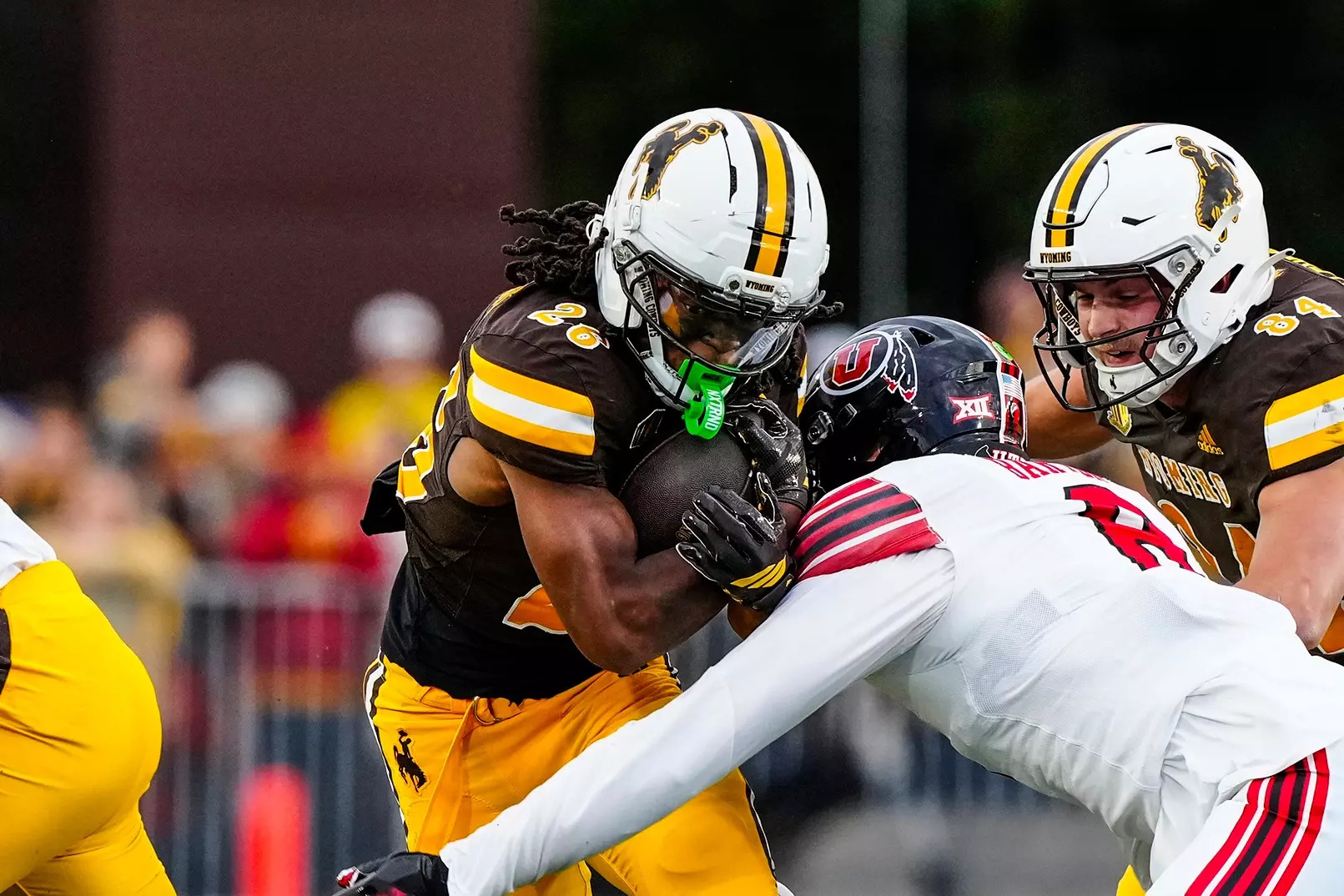
LARAMIE — The University of Wyoming and the Mountain West Conference announced the Cowboys’ 2026 football schedule Monday, a slate that opens with the Border War and concludes with back-to-back home games in Laramie.
Wyoming opens the season Sept. 5 on the road against Colorado State in the 118th edition of the Border War. The Cowboys then host Northern Colorado on Sept. 12 in the home opener before traveling to Central Michigan on Sept. 19.
The Cowboys begin Mountain West play Sept. 26 at home against Hawaii in a matchup for the Paniolo Trophy. Wyoming then faces back-to-back road games at North Dakota State on Oct. 3 and San Jose State on Oct. 10.
Advertisement – Story continues below…
University of Wyoming sports coverage
in Southwest Wyoming is supported by these great sponsors:
Wyoming returns to War Memorial Stadium on Oct. 17 to host conference newcomer Northern Illinois before facing Air Force at home on Oct. 24. The Cowboys will have an open week on Oct. 31.
The Cowboys open November with road games at UNLV on Nov. 7 and at UTEP on Nov. 14, marking Wyoming’s first meeting with the Miners as members of the Mountain West. Wyoming closes conference play by hosting New Mexico on Nov. 21 and wraps up the regular season with a nonconference game against UConn on Nov. 28 in Laramie.
Each Mountain West team will play four home and four road conference games during the 13-week season, which will conclude with the Mountain West Football Championship Game featuring the two teams with the highest conference winning percentages. The championship game date will be announced later.
With the conference schedule set, Mountain West television partners CBS Sports, FOX Sports, and The CW will begin selecting broadcast games, which could include moving some contests to non-Saturday dates. Network assignments and kickoff times will be announced at a later date.
Season ticket renewals for the 2026 Wyoming football season are now available. Fans can renew their tickets online by visiting gowyo.com/tickets and logging into their account.

Forest Home Avenue construction to resume in Milwaukee County

Metro Atlanta gas prices surge ahead of spring break, leaving drivers stunned

Minnesota snow causing slick spots on roads

FBI arrests suspect at Indianapolis International Airport

How Pittsburgh area drivers can save money on gas as prices rise during the war with Iran

Florida High School Football Rankings: Top 25 teams – Oct. 21

Cleary's 21 help Le Moyne down Central Connecticut State 69-64 in OT

How old is Bo Nix? What to know about Oregon quarterback ahead of 2024 NFL Draft

99th annual Pony Swim held in Virginia

Indiana Members Credit Union announced as new anchor tenant at Bottleworks District

EXCLUSIVE: ICE says El Paso detention facility will stay open under new contractor after $1.2B deal scrapped

Von der Leyen ‘acting outside of competence,’ Araud tells Euronews

Wheelchair curler Steve Emt’s path from drunk driver to three-time Paralympian

Map: 2.3-Magnitude Earthquake Reported North of New York City

Trump stirs GOP primary drama with visit to Massie’s Kentucky home turf
-

 Wisconsin1 week ago
Setting sail on iceboats across a frozen lake in Wisconsin
-

 Massachusetts1 week ago
Massachusetts man awaits word from family in Iran after attacks
-

 Pennsylvania6 days ago
Pa. man found guilty of raping teen girl who he took to Mexico
-

 Detroit, MI5 days ago
U.S. Postal Service could run out of money within a year
-

 Miami, FL7 days ago
City of Miami celebrates reopening of Flagler Street as part of beautification project
-

 Sports6 days ago
Keith Olbermann under fire for calling Lou Holtz a ‘scumbag’ after legendary coach’s death
-

 Virginia7 days ago
Giants will hold 2026 training camp in West Virginia
-

 Culture1 week ago
Try This Quiz on the Real Locations in These Magical and Mysterious Novels