Wyoming
Spaghetti Westerner Gap Pucci, 88, Is The Last Wyoming Mountain Man Of His Time


There was a time when Gaspari “Gap” Pucci was noted for his Sicilian background. He was an oddity — an Italian from South Philly cowboying out West in Wyoming.
But he followed his dream. He built a highly respected big game hunting outfit in Jackson Hole and spent almost four decades doing what he loved from the back of a horse.
His office was the Gros Ventre Wilderness, an unspoiled section of Bridger-Teton backcountry where few tread even today. It’s a roadless and wild 250-square-mile chunk of forest as rugged and remote as it gets anywhere in the continental U.S.
Nowadays what makes this 88-year-old special is the fact that he still lives like he does — straight-up cowboy. No phone, no internet, no modern amenities. Not even a fancy hay fork with the composite handle.
His tack room looks like an episode of “Pickers: Little House on the Prairie” edition. The bunkhouse was built in 1930 by Howard Bellew. It holds a worn saddle Gap estimates has about 40,000 miles on it. There are halters, headstalls and horseshoes from the Eisenhower era. Saddle blankets are older than the average rodeo contestant.
He Is The Lifestyle
The longtime Wyoming outfitter makes his home 17 miles south of Jackson on a 5-acre ranchette squeezed between a state elk feedground, national forest land and aggressively approaching Jackson Hole buildout. He bought the place in the disco era. He’ll die there.
Every day he chores around the homestead, caring for the last handful of his once 40-head string of horses. He bucks hay, chops holes in an iced-over spring so his stock can drink and keeps a rifle ready at the back door when the wolves get too close.
Nights, the old-time hand relives what was, watching black-and-white Westerns in reruns. He remembers what was by writing down his escapades by hand and gathering them into memoirs.
Two books published and a third on the way offer a fascinating glimpse into a man and his family carving out a way of life in Western Wyoming that reads like exaggerated folklore.
Fighting bears, lost in a blizzard, horses plummeting from a cliff edge down into a raging river below. Gap Pucci somehow survived it all and lived to tell about it.
“I don’t know how I’m still here. The things I did. The way I lived,” Pucci says, slowly shaking another memory out of his head. “The good Lord and good horses are the only reasons I’m still breathing.”
Pucci is quite literally the last of his kind. His peers, as he often laments, are all gone. His way of life, outmoded and obsolete. Like him.
Coming To America
Pucci, the character, is summed up by tenacity, grit and any other adjective Louis L’Amour ever used in one of his pulp fiction Westerns. A living legend in the hunting world and a testament to the indefatigable human spirit.
The wiry Italian’s work ethic was instilled growing up an emigrant during the Depression. Like his father, and his father’s father, Pucci broke big rocks into smaller rocks with a 12-pound hammer all day long in a quarry.
The Puccis immigrated to the U.S. from Sciacca, Sicily, in the early 1900s. His ancestors were hunters and fishermen in the homeland. In America, the Puccis were reduced to little more than grunt work.
To keep out of trouble, Pucci took up competitive weightlifting and body building. He would later take a farrier course at Penn State University and pick up work at local harness racing tracks and area veterinarians.
Those jobs taught Pucci how to handle hotblooded stallions, a valuable lesson he would apply in his second life.
Still, through his teens and early 20s, Pucci had few aspirations beyond the quarry until the Vietnam War. If not for a stint in the Army, Pucci may never have left Black Horse, Pennsylvania, where he was born in 1935.
“Italians don’t leave their families,” Pucci shared.
Fearful of Soviet Union invasion during the Cold War period, the U.S. set up a strike force unit in Point Barrow, Alaska, where Pucci was stationed from 1958-59. It was a frigid remote mountain outpost.
Pucci never encountered any Russians, but he got his first look at wild and untamed land unlike anything back East. Plus, he learned firsthand how to survive in challenging conditions.
“My hands were frostbitten all the time. I went snow blind. It was tough,” Pucci remembered. “We often slept with the wolves howling outside.”
While the rest of his company couldn’t wait to get out, Pucci couldn’t wait to get back. He was hooked. He simply had to get out West and seek a new life.
On To Wyoming, Hello Wilderness
Pucci eventually made his way to Utah, where he hired on with a sheepherding outfit high in the Uinta Mountains. From there, Pucci discovered Jackson, Wyoming.
He met his wife, Peggy McClung, while working at Albert Feuz’s V-V Cattle and Dude Ranch in Bondurant. They were married in 1965.
It may have well been 1865 because that’s how the newlyweds lived.
Gap carried Peggy over the threshold of a drafty log cabin built in the early 1900s far from civilization up Granite Creek. There was no running water. That had to be hauled in 5-gallon cans from the creek. The only heat source was a woodstove.
No phone, no TV, no connection to the outside world. The only transportation in winter was an unreliable snowmobile. When it wasn’t running, which was often, it was a 10-mile snowshoe hike to the pickup parked out at the highway. From there, it was another 25 miles to the nearest grocery store in Jackson.
Their closest neighbors were frequent visits from elk, moose and myriad other wildlife.
The Puccis loved it.
Gap would eventually pen his first book in 2011 about the experience. Titled “We Married Adventure,” the autobiography includes firsthand accounts of the hardships the couple endured.
“It was a matter of rugged endurance just to make a living. You couldn’t have any quit in you,” Pucci said. “Of course, I loved my work. To me, it was an adventure, not an ordeal.”
The Puccis managed the hot springs for the Forest Service, charging a dollar for a soak. Other than chasing off a few hippies now and then who poached the hot spring pool in the dead of night, it was a lonesome existence.
“I owned that cabin for 25 years, with a special use permit from the Forest Service. I was the first to keep the hot springs open in the winter,” Pucci said.
When it came time to leave, Pucci asked the Forest Service to buy the old cabin from him. It wouldn’t.
“Even 500 bucks. Give me something for the damn thing,” Pucci said. “They said no, so I took that place down log by log, board by board. I wasn’t going to let them have it for nothing.”
Living The Dream
Pucci’s ultimate dream was to open his own outfitting business. He worked for a few area outfitters, guiding hunters until he had a chance to buy his own business in 1975.
It wasn’t long before Pucci acquired Red Buescher’s hunting business and a basecamp in Granite Creek from Larry Moore, as well several other hunt camps in the Gros Ventre Wilderness.
He slowly grew his horse herd, hauled hay and horses in a 1948 green Dodge stock truck to his basecamp in the Gros Ventre. The old log home there would one day be recognized on the National Registry of Historical Places (No. 287) as the old John Wort/Gap Pucci hunting cabin.
He eventually would build his business into one of the premier hunting outfits in Jackson Hole, internationally renowned with clientele from around the world.
Crystal Creek Outfitters took its name from a pristine stream in a remote region of the Gros Ventre where Pucci would help thousands of eager hunters bag their elk, moose, bighorn sheep or bear.
The Puccis moved into the house Gap still lives in today. It was a hardscrabble homestead even then in the 1970s. Built in 1910, it was known as the Startled Doe Ranch for years when Arthur Welch and his wife lived there.
The Puccis had to add water and electricity. Once indoor plumbing was installed, the Pucci girls made a playhouse out of the old outhouse.
It was rustic living, but nothing compared to the places Gap spent up to eight months a year living out of.
‘Fire Will Keep You Alive’
For most of a calendar year, Pucci hung his hat in various homesteader cabins with enough space between the logs to allow the snow to blow in. Even those were uptown living compared to the high-mountain hunt camps where a canvas tent was all that kept a sleeping body from a hungry bear.
“It was more than once I had a grizzly tear up a tent — claw right through a wall and shred it to pieces, knock everything in camp all over the place,” Pucci said.
And then there was many a night when Pucci never made it back to camp at all.
“In those early younger years there were times I was too far from camp, so I’d just build a fire, sleep on the mountain, and return the next day,” Pucci said.
A good mountain man is always prepared for just about anything. Pucci was no exception. He packed several emergency items in his saddle bags.
“I’ve got some rawhide in there in case you need to fix a bridle or something, you’ll need that. You always want to carry fire. I packed a little Sterno can for heat. And I never travel without a lighter. Fire will keep you alive,” Pucci said.
One thing Pucci never carried was a canteen of any kind.
“I never carried a water bottle in my entire life. It’s crazy how everyone hydrates today. You don’t need to drink every 15 to 20 minutes and neither do your horses,” Pucci claimed. “I would carry a little water cup and I knew where all the springs were.”
Before Gore-Tex made “Life Below Zero” bearable and North Face labeled anything done in a puffer as “Xtreme,” Pucci made a living outdoors and thought nothing of it. All in unpredictable mountain weather and surrounded by predators that wanted to make a big game kill as much as Pucci’s hunters.
On more than one occasion, grizzly bears scratched his canvas wall tent to pieces. Horses fell off sheer cliff walls into an icy river below. Autumn blizzards made finding the way back to camp impossible, so he hunkered down and rode it out buried in snow until it let up.
By his own account, Pucci should have been dead a few times over.
“I think back to some of those stories, the things I did and wrote about in my books. I must have been crazy,” Pucci said. “They are not embellished. I remember them clearly. And I can’t believe I am still alive after all that.”
A Bear Called Scarface
One particular encounter with a grizzly bear could have turned deadly. The massive bear was nicknamed Scarface for a nasty wound above its left eye. For years, Pucci pursued the wily bruin, but neither he nor his clients ever got a good shot off.
“We stalked and trailed him in all kinds of weather, dawn and dusk, but he got away every time. He learned to feed and travel only at night,” Pucci said. “That ol’ Scarface just kept on eating, hiding, and getting bigger and fatter. Making fools of us.”
Finally in spring 1983, with his hunters all gone, Gap set out for Scarface once and for all. Near dusk, he came upon the cagey adversary and got a good shot off from his pre-1964 .308-caliber Winchester. He heard the bullet thud into the bear’s side, but Scarface did not go down. He disappeared over a distant ridge.
“If the big bear was only wounded, I knew this could be a dangerous situation, especially in the dark with rain and snow soaking me through my rain gear, making it hard to move very quickly,” Pucci said. “Big bears don’t always immediately drop even when mortally wounded. Bears can take a lot of punishment, even with a heart and lung shot, they can go a long way before lying down.”
Pucci set his rifle aside, stripped off his heavy poncho for better mobility and followed the bear’s tracks with a flashlight and his trusty .44 Magnum revolver. For two hours he tracked the wounded bear in the pitch black.
“Every stump looked like a bear,” Pucci remembered about cautiously making his way through the heavy timber.
“Then, all hell broke loose! There was a loud growl and teeth-chomping splitting the night air,” he recalled. “It happened so quick I could hardly comprehend what was going on. I felt something reach out and hit me hard in the calf of my left leg, just above my high snowpack boots.
“The blow knocked me flying into the air. I still remember my hat and flashlight flying off into the night. I rolled over at least twice, trying to regain my footing.
“Getting to my knees, I instinctively pointed the barrel in the direction of the now-moving bear at about 10 feet away. I cocked the hammer and fired. A loud explosion rocked my arm. Two feet of fire came out of the barrel, lighting up the dark night.”
To find out how that encounter turned out you’ll have to buy the book, Pucci says.
“It gets my bristles up when people question whether my dad really did everything he claims,” daughter Teresa Pucci-Haas said. “These are real fact stories. I was there. I lived them with him.”
Off-grid With The Wilderness Family
Pucci’s hunt camps were in the middle of nowhere. Small clearings nested within a tangle of dark, thick woods few have ever penetrated. No hospital if someone were injured. No convenience store for a snack. No modern amenities whatsoever.
These are places so remote that Gap found out he was a first-time father only when a bush plane flew over low at hunt camp and dropped him a note.
Scrawled on yellow legal pad paper, it read: “Gap, you are the proud papa of a baby girl, 7#, born on Friday, 10-13-78. Mother and daughter are doing fine.”
Catherine was born first. Teresa followed two years later, also in October. The girls took to off-grid living with aplomb. They knew no other way.
“They would play Outfitter Barbie, attaching dolls to toy horses with rubber bands and head them off into the forest for an elk hunt,” Pucci said. “They grew up with the unspoiled Wyoming wilderness for a backyard. They would pull themselves up on the backs of our more patient Morgan horses when they were 3 years old and ride around the property.”
The girls’ babysitter was a German shepherd named Nino. Their closest friends were animals. The whole family were rugged individualists to the core.
“Wild animals were the first sights the girls saw as we held them up to the windows of the small log cabin. Our ranch horses and other animals would look right back into those windows, watching the little girls grow up,” Pucci remembered.
Catherine and Teresa played outside all day with any animal that could be suckered into it — including wild ones.
“The girls had no human playmates, so they played together with any animal that would play with them,” Pucci said. “I remember they played with a certain coyote who would run up and down the fence line as if to show off his speed. Their favorite playmate was a bighorn ram they named Amigo. They would run around the haystack chasing each other in a game of hide-and-seek.”
They Pucci family clan didn’t so much shun society, they just didn’t live anywhere near it.
Gap was gone from home much of the time, though. Up to eight months a year he would be out in the wilds hunting something, helping clients fill their tags.
“By the time they were about 7 I would bring one of the girls with me to camp for a 10-day hunt,” Pucci said. “The other would stay home and help mom. Then we would switch girls for the next hunt. They would do chores around camp just like my hired hands.”
-

Half museum, half living room, Gap Pucci’s home holds a million memories. (Jake Nichols, Cowboy State Daily) -
These hands tell a thousand stories, left. At right, Pucci shows off his 20x hat, once his “going to church” hat. The one he’s wearing in this photo is his “good” one now. (Jake Nichols, Cowboy State Daily)


Retired And Reclusive
After his retirement in 2008, looking back, Pucci is quick to credit his hardworking mounts for the success of his business and his very life. He favored the Morgan breed almost exclusively for their smarts and endurance.
“They built my business and paid the bills. They were my friends. I learned to have more patience with my horses than I ever had with most humans,” Pucci said. “Horses saved my life more than once, and I learned to know and respect them. If treated well, they’ll give their life for you, especially in desperate situations.”
Pucci figures he rode about 1,000 miles a year horseback. He feels it these days in the hips. They’re shot. So are his shoulders. Recent heart scares and a bout with COVID-19 slowed the ol’ cowboy down as well, but he still completes his daily chores on the ranch.
A once majestic horse herd is now down to the last stallion, a mare and a gelding. The goats are gone, the chickens killed off by foxes and coyotes. The last dog he’ll ever own — Nina, another German shepherd — died last spring.
There are still about 20 or so peacocks on the property. They do surprisingly well in Wyoming, and Gap has always had them around to brighten up the place.
There is also a friendly badger Pucci calls Tuffy. He’s had to escort Tuffy out of the house more than once.
The lifelong devoted Catholic has become a bit of a St. Francis of Assisi in a way. His reverence for critters of all kinds runs deep.
Hungry elk, moose and sheep stop by almost every winter, and Pucci throws them what hay he can spare even if big game managers frown upon that sort of thing.
“I probably missed some ‘dos and don’ts’ somewhere in there,” Pucci said. “Look, I know these guys at Game and Fish are doing the best they can. But they have more book smarts than actually experience.
“I lived in [close harmony] with wildlife for 50-some-odd years. I’ve tracked them, killed them, studied them and rescued them. I know a thing or two about wildlife.”
In his living room, Pucci is surrounded by trophy mounts, his life’s work on display courtesy of skilled taxidermists.
Bear, elk, moose, deer, sheep and several ducks keep the timeworn hunter company. A coyote with a snowshoe hare in its mouth stands by the fireplace. A pine martin with an ermine in its mouth tells a story of revenge. Pucci trapped that ermine after it had killed one of his chickens.
The outfitter doesn’t have the heart to raise a rifle at an animal anymore. He’s come to view wildlife as worthy adversaries and one of God’s gifts to mankind.
The other day, a coyote let out a high-pitched howl from just outside the chicken coop where Pucci’s peacocks are boarded.
“I came out and he slunk away, almost looking guilty that he was caught snooping around,” Pucci said. “I called out, ‘Go on, git! I ain’t gonna shoot ya.’”
Every day is a blessing at this point, Pucci said. He adds that he is grateful he came out West just in time to meet and learn from some of the last of the great cowboys.
“I’ve lived a good life. Wish I could do it all over again,” Pucci said. “I will, in Heaven, with all the good horses I ever rode.”
Jake Nichols can be reached at Jake@CowboyStateDaily.com



CHEYENNE, Wyo. — Wyoming is a state known for cowboys, rodeos, and beautiful plains, but is also known for being the first territory to grant women the right to vote, something historian Jennifer Helton explored in her Suffrage Stories presentation.
Helton was invited to highlight Wyoming’s remarkable role in the fight for women’s suffrage as part of the museum’s special America 250 Discover & Discuss series on Jun 18, but the recorded version was just released. This is a part of Cheyenne Frontier Days Old West Museum’s goal of exploring Cheyenne and the greater state of Wyoming’s history.
Helton’s presentation not only celebrates Wyoming’s role in suffrage, but also how the state’s pioneering women helped shape the future of voting rights across the nation.
Born and raised in Wyoming, Jennifer Helton left the state at age 18 to attend college, “which left a giant, Wyoming-sized hole in my heart,” Helton said, “and the way that I fill that hole is by conducting research on women’s suffrage.”
Upon realizing that most people outside of the state of Wyoming did not know the West’s progressive role in suffrage, she became obsessed with bridging this knowledge gap and researching the history of suffrage.
“My kids would tell you it’s an obsession, not just an interest or a hobby,” Helton said. “They always joke that I have three kids, the two of them and then Esther Morris.”
During her presentation, Helton’s admiration for Esther Morris was apparent due to her trailblazing nature as suffragist, her courage to stand up to torch-bearing mobs, and abolitionist activities.
Interestingly enough, her sons were also instrumental in shaping Wyoming’s history. E.A. Slack is known as the “Father of Frontier Days” and citizens of Wyoming can thank Robert C. Morris for Cheyenne’s public library, as he brought the Carnegie Public Library System to Wyoming.
.
” data-large-file=”https://i0.wp.com/capcity.news/wp-content/uploads/2026/06/image-2.png?fit=780%2C863&ssl=1″ alt=”” class=”wp-image-170117″ style=”aspect-ratio:0.90332473687879;width:464px;height:auto” srcset=”https://i0.wp.com/capcity.news/wp-content/uploads/2026/06/image-2.png?resize=925%2C1024&ssl=1 925w, https://i0.wp.com/capcity.news/wp-content/uploads/2026/06/image-2.png?resize=271%2C300&ssl=1 271w, https://i0.wp.com/capcity.news/wp-content/uploads/2026/06/image-2.png?resize=768%2C850&ssl=1 768w, https://i0.wp.com/capcity.news/wp-content/uploads/2026/06/image-2.png?resize=780%2C864&ssl=1 780w, https://i0.wp.com/capcity.news/wp-content/uploads/2026/06/image-2.png?resize=400%2C443&ssl=1 400w, https://i0.wp.com/capcity.news/wp-content/uploads/2026/06/image-2.png?resize=706%2C782&ssl=1 706w, https://i0.wp.com/capcity.news/wp-content/uploads/2026/06/image-2.png?w=960&ssl=1 960w, https://i0.wp.com/capcity.news/wp-content/uploads/2026/06/image-2-925×1024.png?w=370&ssl=1 370w” sizes=”auto, (max-width: 780px) 100vw, 780px”/><figcaption class=) Photo of Esther Morris, the first female justice of the peace (Cheyenne Frontier Days Old West Museum). Credit: Cheyenne Frontier Days Old West Museum (Jennifer Helton Presentation) / Cheyenne Frontier Days Old West Museum
Photo of Esther Morris, the first female justice of the peace (Cheyenne Frontier Days Old West Museum). Credit: Cheyenne Frontier Days Old West Museum (Jennifer Helton Presentation) / Cheyenne Frontier Days Old West Museum
Throughout the course of her presentation, Helton revealed the results of her research by tracing the course of American history in order to highlight the intersection between Wyoming, women, and winning the right to vote.
The talk also highlighted incredible Black women such as Lucy Phillips and Nancy Phillips, some of the first Black women to vote.
As America celebrates its 250th anniversary, the museum invites visitors to explore the stories of trailblazers like the nation’s first woman justice of the peace Esther Morris, the first woman governor, the first Black women to vote, and many other extraordinary leaders who made history.
The museum is hosting its special America 250 exhibit and allows visitors to discover the stories, artifacts, and moments that connect the community to the nation’s history. The exhibit even features six U.S. presidents who visited Cheyenne or Cheyenne Frontier Days, and is currently running at the museum. For those who cannot attend, lectures such as this are filmed and provided online.
As Helton closed her lecture, she read the words of Esther Morris, “I say do all the good you can while you do live.”
“Because women like Esther Morris, like Theresa Jenkins, had the courage to stand up and do all the good that they could in their lives we are all able to live the lives that we are living today,” Helton said.
“So, we should be grateful to them, and I think we should also be asking ourselves what is it that we need to be doing so that future generations can preserve the same opportunities we have, and perhaps more.”
Watch Jennifer Helton’s full presentation at the link provided here.
To learn more about historian Jennifer Helton visit jenniferhelton.org.
.
” data-large-file=”https://i0.wp.com/capcity.news/wp-content/uploads/2026/06/image-3.png?fit=780%2C519&ssl=1″ alt=”” class=”wp-image-170141″ srcset=”https://i0.wp.com/capcity.news/wp-content/uploads/2026/06/image-3.png?resize=1024%2C681&ssl=1 1024w, https://i0.wp.com/capcity.news/wp-content/uploads/2026/06/image-3.png?resize=300%2C200&ssl=1 300w, https://i0.wp.com/capcity.news/wp-content/uploads/2026/06/image-3.png?resize=768%2C511&ssl=1 768w, https://i0.wp.com/capcity.news/wp-content/uploads/2026/06/image-3.png?resize=1536%2C1022&ssl=1 1536w, https://i0.wp.com/capcity.news/wp-content/uploads/2026/06/image-3.png?resize=1200%2C799&ssl=1 1200w, https://i0.wp.com/capcity.news/wp-content/uploads/2026/06/image-3.png?resize=780%2C519&ssl=1 780w, https://i0.wp.com/capcity.news/wp-content/uploads/2026/06/image-3.png?resize=400%2C266&ssl=1 400w, https://i0.wp.com/capcity.news/wp-content/uploads/2026/06/image-3.png?resize=706%2C470&ssl=1 706w, https://i0.wp.com/capcity.news/wp-content/uploads/2026/06/image-3.png?w=1605&ssl=1 1605w, https://i0.wp.com/capcity.news/wp-content/uploads/2026/06/image-3-1024×681.png?w=370&ssl=1 370w” sizes=”auto, (max-width: 780px) 100vw, 780px”/><figcaption class=) Jennifer Helton’s information (Cheyenne Frontier Days Old West Museum).
Jennifer Helton’s information (Cheyenne Frontier Days Old West Museum).
Related
Wyoming
At 6,000-year-old crossing, Gov. Gordon OKs Wyoming’s first-ever designated pronghorn migration route – WyoFile

SUBLETTE COUNTY—Gov. Mark Gordon heralded Wyoming’s first-ever designation to protect a pronghorn migration corridor — a more than 2 million-acre web of habitat — at Trapper’s Point, which he called a “wonderful passageway.”
“How incredibly valuable it is that you are standing here today,” Gordon told the crowd, “to witness this remarkable moment.”
Gordon commemorated the moment with his feet planted on the narrow bulge of high country that splits the Green and New Fork rivers. Thousands of years ago, the site was a well-used hunting ground for Native Americans — it’s the earliest known killing and processing site for pronghorn in North America. Now it boasts a wildlife overpass.
No pronghorn were to be seen during the especially windy Friday afternoon gathering, which attracted 75 attendees from nearby Pinedale and other western Wyoming communities.
Now Trapper’s Point is officially classified as a “bottleneck” for the Sublette Pronghorn Herd — one of 13 such bottlenecks. That classification is supposed to prevent any surface-disturbing activity, with the intent that pronghorn can keep passing through Trapper’s Point for generations to come.

Protecting the ability of the fleet-footed, tawny-and-white ungulates to migrate is a “key factor” in sustaining their population, Wyoming Game and Fish Director Angi Bruce said.
“This becomes even more important in severe winters or extreme droughts,” Bruce said. “Pronghorn are long overdue for recognition.”
Pronghorn in Sublette, Teton, Sweetwater and Lincoln counties travel a long road — some migrate more than 200 miles to escape harsh winters, trekking south into the lower Green River Basin, a semi-arid sweep of sagebrush steppe between Pinedale and Rock Springs. Then in the spring, they retrace those paths, returning to summer ranges, lush with verdant vegetation, even going as far as Grand Teton National Park.
There was also a long road of bureaucracy to get to this point.
Nearly three decades of effort preceded the formal designation of the migration routes used by the Sublette Pronghorn Herd, which is the farthest-traveling and among the largest pronghorn herds in the West.
Jackson Hole biologists long knew that the valley’s pronghorn left in the winter. But details were hazy on where they went and how they got there until around the turn of the century. Using data from tracking collars, biologists like Joel Berger, Steve Cain, Hall Sawyer and Doug Brimeyer helped delineate the route.

In 2008, a Bridger-Teton National Forest plan amendment established a portion of the path as the nation’s first designated wildlife migration corridor.
Popularized by its branding as the “Path of the Pronghorn,” the route has received press in national publications like High Country News and the New York Times.
But the southern reaches of the migration through the energy-rich Green River Basin have faced major political opposition since the early 2000s. Wyoming first attempted to protect those travel corridors in 2019, under a policy administered by the Wyoming Game and Fish Department. That effort was halted after a coalition of industry trade groups and counties protested.
Then, in early 2020, Gordon revamped the migration policy with an executive order. Still, the Sublette Pronghorn Herd proposal gathered dust, even as development threatened the route.
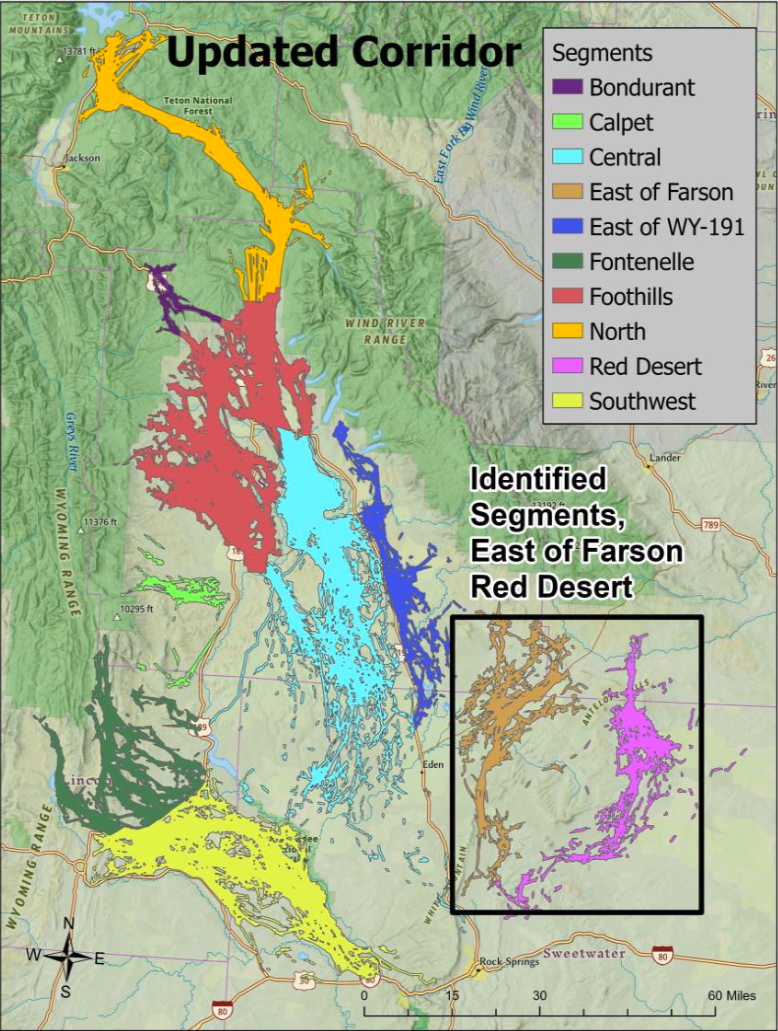
Game and Fish revived efforts to protect the migration in late 2023 and early 2024. Biologists pulled together one of North America’s most comprehensive migration datasets, benefiting from approximately two decades of GPS collar information collected from more than 400 pronghorn.
Some controversy followed the process until near the end. There was a debate about whether to designate the migration’s two easternmost segments, in the Red Desert and east of Farson. The Game and Fish Department proposed excluding the routes, but was overridden by its commission. Then Gordon upended that decision, excluding the two segments.
Vetting the migration corridor through a Gordon-appointed working group was the second-to-last step in the designation process.
“Today’s designation demonstrates that voluntary, locally driven conservation works,” said Robb Slaughter, who chaired the group, during the commemoration at Trapper’s Point.
Time will tell if that’s the case. Wyoming’s migration policy is, by design, permissive of development. Private land is exempt from protections, and designation is not an assurance that new stressors won’t be added to the landscape.

“Today is not the end of the process,” Slaughter said. “It’s the beginning of the next chapter. Continued monitoring, adaptive management, research, and cooperation will ensure these recommendations remain effective as conditions change.”
But Friday was the end of the migration designation process. The governor’s informal OK — no signature was needed — was the last step, said Sara DiRienzo, the governor’s deputy policy advisor.
Wildlife advocates celebrated the moment.
“This is historical,” Bruce said. It’s the first effort to protect the full length of a pronghorn migration corridor in the nation, she said.
Wyoming
Politicians mull action as details of alleged abuse, falsified records at Wyoming Boys’ School become public

by Maya Shimizu Harris, WyoFile
The photo of an Iraqi inmate strapped by U.S. military police to a restraint chair in the Abu Ghraib prison sparked “a collective cry of ‘torture,’” Sue Burrell, an attorney and author of a 2009 paper on restraints used at U.S. youth detention centers, recalled of a 2005 Newsweek magazine cover.
For Burrell, however, it stirred a more personal response. “All I could think of was that the restraint chair in the photo was almost exactly like the one we had recently seen in a juvenile detention facility in the United States,” she stated in the paper’s preface, which showed the Newsweek photo next to another of a restraint chair at a U.S. youth detention center.
A June court filing in an ongoing lawsuit alleging abuse at the Wyoming Boys’ School, a state facility for delinquent juveniles, almost mirrors the 2009 paper’s preface, showing two side-by-side images, one of a boy in a restraint chair with a white bag over his head and another of him huddled alone in the corner of a cinderblock room. Above the images is a quote attributed to one of the defendants: “[The] best part of the chair is watching the kids cry and scream like a fucking child . . . that’s what makes it worth it.”
“I had never thought I would see a photo of a child with a bag over their head, like they’re being water boarded,” said Rep. Karlee Provenza, a Laramie Democrat who has advocated for juvenile justice reform in Wyoming.
It’s unlikely the images — which sparked outrage on social media — would have come to light if it weren’t for the lawsuit. For years, lawmakers and advocates have grappled with the lack of transparency around the Wyoming Boys’ School specifically and the state’s juvenile justice system more broadly.
Citing confidentiality laws, the Wyoming Department of Family Services, which oversees the boys’ school, has declined to release information about abuse allegations at the facility. DFS treats allegations of abuse or mistreatment at the detention center as Child Protective Service cases. Child Protective Services and the boys’ school are both under the auspices of DFS, meaning the agency investigates itself without oversight or transparency.
“We can’t trust the government to investigate itself,” Provenza said. “We’ve seen how that falls short, so it might be that it needs to be a broader conversation and not just targeted at DFS.”
A legislative catch-22
Lawmakers — those responsible for crafting laws that regulate the state’s juvenile justice system — also struggle to access data that could help them see more broadly how Wyoming’s juvenile justice system works. That’s because Wyoming doesn’t have a statewide system. Instead, each county takes a different approach, making it difficult to collect uniform data showing how kids move through the system and what outcomes they experience.
For years, legislators have sought new laws to standardize data collection on Wyoming’s juvenile justice system and allow DFS to share it. They hoped the data would show how children move through the system and what their outcomes are, which could help lawmakers pinpoint what’s working and what needs to improve.
But fears of government overreach have stymied efforts to pass legislation that would increase transparency. Some lawmakers who opposed these measures have suggested studying the juvenile justice system more before passing any laws.
“My recommendation would be that the Legislature take some time to really put together a good dive into the juvenile justice system and all of its programs together to be able to make one clear, concise bill that fixes a plethora of problems,” Casper Republican Rep. Jayme Lien told her colleagues before voting against a measure to change Wyoming’s confidentiality statutes.
That idea puts the Legislature in a catch-22: to study the state’s juvenile justice system, lawmakers need data. But when the Joint Judiciary Committee tried to do a deep dive into juvenile justice in 2021, it quickly realized that access to that data would require a statute change.
Lien didn’t respond to a message from WyoFile sent Monday inquiring about whether she had looked into the topic and had interest in supporting any related legislation this upcoming session if reelected.
Political will?
Juvenile justice reform isn’t an interim priority for the Joint Judiciary Committee this year. “It doesn’t need any study,” Rep. Art Washut, the Casper Republican who chairs the House Judiciary Committee, said. “We know what it is, we know what the needs are. It’s just a political will to pass legislation.”
“It’s always been very frustrating, sort of circular arguments that we haven’t done this, so we can’t do that,” Donna Sheen, the former executive director of the Wyoming Children’s Law Center, said. “But the bottom line is that we continue to leave children in really harmful places.”
When it comes to how children are treated at juvenile facilities, Wyoming’s current regulations are “pretty minimal,” Sheen said, and don’t differentiate between facility types. “So in that respect, there are very minimal expectations or rules around how children can be treated.”
Through materials provided in discovery, including depositions — testimony given under oath — images and records, the lawsuit against the boys’ school provides a window into what a child might experience at the facility. Besides providing images, the latest response in the case also includes new allegations that boys’ school employees were encouraged to downplay the use of force against residents in incident reports.
“In light of what’s coming out from this lawsuit, it is clear that we need to make changes,” Provenza, the Laramie Democrat, said in a phone call.
What those changes might look like is unclear right now. “I think everyone is digesting what’s coming out from the lawsuit, and then trying to figure out: What are the policies that need to change within the agency? What are the guardrails that the state needs to put in place to protect kids?”
Provenza said over text that she’s “hopeful” other lawmakers “will see the need for statute changes” and will also be willing to work on juvenile justice reforms come the next legislative session.
More broadly, Provenza said she would also prioritize putting a version of past confidentiality amendment bills into statute. “Without that change in statute, we are going to have a difficult time evaluating any program effectiveness,” she said in a follow-up text message.
Governor, candidates react
Gov. Mark Gordon, who appointed DFS director Korin Schmidt, declined to comment on the specifics of the case when asked by WyoFile if he thinks Wyoming should have stronger guardrails on the use of solitary confinement and force against children in state custody and if the lawsuit’s allegations call for an independent review of the boys’ school and DFS’ oversight of the facility.
“Building upon the commitment I witnessed firsthand during my mental health town hall and visit to the Wyoming Boys School in 2023, the safety and security of the students and staff at the facility are paramount to me,” he said.
The governor said that he had been “in direct contact” with Schmidt, who “verified and assured” him that “the youth currently residing at the school are safe and receiving proper care.” He also mentioned that most of these allegations “were made roughly four years ago.” In 2022, WyoFile and the Casper Star-Tribune reported that the use of force, restraints and confined isolation had increased at the boys’ school.

Gordon will finish his final term as governor in November. There are four Republicans and a Democrat vying to replace him. WyoFile posed the same questions to these candidates.
“Wyoming needs a juvenile justice system that protects communities, holds offenders accountable, and ensures children in state custody are treated humanely, safely, and with appropriate guardrails that focus on rehabilitation,” State Superintendent of Public Instruction Megan Degenfelder, a Republican running for governor, said in a statement to WyoFile.
“I take these allegations seriously, children in state custody are the responsibility of the State of Wyoming.”
If elected, Degenfelder said she would “support an independent review” of the boys’ school, including its use-of-force policies, isolation practices, staff training, reporting and transparency for lawmakers and the public.
Republican gubernatorial candidate Brent Bien also said in a statement to WyoFile that he would support an independent review of the allegations. “These are minor children in state custody. As such, the state does have a duty to not only maintain order, but to also ensure accountability while still protecting that child.”
“Though I can not prejudge a lawsuit, as Governor, I would not ignore any allegations that involve excessive force, isolation, ‘restraint chairs,’ or any other actions that may harm children in state custody.”
Wyoming, he said, should have “clear guardrails” for juveniles in state custody. If elected, he would support legislation requiring reporting, “body/video records,” limits on isolation and restraints, trauma-informed training and regular oversight of “all juvenile facilities.” Bien said those measures should include “strong consequences” for violations.
“The recent allegations about the Wyoming Boys’ School are deeply concerning,” Sen. Eric Barlow, a Gillette Republican who served as Speaker of the House, said in a statement to WyoFile. “Every young person in the state’s care deserves to be safe and treated with dignity. Wyoming families want their kids close to home, getting help and support.”
In 2025, Barlow voted in favor of Senate File 157, “Department of family services-confidentiality amendments-2,” one of many attempts over the last couple of years to improve juvenile justice data sharing, before it died in the House Judiciary Committee.
Republican candidate Curt Blake did not respond to WyoFile by publishing time.
The state defendants in the boys’ school lawsuit have until Friday to file their reply supporting their request for summary judgement — when a court decides a matter before a case goes to trial.
This article was originally published by WyoFile and is republished here with permission. WyoFile is an independent nonprofit news organization focused on Wyoming people, places and policy.
Related
-

 Los Angeles, Ca1 hour ago
About 20 detained after armed suspect call sparks LAPD response in Koreatown
-

 Detroit, MI1 hour ago
With Jack Flaherty returning, AJ Hinch ponders Tigers’ starting rotation
-
 San Francisco, CA2 hours ago
Serving up a slice of Palestine at Old Jerusalem in the Mission District
-

 Dallas, TX2 hours ago
All-day restaurant and patio coming to Dallas’ Knox and more top stories
-

 Miami, FL2 hours ago
Bugtopia takes center stage at Zoo Miami
-

 Boston, MA2 hours ago
What JJ Peterka Will Add to the Bruins’ Roster, ‘He’s Got an Elite Shot’ | Boston Bruins
-

 Denver, CO2 hours ago
This Boulder farm dinner serves up midsummer Slavic vibes with James Beard-worthy fare
-

 Videos2 hours ago
Destruction in Venezuela after deadly earthquakes | BBC News

