Wyoming
Grizzlies killed record high number of cattle in Wyoming, 2024 data shows – WyoFile


Every year is a conflict-prone year for the scores of cattle and grizzly bears that mix annually on Union Pass, but Coke Landers was especially glad to put 2024 behind him.
The run-ins started shortly after the historic Green River Drift delivered many thousands of cattle to the national forest to fatten up over the summer. By the time ranchers herded the domestic bovids off the vast 267-square-mile Upper Green River grazing allotment on the Bridger-Teton National Forest in the fall, some 94 head of cattle were confirmed to have been killed by large carnivores, he said.
“Ninety-one of them were bears and three were wolves,” said Landers, who took the reins of the Upper Green River Cattlemen’s Association from former president Albert Sommers a few years ago.
“That was the highest ever,” Landers said. “It was a record.”
That’s especially notable considering that the Upper Green has been the Greater Yellowstone Ecosystem’s epicenter of grizzly-cattle conflict over the last couple of decades. It’s also been the site of a not-yet completely resolved legal battle about that conflict, stemming from a federal assessment that OK’d killing up to 72 Endangered Species Act-protected grizzlies due to cattle grazing on public land.
Across grizzly range in the Equality State, it was a tough year for not only bruins killing cattle but for conflict generally. Grizzlies, in turn, were killed at record rates.
The phenomenon was partially explained by the dry year, which 2024 certainly was: More than 800,000 acres in Wyoming burned. The result is desiccated vegetation and sparse berry crops that send the adaptable omnivores looking for alternative food sources. Oftentimes, they end up finding trouble instead.
Wyoming Game and Fish Department officials ran through the numbers and nature of the conflicts during their commission meeting last week in Cody.
“They’re occurring on private lands, the majority of these conflicts,” said Brian Debolt, the large carnivore conflict coordinator for Game and Fish.
Grizzly bears have stopped expanding their range in the Greater Yellowstone Ecosystem, federal biologists say. Nevertheless, much of where they occur today is outside of what Wyoming officials believe to be “suitable habitat.”
“The amount of private land occupied by grizzly bears in the Yellowstone ecosystem — outside of suitable habitat — is bigger than the area of New Jersey,” Debolt said. “Frankly, I get frustrated.”
A graph Debolt presented showed that upwards of 60% of all verified grizzly conflicts in 2024 occurred on private property.

Another graph broke down the cause of the conflict. Cattle dominated with 188 of 242 — a whopping 78% — of all confirmed Wyoming grizzly bear conflicts attributed to domestic bovids in 2024. In order, the next largest conflict sources were pet food, livestock feed and birdseed (13 conflicts) and property damage (11 conflicts).
Grizzlies also killed a record number of Wyoming cattle, Game and Fish Large Carnivore Supervisor Dan Thompson told WyoFile.
“It’s definitely our highest level of conflict,” Thompson said. “There’s this notion that nobody’s doing anything about it. That’s not true. Those producers are doing as much as they can to reduce that conflict potential — as are we.”
About half of Wyoming’s grizzly depredations in 2024 occurred in the Upper Green. Four grizzlies there were captured and killed in response, Thompson said.

There’s been mixed results from efforts to stem the grizzly bear-cattle bloodshed on the massive Bridger-Teton National Forest allotment. Nearly a decade ago, range riders attempted an experimental herding technique to keep cattle bunched up and less vulnerable.
“The herding actually made the kills worse,” Landers said.
More recently, the Upper Green River Cattlemen’s Association tested out motion-triggered LED lights known as “flasher tags” that were fastened to calves’ ears.
“I put 250 in, and I didn’t have any calves killed with a flasher tag that year,” Landers said. “But when I pulled the flasher tags in the fall, of the 250, there were only 10 of them that were still working.”

Wyoming secured, but then lost, a federal grant that was going to allow Upper Green cattlemen to scale up the effort with more durable flasher tags, according to Thompson. He didn’t specify exactly what happened to the grant, which went away during a period of extreme turmoil for the federal workforce and grants provided by the federal government under the Trump administration.
“There’s a lot of unknowns right now, let’s put it that way,” Thompson said. “But we still figured out a way to do a pilot component to look at some of these things. We’re still moving forward.”
A new prototype of the tags, Landers said, went out on 14 calves during the 2024 grazing season.
“One of my calves with a flasher tag got killed,” Landers said, “but all of those flasher tags were working when they came home.”
In 2025, they’re going to try another design again, just not in big numbers, he said.

A few months out from the Bridger-Teton grazing season, Landers is encouraged by the relatively big snow year in the region. Snowpack readings in the Upper Green River drainage were sitting at 110% of the long-term median as of Tuesday, but a SNOTEL site up in the allotment was at 127%.
“We should have plenty of moisture and hopefully not as dry of a summer,” Landers said. “A better berry crop does make a difference.”
If an easy conflict year doesn’t come to fruition, the status quo will have to do. Although there’s plenty of carnage, the system is one that the Upper Green River Cattlemen’s Association president says is working.
“The way our cattle association has been living with the bears and the wolves — and with our state’s compensation program — is a pretty good success story,” Landers said. “Honestly, we’re living together. We’re not always getting along, but we’re living together and we’re getting it done.”
Grizzlies in Wyoming and throughout the Lower 48 continue to be managed as “threatened” under the Endangered Species Act. A Biden-era proposal to extend that classification, which precludes grizzly bear hunting, is open to public comments through May 16.


CHEYENNE, Wyo. — Wyoming is a state known for cowboys, rodeos, and beautiful plains, but is also known for being the first territory to grant women the right to vote, something historian Jennifer Helton explored in her Suffrage Stories presentation.
Helton was invited to highlight Wyoming’s remarkable role in the fight for women’s suffrage as part of the museum’s special America 250 Discover & Discuss series on Jun 18, but the recorded version was just released. This is a part of Cheyenne Frontier Days Old West Museum’s goal of exploring Cheyenne and the greater state of Wyoming’s history.
Helton’s presentation not only celebrates Wyoming’s role in suffrage, but also how the state’s pioneering women helped shape the future of voting rights across the nation.
Born and raised in Wyoming, Jennifer Helton left the state at age 18 to attend college, “which left a giant, Wyoming-sized hole in my heart,” Helton said, “and the way that I fill that hole is by conducting research on women’s suffrage.”
Upon realizing that most people outside of the state of Wyoming did not know the West’s progressive role in suffrage, she became obsessed with bridging this knowledge gap and researching the history of suffrage.
“My kids would tell you it’s an obsession, not just an interest or a hobby,” Helton said. “They always joke that I have three kids, the two of them and then Esther Morris.”
During her presentation, Helton’s admiration for Esther Morris was apparent due to her trailblazing nature as suffragist, her courage to stand up to torch-bearing mobs, and abolitionist activities.
Interestingly enough, her sons were also instrumental in shaping Wyoming’s history. E.A. Slack is known as the “Father of Frontier Days” and citizens of Wyoming can thank Robert C. Morris for Cheyenne’s public library, as he brought the Carnegie Public Library System to Wyoming.
.
” data-large-file=”https://i0.wp.com/capcity.news/wp-content/uploads/2026/06/image-2.png?fit=780%2C863&ssl=1″ alt=”” class=”wp-image-170117″ style=”aspect-ratio:0.90332473687879;width:464px;height:auto” srcset=”https://i0.wp.com/capcity.news/wp-content/uploads/2026/06/image-2.png?resize=925%2C1024&ssl=1 925w, https://i0.wp.com/capcity.news/wp-content/uploads/2026/06/image-2.png?resize=271%2C300&ssl=1 271w, https://i0.wp.com/capcity.news/wp-content/uploads/2026/06/image-2.png?resize=768%2C850&ssl=1 768w, https://i0.wp.com/capcity.news/wp-content/uploads/2026/06/image-2.png?resize=780%2C864&ssl=1 780w, https://i0.wp.com/capcity.news/wp-content/uploads/2026/06/image-2.png?resize=400%2C443&ssl=1 400w, https://i0.wp.com/capcity.news/wp-content/uploads/2026/06/image-2.png?resize=706%2C782&ssl=1 706w, https://i0.wp.com/capcity.news/wp-content/uploads/2026/06/image-2.png?w=960&ssl=1 960w, https://i0.wp.com/capcity.news/wp-content/uploads/2026/06/image-2-925×1024.png?w=370&ssl=1 370w” sizes=”auto, (max-width: 780px) 100vw, 780px”/><figcaption class=) Photo of Esther Morris, the first female justice of the peace (Cheyenne Frontier Days Old West Museum). Credit: Cheyenne Frontier Days Old West Museum (Jennifer Helton Presentation) / Cheyenne Frontier Days Old West Museum
Photo of Esther Morris, the first female justice of the peace (Cheyenne Frontier Days Old West Museum). Credit: Cheyenne Frontier Days Old West Museum (Jennifer Helton Presentation) / Cheyenne Frontier Days Old West Museum
Throughout the course of her presentation, Helton revealed the results of her research by tracing the course of American history in order to highlight the intersection between Wyoming, women, and winning the right to vote.
The talk also highlighted incredible Black women such as Lucy Phillips and Nancy Phillips, some of the first Black women to vote.
As America celebrates its 250th anniversary, the museum invites visitors to explore the stories of trailblazers like the nation’s first woman justice of the peace Esther Morris, the first woman governor, the first Black women to vote, and many other extraordinary leaders who made history.
The museum is hosting its special America 250 exhibit and allows visitors to discover the stories, artifacts, and moments that connect the community to the nation’s history. The exhibit even features six U.S. presidents who visited Cheyenne or Cheyenne Frontier Days, and is currently running at the museum. For those who cannot attend, lectures such as this are filmed and provided online.
As Helton closed her lecture, she read the words of Esther Morris, “I say do all the good you can while you do live.”
“Because women like Esther Morris, like Theresa Jenkins, had the courage to stand up and do all the good that they could in their lives we are all able to live the lives that we are living today,” Helton said.
“So, we should be grateful to them, and I think we should also be asking ourselves what is it that we need to be doing so that future generations can preserve the same opportunities we have, and perhaps more.”
Watch Jennifer Helton’s full presentation at the link provided here.
To learn more about historian Jennifer Helton visit jenniferhelton.org.
.
” data-large-file=”https://i0.wp.com/capcity.news/wp-content/uploads/2026/06/image-3.png?fit=780%2C519&ssl=1″ alt=”” class=”wp-image-170141″ srcset=”https://i0.wp.com/capcity.news/wp-content/uploads/2026/06/image-3.png?resize=1024%2C681&ssl=1 1024w, https://i0.wp.com/capcity.news/wp-content/uploads/2026/06/image-3.png?resize=300%2C200&ssl=1 300w, https://i0.wp.com/capcity.news/wp-content/uploads/2026/06/image-3.png?resize=768%2C511&ssl=1 768w, https://i0.wp.com/capcity.news/wp-content/uploads/2026/06/image-3.png?resize=1536%2C1022&ssl=1 1536w, https://i0.wp.com/capcity.news/wp-content/uploads/2026/06/image-3.png?resize=1200%2C799&ssl=1 1200w, https://i0.wp.com/capcity.news/wp-content/uploads/2026/06/image-3.png?resize=780%2C519&ssl=1 780w, https://i0.wp.com/capcity.news/wp-content/uploads/2026/06/image-3.png?resize=400%2C266&ssl=1 400w, https://i0.wp.com/capcity.news/wp-content/uploads/2026/06/image-3.png?resize=706%2C470&ssl=1 706w, https://i0.wp.com/capcity.news/wp-content/uploads/2026/06/image-3.png?w=1605&ssl=1 1605w, https://i0.wp.com/capcity.news/wp-content/uploads/2026/06/image-3-1024×681.png?w=370&ssl=1 370w” sizes=”auto, (max-width: 780px) 100vw, 780px”/><figcaption class=) Jennifer Helton’s information (Cheyenne Frontier Days Old West Museum).
Jennifer Helton’s information (Cheyenne Frontier Days Old West Museum).
Related
Wyoming
At 6,000-year-old crossing, Gov. Gordon OKs Wyoming’s first-ever designated pronghorn migration route – WyoFile

SUBLETTE COUNTY—Gov. Mark Gordon heralded Wyoming’s first-ever designation to protect a pronghorn migration corridor — a more than 2 million-acre web of habitat — at Trapper’s Point, which he called a “wonderful passageway.”
“How incredibly valuable it is that you are standing here today,” Gordon told the crowd, “to witness this remarkable moment.”
Gordon commemorated the moment with his feet planted on the narrow bulge of high country that splits the Green and New Fork rivers. Thousands of years ago, the site was a well-used hunting ground for Native Americans — it’s the earliest known killing and processing site for pronghorn in North America. Now it boasts a wildlife overpass.
No pronghorn were to be seen during the especially windy Friday afternoon gathering, which attracted 75 attendees from nearby Pinedale and other western Wyoming communities.
Now Trapper’s Point is officially classified as a “bottleneck” for the Sublette Pronghorn Herd — one of 13 such bottlenecks. That classification is supposed to prevent any surface-disturbing activity, with the intent that pronghorn can keep passing through Trapper’s Point for generations to come.

Protecting the ability of the fleet-footed, tawny-and-white ungulates to migrate is a “key factor” in sustaining their population, Wyoming Game and Fish Director Angi Bruce said.
“This becomes even more important in severe winters or extreme droughts,” Bruce said. “Pronghorn are long overdue for recognition.”
Pronghorn in Sublette, Teton, Sweetwater and Lincoln counties travel a long road — some migrate more than 200 miles to escape harsh winters, trekking south into the lower Green River Basin, a semi-arid sweep of sagebrush steppe between Pinedale and Rock Springs. Then in the spring, they retrace those paths, returning to summer ranges, lush with verdant vegetation, even going as far as Grand Teton National Park.
There was also a long road of bureaucracy to get to this point.
Nearly three decades of effort preceded the formal designation of the migration routes used by the Sublette Pronghorn Herd, which is the farthest-traveling and among the largest pronghorn herds in the West.
Jackson Hole biologists long knew that the valley’s pronghorn left in the winter. But details were hazy on where they went and how they got there until around the turn of the century. Using data from tracking collars, biologists like Joel Berger, Steve Cain, Hall Sawyer and Doug Brimeyer helped delineate the route.

In 2008, a Bridger-Teton National Forest plan amendment established a portion of the path as the nation’s first designated wildlife migration corridor.
Popularized by its branding as the “Path of the Pronghorn,” the route has received press in national publications like High Country News and the New York Times.
But the southern reaches of the migration through the energy-rich Green River Basin have faced major political opposition since the early 2000s. Wyoming first attempted to protect those travel corridors in 2019, under a policy administered by the Wyoming Game and Fish Department. That effort was halted after a coalition of industry trade groups and counties protested.
Then, in early 2020, Gordon revamped the migration policy with an executive order. Still, the Sublette Pronghorn Herd proposal gathered dust, even as development threatened the route.
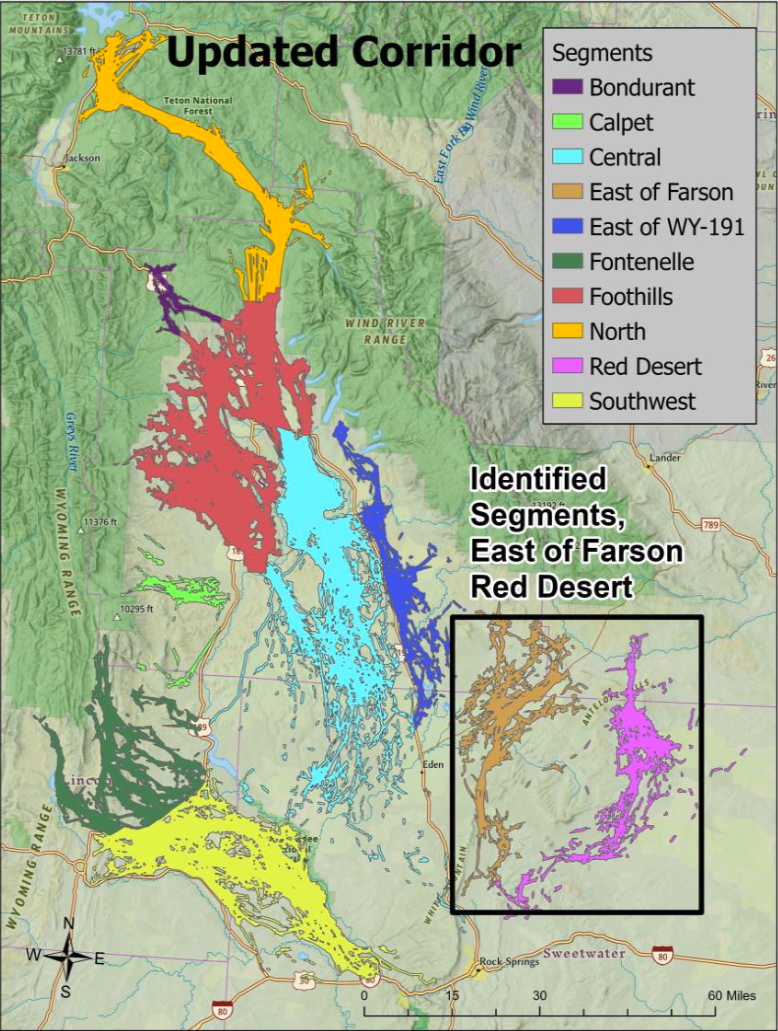
Game and Fish revived efforts to protect the migration in late 2023 and early 2024. Biologists pulled together one of North America’s most comprehensive migration datasets, benefiting from approximately two decades of GPS collar information collected from more than 400 pronghorn.
Some controversy followed the process until near the end. There was a debate about whether to designate the migration’s two easternmost segments, in the Red Desert and east of Farson. The Game and Fish Department proposed excluding the routes, but was overridden by its commission. Then Gordon upended that decision, excluding the two segments.
Vetting the migration corridor through a Gordon-appointed working group was the second-to-last step in the designation process.
“Today’s designation demonstrates that voluntary, locally driven conservation works,” said Robb Slaughter, who chaired the group, during the commemoration at Trapper’s Point.
Time will tell if that’s the case. Wyoming’s migration policy is, by design, permissive of development. Private land is exempt from protections, and designation is not an assurance that new stressors won’t be added to the landscape.

“Today is not the end of the process,” Slaughter said. “It’s the beginning of the next chapter. Continued monitoring, adaptive management, research, and cooperation will ensure these recommendations remain effective as conditions change.”
But Friday was the end of the migration designation process. The governor’s informal OK — no signature was needed — was the last step, said Sara DiRienzo, the governor’s deputy policy advisor.
Wildlife advocates celebrated the moment.
“This is historical,” Bruce said. It’s the first effort to protect the full length of a pronghorn migration corridor in the nation, she said.
Wyoming
Politicians mull action as details of alleged abuse, falsified records at Wyoming Boys’ School become public

by Maya Shimizu Harris, WyoFile
The photo of an Iraqi inmate strapped by U.S. military police to a restraint chair in the Abu Ghraib prison sparked “a collective cry of ‘torture,’” Sue Burrell, an attorney and author of a 2009 paper on restraints used at U.S. youth detention centers, recalled of a 2005 Newsweek magazine cover.
For Burrell, however, it stirred a more personal response. “All I could think of was that the restraint chair in the photo was almost exactly like the one we had recently seen in a juvenile detention facility in the United States,” she stated in the paper’s preface, which showed the Newsweek photo next to another of a restraint chair at a U.S. youth detention center.
A June court filing in an ongoing lawsuit alleging abuse at the Wyoming Boys’ School, a state facility for delinquent juveniles, almost mirrors the 2009 paper’s preface, showing two side-by-side images, one of a boy in a restraint chair with a white bag over his head and another of him huddled alone in the corner of a cinderblock room. Above the images is a quote attributed to one of the defendants: “[The] best part of the chair is watching the kids cry and scream like a fucking child . . . that’s what makes it worth it.”
“I had never thought I would see a photo of a child with a bag over their head, like they’re being water boarded,” said Rep. Karlee Provenza, a Laramie Democrat who has advocated for juvenile justice reform in Wyoming.
It’s unlikely the images — which sparked outrage on social media — would have come to light if it weren’t for the lawsuit. For years, lawmakers and advocates have grappled with the lack of transparency around the Wyoming Boys’ School specifically and the state’s juvenile justice system more broadly.
Citing confidentiality laws, the Wyoming Department of Family Services, which oversees the boys’ school, has declined to release information about abuse allegations at the facility. DFS treats allegations of abuse or mistreatment at the detention center as Child Protective Service cases. Child Protective Services and the boys’ school are both under the auspices of DFS, meaning the agency investigates itself without oversight or transparency.
“We can’t trust the government to investigate itself,” Provenza said. “We’ve seen how that falls short, so it might be that it needs to be a broader conversation and not just targeted at DFS.”
A legislative catch-22
Lawmakers — those responsible for crafting laws that regulate the state’s juvenile justice system — also struggle to access data that could help them see more broadly how Wyoming’s juvenile justice system works. That’s because Wyoming doesn’t have a statewide system. Instead, each county takes a different approach, making it difficult to collect uniform data showing how kids move through the system and what outcomes they experience.
For years, legislators have sought new laws to standardize data collection on Wyoming’s juvenile justice system and allow DFS to share it. They hoped the data would show how children move through the system and what their outcomes are, which could help lawmakers pinpoint what’s working and what needs to improve.
But fears of government overreach have stymied efforts to pass legislation that would increase transparency. Some lawmakers who opposed these measures have suggested studying the juvenile justice system more before passing any laws.

“My recommendation would be that the Legislature take some time to really put together a good dive into the juvenile justice system and all of its programs together to be able to make one clear, concise bill that fixes a plethora of problems,” Casper Republican Rep. Jayme Lien told her colleagues before voting against a measure to change Wyoming’s confidentiality statutes.
That idea puts the Legislature in a catch-22: to study the state’s juvenile justice system, lawmakers need data. But when the Joint Judiciary Committee tried to do a deep dive into juvenile justice in 2021, it quickly realized that access to that data would require a statute change.
Lien didn’t respond to a message from WyoFile sent Monday inquiring about whether she had looked into the topic and had interest in supporting any related legislation this upcoming session if reelected.
Political will?
Juvenile justice reform isn’t an interim priority for the Joint Judiciary Committee this year. “It doesn’t need any study,” Rep. Art Washut, the Casper Republican who chairs the House Judiciary Committee, said. “We know what it is, we know what the needs are. It’s just a political will to pass legislation.”
“It’s always been very frustrating, sort of circular arguments that we haven’t done this, so we can’t do that,” Donna Sheen, the former executive director of the Wyoming Children’s Law Center, said. “But the bottom line is that we continue to leave children in really harmful places.”
When it comes to how children are treated at juvenile facilities, Wyoming’s current regulations are “pretty minimal,” Sheen said, and don’t differentiate between facility types. “So in that respect, there are very minimal expectations or rules around how children can be treated.”
Through materials provided in discovery, including depositions — testimony given under oath — images and records, the lawsuit against the boys’ school provides a window into what a child might experience at the facility. Besides providing images, the latest response in the case also includes new allegations that boys’ school employees were encouraged to downplay the use of force against residents in incident reports.
“In light of what’s coming out from this lawsuit, it is clear that we need to make changes,” Provenza, the Laramie Democrat, said in a phone call.
What those changes might look like is unclear right now. “I think everyone is digesting what’s coming out from the lawsuit, and then trying to figure out: What are the policies that need to change within the agency? What are the guardrails that the state needs to put in place to protect kids?”
Provenza said over text that she’s “hopeful” other lawmakers “will see the need for statute changes” and will also be willing to work on juvenile justice reforms come the next legislative session.
More broadly, Provenza said she would also prioritize putting a version of past confidentiality amendment bills into statute. “Without that change in statute, we are going to have a difficult time evaluating any program effectiveness,” she said in a follow-up text message.
Governor, candidates react
Gov. Mark Gordon, who appointed DFS director Korin Schmidt, declined to comment on the specifics of the case when asked by WyoFile if he thinks Wyoming should have stronger guardrails on the use of solitary confinement and force against children in state custody and if the lawsuit’s allegations call for an independent review of the boys’ school and DFS’ oversight of the facility.
“Building upon the commitment I witnessed firsthand during my mental health town hall and visit to the Wyoming Boys School in 2023, the safety and security of the students and staff at the facility are paramount to me,” he said.
The governor said that he had been “in direct contact” with Schmidt, who “verified and assured” him that “the youth currently residing at the school are safe and receiving proper care.” He also mentioned that most of these allegations “were made roughly four years ago.” In 2022, WyoFile and the Casper Star-Tribune reported that the use of force, restraints and confined isolation had increased at the boys’ school.

Gordon will finish his final term as governor in November. There are four Republicans and a Democrat vying to replace him. WyoFile posed the same questions to these candidates.
“Wyoming needs a juvenile justice system that protects communities, holds offenders accountable, and ensures children in state custody are treated humanely, safely, and with appropriate guardrails that focus on rehabilitation,” State Superintendent of Public Instruction Megan Degenfelder, a Republican running for governor, said in a statement to WyoFile.
“I take these allegations seriously, children in state custody are the responsibility of the State of Wyoming.”
If elected, Degenfelder said she would “support an independent review” of the boys’ school, including its use-of-force policies, isolation practices, staff training, reporting and transparency for lawmakers and the public.
Republican gubernatorial candidate Brent Bien also said in a statement to WyoFile that he would support an independent review of the allegations. “These are minor children in state custody. As such, the state does have a duty to not only maintain order, but to also ensure accountability while still protecting that child.”
“Though I can not prejudge a lawsuit, as Governor, I would not ignore any allegations that involve excessive force, isolation, ‘restraint chairs,’ or any other actions that may harm children in state custody.”
Wyoming, he said, should have “clear guardrails” for juveniles in state custody. If elected, he would support legislation requiring reporting, “body/video records,” limits on isolation and restraints, trauma-informed training and regular oversight of “all juvenile facilities.” Bien said those measures should include “strong consequences” for violations.
“The recent allegations about the Wyoming Boys’ School are deeply concerning,” Sen. Eric Barlow, a Gillette Republican who served as Speaker of the House, said in a statement to WyoFile. “Every young person in the state’s care deserves to be safe and treated with dignity. Wyoming families want their kids close to home, getting help and support.”
In 2025, Barlow voted in favor of Senate File 157, “Department of family services-confidentiality amendments-2,” one of many attempts over the last couple of years to improve juvenile justice data sharing, before it died in the House Judiciary Committee.
Republican candidate Curt Blake did not respond to WyoFile by publishing time.
The state defendants in the boys’ school lawsuit have until Friday to file their reply supporting their request for summary judgement — when a court decides a matter before a case goes to trial.
This article was originally published by WyoFile and is republished here with permission. WyoFile is an independent nonprofit news organization focused on Wyoming people, places and policy.
Related
-

 Movie Reviews6 minutes ago
‘House of Criticism’ Review: A Pensive and Touching Portrait of Married Art Critics Jerry Saltz and Roberta Smith (It Is Only, at Moments, a True-Life Christopher Guest Movie)
-

 World18 minutes ago
Annecy Colombian Short ‘Once in a Body’: Fiction Rooted in Real Experiences
-

 Health41 minutes ago
This Protein Smoothie Trick Helps Women Over 40 Lose Twice as Much Fat
-
 Lifestyle56 minutes ago
‘Wait Wait’ for June 27, 2026: With Not My Job guest Stephen Malkmus
-

 Technology1 hour ago
Margaret Atwood says the problem with AI is ‘garbage in, garbage out’
-

 World1 hour ago
Gulf countries strongly condemn Iran’s drone attack on Bahrain as rising tensions threaten MOU
-

 Politics1 hour ago
Jeffries welcomes Democratic Socialists into the fold as critics warn party is revealing ‘exactly who it is’
-

 Health1 hour ago
These leafy greens could help protect your lungs, study suggests

