Wyoming
Former Gillette Cop Accused Of Triple Homicide Had Justified Shooting In Wyoming


The criminal affidavit pertaining to a former Wyoming police sergeant now accused of triple homicide in South Dakota alleges the man charged into his neighbor’s house and shot three young men to death after leaving home in a rage.
Jay Ostrem, 64, was a Gillette Police Department agent from 1982-2003 and retired at the rank of sergeant, Jennifer Toscana, Gillette City spokeswoman, confirmed Thursday.
He’s facing three first-degree murder charges in South Dakota, in what court documents describe as an attack on three young adult male neighbors, after Ostrem heard that one of them had made an unwanted sexual advance on his wife.
Ostrem had his first court appearance Wednesday, Dakota News Now reported.
The three victims included a 26-year-old man who’d allegedly rubbed his genitalia against Ostrem’s wife while the pair were drinking together – as Ostrem slept – in Ostrem’s home four days before the attack, according to an evidentiary affidavit filed in Turner County, South Dakota on Tuesday and sent to Cowboy State Daily on Thursday.
The other two victims included a 21-year-old man who was the first decedent’s brother, and a 35-year-old man who had a different last name from the two brothers, the affidavit says.
Neighbor Man
The wife reported to South Dakota Division of Criminal Investigation agents that the 26-year-old man was a neighbor, and that he had been over at her home while Ostrem was there sleeping on May 23.
She said the man forcibly kissed her, exposed himself to her and rubbed his genitalia against her against her wishes, the affidavit says.
When she told Ostrem about these incidents four days later, Monday, he “got up and went raging out of the house,” says the document. The wife reportedly didn’t know where he was going or if he was armed when he left. She stayed home until law enforcement arrived, she said.
The Call
The 21-year-old called 911 dispatch at about 9:44 Monday night, frantic, saying a shooting was happening at the home across from Ostrem’s, reportedly. The affidavit says the man told dispatch that his brother had been shot and killed with a shotgun.
The shooter was “a guy from across the street,” the affidavit says. The caller then said the shooter had gone back to his own home; but after some time on the phone with the dispatcher, the young man said that he, too, had been shot, reportedly.
Then the man “stopped communicating with the dispatcher,” the document says.
Shotgun Shells
A Game Fish and Parks Conservation officer responded to the home where the shooting happened, and called for backup. There he met Ostrem exiting the home through the attached garage, allegedly.
The conservation officer ordered Ostrem to stop, but Ostrem kept walking down the street. So the officer drove his vehicle that way and contacted Ostrem again near an intersection, and ordered him to get on the ground.
Ostrem complied, and let the officer know he had a gun in his pocket, the document says. An AR-style rifle allegedly lay on the ground near Ostrem. His left hand was bleeding and he reeked of alcohol, the officer reportedly observed.
Agents discovered Ostrem had a .380 handgun in his pants pocket and also had spent shotgun shell casings and at least one spent rifle casing, the affidavit says.
He was arrested.
Into The Home
Investigators entered the home where the shooting had happened and found three deceased men with apparent gunshot wounds, reportedly. They noted that Ostrem’s home is just across the street.
Use Of Force Incident
Ostrem was involved in a lethal use-of-force incident 23 years ago in Gillette, according to civil court documents, but a federal lawsuit leveled against him over it was dismissed Aug. 18, 2004. Then-U.S. District Court Judge Clarence A. Brimmer noted the use of force officers used in that incident was not found to be unreasonable.
In the early-morning hours of Nov. 3, 2001, a woman left her home to get away from her husband, Michael Owens, with whom she’d been fighting in their Gillette home, according to a civil lawsuit complaint filed in the U.S. District Court for Wyoming in 2003.
The woman’s sister reported Michael Owens to police, saying Owens was “just trying to kill her,” court documents say.
Dispatch asked Owens’ wife if Owens had a gun and she answered “yes.”
Ostrem and other Gillette police agents responded, found Owens to be driving, and followed Owens to his home. Brimmer’s order dismissing this case called it a “chase.”
One officer videotaped the events. The judge’s order says the tape “clearly reveals” the following sequence of events:
Officers ordered Owens to show his hands, as the man parked in his own driveway and rammed his pickup into the back of his garage.
Owens smashed into one of the agent’s patrol cars, then hit his garage again; then crashed into a boat seconds after one of the officers took cover behind it.
Owens then sped in reverse across the street and rammed the front door of a neighbor’s house.
Two officers (not Ostrem) were concerned for the neighbors’ safety and decided to use lethal force to stop Owens, but since they didn’t know where in the house the neighbors were, they didn’t fire.
Owens pulled forward and crashed into another car “in an apparent attempt” to hit one of the officers on scene. That officer was later found to be severely injured; he had to have two cervical discs fused, the judge’s order notes.
Then-Sgt. Ostrem saw all this and believed the officers’ lives were in danger. He ran alongside Owens’ pickup while drawing his gun; shouted commands at Owens; watched as the pickup rammed the back of the garage, and hoped Owens had knocked himself out, the order recounts.
But Owens kept driving, trying to back up again.
Ostrem emptied his entire pistol, even as Owens tried to get the truck into reverse. Owens started driving in reverse, and another officer opened fire, killing Owens.
“Our system of justice… does not deal in either sympathy or suspicion; it is built on proof,” wrote Brimmer when dismissing the case. “When the officers were threatened by Owens’ vehicle, a deadly weapon, the officers were permitted to use deadly force.”
What A Shock
Former Gillette Police Department Chief Ric Paul, who supervised Ostrem during their shared tenure, told Cowboy State Daily on Thursday that the news of Ostrem’s homicide case shocked him.
“You just can’t understand why a guy of his magnitude would do something he apparently did,” said Paul, who described Ostrem as a solid, intelligent police officer.
Though Ostrem had potentially traumatic incidents on the job, Paul said he’d insisted on Ostrem having any issues from those addressed and tracked.
“And Jay was part of those (issue briefings for the critical incidents) he was involved in,” he said.
Clair McFarland can be reached at clair@cowboystatedaily.com.



The top boys’ basketball players in Wyoming for Classes 1A and 2A were chosen for the 2026 high school season. The Wyoming Coaches Association has unveiled the all-state awards for this year, as voted on by the head coaches in the two classifications, respectively. The Wyoming Coaches Association only recognizes one team for all-state, and only these players receive an award certificate from the WCA. WyoPreps only lists all-state players as defined by the WCA.
WCA 1A-2A BOYS BASKETBALL ALL-STATE SELECTIONS IN 2026
Each class selected 14 players for all-state, reflecting a broad recognition of talent across Wyoming. Notably, congratulations go to Hulett’s Kyle Smith, Brady Cook from Lingle-Fort Laramie, and Carsten Freeburg from Pine Bluffs, who earned all-state honors for the third straight year. In addition, eight more players achieved all-state status for the second time in their prep careers.
Class 1A
Paul McNiven – Burlington
Bitner Philpott – Burlington
Ammon Hatch – Cokeville (All-State in 2025)
Hudson Himmerich – Cokeville
Kyle Smith – Hulett (All-State 2024 & 2025)
Anthony Arnusch – Lingle-Ft. Laramie
Brady Cook – Lingle-Ft. Laramie (All-State 2024 & 2025)
Tymber Cozzens – Little Snake River (All-State in 2025)
Corbin Matthews – Lusk
Max Potas – Meeteetse (All-State in 2024)
Jace Westring – Saratoga
Hazen Williams – Saratoga
TJ Moats – Southeast (All-State in 2024)
Nic Schiller – Upton
Read More Boys Basketball News from WyoPreps
WyoPreps 1A-2A State Basketball Scoreboard 2026
WyoPreps 3A-4A Regional Basketball Scoreboard 2026
WyoPreps Coaches and Media Final Basketball Poll 2026
1A-2A Boys Basketball Regional Scoreboard 2026
WyoPreps Boys Basketball Week 11 Scores 2026
WyoPreps Coaches and Media Basketball Polls 2-25-26
WyoPreps Boys Basketball Week 10 Scores 2026
WyoPreps Coaches and Media Basketball Polls 2-18-26
WyoPreps Boys Basketball Week 9 Scores 2026
WyoPreps Coaches and Media Basketball Polls 2-11-26
WyoPreps Boys Basketball Week 8 Scores 2026
WyoPreps Coaches and Media Basketball Polls 2-4-26
Class 2A
Caleb Adsit – Big Horn
Chase Garber – Big Horn
Carsten Freeburg – Pine Bluffs (All-State 2024 & 2025)
Mason Moss – Rocky Mountain
Oakley Hicks – Shoshoni
Kade Mills – Sundance
Cody Bomengen – Thermopolis (All-State in 2025)
Zak Hastie – Thermopolis
Ellis Webber – Thermopolis (All-State in 2025)
Joseph Kimbrell – Wright
Mitchell Strohschein – Wright (All-State in 2025)
Adriano Brown – Wyoming Indian
Heeyei’Niitou Monroe-Black – Wyoming Indian (All-State in 2025)
Cordell Spoonhunter – Wyoming Indian
The 2026 state champions were the Saratoga Panthers in Class 1A. They beat Lingle-Fort Laramie, 50-45, in the championship game. The 2A winners were the Thermopolis Bobcats, who repeated as champions, after a 45-38 victory over Wyoming Indian in the title game.
Lusk versus Rock River high school basketball 2026
Game action between the Tigers and Longhorns
Gallery Credit: Courtesy: Lisa Shaw

A pair of bills signed into law last week aim to build out a more comprehensive system of literacy education across Wyoming’s public schools.
One mandates evidence-based practices and requires regular screenings for dyslexia, while the other enables the Wyoming Department of Education (WDE) to hire a dedicated literacy professional to oversee statewide compliance.
Gov. Mark Gordon’s signing of both bills on Friday was the latest accomplishment of an ongoing push for improved literacy standards. That push has been spearheaded by State Superintendent of Public Instruction Megan Degenfelder.
“Wyoming is not going to let a single child fall through the cracks,” Degenfelder said during a public bill signing last week. “We are not going to fall behind when it comes to ensuring that our children can read at grade level.”
The primary bill, Senate File 59, establishes a statewide K-12 program for teaching students to read that is built on “evidence based language and literacy instruction, assessment, intervention and professional development that supports educators, engages families and promotes literacy proficiency for all Wyoming students.”
The bill defines evidence-based strategies as those that conform to the science of reading, a term that will be defined and updated by Degenfelder’s office. Nationwide, it generally means putting academic research into practice in classrooms. SF 59 specifically prohibits the exclusive use of “three-cueing” — a strategy once widely employed to teach reading but which education experts now say is outdated and less effective than other strategies.
It also requires annual dyslexia screeners for students below the third grade, and testing for reading difficulties for all students.
The screeners are used to identify the severity of reading difficulties in order to direct “tiered” support that offers the most intensive interventions to the students most in need, while still providing “evidence based” language instruction to all students.
Each school district must formulate an individualized reading plan “for each student identified as having reading difficulties or at risk for poor reading outcomes.”
Districts must now report to the state annually regarding their literacy-related work. Any district where 60% or more of the students are struggling will be required to implement “summer literacy camps or extended supports, including after school support and tutoring.”
The bill also requires literacy related professional development for teachers and specialists “appropriate to their role and level of responsibility” related to literacy education.
SF 59 was backed by dyslexia advocates and literacy specialists.
Senate File 14, the other literacy bill signed into law Friday, appropriates $120,000 annually for the next two years for a full-time position at WDE “to assist school districts in implementing a reading assessment and intervention program and language and literacy programs.”
Both bills go into effect July 1.

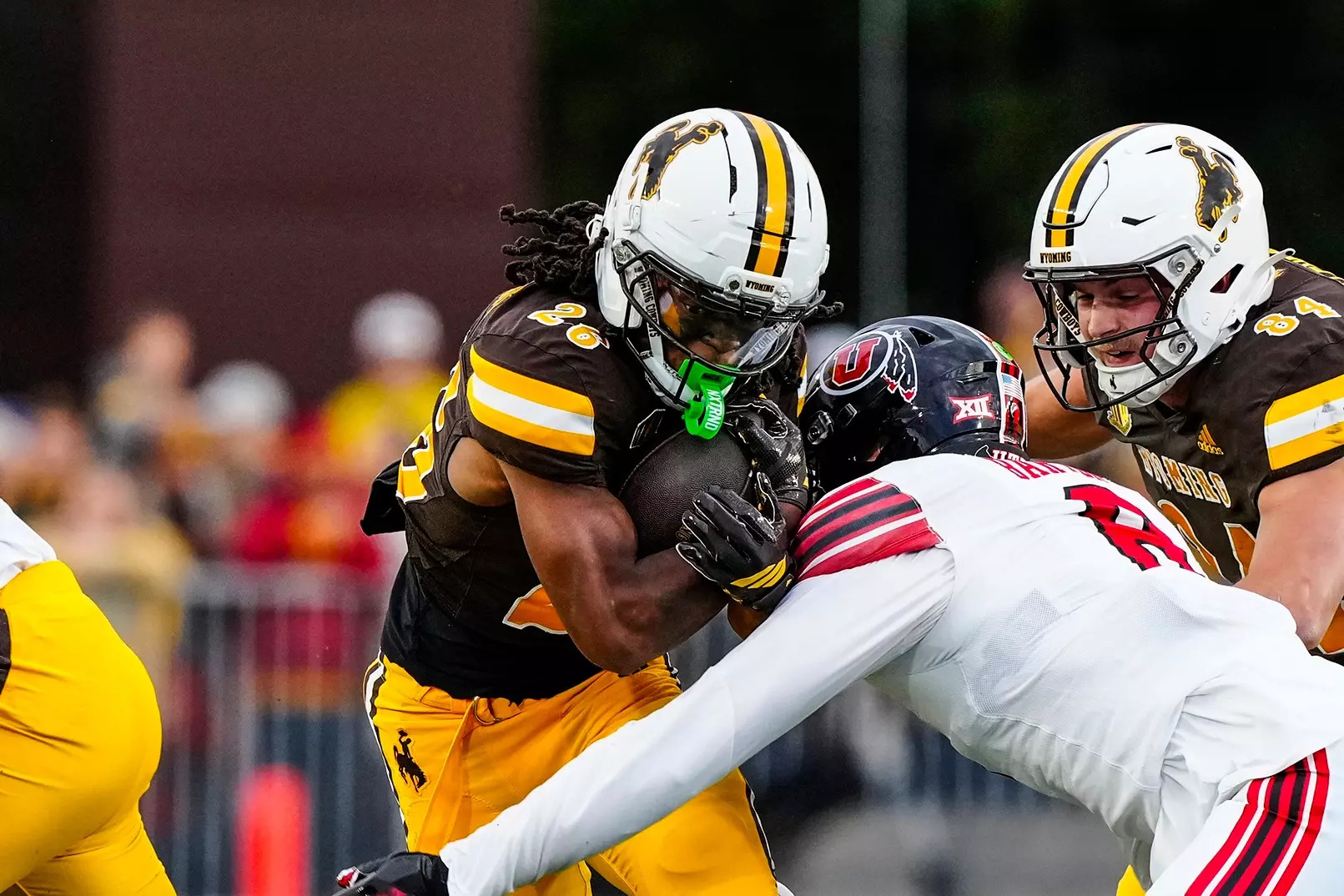
LARAMIE — The University of Wyoming and the Mountain West Conference announced the Cowboys’ 2026 football schedule Monday, a slate that opens with the Border War and concludes with back-to-back home games in Laramie.
Wyoming opens the season Sept. 5 on the road against Colorado State in the 118th edition of the Border War. The Cowboys then host Northern Colorado on Sept. 12 in the home opener before traveling to Central Michigan on Sept. 19.
The Cowboys begin Mountain West play Sept. 26 at home against Hawaii in a matchup for the Paniolo Trophy. Wyoming then faces back-to-back road games at North Dakota State on Oct. 3 and San Jose State on Oct. 10.
Advertisement – Story continues below…
University of Wyoming sports coverage
in Southwest Wyoming is supported by these great sponsors:
Wyoming returns to War Memorial Stadium on Oct. 17 to host conference newcomer Northern Illinois before facing Air Force at home on Oct. 24. The Cowboys will have an open week on Oct. 31.
The Cowboys open November with road games at UNLV on Nov. 7 and at UTEP on Nov. 14, marking Wyoming’s first meeting with the Miners as members of the Mountain West. Wyoming closes conference play by hosting New Mexico on Nov. 21 and wraps up the regular season with a nonconference game against UConn on Nov. 28 in Laramie.
Each Mountain West team will play four home and four road conference games during the 13-week season, which will conclude with the Mountain West Football Championship Game featuring the two teams with the highest conference winning percentages. The championship game date will be announced later.
With the conference schedule set, Mountain West television partners CBS Sports, FOX Sports, and The CW will begin selecting broadcast games, which could include moving some contests to non-Saturday dates. Network assignments and kickoff times will be announced at a later date.
Season ticket renewals for the 2026 Wyoming football season are now available. Fans can renew their tickets online by visiting gowyo.com/tickets and logging into their account.

Forest Home Avenue construction to resume in Milwaukee County

Metro Atlanta gas prices surge ahead of spring break, leaving drivers stunned

Minnesota snow causing slick spots on roads

FBI arrests suspect at Indianapolis International Airport

How Pittsburgh area drivers can save money on gas as prices rise during the war with Iran

Florida High School Football Rankings: Top 25 teams – Oct. 21

Cleary's 21 help Le Moyne down Central Connecticut State 69-64 in OT

How old is Bo Nix? What to know about Oregon quarterback ahead of 2024 NFL Draft

99th annual Pony Swim held in Virginia

Indiana Members Credit Union announced as new anchor tenant at Bottleworks District

EXCLUSIVE: ICE says El Paso detention facility will stay open under new contractor after $1.2B deal scrapped

Von der Leyen ‘acting outside of competence,’ Araud tells Euronews

Wheelchair curler Steve Emt’s path from drunk driver to three-time Paralympian

Map: 2.3-Magnitude Earthquake Reported North of New York City

Trump stirs GOP primary drama with visit to Massie’s Kentucky home turf
-

 Wisconsin1 week ago
Setting sail on iceboats across a frozen lake in Wisconsin
-

 Massachusetts1 week ago
Massachusetts man awaits word from family in Iran after attacks
-

 Pennsylvania6 days ago
Pa. man found guilty of raping teen girl who he took to Mexico
-

 Detroit, MI5 days ago
U.S. Postal Service could run out of money within a year
-

 Miami, FL7 days ago
City of Miami celebrates reopening of Flagler Street as part of beautification project
-

 Sports6 days ago
Keith Olbermann under fire for calling Lou Holtz a ‘scumbag’ after legendary coach’s death
-

 Virginia7 days ago
Giants will hold 2026 training camp in West Virginia
-

 Culture1 week ago
Try This Quiz on the Real Locations in These Magical and Mysterious Novels