Connect with us

Wyoming

Bertagnole, defensive line ready for second-half push for Wyoming

Published

on

Bertagnole, defensive line ready for second-half push for Wyoming


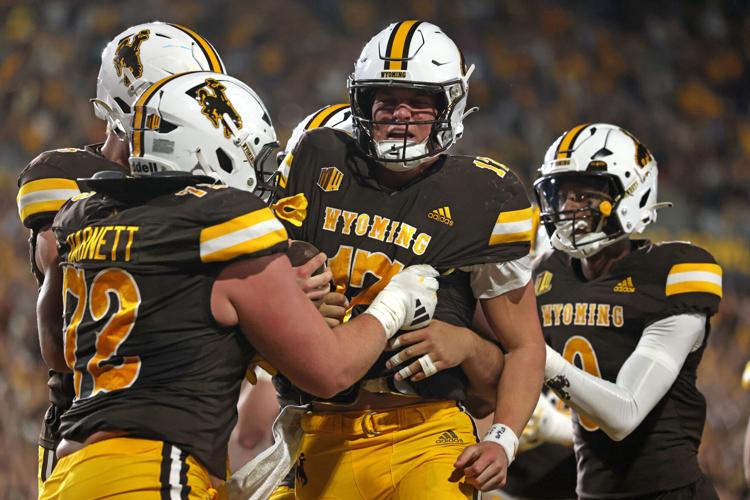
LARAMIE — As a captain and one of the true leaders of the Wyoming defense, defensive tackle Jordan Bertagnole will be the first to tell you his unit’s play has not been up to par through the first five games.

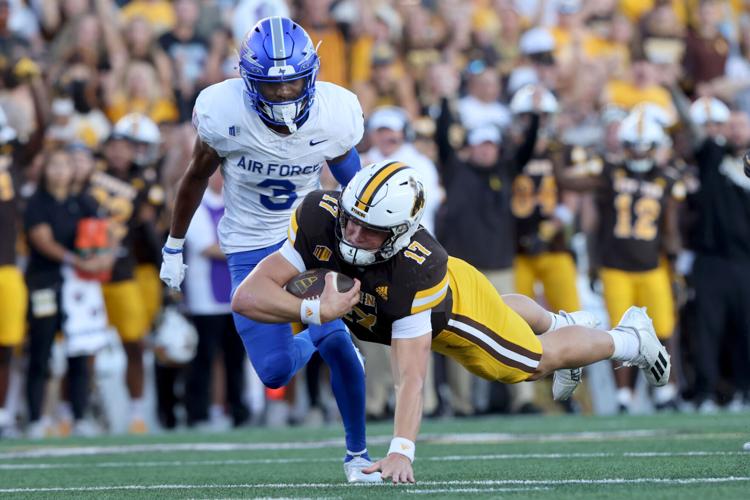
That admitted, Bertagnole will also warn you to prepare for a quick turnaround. The senior leader and Casper native was pleased with the defense’s performance against Air Force and sees only more success on the horizon.

Next on the docket for the Cowboys is a Mountain West home game against San Diego State on Saturday.

“I feel like we’ve definitely gotten better. We didn’t start out how we wanted to in the non-conference play,” Bertagnole said. “We really didn’t live up to our standard and our expectations. I feel like going into this game and building off Air Force, is something we’re looking forward to.”

Advertisement

People are also reading…


Advertisement


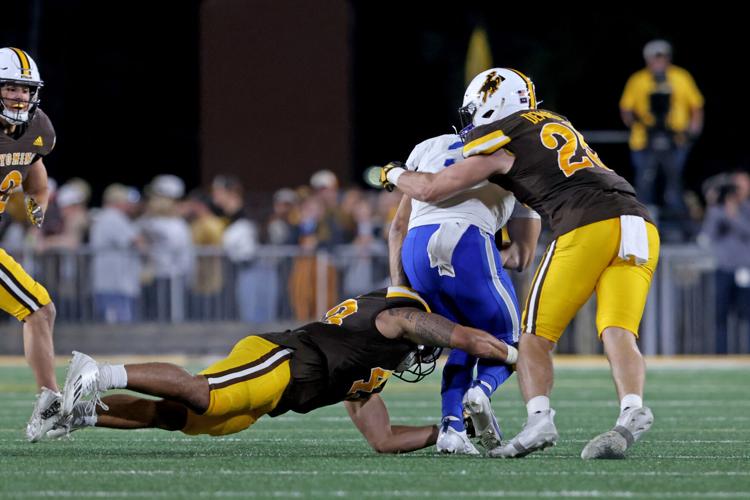
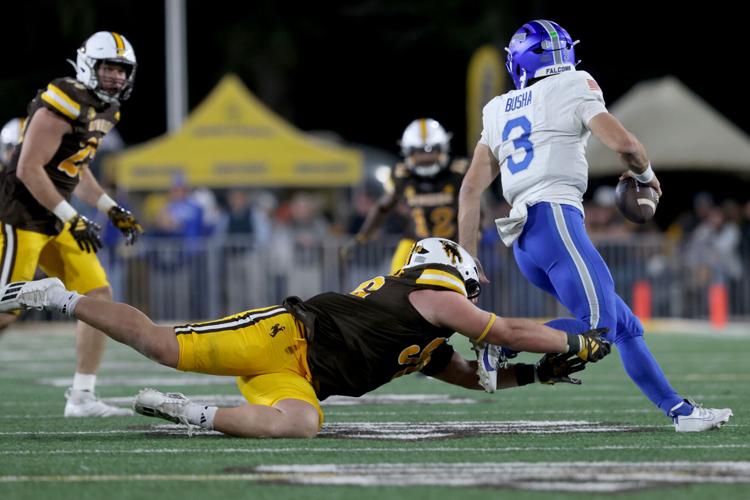
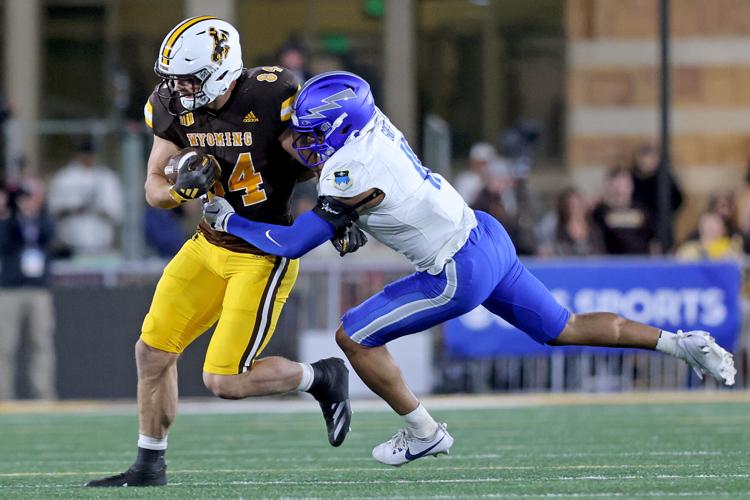
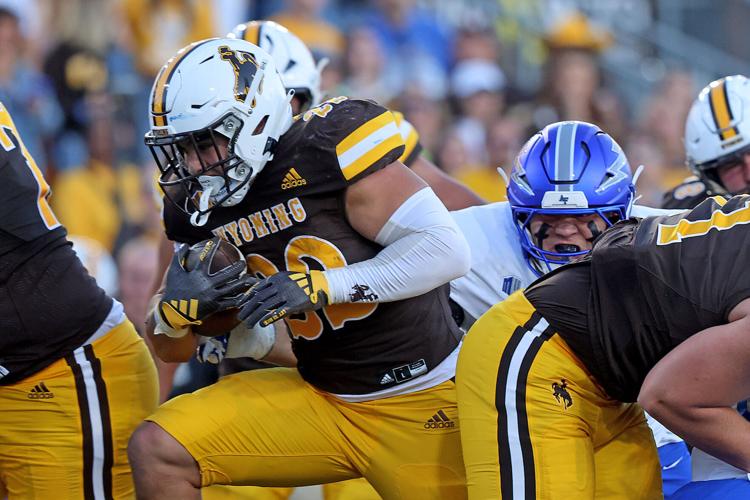
Wyoming defensive tackle Jordan Bertagnole trips up Air Force quarterback John Busha in the second half of the Cowboys’ 31-19 victory over the Falcons on Sept. 28 at War Memorial Stadium in Laramie.

Advertisement


Andrew Towne


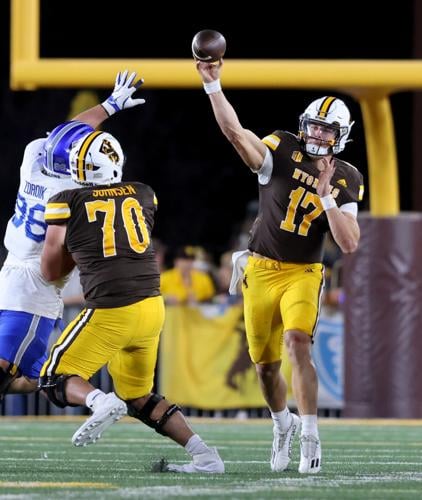
Against three Big 12 foes and a strong FCS squad in Idaho, Wyoming’s defense was found wanting. Through those four games, UW ranked among 115th in the nation in total defense, allowing 429 yards per game.

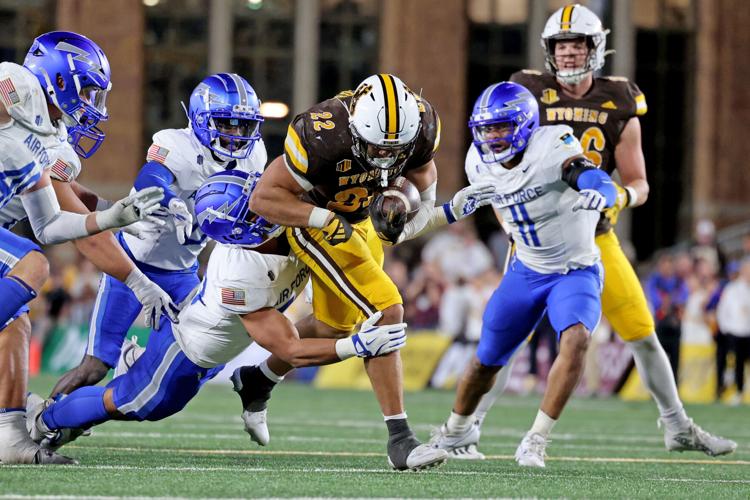
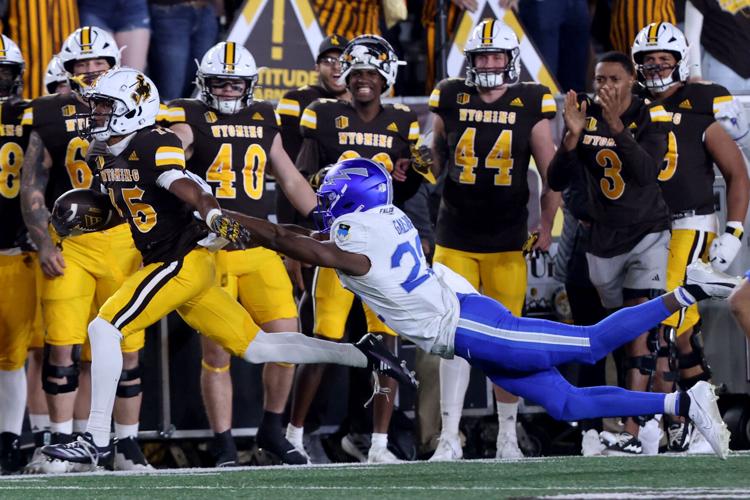
The Pokes rebounded in their return home against Air Force and its triple option. UW limited the Falcons to 320 total yards. That number may have been 70 yards better had Bertagnole not been flagged for an unsportsmanlike conduct penalty, which erased a punting situation and enabled the Falcons to continue their drive with a fresh set of downs.

Advertisement

A large part of the Pokes’ defensive success against the Falcons was owed to the players in the interior of the defensive line, a group that includes Bertagnole, Ben Florentine, Dante Drake and Jaden Williams. Those four combined for 13 tackles, one tackle for loss and a half sack. Bertagnole himself finished with five tackles and the half sack. The interior players did an excellent job of maintaining their gaps and pursuing the football. Those two areas were lacking in the four losses in the non-conference slate and Bertagnole said it is a point of emphasis at practice.

“Ball key is an emphasis every single day at practice because obviously we don’t want to give (opponents) cheap stuff that’s just us being undisciplined,” he said. “So focusing on that, but then running to the ball is huge. If you have everybody running to the ball, guys are going to miss tackles during a play every now and then, and if you have guys running to the ball, then somebody doesn’t break a tackle and get an extra 20 yards. … Effort and energy is a big emphasis with the d-line.”

Looking at the Pro Football Focus grades through five games, the numbers tell a story of necessary improvement.

Bertagnole, coming off a second-team All-Conference award, has earned a 70.4 run grade, but just a 52.6 pass rush grade on a scale of 0 to 100. Florentine, the Pokes’ other starter inside, currently has a 63.7 grade against the run and 51.0 grade in pass rush while Drake has earned a 59.4 run grade and 54.5 pass rush grade. Jayden Williams has been graded out the best, but has just 83 total snaps. His numbers sit at 72.9 versus the run and 53.8 for pass rush.


Advertisement


Cowboys fall to BYU

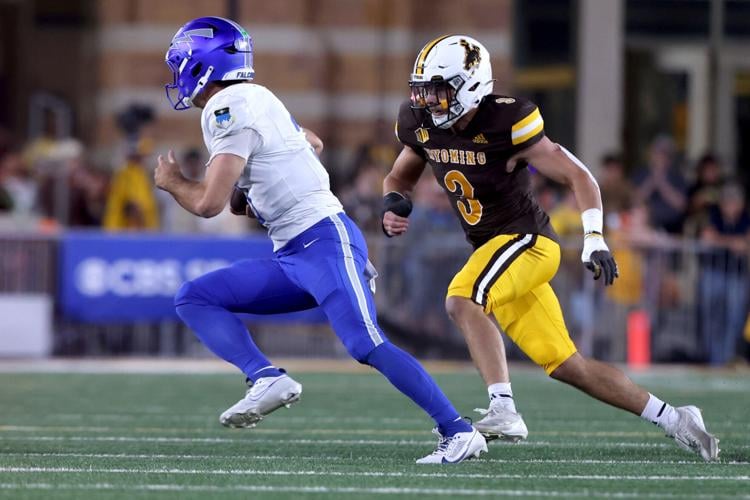
Wyoming linebacker Shae Suiaunoa chases down BYU quarterback Jake Retzlaff during their game Sept. 14 at War Memorial Stadium in Laramie.


Andrew Towne

Advertisement


As Bertagnole enters the final seven games of his collegiate career, his focus remains on improving every single week to help Wyoming chalk up W’s. He knows individually his pass rush has to improve. That goes for the entire defensive line across the board.

Bertagnole pointed out pass rush success will come as the defense wins on first and second down. Opposing quarterbacks are having so much success finding open targets within three seconds that the Pokes’ linemen don’t have enough time to get home.


Cowboys victorious over Air Force

Advertisement

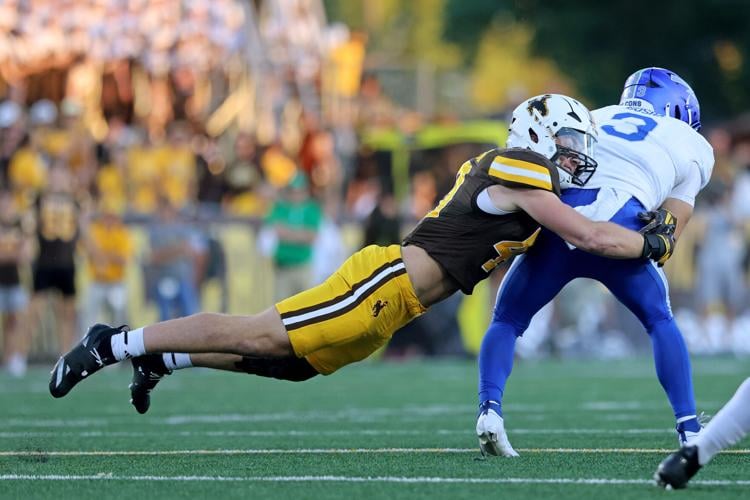
Wyoming strong safety Andrew Johnson chases down Air Force quarterback John Busha during their game Sept. 28 at War Memorial Stadium in Laramie.


Andrew Towne


Advertisement


“Winning first and second down is probably the biggest part, because even if you are in a close game, if they’re in third and long, they’ve got to drop back and throw it, so that gives you an opportunity, too,” Bertagnole said.

With lessons learned from a difficult non-conference slate, Bertagnole and his defense line teammates are beginning to show progress.

“We’re taking steps forward. I’m super happy with seeing what we’re doing in practice right now,” he stated. “We all have a bunch of energy and we’re super happy with where we’re at right now in conference play. Obviously, the first four games didn’t go as planned. We’ve responded every week with improvement and so going into our second game of conference play 1-0 is our mantra.”
Follow UW beat writer Anthony Dion on Twitter @anthonydion03


Source link

Advertisement

Wyoming

Wyoming authorities call on Rocky Mountain Power to explain role in massive November power outage

Published

on

Wyoming authorities call on Rocky Mountain Power to explain role in massive November power outage


by Dustin Bleizeffer, WyoFile

The massive, multiple-utility power outage last fall that left some 250,000 customers across parts of Wyoming, South Dakota and Montana without electricity was the result of miscommunication and inadequate procedures during planned maintenance that required de-energizing a power line in southcentral Wyoming, according to a report.

The Nov. 13 incident left thousands of homes and businesses without power for 9.5 hours — longer, in some cases — and knocked out a coal-powered generator outside Glenrock. The unit at the Dave Johnston Power Plant remains offline, leaving Rocky Mountain Power to backfill some 300 megawatts of electricity — enough to power about 225,000 homes.

The Dave Johnston coal-fired power plant, pictured on the afternoon of Nov. 13, 2025. (Dustin Bleizeffer/WyoFile)

Without expressly assigning blame to any one party, the report — conducted by the Western Electricity Coordinating Council and the North American Electric Reliability Corporation — indicates a series of communication breakdowns between PacifiCorp (parent company of Rocky Mountain Power), the Western Area Power Administration and, to some degree, electrical grid coordinating teams.

Advertisement

While it’s unclear whether authorities such as the North American Electric Reliability Corporation might pinpoint fault and assess penalties, the Wyoming Public Service Commission has called on Rocky Mountain Power to appear at a hearing scheduled for 2:30 p.m. Wednesday. The commission wants to hear from the utility about “the specifics and details of the event and report,” a public notice announced, and it “may consider and take any action that is in the public interest.”

The hearing at the Public Service Commission’s office located at 2515 Warren Avenue, Suite 300, in Cheyenne, will also be livestreamed at this link.

What happened

According to the 49-page report published in June, PacifiCorp and the Western Area Power Administration were coordinating maintenance on their respective systems that, together, required temporarily de-energizing PacifiCorp’s Aeolus–Clover 500 kilovolt line, which runs east-west and is anchored, in part, by a substation near Medicine Bow.

The effort also required curtailing some local wind energy from feeding the grid, according to the report. But on the day of the planned maintenance, Nov. 13, there was confusion about whether the Western Area Power Administration would scrap its work, so wind energy wasn’t curtailed as originally planned.

Wind turbines near Cheyenne poke into a colorful sunrise in January 2025. (Tennessee Watson/WyoFile)
Advertisement

The report indicates that modeling tools might have failed to accurately measure local grid conditions, so when the power line was de-energized, “power flow rapidly redistributed throughout the northeast portion” of the local grid. “Within six seconds,” according to the report, “an electrical island formed and collapsed, causing widespread effects across that portion of the interconnection.

“The disturbance,” the report continues, “culminated in the loss of more than 4,800 [megawatts] of generation from coal, natural gas, photovoltaic and wind resources.”

The cascading power failure began at about 12:45 p.m. on a Thursday, dragging down portions of service territories operated by Rocky Mountain Power, Black Hills Energy, Montana-Dakota Utilities and some rural electric co-ops. 

The report points to failures in communication, process deficiencies and inadequate modeling tools. Wind energy was not “identified as a contributing factor,” according to the report. It credits both battery storage and wind energy throughout the impacted area for supporting “a faster frequency recovery across the interconnection” and for providing “readily available capacity during system restoration.”


This article was originally published by WyoFile and is republished here with permission. WyoFile is an independent nonprofit news organization focused on Wyoming people, places and policy.

Advertisement


Source link

Continue Reading

Wyoming

First Alert Weather Days through Sat. for excessive heat, possibly through Wednesday for fire danger

Published

on

First Alert Weather Days through Sat. for excessive heat, possibly through Wednesday for fire danger


A dangerous heat wave is pushing temperatures above 100 degrees across western South Dakota, northeastern Wyoming and southeastern Montana, with records already broken in Sheridan. Red flag warnings have expanded to include Gillette, Newcastle, Rapid City and Pine Ridge as gusty winds and low humidity fuel critical fire danger through at least Wednesday.


Source link

Continue Reading

Wyoming

Health and elections: Vote like your life depends on it

Published

on

Health and elections: Vote like your life depends on it


CASPER, Wyo. — Wyoming ranks 29th in the nation for overall health, according to the America’s Health Rankings 2025 Annual Report. That middling score hides a sharper story, and Wyoming voters have the power to change it.

Wyoming performs well on education and income equality, but it ranks 49th in cancer screening and 43rd for its uninsured rate.

At the same time, voter turnout sits at just 56.4%, below the national average, on ballots that will decide who can bridge the gap.

Those things are related, said Dr. Gabriela Alvarado, a health policy researcher at the University of Wyoming and former RAND Corp. analyst.

Advertisement

“All the sources are kind of saying the same thing: Wyoming health is not where it should be,” Alvarado said.

While lawmakers write the laws that shape Wyoming’s health outcomes, voters hold the power to change them. Whether it’s increasing preventative care, funding the 988 hotline, preventing maternity deserts or shortening the distance to the emergency room after a workplace accident, voting could be the difference between life and death.

Ripple effects of policy

To vote smarter, citizens need to know the candidates, their plans to tackle the state’s healthcare challenges, and how those plans translate to policy.

The connections aren’t always clear. The cancer screening rate, for instance, is tied to low HPV vaccination rates and Title X–funded reproductive health clinics, Alvarado said.

“Those clinics screen for cervical cancer and administer the vaccine that prevents it,” she said. “Cultural discomfort deepens the gap, because Americans associate the HPV vaccine with sex rather than cancer prevention.”

Advertisement

Wyoming’s low rates of preventive care are a policy outcome.

Wyoming is one of only 10 states that has not expanded Medicaid, a decision lawmakers have upheld session after session, excluding roughly 9,000 residents who earn too much for the state’s narrow program but too little to afford private coverage.

“That ripples over to all these other indicators,” Alvarado said. “If you don’t have insurance, you’re not going to get a colonoscopy or other forms of cancer screening.”

Dr. Beth Robitaille sees where those people end up. Robitaille is a family physician and interim chief medical officer at the Educational Health Center of Wyoming, a federally qualified health center and residency program with clinics in Casper, Cheyenne and Laramie. 

She said her clinics saw more than 60,000 provider visits last fiscal year, and roughly 20% of those patients are uninsured.

Advertisement

Uninsured patients who skip routine care because they can’t pay for it, Robitaille said, arrive only when their conditions have advanced. An uninsured diabetic who can’t afford checkups or insulin develops uncontrolled blood sugar. That can lead to a foot wound, then an infection.

“Those infections often end with amputation, which requires hospitalization,” she said. “That hospitalization and treatment become uncompensated care for the hospital.”

Those unpaid bills added up to $141 million in 2024–25, according to the most recent report by the Wyoming Hospital Association.

Who pays when hospitals fail?

Hospitals recoup the losses by charging insured patients more, Robitaille said. Taxpayers who oppose Medicaid expansion as a cost-saving measure are already covering the bill through premiums instead, which impact the broader community.

“The reality is we’re still paying for it,” Robitaille said. “It’s just in a different manner.”

Advertisement

Her clinic writes off 80%–85% of costs for its lowest-income patients through a sliding fee scale, turning a $140 visit into a $15 charge. Federal funding offsets only part of that.

Robitaille pushed back on a common assumption about who’s uninsured.

“There’s a misconception that it’s all these people taking advantage of the system,” she said. “In 25 years of caring for this population, I find that they are often employed, self-employed or working for small businesses that can’t afford private insurance.”

Michael Shepherd, a political scientist who studies how health outcomes shape politics, said uncompensated care is a leading cause of rural hospital closures nationally.

“That’s everybody’s hospital,” he said. “That’s not just the people who are on Medicaid.”

Advertisement

The stakes are high in Wyoming, a largely rural state in which farming and ranching — among the country’s most dangerous jobs — depend on nearby emergency rooms when workplace accidents strike. Rural residents already travel twice as far as urban patients for care. In life-or-death situations — such as strokes and heart attacks — every mile and minute counts.

Strained hospitals cut services before they close, Alvarado said, and obstetrics usually goes first.

Nearly 60% of rural hospitals nationwide no longer deliver babies. Medicaid pays for nearly half of rural births, and federal cuts under the One Big Beautiful Bill Act are expected to leave about 10 million more people uninsured by 2034, per the Congressional Budget Office.

Yes, but…

The same law created a $50 billion Rural Health Transformation Program to soften the blow, though researchers estimate it covers only about 37% of the Medicaid funding rural areas stand to lose.

Wyoming’s share is substantial. The state was awarded $205 million in the program’s first year, according to reporting by WyoFile. That’s the second-largest per-capita award in the nation, behind Alaska, and providers can apply for the funds through Aug. 3.

Advertisement

Eric Boley, president of the Wyoming Hospital Association, told Oil City News that those one-time funds have the potential to be “transformational for struggling hospitals.”

“We may be able to use the funds to strengthen OB-GYN and emergency services,” he said. “Studies show that, with heart attack and stroke, getting care within an hour significantly improves your chances of making a full recovery.”

A vicious cycle

So why don’t bad outcomes produce different votes? Shepherd calls the answer the “rural health spiral.”

“Poor outcomes breed resentment toward government, resentment elects candidates who campaign on it, and those candidates pass policies that worsen the outcomes,” he said. “Instead of voters rallying to correct that course, they often double down on the course that they’re on, and things continue to spiral out of control.”

Alvarado worries that voters aren’t connecting policies to outcomes. 

Advertisement

“Legislators are there to serve their constituents,” she said. “If we tell our legislators what it is we care about, they know that there’s votes attached to that.”

Breaking the cycle

The mechanism to repair a broken system is the ballot.

Alvarado urged voters to treat elections as a “window of opportunity” when a known problem, an available solution and political will align.

“Whoever wins decides what the Legislature takes up,” she said.

Robitaille framed the choice as a question.

Advertisement

“Is healthcare a right or a privilege?” she asked. “Depending on where you as an individual stand on that question would affect who you vote for.”

Her advice is to go beyond the commercials, social media posts and yard signs to learn where candidates actually stand, because healthcare touches everyone eventually.

“We all need healthcare at some point, or our loved ones do,” she said. “So it affects everybody.”

Advertisement


Source link

Continue Reading
Advertisement

Trending