West
Watchdog group exposes Idaho colleges’ alleged scheme to sidestep new DEI law

NEWYou can now listen to Fox News articles!
As a watchdog demands that Idaho’s attorney general launch an investigation into a new anti-DEI law, an attorney for the group exposed how four universities in the state have allegedly schemed to sidestep the law’s provisions.
In April, Idaho enacted the Freedom of Inquiry in Higher Education Act, which took effect in July and prohibits institutions of higher learning from forcing students to enroll in mandatory DEI courses that are unrelated to their field of study. Schools are allowed to apply for exemptions for programs of study that are primarily focused on racial, ethnic or gender studies.
But the Goldwater Institute says schools are already attempting to skirt the new regulations.
“The whole goal of this law is to make it so that no one is forced to take mandatory courses that indoctrinate students with these discriminatory ideologies as a condition of graduation in unrelated fields,” Parker Jackson, a staff attorney at the Goldwater Institute, told Fox News Digital. “So we’re talking about degree programs like social work or counseling or psychology, things that you wouldn’t normally think would involve things like critical theory, race and gender studies, ethnic studies.”
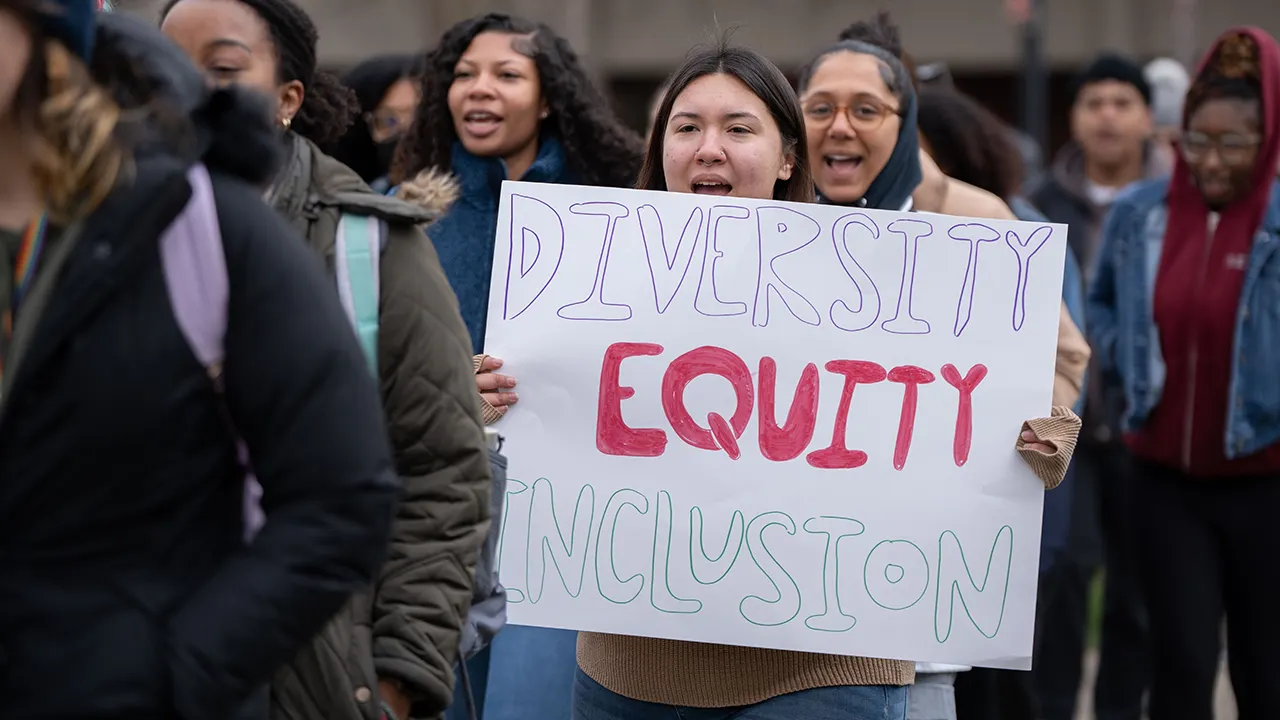
Homemade and hand-painted signs express a variety of viewpoints in a small group of eight adults within a huge crowd at Union Square. (John Senter/UCG/Universal Images Group via Getty Images)
UNIVERSITY DROPS JOB POSTING AFTER DEI REQUIREMENT EXPOSED, PROFESSOR SAYS ‘I WOULD NOT BE HIRED’ TODAY
The law is meant to ensure that unsuspecting students don’t wind up being indoctrinated by DEI programs when they are simply trying to obtain a degree for which DEI is irrelevant.
But the University of Idaho, Boise State University, Idaho State University and Lewis-Clark State College are skirting this law and applying for exceptions for courses that should not be exempt, according to a Goldwater Institute letter sent to Attorney General Raul Labrador asking him to look into the matter.
The letter also questions a memorandum sent to the schools by the Idaho Board of Education just before the law took effect, explaining the new law to the universities. That memorandum misinterprets the law to allow for more exceptions than intended, according to the letter.
“So, the statute specifically says that the exemptions can only be used for courses, the title of which indicates that they’re targeted towards these racial or gender or ethnic studies,” Jackson explained. “And what the board has did is they’ve gone through, and they’ve essentially tried to delete that portion of the statute and say that if the degree program requirements have these DEI mandates in them, then they can get an exemption for the class.”
In New York City, members of the National Action Network rallied in support of DEI, diversity, equity and inclusion, on August 14, 2025. (Deb Cohn-Orbach/UCG/Universal Images Group via Getty Images)
GOT A SCOOP ON CAMPUS? SEND US A TIP HERE
According to Jackson, that is a perversion of the law.
“Well, that’s kind of circular. They can’t just avoid the mandate against these requirements by creating the requirements,” said Jackson. “And so, what we’re asking the attorney general to do is to take a look at all of these exemptions that the board has granted across the state at Boise State and Idaho State and University of Idaho — I think Lewis-Clark College — Lewis-Clark State College is the other one, and find that these are violations of the Freedom of Inquiry in Higher Education Act.”
The letter also says that the schools now require DEI-related courses in degree programs whose titles do not clearly indicate a primary focus on racial, ethnic or gender studies.
For example, a required course in the sociology program at the University of Idaho is called “Introduction to Inequity and Justice.” The school has received a DEI exemption for the sociology program because of this course and several other elective courses, despite the fact that the degree program, sociology, is not explicitly a race, ethnic or gender studies program.
LEAKED UNIVERSITY OF ILLINOIS LECTURE MATERIAL BLAMES TRUMP FOR ‘WHITE SUPREMACY,’ EMBRACES FAR-LEFT ACTIVISM
People participate in the Boise Pride Festival parade along River Street in Boise, Idaho, on Sept. 7, 2025. (Sarah A. Miller/The Idaho Statesman/Tribune News Service via Getty Images)
“Stated simply, DEI-related courses may not be mandated unless the title of the degree program (e.g., ethnic studies) clearly establishes that the degree program itself is primarily focused on racial, ethnic, or gender studies,” the letter says. “Only then may the institution require a DEI-related course for completion of the degree program. By omitting the title requirement, the guidance mischaracterizes which programs are eligible for an exemption under the Act, making exemptions available for a much broader category of degree programs.”
The letter ends with a call to action, asking Labrador to investigate the exceptions that have been made, and the memorandum sent by the Board of Education to the schools.
CLICK HERE TO DOWNLOAD THE FOX NEWS APP
“Taxpayers shouldn’t be on the hook for funding left-wing activism and indoctrination,” said Jackson. “And that’s part of the goal of these laws that are starting to be passed throughout the country is not only protecting students that are unsuspecting — they’re just trying to go get a job and get qualified for their jobs — from this type of political indoctrination, but it’s also protecting taxpayers.”
“Let students go and be social work students and become psychologists and counselors without having this radical, toxic political ideology shoved down their throats.”
The University of Idaho, Lewis-Clark State College and Idaho State University directed Fox News Digital to the Idaho Board of Education.
“The Office of the Idaho State Board of Education will cooperate fully with the Idaho Attorney General’s Office,” a spokesperson for the board told Fox News Digital. “The Office cannot comment further at this time.”
Boise State University did not return a request for comment.
Read the full article from Here




It was on this day in 1964 that a massive 9.2 earthquake in Southcentral Alaska.
The massive quake at 5:36 pm on March 27th caused much devastation throughout the region and generated a huge tsunami that inundated many communities in the region.
The quake was the largest in the history of the United States and initially killed 15 people while the resulting tsunami killed an additional 100 people in the new state and another 13 in California as well as five in Oregon.
The megathrust earthquake endured for four minutes and thirty-eight seconds and ruptured over 600 miles of fault and moved up to 60 feet in places.
The deadly quake occurred 15 and a half miles deep 40 miles west of Valdez and generated a ocean floor shift that created a wave 220 feet high.
As many as 20 other smaller tsunamis were generated by submarine landslides.

Boats, beaches, and buckets of fun! Just the way you’d expect a boy to spend his Florida vacation!
But there was something else 11-year-old Miles Boyd got to do last year when he and his family traveled to Florida. It was a sea turtle adventure that truly became the trip of a lifetime.
“I had never been to the ocean before,” explained Miles. “So see that just wowed me. It was amazing!”
Miles and his family also got to see baby sea turtles on the beach at night.
“The ocean is so mysterious,” says Miles. “It’s such a big place, and the fact that these turtles can move but are so tiny and when they go in the ocean, they get to hundreds of pounds.”
In so many ways, the trip to Palm Beach County, Florida, was a dream vacation for Miles and his family, but it only came after what was a living nightmare.
“I couldn’t imagine losing him,” says Miles’ mom, Natasha.
It was the harsh reality that Natasha had to face after learning her son Miles had a cancerous brain tumor.
“The world just stopped,” Natasha says about the moment she found out the devastating news. “I just sat on the floor and cried.”
Even Miles admits he was scared.
“I’m just a kid, you know what I mean?” he says. “It’s a lot to handle all at once.”
After three brain surgeries, countless hours of therapy and rehab, and having to take a chemo medication twice daily, Miles proved to the world he is a true survivor!
And his trip to Florida, through Make-A-Wish Arizona, proved to be the medication he never knew he needed.
Miles explains that the trip motivated him to keep going.
“It showed me that I made it to this car, and I can keep going,” he says. “I started at the lowest of lows, and now, I’m on a beach – it just gave me confidence and motivated me that I could keep going.”
Last year alone, Make-A-Wish Arizona granted 476 wishes; they’ve also fulfilled more than 8,500 since being founded in 1980.
Across the Globe, Make-A-Wish has granted more than 650,000 wishes since 1980
Miles and Nick Ciletti will co-host Make-A-Wish Arizona’s Wish Ball on Saturday! To learn more about Make-A-Wish Arizona, click here.

Polling shows Republicans Steve Hilton and Chad Bianco leading the pack, while eight Democrats split the liberal vote.

Democrats face nightmare scenario in California governor’s race
Polling shows Republicans Steve Hilton and Chad Bianco leading the California governor’s race, while eight Democrats split the liberal vote.
Democrats’ 2026 comeback could be spoiled by California electing a Republican governor, as two GOP candidates are leading in recent polls.
Experts forecast a potential “blue wave” in the midterm elections, as Democrats have recently overperformed in special elections, including flipping a state senate seat in President Donald Trump’s own Palm Beach, Florida, district on March 24.
But the party is facing a nightmare scenario in the nation’s most populous state, where polling shows Republicans Steve Hilton and Chad Bianco leading the pack in the June 2 nonpartisan primary. The state’s liberal majority is split among eight Democratic contenders.
The Democrats’ dilemma stems from California’s unusual election system, in which the top two finishers, regardless of party, advance to the November general election. A Berkley ISG survey released March 18 of more than 5,000 registered voters showed Hilton, a conservative TV host, receiving 17% of the vote while Bianco, the Riverside County sheriff, held 16%.
In third was Democratic Rep. Eric Swalwell, with 14%, then former Rep. Katie Porter holding 13%, followed by Tom Steyer at 10% and the five other Democratic candidates each getting 5% or less.
Other yardsticks show a similar trend, such as a March 18 survey commissioned by the California Democratic Party showing the two GOP candidates on top with Swalwell, Porter, and Steyer in a three-way tie for third place.
California Democrats enjoy a 2-to-1 voter registration edge over the GOP, but Golden State voters say there is a fog of confusion around the race due to the party’s failure to coalesce around a frontrunner. Olivya Reyes, a graduate student who lives in Oxnard, California, told USA TODAY the party still feels like it is trying to “find its footing” between a more moderate or progressive candidate.
“I feel like as a Democratic voter, what I would want to see from my party is clarity on who we’re supporting and getting behind,” she said.
Democratic Gov. Gavin Newsom, who is prevented from running due to term limits, has one eye on the presidency and hasn’t endorsed a successor or publicly nudged lower-performing candidates out of the race.
That neutrality could come at a cost, some experts say, should the two GOP aspirants prevail.
Do Democrats have a strategy for winning in midterms?
Democrats prioritize electability over ideology as they regroup from 2024 losses and focus on winning amid shifting voter confidence.
‘Nobody has leapt out’: Voters disengaged, largely unenthusiastic
Reyes, 29, a lifelong Democrat, said typically by the end of March she would have a strong idea of which candidate she planned to support. She was planning to back former Vice President Kamala Harris or Sen. Alex Padilla, but both bypassed running, leaving her clueless about who was running or who to support.
She has only learned about Steyer, who has poured millions into the contest, and former U.S. Health and Human Services Secretary Xavier Becerra.
“I’m going to be honest in saying that I have been getting a lot of conflicting messaging, even from my own party, about who I should put my vote behind,” Reyes said. “Right now, it seems that the party is very much trying to find its footing on whether or not we’re going for a progressive candidate or for a more moderate Democrat.”
Experts say voter apathy typically occurs in California because it’s a heavily Democratic-leaning state, and that a majority of voters don’t pay attention until after the usually low-turnout primary.
The Berkeley survey underscored how much inattention is responsible for Democrats’ lack of enthusiasm for a specific candidate. It noted that voters “remain largely disengaged and unenthusiastic,” and about 16% of Californians are undecided.
The poll found that even among the candidates who are generally better known, “significant proportions of likely voters have no opinion” of them.
That might come as a surprise, given that the top three Democrats all ran for major office before. Porter made an unsuccessful bid for Senate in 2024 while Steyer and Swalwell launched uneventful presidential campaigns in 2020.
There are other notable contenders on the Democratic side: Becerra, the former health secretary in the Biden administration who had just 5% in the Berkley poll; former Los Angeles Mayor Antonio Villaraigosa and San Jose Mayor Matt Mahan who raked in 4%; Tony Thurmond, state Superintendent of Public Instruction and Betty Yee, a former state controller who both shared 1%.
“No one in particular has caught fire with the average Democratic voter,” said Brian Sobel, a veteran political analyst based in San Francisco. “Nobody has leapt out.”
Democrat Rick De Alba, a workers’ compensation rights attorney from Pacifica, California, said he prefers Beccera, but noted he consistently sits in the basement of the race. He doesn’t want his vote going to someone who doesn’t have a shot at winning, and wishes underdog contenders would heed state party leaders’ advice and bow out gracefully.
“I think realistically you need about $30 million to put on an effective campaign in California, and if you can’t raise that, you should step aside,” De Alba said. “California always votes Democrat, no matter what. We just need to know who the candidate is.”
Reyes, the graduate student, said she had hoped to learn more about the other Democrats running through a debate hosted by the University of Southern California, which was originally scheduled to air on March 24. But the university canceled the event at the last minute after an accusation that it purposefully left out candidates of color, casting a shadow over the event for days.
Swalwell, Porter, and Steyer are White, whereas the lower-polling candidates are mostly people of color. Becerra and Villaraigosa are Hispanic; Mahan is White; Thurmond is Black; and Yee is Asian American.
“As a person of color, it did make me take a pause, and it didn’t look good,” Reyes said. “But I feel like this was a chance for all of these Democratic candidates to kind of put their faces in front of California voters.”
GOP shutting out Democrats ‘theoretically possible’ expert says
Conservative-leaning California voters such as Bud Thompson, a 61-year-old state government employee, said they are enjoying the spectacle of the usually dominant California Democrats in disarray. He was surprised to learn that the two leading candidates in this year’s races were the two GOP candidates.
“I think that you can look at California and see what a mess it is. Look at who’s been running it for the last few years,” the Sacramento, California, native said in an interview. “I am going to start seriously looking at the two Republicans. It would be a nice change of pace.”
California, under Newsom, has been one of the larger state governments that have opposed much of the Trump administration’s agenda, so having either Hilton or Bianco, who are both decidedly behind the president, would be a drastic shift.
Bianco made headlines this month when he followed the administration’s lead by seizing roughly 650,000 ballots in Riverside County, based on a tip from a citizen-led group that has been criticized for delving into conspiracy theories by local officials and other voting rights experts. He’s also made support for the president’s controversial SAVE Act voting bill one of the central themes in his campaign.
“Investigations into irregularities must happen so that the public can have full confidence,” Bianco said in a March 22 post on X.
Hilton, a former Fox News host, has also spoken in favor of Trump’s election overhaul, arguing that “(u)niversal mail-in voting must end,” in a March 26 post on X. He has emphasized allegedly fraudulent government spending and slammed Bianco for calling to work with Black Lives Matter protesters in 2020.
Thomas Holyoke, a political science professor at California State University, Fresno, said it’s “theoretically possible” that the two could shut out the Democrats, assuming GOP voters back their own candidates and earn enough votes from some independent voters.
But he said in the next couple of months, there will be a lot more pressure from state Democrats and others to significantly drain the pool of candidates so that the remaining contenders can consolidate support.
“I just got to imagine that pressure is really going to mount and a lot of donors to Democratic candidates may also push heavily for some Democrats to drop out,” Holyoke said.
Asked about the prospect of Republicans keeping Democrats out of the top two spots, national campaign officials who spoke with USA TODAY exuded optimism and spotlighted the party’s history of success in the state.
“We are confident that will not happen, and we are having active conversations with our partners in California about ways that we can ensure that doesn’t happen,” Johanna Warsaw, a spokesperson for the Democratic Governors Association, told USA TODAY in an interview.
She noted the group was heavily engaged in other elections that turned out well for progressives, including the 2025 redistricting ballot initiative known as Proposition 50 and the failed 2021 recall battle against Newsom.
Democrats express confidence as Newsom’s absence scrutinized
As the California election comes into focus, Newsom’s role in picking a successor is also being heavily scrutinized, especially given that he’s a rumored 2028 presidential contender.
Newsom served as lieutenant governor under former Gov. Jerry Brown, a longtime fixture in the state, before taking the reins in 2019. But Newsom’s second-in-command, Lt. Gov. Eleni Kounalakis, dropped out of the running last August.
“There isn’t a logical heir to the throne this time around,” said Eric Schickler, a political science professor at the University of California, Berkeley.
Newsom’s office did not respond to USA TODAY’s request for comment, but he addressed the lack of a focused message among the Democratic pool when speaking with Politico’s “On the Road” podcast. The governor noted that Harris and Padilla declining to run created “a lot of chill and a lot of delay” in this year’s campaign.
“You have this condensed period of time with a lot of candidates,” Newsom told host Jonathan Martin.
Sobel, the Bay Area political analyst, said Newsom has worked with many of the top candidates in various capacities previously and might want to avoid playing favorites. The 58-year-old governor will need their diverse and wide-ranging networks of support should he formally announce a White House bid.
“He’s going to need them again, sooner than later,” Sobel said.
Many of the low-polling candidates carry significant weight within the party at the local and state level, too, and some have been running for governor as far back as 2023. They are used to fighting ugly political battles, observers say, so they won’t go away easily.
The Yee campaign, for instance, points to the state party chair’s March 3 letter urging candidates to “honestly assess (their) viability” as an example of powerbrokers trying to clear the field for a select few.
“I’m not going to let that happen. Voters are still shopping,” Yee, a former state party vice chair, told USA TODAY in a statement. “Every poll shows the race remains wide open. Californians have a right to see and hear from a range of candidates, not just the billionaire-backed voices. Let the voters decide. Anything less is undemocratic and simply un-American.”
While the race might have some Democrats biting their nails, psychologist Steve Flannes, of Piedmont, California, said he’s pleased that so many people are running for governor. He said it’s a chore examining all the candidates, but he hopes it won’t be too cumbersome in the coming weeks.
“I’m trying to narrow down the options for myself,” Flannes, 75, said. “I’ve still got a couple of months to figure it all out, right?”

50 years of DC Metro: A look back in photos

WKYC Channel 3

Austin’s Star Is Still Shining Bright: Venture Funding To City’s Startups Hits All-Time High

How To Watch: Michigan vs Alabama in NCAA Tournament Sweet 16

This Day in Alaska History-March 27th, 1964

Florida High School Football Rankings: Top 25 teams – Oct. 21

How old is Bo Nix? What to know about Oregon quarterback ahead of 2024 NFL Draft

Cleary's 21 help Le Moyne down Central Connecticut State 69-64 in OT

99th annual Pony Swim held in Virginia

Indiana Members Credit Union announced as new anchor tenant at Bottleworks District

Video: Will ICE Change Under Its New Leader?

DHS shutdown breakthrough comes at cost for Republicans as funding fights nears end

Rubio joins crucial G7 talks as Iran war set to dominate second day

A surprise resignation could open the door for an independent to win a Montana Senate seat

Video: Savannah Guthrie Says She Believes Her Mother Was Taken for Ransom
-

 Detroit, MI1 week ago
Drummer Brian Pastoria, longtime Detroit music advocate, dies at 68
-

 Science1 week ago
How a Melting Glacier in Antarctica Could Affect Tens of Millions Around the Globe
-
 Science1 week ago
I had to man up and get a mammogram
-

 Movie Reviews1 week ago
‘Youth’ Twitter review: Ken Karunaas impresses audiences; Suraj Venjaramoodu adds charm; music wins praise | – The Times of India
-

 Sports6 days ago
IOC addresses execution of 19-year-old Iranian wrestler Saleh Mohammadi
-

 New Mexico5 days ago
Clovis shooting leaves one dead, four injured
-
 Business1 week ago
Disney’s new CEO says his focus is on storytelling and creativity
-

 Texas1 week ago
How to buy Houston vs. Texas A&M 2026 March Madness tickets