Washington
Kentucky Teacher of the Year: Washington Week Reflection


Kevin Dailey, 2024 Kentucky Teacher of the Year
Over the course of the past few weeks, I have been a part of many incredible, unbelievable, once-in-a-lifetime experiences. These events are so fresh in my mind that I haven’t even been able to fully process them, let alone see or understand their long-term impact. Already, I think if given the chance, I could talk about the events of those days for an entire lifetime: the experiences, the people, the feelings and emotions around them, the life lessons, I could actually go on forever. Since that is impractical and too much for anyone to listen to, I want to focus on a single part of the culminating event, the first-ever State Dinner honoring teachers at the White House. You read that correctly: the state teachers of the year were invited to dine with the First Lady of the United States, and fellow educator herself, Dr. Jill Biden (as I said in the opening statement… unbelievable).
But the story begins long before the dinner itself on May 2. We have to go back to the welcome address a week prior, delivered by 2019 National Teacher of the Year Rodney Robinson, where he planted a seed of thought into my mind that I wasn’t expecting nor fully able to comprehend in that moment. Among his many words of wisdom, he said, “YOU (the state teachers of the year) are not the reason you are here.” Certainly a strange statement to make to a group of extraordinary professional educators. Nevertheless, he went on to explain that even though we are exactly where we are supposed to be, our journey here wasn’t entirely of our own making. This thought stayed in the front of my mind throughout every experience of the following week.
The truth Rodney helped me to confront is that I would not be where I am today were it not for a host of people along my journey. My family and friends, whose love and unconditional support has sustained me when things have been tough. My own teachers, whose dedication and belief in me during one of the most challenging times of my life allowed me to believe in myself. My colleagues, who have pushed and challenged me to keep moving forward. But most importantly, my students, who for over a decade have given me purpose, strength, and inspiration in more ways than can be named. Each of them helped me along in one way or another.
The next day brought about the chance to hear from yet another world class educator, 2010 National Teacher of the Year and coordinator for the state teachers of the year, Sarah Brown Wessling. More than any other person I’ve met, Sarah has the ability to know what you need before you know yourself, and as someone who has gone through these same experiences, she told a story of her meeting the president when she was named National Teacher of the Year in 2010. It was the exact story we needed. Without retelling someone else’s story, the moral was that we should be aware of who it is we are carrying into the spaces we occupy, from the ordinary to the incomprehensible, they are with us. Again, the words stuck. They meant something despite my lack of context to understand their meaning.
Fast forward to Thursday evening, when we were on our way to the White House to attend the historic State Dinner. From the outside, we looked ready. Each of us dressed in our finest clothes, adorned with little personal touches that showcased our profession, our state, and our personalities. We looked invincible. But inside, my mind was racing, and as it did, the words of wisdom from earlier in the week appeared again, only this time, they didn’t rattle in my mind, they came out.
Sitting across the aisle from me was 2024 Delaware Teacher of the Year Cory Hafer, which in hindsight was the perfect person. So I asked, “Cory, who are you carrying with you?” In the most truthful and vulnerable way, we both went on to name students, family members, and other folks that we were thinking about in the moment. This last conversation started to bring to focus the thoughts that were dominating my mind all week long. Then in an instant, we went from sitting at 1400 Pennsylvania Avenue waiting to depart the bus to the entrance of the East Room of the White House. There are a million memories between the two, but again, this story has one focus.
Once I entered that incredible dining room, I felt myself losing control. My heart fluttered, my mind raced, and I thought of all of the reasons why I shouldn’t be in that room; why I didn’t belong; why I wasn’t deserving of such an honor. Quickly, I looked into my hand at my seating card, I saw the number “15” and took a beeline to find my seat. Once I noticed the table, I saw a golden apple with the words “Kevin Dailey” sitting on the table, but I certainly did not feel like that was my place. Every negative thought, every doubt, every flaw, every failure flashed right in front of my eyes.
I pulled out the chair to take my seat and saw a glimpse of a book. I had never seen this book before, but I instantly knew what it was. It was Rodney’s words, “you are not the reason why you are here.” It was Sarah’s story, “who are you carrying with you?” As I lifted the book, it all made sense. All of the worries, the doubts, the failures that had dominated my senses parted and in their place were handwritten notes from my students. I took a deep breath and knew that no matter what I felt about my own presence in those hallowed halls, the people I carried with me, the people that brought me to that moment, they all deserved to be there. They belonged in that room. And it was my responsibility, my honor, to bring them with me. Those little notes of kindness gave me power, confidence, and a sense of belonging and purpose that I will never forget.
It’s pretty amazing, the power of kindness. What a nice note, a simple gesture, or a short reminder can do for a person. In my career as a teacher, I have saved every note, every email, every Post-it given by my students. I store them in a binder behind my desk. These notes mean the world to me. But this book of kindness is a constant reminder of the reason I am where I am today and of those that I carry with me. And that is a lesson I hope I never forget.


Washington
Review: Our critic cannot tell a lie: ‘Young Washington’ is the dullest of history lessons
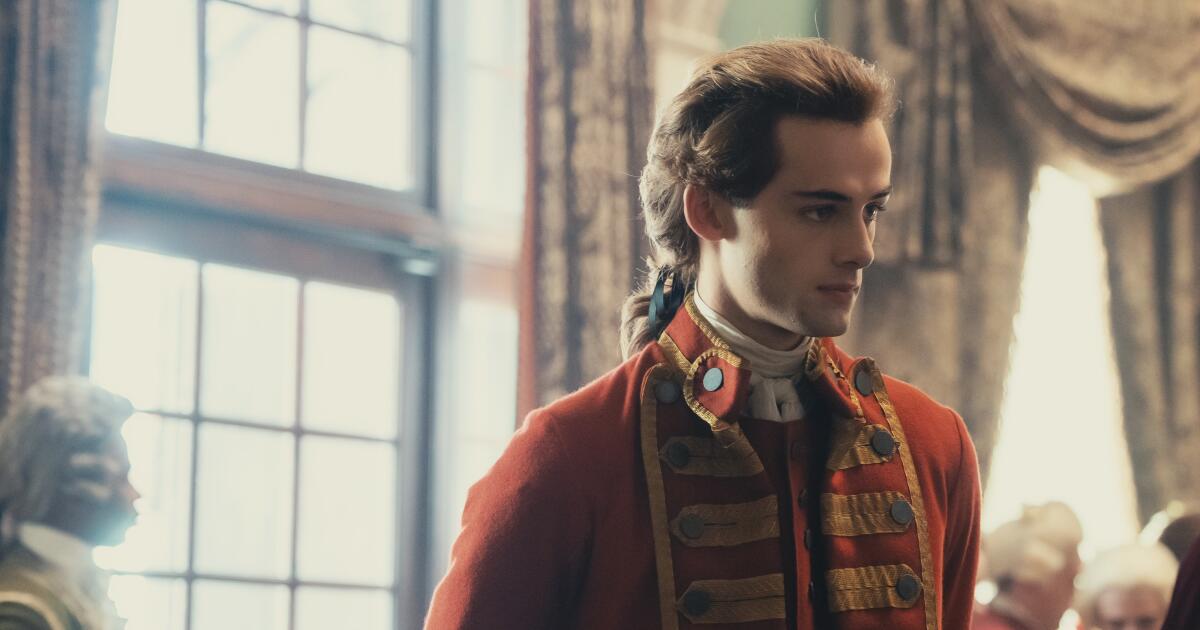
It’s the 250th birthday of the United States of America and how better to celebrate than with a big-screen hagiography of America’s first president, George Washington? “Young Washington” arrives in theaters just in time for the Fourth of July with a chiseled, hot young actor in the lead role and the sheen of a prestige HBO drama, though the result isn’t really big-screen spectacle or appointment television. It feels more like something to be watched on the AV rig in a middle school social studies class. At least there won’t be a quiz at the end.
But there could be, because the plot of “Young Washington” plays out with all the thrill of a textbook chapter. It takes place mostly around 1753-55, at the advent of the French and Indian War. We open in medias res when the 23-year-old Col. Washington (William Franklyn-Miller) lurches from a dysentery-riddled nap directly into battle in the Pennsylvania woods, his battalion on the back foot, surrounded by gore and gunpowder. Another officer describes how dire the situation is while George ponders saving his men and asks, “What could be worth the risk?” Washington steels his gaze and we cut to black. You can almost hear the eagles scream, guitars riff and engines rev.
“Young Washington” is produced and distributed by Angel Studios, the faith-based movie studio that churns out films based on true stories that either feature freak accidents, strange illnesses or, more recently, unique stories from the past in which faith in God is a factor. Apparently, our nation’s founding also falls under this umbrella.
The film is directed by Jon Erwin, one of the in-house Angel Studios mainstays, who also helmed “Jesus Revolution,” “I Still Believe” and “I Can Only Imagine.” Erwin gives the whole project a kind of gritty, visceral approach — very “Game of Thrones” in red coats. It’s violent, muddy, the contrast is high and too many drone shots soar over the forest treetops.
Though it opens with a bang, this 1755 battle framing device gives way to the George origin story, starting with his father’s death 12 years earlier, when the 11-year-old George is bereft that he’ll have to sacrifice his education in order to become a tenant farmer and provide for his family including his mother, Mary (Mary-Louise Parker, doing a bizarre accent).
His older half-brother Lawrence (John Foss) takes him under his wing and teaches him, and the young George grows into a smart, bright, ambitious young man, whose dreams of becoming a British officer are dashed because he doesn’t have formal education, a fortuitous marriage or his own land. But he’s bootstrapped himself into intelligence and with savvy networking and know-how, he becomes indispensable to the British, volunteering as a major to survey land and negotiate treaties with the Native tribes and French army. It’s all a bunch of politicking and petty disputes until it escalates into all-out war thanks to an ill-advised ambush.
Sir Ben Kingsley, Kelsey Grammar (who starred in “Jesus Revolution”) and Andy Serkis play the British officers who begrudgingly, at times, believe in George and his capabilities, though a lot of the film is about a young man getting rebuffed by snobbish British officers.
He’s the kind of character who always makes the noble choice, does and says what’s right, and sees everyone as equals (including enslaved African men and Native American allies). He inspires his brother and others that the world can change and takes inspiration from his mother, who encourages him to continue his path and do it as God’s servant.
Unfortunately, this doesn’t make for a character that’s in any way complex or interesting at all. Franklyn-Miller is certainly pretty, serving as a fine face for this story, but the screenplay (by Erwin, Diederik Hoogstraten and Tom Provost) flattens his character into a basic cookie-cutter hero. Audiences, including the middle school social studies students, deserve better and more nuanced stories about this country and the values it was built upon.
“Young Washington” is propaganda in the form of a history lesson wrapped in a summer blockbuster. If only it were even slightly entertaining — maybe they’ll tackle that in the inevitable sequel.
‘Young Washington’
Rated: PG-13, for sequences of strong war violence and some bloody images
Running time: 2 hours, 5 minutes
Playing: Opens Friday, July 3 in wide release

Mathematicians and statisticians from around the world descended onto Pullman to attend the regional conference of the International Biometric Society (IBS) in early June. Joining leading experts in data science and biometrics were several special guests: high school students from the Kalispel Tribe in northwestern Washington.
The eleven students from Cusick are participants in a collaborative tutoring program between the WSU Department of Mathematics and Statistics and the Camas Learning Center (CLC), an in-school and after-school program managed by the Kalispel Tribe. They were invited to the IBS conference by Regents Professor Jan Dasgupta, department chairperson and the current president of the IBS western North American region. Dasgupta saw an opportunity to share the Pullman academic experience with both leading researchers and the students tutored by her undergraduate students.
“The IBS conference includes an Access and Opportunity workshop focused on engaging local students, and we wanted them to experience WSU and see the possibilities that exist in STEM education and careers,” Dasgupta said.
Undergraduate students from the WSU “Future Teachers of Math” club typically tutor the high schoolers via one-on-one Zoom consultations, supported by CLC staff. The tutoring program has evolved since 2023, but the focus has always remained on student math preparation, for those learning and those teaching the subject. The partnership creates stronger pathways to both higher education and STEM opportunities for students in rural and tribal communities across Washington.
Integrating high school students into the IBS conference proceedings is not a new concept. In 2024, the annual conference’s Access and Opportunity Workshop invited community college students from the Denver area to network with attendees and participate in a data skills seminar. The next year, the workshop invited students from around Whistler, B.C. to the conference proceedings. This year, it was time for the students from Cusick.
Eleven students and four chaperones made the trip from Pend Oreille County to Pullman, where they stayed in Stimson Hall as an on-campus dormitory experience. While the students’ conference activities included hands-on experiences with biostatistics, data science, and biometry analysis, they were also treated to a campus facilities tour. Physics professor Guy Worthy provided a tour of the WSU Planetarium, and Squeak Meisel from the Department of Art led students on a tour of the art facilities and the Jordan Schnitzer Museum of Art at WSU. Other tour locations included the Veterinary Teaching Hospital and the University Recreation Center for some earned relaxation time in the pool.
Cross-discipline researchers also sat down for a panel discussion with the students, discussing their education, career, and life experiences. The speakers included Denise Dillard, director of the Institute for Research and Education to Advance Community Health (IREACH); Mikaela Nishida, PhD scholar in statistics from University of California, Irvine; and Courtney Meehan, Dean of the WSU College of Arts and Sciences.
“One of the most important things we can do as a university is help students see new possibilities for themselves,” said Dean Meehan. “Hosting international conferences like this on our campus creates powerful opportunities for students to interact with researchers and explore potential career paths firsthand. These connections can have a lasting impact long after they leave Pullman.”
-

 San Francisco, CA7 minutes ago
Marina braces for Golden Gate Bridge fireworks show, massive crowds
-

 Dallas, TX10 minutes ago
Maradona’s ‘Hand of God’ ball heads to auction in Dallas
-

 Miami, FL15 minutes ago
Miami-Dade sheriff urges residents to celebrate Fourth of July safely
-

 Boston, MA22 minutes ago
Jaylen Brown says Celtics showed ‘lack of respect’ after trade to 76ers – The Boston Globe
-

 Denver, CO25 minutes ago
Who are the Top 5 offensive linemen in Denver Broncos history?
-

 Seattle, WA30 minutes ago
Seattle’s Lake Union to light up with big July 4 fireworks show for America’s 250th
-

 San Diego, CA37 minutes ago
New training program grants tribal members access to reservation land during emergencies
-
Milwaukee, WI40 minutes ago
Leaders of ‘United for Venezuela Emergency Relief Campaign’ grateful for support


