Utah
The Jazz got their 3rd straight win by avoiding making a critical error against the Nuggets

/cdn.vox-cdn.com/uploads/chorus_asset/file/25218767/merlin_3013540.jpg "The Jazz got their 3rd straight win by avoiding making a critical error against the Nuggets")
The memory of Monday night had not escaped the minds of Utah Jazz players.
In Milwaukee they led by as many as 33 points and then the Bucks surged back in the third quarter, cutting the Jazz lead to single digits.
“We didn’t want a repeat of what happened in Milwaukee,” Walker Kessler said. “We acted like we’d already won the game and just made it harder on ourselves than it needed to be. That’s a bad precedent to set.”
So when the Jazz went into halftime on Wednesday night, with a 71-53 lead over the reigning champion Denver Nuggets, Jazz head coach Will Hardy didn’t even need to say anything.
“I think the other night scared us all to death,” Hardy said. “I walked in the locker room and they were all saying it before I did … They were talking about winning the third quarter, they were talking about being in this situation again.”
The Nuggets are of course, much like the Bucks, not the kind of team to mess around against. Led by Nikola Jokic and Jamal Murray, the Nuggets are able to come back in even the tightest of situations and have made huge runs late in games this season, proving that point.
“There was a ton of time left against a really good team,” Kessler said. “And with all due respect to coach, he’s not in the game, he’s not on the court with us. We knew that we couldn’t let that happen again.”
The Jazz players made sure to put their best foot forward this time. They stayed tight on defense, let the game develop organically on offense and never took their foot off the gas pedal.
In particular, the Jazz made sure to keep Jokic from being as good of as passer as he is a scorer and limited Michael Porter Jr. as much as possible.
Jokic finished the night with a game-high tying 27 points, but had just six assists, which is a lower number than he is capable of. Porter only took three 3-point attempts and only converted on one of them.
“That was a pretty complete game by our team,” Hardy said. “The team’s focus defensively against a really, really good basketball team was very, very good from the beginning of the game.”
And importantly, the Jazz proved that they have the ability to recognize mistakes and to not make the same mistakes over and over.



Four lifts, 174 acres, night skiing and a concert venue near Logan are up for grabs.
(Photo courtesy of Dylan White |@blanco_photovideo/Cherry Peak Resort)
The entire front side of Cherry Peak Resort, located about half an hour north of Logan, is illuminated for night skiing.

President Donald Trump sharply reduced the size of two national monuments in Utah, undoing protections established by his Democratic predecessors on public lands that are sacred among many Native Americans.
Bears Ears and Grand Staircase-Escalante national monuments in southern Utah have ancient cliff dwellings, petroglyphs and scenic canyons, as well as coal and uranium deposits that state officials want made available for development.
Trump, a Republican, issued proclamations Monday under the Antiquities Act to reduce their size by about 90% each. He took similar actions during his first term, but those were reversed by President Joe Biden, a Democrat.
The latest move comes as Trump and other Republicans have drastically reshaped the management of vast taxpayer-owned lands concentrated in Western states. Trump administration officials and congressional Republicans have sought to expand drilling, mining and logging on public lands, while removing protections for imperiled species and rolling back rules for conservation.
“They took the land from the people quite honestly,” Trump said at a signing event at the White House Monday. “We’re giving it back.”
President Bill Clinton, a Democrat, established Grand Staircase-Escalante National Monument in 1996, and President Barack Obama, also a Democrat, created Bears Ears National Monument in 2016 under the Antiquities Act. The 1906 law gives presidents the powers to protect sites considered historic, archaeologically significant or culturally important.
Davina Smith-Idjesa, a citizen of the Navajo Nation and co-chair of the Bears Ears Inter-Tribal Coalition, said tribal leaders had braced for a reduction since Trump was elected to a second term. She said it was “heartbreaking” and accused federal officials of sidestepping their legal responsibility to consult with tribal nations that would be impacted.
“From a Navajo perspective, Bears Ears is not simply a piece of federal public land,” Smith-Idjesa said. “This is a living cultural site that holds our histories, our ceremonies, our traditional foods and medicines and our ancestors’ footprints.”
‘Big day for Utah’
Utah officials had long fought against the monument designations and argued that the state should be in charge of controlling its own lands. Trump in his first term reduced their size, calling their creation a “massive land grab.” Combined they spanned more than 3.2 million acres (13 million hectares), an area nearly the size of Connecticut.
Trump reduced them Monday to less than 303,000 acres (123,000 hectares) combined.
That’s a greater reduction than his first term, when he left Grand Staircase Escalante at 1 million acres (405,000 hectares) and Bears Ears at 213,000 acres (86,000 hectares).
“This is a big day for Utah,” Utah Gov. Spencer Cox as he stood next to Trump at the White House. “These monument designations are supposed to be the smallest area as possible to protect the antiquities.”
Bears Ears was the first national monument created at the request of tribal nations that consider the land sacred. The landscape contains ancestral villages, ceremonial and burial sites and features in some tribes’ creation and migration stories. Its designation honored five tribes in the region — Navajo, Hopi, Zuni, Ute Mountain Ute and Uintah-Ouray Ute.
Home to hundreds of thousands of objects of cultural and scientific significance, Bears Ears is jointly managed by an agreement between tribal nations and federal agencies.
Rick Bowmer/AP Photo
Rick Bowmer/AP Photo Newspaper Rock, featuring a rock panel of petroglyphs in the Indian Creek Area, is seen near Monticello, Utah, on July 14, 2016.
Grand Staircase-Escalante consists of cliffs, canyons, natural arches and archaeological sites, including rock paintings. It holds large coal reserves, while the Bears Ears area has uranium.
The national monument designation provides sweeping protections not just for significant geological features or artifacts but also for the surrounding landscape, banning drilling, mining and new construction nearby. Proponents of Trump’s move to downsize say the protective boundaries stretch too far and hinder mining for critical minerals.
Trump asserted Monday that people can not hunt, fish or “virtually not even walk” on the monuments. That’s false: Hunting, fishing, camping and other recreation are permitted under state and federal regulations, said Steve Bloch, legal director for the Southern Utah Wilderness Alliance, a conservation group.
Biden designated or expanded more than a dozen monuments and had a goal to conserve at least 30% of U.S. lands and waters by 2030.
Trump’s policies are largely the opposite: He wants to tap into the natural resource wealth of federal lands that total more than 100,000 square miles (260,000 square kilometers) and offshore areas under federal control, such as in the Gulf of Mexico and off Alaska.
That’s drawn backlash from Democrats who warn of the wholesale disposal of treasured landscapes for commercial gain.
“Today’s executive action is another chapter in this administration’s war on the West,” Democratic Sen. Martin Heinrich of New Mexico said Monday. He added that Trump was “turning the Antiquities Act on its head.”
Land sale proposals fell flat
Trump Interior Secretary Doug Burgum said last year that federal officials would review and consider redrawing monument boundaries as part of a push to expand U.S. energy production.
Trump in his current term has used proclamations to lift commercial fishing prohibitions within expansive marine monuments in areas of the Pacific Ocean and in the Atlantic Ocean off the New England coast. Those monuments were created by Democratic and Republican administrations. The effort to boost the fishing industry, which has been challenged in court, marks a dramatic shift in federal policy by prioritizing commercial interests over efforts to allow the fish supply to increase.
Some Republicans have tried to sell or transfer federal lands to states or other entities. Those efforts have largely fallen flat: A push by some GOP lawmakers in the House to sell public lands ran into bipartisan opposition, while another proposal by Sen. Mike Lee of Utah to sell more than 3,200 square miles (8,300 square kilometers) of federal lands was removed from Republicans’ big tax and spending bill.
The U.S. Supreme Court last year turned back a lawsuit from Utah officials who sought to wrest control of vast areas of public land within the state from the federal government.
__
Hannah Schoenbaum reported from Salt Lake City.

This story was adapted from a radio broadcast script using artificial intelligence. Every story, including those adapted with AI, is reviewed by a human editor before publication to ensure that KSL’s editorial standards are upheld.
SALT LAKE CITY — As Utah looks for ways to meet growing electricity demand from data centers, artificial intelligence, manufacturing and population growth, nuclear energy has become part of the state’s energy conversation.
Gov. Spencer Cox has said Utah must embrace nuclear energy if it wants to meet surging electricity demand and remain competitive in the global economy.
“And as I’ve said many times, if you are serious about energy abundance, you have to be serious about nuclear energy,” Cox said.
Much of that demand is being driven by artificial intelligence data centers, which require enormous and reliable power supplies. Proponents say small modular reactors are the answer — offering stable, carbon-free electricity that traditional renewables struggle to match.
Critics, including downwinders and environmental advocates, said Utah’s history with radiation exposure should make state leaders more cautious.
Listen to parts one and two of the nuclear energy reporting on KSL News Daily below.
Advocates tout nuclear reliability and clean air benefits
John Kotek, senior vice president of policy and public affairs at the Nuclear Energy Institute, said nuclear power’s fuel cycle gives it an edge over fossil fuels.
“Once you fuel a nuclear reactor, it’ll run between 18 and 24 months before you have to shut it down and put new fuel in it,” Kotek said. “So you’re not dependent on shipments of coal or gas in a pipeline or what have you.”
Kotek added that nuclear energy produces no carbon emissions or air pollutants, saying it has “a real role to play in cleaning up air quality in the West.”
Dr. Tatjana Jevremovic, director of the nuclear lab at the University of Utah, said the math also favors uranium.
“The amount of energy you get out of a kilogram of uranium is about 10,000 times the amount of energy you get out of a kilogram of coal or petroleum,” Goodell said. “And also it is an energy source that has basically zero carbon emissions along with it.”
Environmental, health groups raise alarms
Not everyone is convinced the benefits outweigh the risks. Carmen Valdez, a senior policy associate at Heal Utah, said co-locating reactors with data centers creates compounding dangers.
“If something were to catch on fire, if something were to fail, you are now accumulating a lot of issues as well as creating toxic spaces,” Valdez said. “If we’re concerned about the cancers coming from data centers, what is the concern about a data center with a nuclear reactor, with spent fuel, on site?”
Valdez urged state lawmakers to invest instead in resources Utah already has in abundance.
“We are extremely equipped for solar. Maybe we should start looking at rooftop solar for our large communities and consumers,” Valdez said. “We have battery storage. We have so many opportunities.”
Waste disposal remains unresolved
Even nuclear supporters acknowledge one lingering challenge: the United States has no permanent disposal facility for radioactive waste.
“The very good part about spent nuclear fuel is that it’s very easy to manage. You put it in pools for a few years, you put it in these concrete and steel containers, and you can leave it on site,” Kotek said. “The challenge is, of course, it is radioactive, so it needs a long-term place to be stored and ultimately disposed.”
The Nuclear Regulatory Commission is an independent federal agency that licenses and regulates the civilian use of nuclear energy. Kotek said the commission has helped to significantly improve plant safety over decades of operation.
“We’ve been operating commercial nuclear power plants in the United States for more than 60 years,” Kotek said. “And when you do something that long, you learn a lot about it. You get good at it.”
Utah’s Downwinders say history demands caution
Between 1951 and 1962, the U.S. government conducted above-ground nuclear testing at what was then called the Nevada Test Site. As a result, the wind carried radioactive debris to thousands of people in Utah, Idaho, Nevada, Arizona and New Mexico.
The people subjected to that fallout are known as Downwinders. For Mary Dickson, a Downwinder and thyroid cancer survivor, the push for nuclear energy carries a deeply personal weight. Dickson advocates for Utahns harmed by radiation exposure from nuclear weapons testing, and she said the state’s history should give leaders pause.
Mary Dickson, a Downwinder and cancer survivor who grew up in Salt Lake City in the path of radioactive fallout during the Cold War, pauses while on a walk with her 3-year-old husky in the foothills in Salt Lake City on Saturday, May 2, 2026. (Tess Crowley, Deseret News)
“The idea that they would be so cavalier and just welcome nuclear energy and everything that goes with it, including nuclear waste, into our state makes us expendable,” Dickson said. “And you’d think with our legacy, we would be far, far more cautious and just say ‘no.’”
Dickson said the concern extends beyond reactors themselves.
“They’re pushing for the facilities for every step — to develop uranium for reactors, to mine it, mill it, fabricate it, enrich it, all of that,” Dickson said. “And they’re looking at these throughout the state.”
Modern reactors designed to contain worst-case scenarios
Goodell said residents worried about safety should consider the track record of communities that already live near nuclear plants. He said modern facilities are engineered with multiple layers of protection.
“We don’t just design them to prevent accidents. We design them to contain accidents, so that even in a worst-case scenario for a nuclear power plant, all of the nasty radioactive material will stay at the plant,” Goodell said.

Graphic accessed from the Downwinders.info website. It indicates which counties in Arizona, Idaho, Nevada, New Mexico, and Utah experienced fallout from nuclear testing.
Dickson acknowledged that newer technology is safer than past designs but said no system is foolproof. She called on Utahns to demand answers from government leaders and push for regulations that protect public health and safety.
Contributing | Simone Seikaly

-
 News24 minutes ago
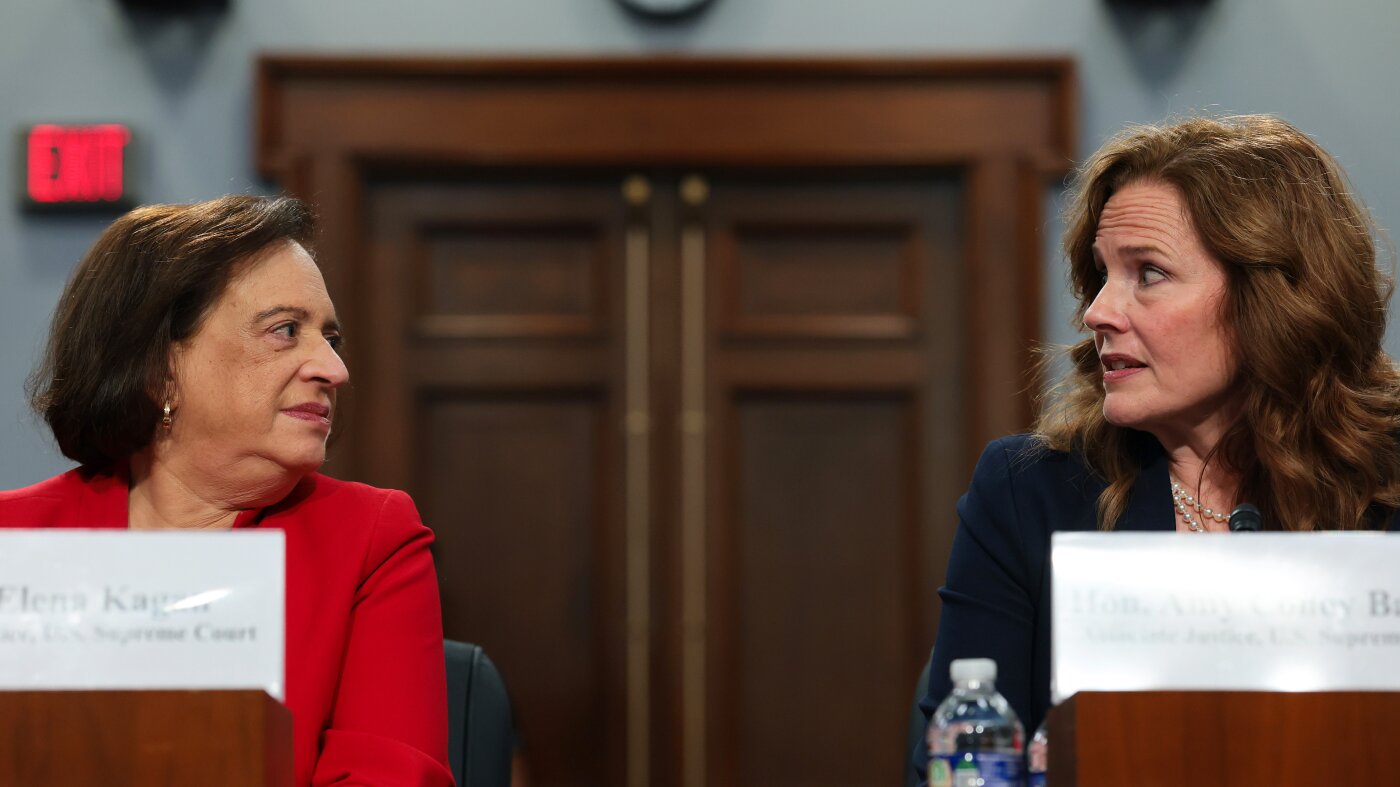
Supreme Court Justices give chilling accounts of threats to their safety
-

 Los Angeles, Ca2 hours ago
Stabbing at Chino Hills liquor store ends in attempted murder arrest
-

 Detroit, MI2 hours ago
A small group of citizens rally for mental health coverage in Detroit
-

 San Francisco, CA3 hours ago
1 dead, 2 missing after boat capsizes near Alcatraz in San Francisco Bay
-

 Dallas, TX3 hours ago
Death penalty off the table for man accused of beheading Dallas motel manager, prosecutors say
-

 Boston, MA3 hours ago
Chickadee, the popular Mediterranean restaurant in Seaport, is shutting down – The Boston Globe
-

 Denver, CO3 hours ago
Denver Nuggets 7-Year NBA Veteran Gets Honest On Peyton Watson
-

 Seattle, WA3 hours ago
Top 25 Seattle Seahawks Going into 2026 NFL Season: #17 Grey Zabel

