Utah
The forecasts for Utah’s monsoon season are in. And it’s not very good news

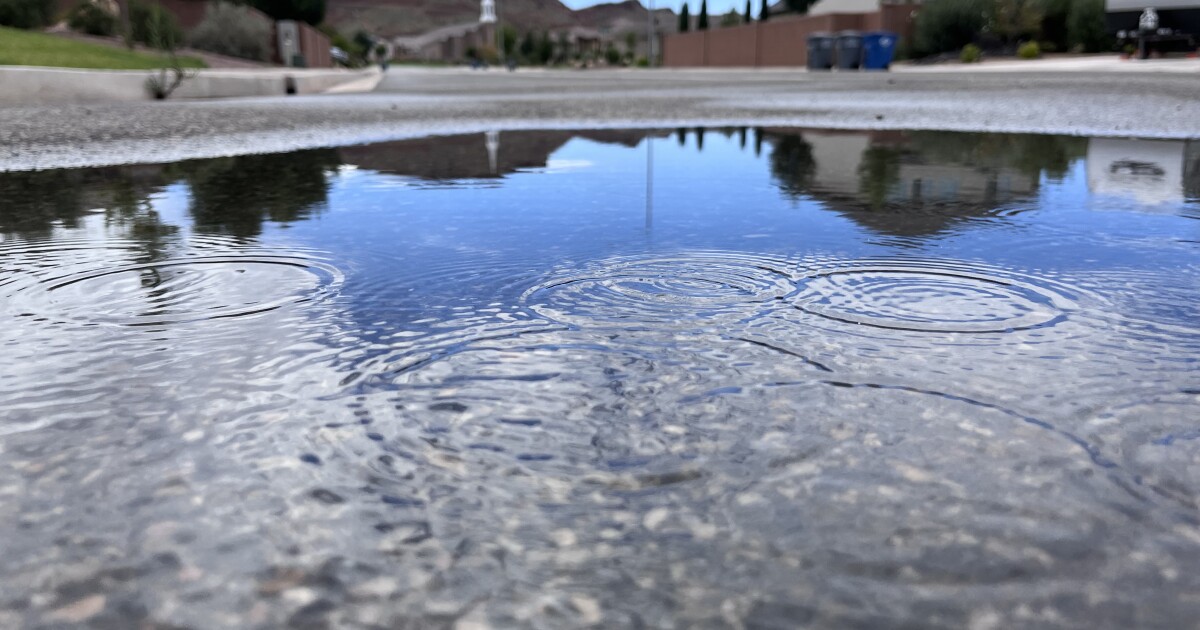
The outlook for this summer’s monsoon season shows Utah’s recent stretch of wetter-than-normal years may soon come to an end.
Below-average rainfall and above-average heat is in store between July and September, according to forecasts from the National Oceanic and Atmospheric Administration.
That’s bad news for water supplies, drought conditions and wildfire risk in an already dry state. But exactly where the worst localized impacts will be won’t be known until later in the summer, said Jon Meyer, assistant state climatologist with the Utah Climate Center.
“That will be a little bit touch-and-go as the season evolves into July and August. But at this point, overall, the region is expected to have an underperforming monsoon.”
Utah’s summer rainy season is also expected to show up late — likely two or three weeks behind its usual July onset. Early signs of monsoonal activity, he said, should already be forming in Mexico.
“They should be seeing afternoon thunderstorms across the mountains right now, and that really hasn’t materialized. So it’s behind getting out of the gate. … I think that is confirming our fears.”
The delay is largely due to lingering soil moisture from the past two wet years, which keeps the monsoon weather pattern from starting. The above-average heat Utah experienced this June may dry out the dirt a bit, he said, but likely not enough — or not quickly enough — to negate the effects of that moisture.
Last year’s summer rains were also delayed. But when they finally arrived, they brought enough moisture to turn things around in a hurry.
“I’m remaining optimistic that that might save our bacon this year with the delayed start expected again,” Meyer said. “But we have quite a few indicators right now suggesting that won’t happen.”
One of those indicators is the cycle of water temperatures in the Pacific Ocean, the phenomenon that creates El Niño and La Niña weather patterns.
Forecasts still expect that cycle to shift to La Niña in the months ahead — which could theoretically boost monsoon rains — but Meyer said that transition has been delayed, too. So La Niña will arrive too late to have much impact.
“It dragged its feet just enough. … So we’re missing out on that ingredient as well.”
With the outlook for La Niña and other global atmospheric patterns not as favorable as they were last year, he said it’s likely Utah will only see sporadic rainfall — rather than the steady storms of summer 2023.
National Oceanic And Atmospheric Administration
For Utah communities, this return to a drier cycle could have big impacts. For one, Meyer said it’ll likely allow drought to creep back in.
“We’ve seen some whispers of drought expansion in southern and eastern Utah thanks to their dry and warmer spring. So what we’re very much focused on right now is how our summer pattern will evolve and affect drought conditions.”
That’s a particularly worrying thought for the desert region around St. George, where water is already hard to come by.
“Monsoon rain for southwest Utah is actually very profound and has a huge effect upon our water supply,” said Washington County Water Conservancy District General Manager Zach Renstrom. “It’s something very critical that we count on.”
It’s vital, partly, because of its timing.
Monsoons typically hit southern Utah in July and August. Those months often have some of the hottest days of the year and ramped up demand for local water supplies — often for outdoor irrigation to keep grass and crops alive.
When it rains, people tend to turn off their sprinklers. To promote that mindset, he said the district offers a rebate on smart irrigation controllers, which use local weather data to help residents adjust their watering schedule.
“If we can save a gallon of water, we have the ability to save that water for multiple years. … So we always preach, ‘Hey, turn off your sprinklers.’”
Without the rain, however, pressure on local water supplies will inevitably rise. The area’s reservoirs are filled and ready to handle that demand this year, Renstrom said. That doesn’t mean there wouldn’t be lasting impacts.
As water storage gets drawn down from increased use, his thoughts turn to refilling it with future runoff from snowpack. But a poor monsoon season could hurt those chances, too.
That’s because soil that gets parched this year might soak up next year’s runoff before the water flows down to replenish reservoirs.
“It makes me actually very nervous about the following year,” Renstrom said.
“If we don’t get a good monsoon rain this year, not only does it affect this year, but it’ll actually affect the next summer. So it almost has a year-long effect.”


SALT LAKE CITY — More fire restrictions are being added in Utah despite some recent help in its drought situation.
The Bureau of Land Management is reinstating Stage 1 fire restrictions on land it manages in Juab and Millard counties on Friday. State land managers issued a similar order for Juab and Sanpete counties, which applies to state lands and unincorporated private lands in the county.
It prohibits building or maintaining any open fire or campfires using solid fuels or any ash-producing fuel in the section of central Utah, except for fire rings or grills at developed campgrounds or day-use areas on public state lands that have a pressurized running water system.
Open fires are also permitted at permanently constructed fire pits at private residences, as long as they have a pressurized water system.
The order also bans any smoking except within a vehicle or enclosed area, as well as grinding, cutting or welding of metal, or operating or using any internal combustion engine without a spark-arresting device. Violation can result in fines, restitution fees and even jail time.
It matches several other Stage 1 restrictions already in place across the state. Most of the restrictions are located in southwest Utah, but recent restrictions have crept up into central Utah and parts of the Wasatch region, too.
Utah Fire Info maintains a list of active fire restrictions in the state.
Both new orders were signed amid some encouraging signs in Utah’s drought situation this week. The amount of extreme drought in the state dropped from 60% last week to 43% this week, the U.S. Drought Monitor reported earlier Thursday. Most of the improvement came in other parts of central Utah.
However, nearly 95% of the state remains in at least severe drought, and all other parts of the state remain in at least moderate drought. That means it’s still plenty dry for new fires.
Close to 250 different fires have been reported across the state this year, burning over 12,000 acres of land. The entire state is currently listed as having above-normal fire potential as well, according to the National Interagency Coordination Center.
“As fire danger continues to increase across the region, fire managers are asking the public to use caution with any activity that could spark a wildfire,” said Kayli Guild, fire prevention and communications coordinator for the Utah Division of Forestry, Fire and State Lands.
The Key Takeaways for this article were generated with the assistance of large language models and reviewed by our editorial team. The article, itself, is solely human-written.

Fox News senior correspondent Alicia Acuna has the latest on two former Utah court clerks charged with harboring illegal aliens on ‘Special Report.’
Jennifer Joma and Lauren Moro, former Utah court clerks, plead not guilty to felony obstruction charges for aiding illegal immigrants. Federal prosecutors allege the clerks improperly accessed databases to identify undocumented individuals, then guided them out the courthouse’s back door to evade ICE agents. A trial is set for August.

SPRINGDALE, Utah — One of the most popular trails at Zion National Park in southern Utah has been closed for repairs just ahead of the busy summer season.
Angels Landing, which entices thousands to hike a trail many claim is one of the most dangerous inside the country’s national parks, was listed as closed on Thursday.
According to the National Park Service, the closure is due to damage to the chain section of the trail. Visitors use the chains to steady themselves while hiking up the steep and narrow path to the top.
There is no indication of when the trail will reopen, with the park service saying day-before lotteries for passes to gain trail access “may be canceled or delayed.” While Angels Landing will be closed, the trail up to Scout Lookout will remain open.
Angels Landing has been the site of more than a dozen deaths since 2000, with the latest fatal fall occurring in April when a 68-year-old Texas man fell during an afternoon hike.
-

 Los Angeles, Ca19 minutes ago
MLB to screen Hollywood classic at drive-ins nationwide
-

 Detroit, MI39 minutes ago
Detroit at Le Mans: Cadillac favorite, Ford poised for 2027
-

 San Francisco, CA49 minutes ago
Hudson Pacific lands SF’s biggest office lease in nearly a decade
-

 Dallas, TX54 minutes ago
NFL Brazil tickets are available: Shop Cowboys vs. Ravens NFL Brazil tickets now
-

 Miami, FL1 hour ago
North Miami man accused of stabbing victim 7 times
-

 Boston, MA1 hour ago
Everything you need to know about Sail Boston 2026
-
Denver, CO1 hour ago
Broncos’ Jonathon Cooper arrested again on four charges, including harassment, violation of protection order
-

 Seattle, WA1 hour ago
Ribbon-cutting marks completion of mixed-income condos in Seattle’s Phinney Ridge


