Business
Commentary: The right-wing attack on science reaches a nadir, but it could get worse


The tally from Trumpian attacks on science now includes billions of dollars in damage to farmers and ranchers and assaults on scientists’ freedom of speech
One of the rules I came to live by during my years of covering global trouble spots is: “Never assume that things can’t get worse.”
But it will be hard to find a worse display of shameful servility to the Trump administration by a scientific organization than the American Diabetes Association provided on Friday.
During the organization’s annual conference in New Orleans, five of its leading members — four former presidents and the current editor of Diabetes Care, its official journal — were distributing paper copies of an editorial from the journal decrying the administration’s aggressive attack on scientific research and funding.
The seeming endorsement by the ADA of the current administration’s approach to science and of its attacks on freedom of speech is unconscionable.
— Open letter to American Diabetes Association
Suddenly they were confronted by security guards and New Orleans police and manhandled out of the hall. (A video is here, courtesy of MedPageToday.)
Their papers were confiscated. They were ordered to surrender their passes and were informed that if they tried to reenter the hall they would be arrested for trespassing.
“We printed 1,000 copies of the editorial, at my personal expense, and we hoped that 200 people who hadn’t seen it would read it,” Steven Kahn, director of the Diabetes Research Center at the University of Washington, editor of the journal and the lead author of the editorial, told me.
Instead, the editorial has become a must-read, with tens of thousands of page views and widespread condemnation of the conference organizers’ actions.
An open letter to the ADA started by David Nathan of Massachusetts General Hospital, titled “Shame on You” and stating that “the seeming endorsement by the ADA of the current administration’s approach to science and of its attacks on freedom of speech is unconscionable” has more than 6,400 signatories on change.org as of this writing.
The Diabetes Association implied in an official statement that the scientists had breached IRS regulations that include “maintaining a strictly nonpartisan environment at all organizational events.” On Wednesday, the organization said it would commission “a thorough independent review of the events that occurred.”
The organization’s action underscores one reason why the Trump administration’s wholesale attack on scientific research has reached a level that, as I’ve written, will have generational ramifications: It’s because some of our most august scientific organizations have failed to stand up for principle.
“It’s part of a larger systems failure among the academic medical centers, research universities, scientific and professional societies and the National Academies,” says Peter Hotez of Baylor College of Medicine, a vaccine expert and veteran adversary of pseudoscience.
The attention given to individual incidents such as the ADA conflict obscure what Hotez calls “the greater reality … a much darker MAHA strategy to tear down American biomedicine.” The goal, he says, is to supplant independent academic research with “an entire system of pseudoscience and grift.” MAHA is the administration’s acronym for “Make America Healthy Again.”
The latest iteration of this effort came late last month with a rule proposal from the Office of Management and Budget, which is headed by the arch-conservative Russell Vought, that would in effect make all scientific grant applications subject to the oversight of politically-appointed commissars.
Among other provisions, grants would be rejected if they’re judged to “fund, promote, encourage, subsidize, or facilitate … diversity, equity, and inclusion” or “gender ideology” such as “theories or ideologies that deny the biological reality of sex or the sex binary in humans.”
The OMB proposal finally stirred major scientific bodies to speak up. “This latest move is a brazen power grab,” the American Association for the Advancement of Science said through its chief executive, Sudip Parikh. “If this rule becomes final, Americans’ hopes for future cures, national security and economic strength will rely on the scientific sensibilities of the nation’s chief bureaucrat.”
As it happens, the OMB proposal dropped just as the economic consequences of the extremist war on science were becoming clearer than ever.
Among the thousands of grants and programs that perished when the administration dismantled the U.S. Agency for International Development, for example, was a program monitoring the advance of the New World screwworm north from Central America.
The screwworm, which has the capacity to devastate cattle and sheep herds, has now appeared in Texas, where its costs could be enormous. Just last year, the Dept. of Agriculture calculated that the eradication of the pest in the U.S. in the 1990s yielded annual economic benefits to producers of an inflation-adjusted $1.7 billion a year to the cattle industry and $6 billion a year to the broader economy. A new outbreak, the USDA estimated, could cost the Texas economy $1.8 billion.
Then there’s measles. The Centers for Disease Control and Prevention reports 2,030 U.S. cases this year as of June 4, almost as many as were seen in all of 2025 (when there were 2,288, including three deaths), the worst outbreak since 1991. This is the harvest of the anti-vaccine ideology being spread by Health and Human Services Secretary Robert F. Kennedy Jr.
The outbreak’s consequences can be measured in dollars and cents: Responding to an outbreak of as few as 600 cases could cost local agencies $10 million, according to healthcare researchers at Johns Hopkins University.
The Trump administration has proposed slashing the budget of the grant making National Science Foundation by 61% and of the National Institutes of Health by 40%. The budget of the CDC, which once reigned as a global gold-standard for public health oversight but has suffered from the disdain of RFK Jr. and his minions, would be cut by 44%.
Taken together, these cuts “would shrink the economy by $1 trillion compared with maintaining the 2025 level of R&D,” reckons the Information Technology and Innovation Foundation, a science and tech think tank.
What frightens scientists more than the sheer numbers are that the cuts are arbitrary and manifestly pernicious. A study published last year in JAMA Internal Medicine identified 383 NIH-funded clinical trials that the administration terminated, leaving more than 74,000 participants high and dry.
“Scientific investment is not a cost to be minimized,” Henry Miller, a former biotech official at the Food and Drug Administration, observed recently; “it is an engine of national wealth. … The internet, mRNA vaccines, human gene therapy, GPS, the transistor — all emerged from the sustained public investment being dismantled today.”
The Diabetes Care editorial that Kahn and his colleagues attempted to distribute at the New Orleans conference is a cri de coeur targeted at the right-wing anti-science campaign. It’s titled, “Misguided Brushes of a Pen Continue to Dismantle and Destroy Biomedical Research in the United States.”
The result of the funding reductions, the authors wrote, will be “researchers being forced out of science and fewer people considering biomedical investigation as a career. Are we ready to watch the crippling of scientific advances in diabetes and all other diseases? It is no longer enough to stand idly by or work behind the scenes with lawmakers. Moreover, it is no longer appropriate to fret about political backlash.”
The scientists intended their distribution of the article implicitly as a counterweight to a keynote talk by NIH Director Jay Bhattacharya, who was going to speak without taking questions but who bailed out at the last minute. I sought a comment from Bhattacharya, who portrays himself as a champion of open scientific debate, about the eviction of the five scientists from the conference, but got no reply.
The uproar has roiled the ADA. Its president-elect, endocrinologist Jennifer Green of Duke University, and its scientific sessions planning committee chair, diabetes expert Mark Atkinson of the University of Florida, have both resigned their positions, though their role in the evictions, if any, is unknown.
The so-called New Orleans Five demanded an apology from the association, Kahn told me. They got one Wednesday from ADA Chief Executive Charles Henderson, via a video in which he extended his apology to “the broader diabetes community,” many members of which of whom he acknowledged were “disturbed, disappointed and concerned about what occurred.”
The truth is that the ADA’s action only validated the editorial’s exhortation to scientists to speak out forcefully: “We can no longer afford complacency and fear. We must all act now!” Will other scientific bodies draw a lesson from what happened in New Orleans? Let’s hope so.

Business
Commentary: How right-wing anti-transgender attacks led to a Supreme Court ruling upholding sex discrimination
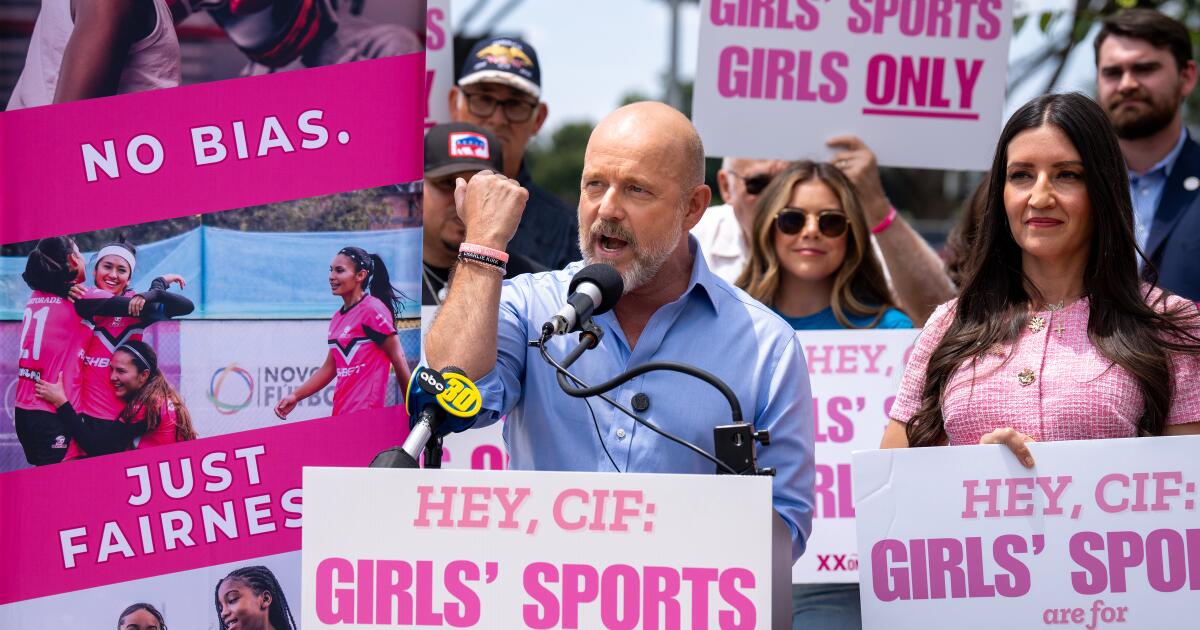
At the Supreme Court, the unfounded fear of boys masquerading as girls in youth sports rolled the clock back on gender equality.
On the surface, the Supreme Court’s June 30 opinion upholding state laws barring transgender girls from women’s and girl’s sports teams looks like a victory for women’s rights.
The 6-3 opinion by Justice Brett M. Kavanaugh certainly presents itself that way. “Females and males have inherent physical differences relevant to athletic performance,” Kavanaugh wrote. “Therefore, in contact sports, forcing female athletes to compete against males can create significant safety risks.” He also asserted that “forcing female athletes to compete against males can undermine competitive fairness.”
The ruling applied to prohibitions enacted in Idaho and West Virginia against “biological” males’ participation on women’s teams in public schools. Federal judges in both states overturned the bans. The Supreme Court majority restored them. The ruling essentially upholds similar bans enacted in 25 other states.
There was no record of any transgender person participating in school sports in the State, let alone any ‘problem’ with transgender students … creating unfair competition or unsafe conditions.
— Justice Sonia Sotomayor, demolishing the Supreme Court’s argument in favor of banning transgender girls from girl’s sports
Kavanaugh, like Donald Trump and others in the anti-transgender camp, maintained that one’s gender is an immutable fact of life, established even before birth.
Anything else, Trump stated in an executive order he issued on inauguration day 2025, could only be the product of “gender ideology extremism.” The U.S., his order stated, recognizes “two sexes, male and female. These sexes are not changeable and are grounded in fundamental and incontrovertible reality.” That’s a “biological truth,” he declared.
In his own version of this overconfident and factually insupportable conclusion, Kavanaugh wrote: “As all agree, females and males have inherent physical differences relevant to athletic performance.”
Science recognizes that some people are “born with sex traits that don’t fit into typical male or female patterns,” to cite a discussion on the Cleveland Clinic web page on the topic “intersex.” The condition “may involve chromosomes, hormones, reproductive organs or genitals.”
From a psychological standpoint, medical science recognizes “gender dysphoria” as a real condition often requiring counseling and medical intervention such as the use of puberty blockers and hormones to stave off the development of secondary sex characteristics until the condition can be resolved.
No one disputes that there are physical differences between the sexes. Few would dispute that on average or even at the median, males may be bigger and more powerful than females, or that in certain contact sports the difference may be telling and on occasion dangerous.
But that’s not the same as asserting that the physical differences between males and females invariably mean that men will invariably prevail over women in all competitions or that their participation will endanger women.
The International Olympic Committee — in a policy statement Kavanaugh cited incompletely — says that in “most running and swimming events,” males have a 10% to 12% advantage over women. That’s a range that would accommodate the full spectrum of outcomes — transgender females win, cisfemales win, they tie. (The “cis” prefix denotes those living consistent with their birth gender.)
West Virginia and Idaho addressed this ambiguity by banning transgender women from all girls’ teams. So under their rules transgender girls can’t play football or soccer with cisgirls. But what’s the argument in favor of banning them from the 100-yard dash, or cross-country track, or diving, or archery?
But something else is going on here. The Supreme Court’s ruling was almost preordained, given the years-long campaign by conservatives to demonize transgender individuals as if they’re members of an alien species.
It will be recalled that during his presidential campaign, Trump spun a despicable fantasy in which children were kidnapped in school and secretly subjected to sex-change operations.
Trump’s executive order wiped out policies aimed at protecting transgender adults from discrimination. He moved to outlaw gender-affirming medical therapies for anyone under 19 by cutting off federal funding for healthcare institutions that provide such care.
He banned transgender individuals from serving in the military and ordered federal prison officials to move transgender inmates into the general populations consistent with their birth genders, which exposes them to physical assault. (Federal Judge Royce Lamberth of Washington, D.C., has blocked the government from transferring three transgender women into the male prison population or terminating their hormone treatments.)
I wrote during Trump’s first term, when his anti-transgender policies were still gestating, that the goal was to show that “one can target any community, as long as it doesn’t have a strong political voice or political power. These are the actions of bullies and cowards, pretending to be strong.”
Last year, the Supreme Court struck its first blow against transgender rights by upholding a Tennessee law banning transgender care, including puberty blockers and hormone therapy, for minors. Similar laws have been enacted in 25 other states. The majority in that ruling by Chief Justice John G. Roberts Jr. was identical to the one in the June 30 ruling — Roberts, Kavanaugh, and Justices Clarence Thomas, Samuel A. Alito Jr., Neil M. Gorsuch and Amy Coney Barrett.
Who are the targets of this ideological campaign? They number only about 1.6 million U.S. adults, or one-half of 1% of the U.S. population. About 300,000 adolescents ages 13 to 17, or 1.4%, identify as transgender, according to a study by UCLA School of Law.
In West Virginia, as Justice Sonia Sotomayor observed in her dissenting opinion, “there was no record of any transgender person participating in school sports in the State, let along any ‘problem’ with transgender students … creating unfair competition or unsafe conditions.”
In endorsing the flat bans directed at transgender women in Idaho and West Virginia, Kavanaugh argued that any attempt to implement case-by-case judgments of students’ requests to join sports teams inconsistent with their biological gender would create “an enormous practical and administrability problem.”
Is that so? That wasn’t the case in Maine, where the annual K-12 population is more than 170,000. There, a committee was charged with determining whether a student’s participation in a sport consistent with their gender identity but inconsistent with their biological sex would “result in an unfair athletic advantage” or present a risk of injury to others. The committee held 56 hearings from 2013 through 2021, or an average of seven per year. During the entire time span, only four involved transgender girls. (The outcome of those hearings couldn’t be learned.)
It was Maine’s policy, one might recall, that provoked a confrontation between Trump and Maine Gov. Janet Mills at the White House last year, when Trump threatened to withhold federal funding from the state unless it barred transgender students from competing on women’s sports teams. “We’ll see you in court,” Mills snapped.
Whether the Idaho and West Virginia laws genuinely protect girls from unfair competition is questionable. (The Idaho law is styled the “Fairness in Women’s Sports Act.”) In practice, the laws may subject women in public schools to “invasive sex verification procedures,” as educational expert George Theoharis of Syracuse University wrote after the court ruling.
They’re also based on a retrograde view of women as fragile creatures needing men’s protection, Theoharis wrote — “the same logic that has historically been used to justify excluding women from making their own healthcare decisions and girls from rigorous math and science; that physically demanding work is simply beyond them.” (There don’t appear to be any state laws barring transgender women from competing in men’s sports.)
Becky Pepper-Jackson, the plaintiff in the West Virginia case, in which she is identified only as B.P.J., is the only transgender girl who sought to join girl’s teams — track and cross-country — in the state. That was in 2021, just after West Virginia passed its law and she was about to enter sixth grade. She didn’t appear to pose any competitive risk to others on the track and cross-country teams she applied to join — her lawyers told the Supreme Court that on those no-cut teams, she “came in near the back.”
Anyway, she had not gone through male puberty, which theoretically might have endowed her with a competitive advantage, because she had been taking puberty blockers and female hormones.
Thanks to the court’s ruling, Sotomayor observed in a dissent joined by Justices Elena Kagan and Ketanji Brown Jackson, West Virginia can deny Becky access to school sports “because it thinks they have an inherent athletic advantage, even if the facts show that they do not.”
B.P.J., Sotomayor wrote, “cannot practice on girls’ teams, even if she would not take anyone’s spot in an eventual competition, even if everyone who tries out for the team makes it, and even if having the chance to participate could aid immensely in treating B. P. J.’s gender dysphoria.”
So whose interest was really protected by the Supreme Court?

An Orange County real estate investor accused of criminally defrauding an Arizona bank of nearly $100 million pleaded not guilty Monday and remains in custody.
Mahender Makhijani, 44, of Corona del Mar — who also was ordered by an arbitrator to pay $1.34 billion in a separate civil fraud case — was arraigned in Santa Ana federal court on two charges.
He is accused of bank fraud and making a false statement to a bank in a June 8 case involving a $100 million real estate loan made by Phoenix-based Western Alliance Bank. He was taken into custody on June 10.
Makhijani is accused of providing bogus collateral for the October 2024 loan now in default. In a civil lawsuit, Western Alliance said the outstanding balance as nearly $99 million.
Prosecutors say he falsified title insurance policies that showed the bank would have a first lien on the underlying collateral if the loan went bad, when in fact it did not.
A trial was set for August 11 before U.S. District Judge David O. Carter in Santa Ana.
Michael Schachter, his criminal defense attorney, did not respond to messages seeking comment.
In the civil case, an arbitrator in May ordered Makhijani to pay Laguna Beach real estate mogul Mohammad Honarkar $1.34 billion after ruling he had fraudulently induced him into a 2021 joint venture — and then wrested control and lost to creditors more than two dozen properties Honarkar had owned.
Makhijani has not been criminally charged in that case, but prosecutors alleged in an affidavit in support of the bank fraud charges that he used “force and threats” in his dealings with Honarkar and others — including taking over the landmark Hotel Laguna in 2023 that Honarkar was renovating.
Prosecutors sought to hold Makhijani without bail after his arrest.
The affidavit noted he is a legal Indian immigrant with a home and bank accounts in that country, has access to private jets and threatened to “run away” if caught in a difficult situation.
The request was denied and he was granted $500,000 bail.
However, Makhijani remains in custody after a hearing sought by prosecutors last month before Magistrate Judge Autumn Spaeth.
The judge declined to accept a $450,000 cashier’s check submitted by a Makhijani associate for the bail, finding insufficient proof the source of the funds was legitimate, according to court records.
Makhijani is not prominent outside Orange County real estate circles, but he established a thriving distressed-assets business over the last decade that attracted prominent Southern California real estate investors.
Prosecutors said it paid for a lifestyle that included two multimillion-dollar homes in Corona del Mar, a luxury apartment in Newport Beach and various luxury vehicles.
As of last month, prosecutors had not fully traced his assets, which they believe are not held in his name and some of which may be in India.
The businessman employed an array of shell companies and strawmen to sign documents on his behalf, and to stand in for him as operators of his companies, according to the affidavit.
Makhijani told an associate he took extra precautions because wanted to insulate himself from litigation and that “they were sharks in the distressed world who took advantage of people,” the affidavit stated.
Business
Many indie festival films struggle to get distribution. Alamo Drafthouse is trying to change that

Dine-in movie theater chain Alamo Drafthouse Cinema is launching a new initiative to show unreleased independent films that had successful festival runs, a move that comes as specialty films have struggled to gain distribution.
The Alamo Exclusives program, announced Wednesday, will give limited theatrical runs to films that showed at festivals including Sundance, the Toronto International Film Festival, Tribeca Festival and South by Southwest festival, as well as Alamo’s own Fantastic Fest.
The idea is to help showcase films that received critical acclaim, but did not secure distribution or acquisition deals. The chain will not acquire these films, but instead will enter into agreements with filmmakers to exhibit their films on Alamo Drafthouse screens. By showing these films to audiences on the big screen, these films could get the momentum they need for further opportunities.
The program’s first film will be the documentary “Butthole Surfers: The Hole Truth and Nothing Butt,” which debuted last year at South by Southwest and chronicles the history of the punk rock band.
The film will be shown in Alamo Drafthouse theaters for a limited time later this summer.
The Austin-based chain, which is owned by Sony Pictures, has a long history of curating indie films for its audiences, giving Alamo Drafthouse confidence that its viewers want to see these kinds of movies, company chief executive Michael Kustermann said in a statement.
“Time and again, they’ve shown they’ll come out to support bold, original films when given the opportunity,” he said. The new Alamo Exclusives “gives us another way to champion filmmaker-driven films that deserve to be discovered and connect them with the wider Alamo Drafthouse audience.”
The initiative comes at a difficult time for indie films. Since the pandemic upended the movie business, traditional studios and distributors have had less appetite for risk, including betting on smaller indie films out of festivals.
And as the 2023 dual writers’ and actors’ strikes thinned out theatrical lineups, that aversion to uncertainty became a push for reliable and profitable hits.
“Too many incredible films premiere at festivals and then never receive the theatrical life they deserve,” Lisa Dreyer, director of Fantastic Fest and film innovation at Alamo, said in a statement. “We are actively searching for films across all genres, from horror to comedy, to everything in-between, to champion in this new, exciting way.”
-
 Lifestyle30 minutes ago
10 new books you won’t want to miss in July
-

 Technology40 minutes ago
Discord accidentally banned over 8,000 people for posting grids and other ‘benign’ images
-

 World45 minutes ago
Video shows bomb rock Damascus hotel where French President Macron is staying during Syrian state visit
-

 Politics52 minutes ago
Trump could hand prized stealth jets to NATO ally once seen as alliance headache
-

 Health55 minutes ago
Common gym supplement could help fight depression, new research suggests
-

 Sports1 hour ago
SJSU was told of decades-old allegations against volleyball coach during controversial 2024 season
-
Business1 hour ago
Commentary: How right-wing anti-transgender attacks led to a Supreme Court ruling upholding sex discrimination
-
 Entertainment1 hour ago
Even if you know his crowd work clips and not his name, comedian Jeff Arcuri is ready to meet you

