Utah
The 10 Best Hikes in Utah’s National Parks


Utah is stacked when it comes to outdoor adventure. Not only does the state have some of the country’s most badass skiing and mountain biking, but it also boasts the nation’s third most national parks in any state, which include some of the world’s best hiking trails.
These protected meccas—Arches, Bryce Canyon, Canyonlands, Capitol Reef, and Zion, known as the Mighty Five—capture unique and stunning landscapes that represent the desert at its absolute finest, from striking sandstone arches to isolated slot canyons to lush oases. And over the years, I’ve been fortunate enough to visit all of Utah’s national parks. Some, during my explorations as a nascent single dude traveling in a diesel VW Jetta with pink bumpers looking for adventure (true story), and others later in life with my wife and kids in tow.
Do I have a favorite? Absolutely. Arches. Wait, Bryce. Definitely Bryce. Or, actually Zion. Okay… truth be told, I can’t pick one. They’re all breathtaking for different reasons, and for me, that’s an impossible task.
I did however pick my two favorite hikes in each park—one for beginners and one for the more adventurous—that you absolutely can’t miss when you go. Especially if you’re a first-timer to Utah’s national parks, consider these hiking trails the ultimate primer. And if you keep coming back as I do, maybe you’ll discover which park you like best. (Good luck with that.)
If you buy through our links, we may earn an affiliate commission. This supports our mission to get more people active and outside. Learn more.
Destinations Newsletter
Want more of Outside’s Travel stories?
Sign up here
Arches National Park
As the name suggests, Arches is loaded with more than 2,000 rainbow-like curved sandstone features within its borders—the highest concentration of such outcroppings in the United States. You’ll also find colorful cliffs, towering pinnacles, and balancing rocks that combine for a red rock landscape like no other.
Best Beginner Hike: Park Avenue

Yes, the national park is named Arches, but this hike takes you through the center of towering cliffs and spires, so tall they’re reminiscent of New York City’s skyscrapers. It’s popular, and can get crowded, but it’s a must-do when you’re in Arches. The 2-mile out and back takes you through the middle of the park’s signature outcroppings, including Tower of Babel, a distinctive, freestanding fin that is part of the larger group of Courthouse Towers. (Some people shuttle themselves via two cars and make it a mile-long point to point.)
Best Advanced Hike: Primitive Loop Trail

The 7.9-mile Primitive Loop, the park’s longest maintained trail, accesses a handful of distinctive sandstone features in the Devil’s Garden area and delivers the desert solitude you probably crave after navigating crowds at the park’s entrance. Its landscape-to-arches bang for buck, combined with the opportunity to ditch the masses, make this my favorite trail inside the park. Spur trails lead to Landscape Arch, which at 306-feet across, makes it the longest stone arch in North America. You’ll also be able to see Double O Arch, Private Arch, and the weird Dark Angel, a black sandstone spike emerging from the sand.
Pro Tip: Arches now requires reservations to enter the park (get them up to three months in advance) between April 1 and October 31. But show up after 4 P.M. and you can enter the park without advanced notice. Just bring a headlamp in case your hike goes longer than expected.
BOOK AIRBNBS NEAR ARCHES
BOOK HOTELS NEAR ARCHES
Canyonlands National Park

At 337,598 acres, Canyonlands is the largest national park in Utah, with three distinct regions; the day-hike-friendly Needles, Island in the Sky (which covers a plateau between the Colorado and Green Rivers), and the super remote Maze. The Needles has the most developed trails for hikers, as well as some of the park’s signature canyons and spires.
Best Beginner Hike: Mesa Arch

This .5-mile lollipop loop in the easy-to-access Island in the Sky District, delivers hikers to a 27-foot arch that’s perched on the edge of a cliff more than 1,000 feet above Buck Canyon. Peer through the arch and you can see some of Canyonland’s signature features, including the massive monoliths of Washer Woman and Monster Tower, as well as the La Sal Mountains beyond the park.
Best Advanced Hike: Chesler Park Loop

Hike some of the best scenery in The Needles District on this 12-mile lollipop that delivers the slot canyons and arches most hikers come to the area to see. The tread is slickrock and sandy washes as you combine four trails (Elephant Hill, Druid Arch, Joint Trail, and Chesler Park), which will have you squeezing through boulders and scrambling through stone notches. Chesler Park itself is a circular valley surrounded by towering sandstone spires.
Pro Tips: First, try to time your visit to Mesa Arch for sunrise, when the red rock cliffs framed by the structure are set aglow by the emerging daylight. Second, there are no reliable water sources on the Chesler Loop hike, so make sure you bring plenty for a full day in the desert.
BOOK AIRBNBS NEAR CANYONLANDS
BOOK HOTELS NEAR CANYONLANDS
Bryce Canyon National Park
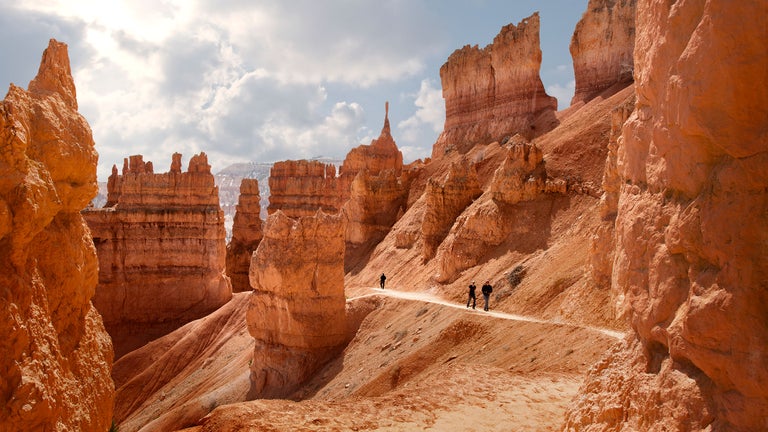
Hoodoos are a trip. These tall, stone spires look like huge versions of the drip castles you made as a kid on the beach, and Bryce Canyon National Park is full of them, as well as deep canyons, surprisingly lush forests, and elevations that top out at 9,100 feet.
Best Beginner Hike: The Rim Trail

The Rim Trail traces the edge of Bryce Canyon for 5.5 miles, connecting two popular overlooks, Bryce Point and Fairyland Point. A free shuttle run by the park service hits multiple overlooks and access points along the Rim Trail, making it easy to treat this as a point-to-point, and there are three overlooks and trailheads along the way, so you can tailor the distance to your own ability. Do the whole thing and you’ll only gain 200 feet of elevation, while the views into the canyon offer peeks of the park’s grandiose canyons and spires, including the appropriately-named Thor’s Hammer.
Best Advanced Hike: Under-the-Rim Trail

At 23 miles, you’ll need at least a couple of days to complete this point-to-point highlight reel of Bryce Canyon. But you’ll be glad you dedicated the extra time, as Under-the-Rim boasts serious backcountry goods, including views of towering orange cliffs, clusters of the park’s signature hoodoos, and even forests of ponderosa pines and aspens. It’s not an easy stroll as you’ll gain 5,500 feet along the way, but primitive backcountry campsites enable you to break it up into a multi-day effort.
Pro Tip: Bryce has a free park shuttle, but it doesn’t access Rainbow Point Trailhead, so you’ll need to hire a shuttle (Bryce Canyon Scenic Tours and Shuttles, from $15 per person) or have two cars complete Under-the-Rim Trail, or if you’re planning to hike the entire Rim Trail.
BOOK AIRBNBS NEAR BRYCE
BOOK HOTELS NEAR BRYCE
Zion National Park
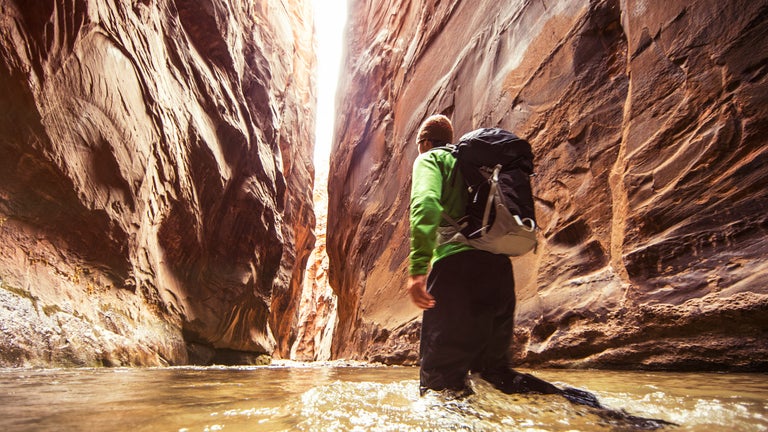
To say Zion protects a desert landscape would be too simple of a description. The 148,733-acre park actually encompasses an area where three distinct ecosystems, the Mojave Desert, the Colorado Plateau, and the Great Basin come together. The result is terrain that’s rich with canyons, lush river valleys, and soaring peaks. It’s also one of the most popular national parks in the entire country, with five million visitors last year.
Best Beginner Hike: Emerald Pools Trail

There are three Emerald Pools in Zion, each of which is an actual oasis in the middle of the desert, located on different tiers of a stream, tucked into the base of a massive, sandstone amphitheater. The Lower Emerald Pool, which is actually a couple of separate pools fed by a small waterfall that tumbles over an alcove, is wheelchair accessible via a 1.2-mile out and back. The Middle and Upper Emerald Pools are a little tougher to reach; a 2.5-mile loop accesses all three, but Upper is worth the effort, as the pool sits at the base of a massive sandstone wall. Show up in spring and all of the pools could be fed by seasonal waterfalls.
Best Advanced Hike: Orderville Canyon

Yes, The Narrows is the park’s most lauded hike, but Orderville Canyon offers a similar experience over more technical terrain that keeps the masses away. The first few miles are easy going, but as you descend deeper into Orderville, the canyon narrows and becomes a tangle of boulders you have to climb and repel over, interspersed with springs and waterfalls. It’s a 12-mile point to point through a lush playground that should take a full day, and you will need technical skills and gear to tackle it safely. You’ll also need a permit ($10 per person). (If you’re not comfortable with canyoneering, hire a guide. Commercial guides can’t lead you through canyons inside the national park, but they can take you through similar canyons outside of the park’s boundaries.)
Pro Tip: Zion has a free shuttle that begins at the Visitor Center and delivers you to popular trailheads, but you need to show up early to get a parking spot. During summer, the first shuttle leaves the Visitor Center at 6 A.M. Be on it.
BOOK AIRBNBS NEAR ZION
BOOK HOTELS NEAR ZION
Capitol Reef National Park

Natural arches and bridges, singular rock pillars, canyons… the 241,904-acre Capitol Reef is home to all of the highlights you’d expect from a national park in the desert of Utah. All of these features are a result of the Waterpocket Fold, a 100-mile long “wrinkle” in the earth’s crust made by an uplift of an underlying fault about 15 million years ago, which caused massive cliffs to rise and eventually erode into domes, towers, canyons, arches, and monoliths that are found throughout this park. Cool, right?
Best Beginner Hike: Grand Wash

Grand Wash gives you a taste of the narrow canyons that people go ape over, but via a flat hike that’s easy to follow and super family friendly. The entire hike is a 4.4-mile out and back, but if you start on the Highway 24 trailhead, you enter the canyon early, with 200-foot vertical rock walls on either side of you, and can turn back when you’ve seen enough. After hiking a half mile over sandy terrain, the canyon begins to shrink and soon you’ll hit the narrows, which has slot canyon vibes without getting so tight it causes claustrophobia (the walls are about 20-feet apart at their slimmest point). The tan, sandstone walls are pockmarked with holes and small caves, and even offer shade in the morning and late afternoon.
Best Advanced Hike: Sheets Gulch Slot Canyon

Capitol Reef has a bevy of canyons to explore, but Sheets Gulch might be the best non-technical option. There’s no official trail through the narrow gorge, which can be found 12.7 miles south of Highway 24 on the paved Notom-Bullfrog Road, but the occasional cairn and obvious route through narrow, sandstone walls make this journey relatively straightforward to navigate. (Bring a map, regardless.) While you won’t need ropes, you’ll need to muscle up and over several chockstones and wade through the occasional pool to keep moving forward, but that’s half the fun. It’s a 9-mile point to point, but most hikers turn around when the canyon begins to open back up, roughly 6.5 miles from the trailhead, making it a long, 13-mile all-day adventure.
Pro Tip: Bring a 4WD rig. The hikes I mention here are accessible via paved roads, but if you have a high clearance, 4WD vehicle, the entire backcountry of Capitol Reef becomes your oyster, and you’ll have options for free, primitive camping and an easier time getting into the remote Cathedral Valley—a backcountry district of the park where you can find a cluster of sandstone monoliths.
BOOK AIRBNBS NEAR CAPITOL REEF
BOOK HOTELS NEAR CAPITOL REEF

Graham Averill is Outside magazine’s national parks columnist. He’s fresh off of a trip to Utah, where he was able to hike portions of Capitol Reef National Park and Grand Staircase-Escalante National Monument. He also just survived Hurricane Helene at his home in Asheville, North Carolina and wrote about it, and ranked the best national parks in the nation for fall foliage.



Utah has spent the past year fighting measles outbreaks — a grim milestone that could affect whether the United States can keep its measles-free designation.
More than 680 people have gotten sick since the state’s first outbreak began on June 20, 2025.
Unlike measles outbreaks in Texas, South Carolina and Arizona, the spread in Utah has been tough to contain to one region — infecting undervaccinated communities in nearly every county.
READ MORE: How health sleuths are watching for threats like measles during the World Cup
Measles popped up in healthcare settings, big-box stores and restaurants, and youth sporting events. In February, an exposure at a state high school wrestling championship sparked at least 46 cases among attendees.
Measles is one of the most contagious diseases known to medicine. It causes a tell-tale rash, high fevers, strong cough, ear infections and diarrhea.
While most recover, some — including young babies, pregnant people and those with weak immune systems — are at higher risk of developing dangerous complications like pneumonia, brain swelling, blindness or even dying. Even healthy people can develop issues years down the road, including a rare but fatal degenerative brain disease that manifests about a decade after infection.
The measles vaccine is safe and 97% protective after two doses.
READ MORE: South Carolina’s measles outbreak is over after sickening nearly 1,000 people
Though Utah’s spread has slowed in recent weeks, state epidemiologist Leisha Nolen sees little opportunity to rest. She’s worried the start of school and arrival of colder weather in the fall will cause measles to surge again.
“It’s still here, it’s still transmitting,” she said. “We just need those few cases to hit the wrong community and it could flare up really big again.”
Utah sees the impacts of dropping vaccination rates
The worst spread has been in the southwestern part of the state, where 265 people have fallen ill with the vaccine-preventable disease since last summer. Overall, measles infections hit 22 of the state’s 29 counties.
READ MORE: Babies too young for MMR vaccine become ‘sitting ducks’ in measles outbreaks
In the state’s rural northeast, the conditions were also ripe for measles to spread. Daggett, Duchesne and Uintah counties — collectively dubbed the “tricounty” health region — has seen the second-largest decline in childhood vaccination rates in the state.
More than 16% of the region’s kindergarteners were missing their measles vaccines in the last school year, according to state data. Statewide, 12.8% were missing their vaccine, putting the state far short of the 95% vaccination rate needed to prevent measles outbreaks.
The TriCounty Health Department logged 74 cases of measles this spring, after people who got sick at the youth wrestling tournament spread the virus in school and later within their households.
The frontier region had seen a rise in vaccine hesitancy for some time, said Sydnee Lyons, the health department’s public information officer.
Despite the large number of cases, local and state health officials consider TriCounty’s measles response a success.
Health officials focused efforts on mitigating the inevitable spread. Unvaccinated students were excluded from in-person school and people who were sick were told to isolate themselves. And their appeal to care for one’s neighbors led to more people coming in to get vaccinated, officials said.
READ MORE: Dr. Mehmet Oz urges public to take the measles vaccine as U.S. cases rise
TriCounty’s infectious disease specialist Cyndie Mattinson recalled a parent who told a school nurse she didn’t want to talk to the health department because “she was worried that we would be angry with her and be judgmental because her children were unvaccinated.”
The nurse vouched for the health department staff, and told the mom to let her know if she felt judged. Mattinson ultimately had a great conversation with the mother.
“The perceptions were changed that we weren’t out there to police, we were there to be a help and a resource to the community,” Mattinson said.
Health experts will meet to decide on U.S. measles status
Utah’s lengthy battle with measles will likely affect whether the U.S. can keep its measles-free designation. Public health officials consider measles to be eliminated from a country when it shows it stopped continuous spread within local communities for at least a year.
The national measles case count was 2,104 as of June 18, nearly surpassing last year’s record total.
READ MORE: A parent’s guide to preventing measles infection and what to look for
Utah has fought measles for a year, but it’s not clear if the earliest clusters are connected with the major outbreak on the Utah-Arizona state line, which was detected in August, Nolen said.
But since then, most of the state’s measles cases have come from within Utah, not from other parts of the country.
International health experts will gather in November to determine if the U.S. and Mexico have lost their measles elimination status. Canada lost its status last year after ongoing outbreaks.
In Utah, doctors continue to reassure scared patients and lobby for better public health policy.
Dr. Ellie Brownstein, president-elect of the state chapter of the American Academy of Pediatrics and a pediatrician in Salt Lake City, spent the height of the outbreak opposing a bill that would have made school vaccine waivers easier to get. It failed, but she says there hasn’t been a clear cultural reckoning over measles’ resurgence.
“I don’t know that we get it to end,” Brownstein said. “I don’t know that we’re going to get this genie back in the box because there’s enough people out there to spread it.”
The Associated Press Health and Science Department receives support from the Howard Hughes Medical Institute’s Department of Science Education and the Robert Wood Johnson Foundation. The AP is solely responsible for all content.
A free press is a cornerstone of a healthy democracy.
Support trusted journalism and civil dialogue.

SANDY — Vibes were as high as the temperature in some cases as thousands gathered at Real Salt Lake’s home stadium to cheer on the United States’ 2-0 win over Australia in the second match of the 2026 FIFA World Cup.
Fernando Sanchez took it all in, between belts of his drum standing in front of more than 4,000 people at the Sandy stadium.
“I was born and raised in Mexico City,” said Sanchez, who hosts a podcast called the “Fercho Show” from his current home in Utah. “But I’m from the U.S. now.”
Four years after scoring just two goals in three group games before a 3-1 exit to the Netherlands in the Round of 16, the United States is flying under Mauricio Pochettino, exciting fans across the country — from the sellout crowd at 69,000-seat Lumen Field in Seattle to watch parties around the world, including Friday in Sandy.
“The vibe is amazing,” Sanchez told KSL.com. “You can see all of the people who came out, everybody is happy because this World Cup means so much for Utah, for everybody. It’s the best of the best from each country fighting on the field. That’s what it feels like, and it’s so good to be part of this game.”
Less than 24 hours after some 9,200 fans showed up at America First Field for Mexico’s 1-0 win over South Korea, Real Salt Lake employees braced to host as many as 6,000 American fans who submitted an RSVP to spend a portion of the Juneteenth holiday in 94-degree weather.
In-game hydration breaks became as much of a necessity for fans as the players in Seattle, with hundreds flooding the open hydration stations, concessions area, and a few food trucks at each “quarter break” installed by FIFA for the first time at a men’s World Cup.
While final attendance dropped to around 4,500 fans in Sandy, the spirits remained high as Folarin Balogun, who scored two goals in a 4-1 win over Paraguay in the World Cup opener, forced the opening goal off Australia’s Cameron Burgess.
Alex Freeman, the son of former Super Bowl champion Antonio Freeman who at 21 is the youngest player on the roster, doubled the advantage in the 43rd minute off a set piece that was initially ruled offside.
But after a lengthy video review where fans refused to sit down, pandemonium ensued as the U.S. fans in Sandy recognized their national team was moments away from clinching passage out of the group in the first men’s World Cup on home soil since 1994.
It’s the first time the United States men’s national team has won consecutive games at a World Cup tournament since 1930.
Yet it’s not just the wins, but how the Yanks are winning that has Americans excited about a sport that has made significant strides domestically in three decades since the founding of Major League Soccer.
The U.S. is winning with an exciting brand of attacking soccer led by Balogun, who grew up in England but chose to represent the country of his birth over his parents’ native Nigeria in 2023, and Christian Pulisic, the AC Milan winger with 33 goals in 87 international appearances from Pennsylvania who did not play Friday due to a calf injury.
“There’s a lot of American pride,” said St. George youth soccer player Tate Hurst, who showed up to the watch party with a half-dozen club teammates at Fire SC during Western Presidents Cup regional this weekend. “The American dream.”
Sunburn, heat and hydration aside, the moment created a memory for thousands of soccer fans and casuals alike. That included RSL season ticket holders, waiting until the end of the month-long international break for the club’s MLS season to resume in July.
But for one afternoon — and perhaps another, as the club plans to host a similar watch party next Thursday when the United States hosts Türkiye in Los Angeles (8 p.m. MT, FS1) — each soccer fan was pulling for the same team.
Except, perhaps, for the dozen or so Australia fans in the corner of the east lawn who represented their own Socceroos for the entire 90 minutes.
“Soccer brings everybody together,” one RSL staff member said over the public-address system as fans headed for the parking lot while James Brown’s “Living in America” blasted over the sound system after the full-time whistle. “That’s what today was all about.”

SALT LAKE CITY — Utah athletics is making a notable change to the Huntsman Center gameday setup, but the move is about more than where the team sits.
The Runnin’ Utes are moving the team bench from the east side of the Jon M. Huntsman Center to the west side, returning the bench to the side it occupied during the Rick Majerus era. The change will also move the MUSS and band from the west side to the east side.
The shift is part of a larger effort by Utah Athletics to improve the student-section experience, create a more consistent setup inside the Huntsman Center and better connect the arena to the university’s growing College Town Magic initiative.
Enhancing The MUSS And Fan Experience
Nowlin said the primary motivation behind the change is improving the MUSS and the overall fan experience.
“The reason we’re doing this is we want to enhance the MUSS,” Utah’s Deputy Athletics Director & Chief Revenue Officer, Patrick Nowlin said. “As an ongoing effort, we’ve been working on for the past two years, how do we enhance the fan experience?”
One issue Utah identified was that the MUSS had been located in different areas for different events. Moving the student section and band to the east side gives the department a more consistent location to build around.
“We wanted to create a better fan experience,” Nowlin said. “We wanted to be able to have one spot that we can build on, which means we can brand. We can enhance everything about it.”
The move also ties directly into College Town Magic. Nowlin said the area around the Huntsman Center will include more than 2,900 total beds, including more than 1,400 new beds, giving students a direct path from nearby housing to the student-section entrance.
“There’s over 2,900 new beds that are right there, which will be right at the branded entrance, right where the student section is,” Nowlin said. “They don’t have to go far at all. So it’s just a walk straight down from the dorm, right in the door.”
And according to Utah’s Patrick Nowlin, the move is not limited to men’s basketball.
“It’s not just men’s basketball. It’s all Huntsman Center events,” Nowlin said.
A Nod To Utah Basketball History
While the move is primarily about fan experience, there is also a clear basketball-history component.
The west-side bench location is where Utah sat during the Majerus era, when the Runnin’ Utes were one of the top programs in the country and the Huntsman Center had a different level of edge. Alex Jensen was part of that era as a player, and now, as Utah’s head coach, the move reconnects the current program with one of its most successful periods.
Nowlin said the historical connection was part of the conversation, even if it was not solely Jensen’s decision.
“Yeah, it’s a nod to history,” Nowlin said. “I think Alex, him being here, he’s a steward of the program. There’s a lot of history to having it on that side.”
Still, Nowlin made clear the change was not simply pushed through by Jensen.
“It wasn’t a push from him,” Nowlin said. “It was a concerted effort from everybody to where, how do we create an area that the MUSS can have, but also how do we lean into our history, but still move forward in a way that we can honor that, but create an unbelievable environment.”
That is the heart of the move. Utah is trying to bring back a piece of its basketball identity while also reworking the building for the future.
How Fans Will Be Impacted
The change will affect some season-ticket holders, donors and fans seated near the current bench, MUSS and band areas, but Utah tried to limit the disruption.
Nowlin said the department spent months working through the seating impact and expects fewer than 200 accounts to be directly affected. Those accounts are in sections T, U and V.
“This wasn’t something that just came about,” Nowlin said. “We’ve been working on this for a few months now, and we wanted to find a way that we could minimize the accounts that were directly impacted, but still create the fan experience change we were after.”
Utah’s plan is to work individually with affected fans and mirror their seat location as closely as possible on the other end of the court.
“If you’re on one end and now you’re going on the other end, we will work with you to get you in the seat that is similar to where you were and allow you to have the same experience you’ve had, just on the other end of the court,” Nowlin said.
Utah will also hold a virtual seat-selection process from July 7-17, allowing fans who want to move to choose from available options.
“We’re going to take care of everybody, but we’re also going to allow people the choice and the freedom to be able to make the changes they want to make,” Nowlin said. “We want to create every opportunity we can to give our fans opportunities to choose their own experience.”
Not Part Of The Huntsman Renovation
The bench and MUSS move is not directly tied to the larger Huntsman Center renovation discussions. Nowlin said the change is instead connected to College Town Magic and Utah’s effort to improve the student and fan experience inside the building.
“It does not have to do with the renovation, but it does have to do with College Town Magic,” Nowlin said.
The move could create some new seating and premium opportunities, particularly around courtside and floor seating. Nowlin said Utah is still evaluating those possibilities.
“By doing this, this will create additional opportunities for us on courtside and floor,” Nowlin said. “We’re also looking to how do we enhance our premium experience across the board. So this is a step in a process that will continue.”
The Bottom Line
Utah’s bench move is not just a nostalgic callback to the Rick Majerus era, and it is not just a seating chart adjustment. It is part of a broader effort to reshape the Huntsman Center experience.
The team bench is moving back to the west side, where Utah sat during some of the program’s most successful years. The MUSS and band are moving to the east side, where Utah believes it can build a stronger, more consistent student-section identity tied to College Town Magic.
For Utah Athletics, it is another step toward rethinking how the Huntsman Center looks, sounds and feels on game day. For Jensen, the move reconnects the program to its winning past.
The symbolism will matter to longtime Utah basketball fans. The logistics will matter to students, band members and season-ticket holders. But the larger goal is simple: make the building feel more intentional, more connected and more like home again.
Steve Bartle is the Utah insider for KSL Sports. He hosts The Utah Blockcast (SUBSCRIBE) and appears on KSL Sports Zone to break down the Utes. You can follow him on X for the latest Utah updates and game analysis.
Take us with you, wherever you go. Download the new & improved KSL Sports app from Utah’s sports leader. You can stream live radio, video and stay up to date on all of your favorite teams.
-

 Montana6 minutes ago
Planning For Life After Coal Cost a Montana County Commissioner His Seat – Inside Climate News
-

 Nebraska9 minutes ago
Today in History – June 20: ‘Carhenge’ opens to public in Alliance, Nebraska
-

 Nevada21 minutes ago
Nevada’s First And Largest Military Outpost Is Now A Historic State Park To Camp, Paddle, And Hike – Islands
-
 New Hampshire24 minutes ago
New Hampshire faces child care crisis: Costs rise, options fall – Valley News
-

 New Jersey29 minutes ago
Parsippany Positioned for the Spotlight Through New Jersey’s Film Ready Program | Parsippany Focus
-

 New Mexico36 minutes ago
APD: Pedestrian hit and killed in early morning crash
-

 North Carolina38 minutes ago
North Carolina’s 5 Most Efficient Scorers Next Season
-

 North Dakota44 minutes ago
For North Dakota producers, ‘death by a thousand paper cuts’

